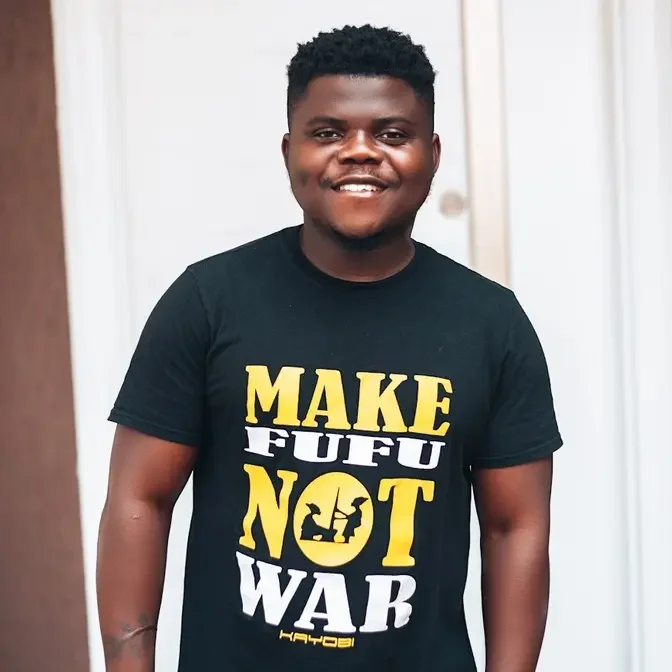
The Image of AFRICA has been DISTORTED around the WORLD & We are CHANGING the NARRATIVE via YOUTUBE videos One Country At Time.Until the HISTORY of AFRICA is told by AFRICANS, the story of GREATNESS will always GLORIFY the IMPERIALISTS!. We are currently in the 6th Region Of Africa which is the AFRICAN DIASPORA to CONNECT the Dots by Bridging the gap between Africans across the Globe
If you have a message for young Africans
watching us right now, what would that
message be?
I would say, hey, believe in what the
power of your brain. Believe in your
potential and believe that you can make
it wherever you are. Everything is in
here.
This month, I've taken it upon myself to
highlight young people living in Ghana
that are doing an incredible job that we
don't see them on the media. I mean,
they are advocating for zero waste.
Perfect. That's our our our key word.
The key word is zero waste.
I
got my plastics right from my house. And
guess what? He has another plastics that
is coming from the
community. There is a saying that
another man's poison is another man's
food. This is exactly what is happening
right here at Gao, Green Africa Youth
Organization. You guys are doing an
incredible job. You won. You won. You
guys won. We won.
We are getting first reactions. Another
earthshot prize comes to Africa. Ghana
stand
up. My name is Death Monna. I'm
co-founder for Green Africa Youth
Organization and in charge of the zero
waste model. We work mainly on just
transition and energy. Work on
implementing zero waste cities in
Africa.
We are youth led. We are gender
balanced. The driving energy of young
people is a driving energy that runs GU
even today. All that what do you do with
this? Why you why you why why are you
taking rubbish bro? This is not rubbish
at all. M. So to the waste pickers, to
us here, this is money.
This is absolutely incredible. Can you
believe that this young man is
converting your waste into
money? This is money. This is money.
This is real good cash. like a cash that
you not really have to invest a lot of
money because you can literally walk on
the street and have your sack and be
picking this plastics and then you can
make your money. You don't really have
to get any investment to start doing
this business. But it's
dirty. This is our daily plastic waste
that we throw everywhere. And look at
it. They build it and very soon some
going to go into exportation. Some will
also end up back into the market for
recycle. There is a world that waste
doesn't need to exist. Where waste
becomes a resource. That's the world
that we are trying to take everybody to.
Where are you taking this to? Right now
our offers are like groups like Poly
Tank. I mean previously the larger
market was export market but now we have
a lot of interest groups in the market
here locally. Uh there's also a new
group in town which is buying like a lot
of our products and I have not visited
them before but what they say is that
they are making it they're using for
synthetic hair wig and and and stuff
like that. So your your your wigs comes
from here.
I've seen plastics everywhere, but I had
no idea that Gile is converting our
plastics into something meaningful.
Yeah.
My name is Deson Aluna and I'm going to
show you how we are revolutionizing
waste management to create cleaner air
at Gao.
You know what? If you're a Ghanaian
watching this video, if you're an
African youth watching this video, a
round of applause for Guo, man.
My brother, it's a pleasure meeting you.
Yeah, the pleasure is all ours. I have a
gift for you. Uh-huh. I can imagine.
These are your waist from home, huh? My
waist from home.
Thank you. You like it? Yeah, of course.
This is waste, bro. As you can see,
you're the waste man.
Nice to meet you, wast we do here. This
is what you do for a living. I did this.
No, it's fine. It's fine. Yeah. Where is
this place? Uh this is Lada Cotto
Municipal Assembly. Okay. Um MRF,
material recovery facility. Um that guy
couched here. But this is really the
assembly, the the government office. And
then we are right behind because they
are like the sole they have the
responsibility for managing municipal
solid waste. And so who is better place
for you to partner with if you are
working on waste than the assembly?
What gave birth to this idea of making
sure that our plastics from our various
homes are being accumulated in here? GAO
as an organization started about 10
years ago but even prior to that I was
already organizing colleagues to do
cleanups because you know you see a lot
of plastics on our beaches see plastics
on campus this time I was in the
University of Cape Coast so it was
really like by default trying to see the
environment clean when we saw that when
it rains there's a lot of flooding
there's a lot of waste um all over the
place especially when you're driving in
the mornings in the night and driving on
the streets a lot of waste on the street
and all that. There was a need to
collect these things. Um upon our
research and everything we realized that
most of this um flooding are caused by
the plastics that are clogged in the
drainages and amongst others. So we have
to come up with an idea what do you do
with this waste? We have to then start
collecting them. Collecting them and
then
and so the aspect of really taking a
zero waste model as we call it and
making it something that can earn a
living that can support and implement uh
employ
came in way later after we've organized
so many cleanup exercises and then we
are asking ourselves every now and then
so then what next? you know, were you
were you doing all of that for free? We
were doing that on volunteer basis. No
one was paying you. No one was paying.
Nobody was, you know, we we I mean, as
you probably can tell, I can I have my
way of convincing communities to come on
board to support with the cleanup
exercises and stuff like that. And even
convincing the district assembly,
especially in Cape Co, CCMA, to come
with the big truck after we do the
cleanup and then they will pick it up,
you know. But then as time went on we
realized that there are so many variety
of waste and some of them could be
utilized for something elseow and so why
do we just you know keep suffering and
you know not supporting those who are
earning a living from it like waste
pickers. that came to the point where we
have to get this airf and the waste
workers and for them to make content.
What happens in here?
Well, this is where waste is built. So,
you can call it waste bank. Okay?
Because we collect, we bring on board
plastics, electronic, metal, um
organics, food waste from the hotels,
from the community, from the markets.
you know the way African market some of
the fruits and food they you know go
waste right there even before they get
to the table and so this where we bring
all that and then different innovations
are then set in.
So after the sorting is done as these
people are still sorting final sorting.
Okay. But most of the sorting also comes
from the community already. And then
after everything is done you come here
where it is built built to this these
bills. Each of them is about
um,400 kilos. So like 1.4 tons. Okay. Um
1.2 1.4 tons per bill. And once it is
built, it is ready for the market. Oh,
you have a machine for bailing? Yeah,
the ber is right here.
You convert our daily waste into
something valuable. Something valuable.
Exactly. That deserves a round of
applause, man.
And wow this is climate solution for us
as we are everything you are seeing here
because this is is a burden in in order
to get off the burden you have to find
ways to deal with the burden and one way
of solving that burden is to find value
in it. So as you can see some of these
bills it comes like this from the
community sometimes not really also
comes like this and then at the end we
put it together like this and then it
has its places that it goes to and so if
this is recycled into for example your
big waste bin that you have at home,
your big poly tank that you have at
home, of course it becomes useful,
right? And that's the point at which
people see the value in it. But when
it's like this, people don't really see
it easily. So you guys are adding value
to our plastic waste. Exactly. We are
adding value to waste in general.
Fresh graduate from university and you
decided to go pick plastic waste. What
were people telling you?
Um I think even before what people were
telling me I think I had an instance um
somewhere in OSU and just imagine that
you going through somebody's baller as
we call it here and then you are seeing
baby diapers and what have you already I
I think I started questioning myself
before people question you know I'm like
okay I I This is the life you want.
Yeah. I'm I'm like, okay, look at what
I'm going through.
It doesn't really, you know, it's not
the cleaner aspect of a graduate job as
um as it is. But then I think with the
internal conviction of having a goal
knowing that this is the aim and I want
to reach there anything at all that
looked like a stumbling block just
looked at like something that you can
step on and leap. So I never really and
because of already internalizing and
building this whatever people say didn't
really come across as something that
look like so bad or it didn't weaken me
and you know because of u zoom lion
which is like which has been which is
like the most popular waste management
waste collection group in the country.
So anybody that's the name they give
you. They they don't call you mist
manager or something. It's a zoom lion.
And what that translate is also what
close allies and family members now see
you
as. And for me I didn't want to to get
that label. And so I made sure that the
climate activism, the climate advocacy
aspect of it
dominated my my my narrative. And so
yeah, so I mean people still refer you
as oh
you are you the ones doing the zoom
lion. Yeah. But it's not you know you
have to go through life.
You've been doing this for 10 good
years. Yeah. Was there at any point in
your life you felt like, you know what,
I cannot do this anymore. It's time for
me to give up on this journey. Well, to
be honest, there has been several stage
stages where I I I I start asking
myself, is this what I want to be known
for? Wow. And what's the value of really
doing this? you know so but but then
because I conquered this within myself
with time I didn't really have so much
hesitation even when I finished when I
when I in 2018 when I left uh to to do
my my f studies in Germany after my
studies I was living there I was working
and I I I have to be honest with you the
fulfillment level was never the same as
compared to before I left so after the
co I was like I couldn't Even wait when
COVID was there I I wanted to come back
because I had finished my studies
immediately after COVID 2021 I decided
to return. You got opportunity to study
abroad? Yeah. Through scholarship or you
Yes, through scholarship. What did you
what did you study there? I studied
climate governance. Wow. Yeah. And did
you stay after school? Yeah, I I stayed
I stayed for Yeah, pretty much almost
close to a year. But And you came back?
Yeah. Yeah, I came back. Why did you
come back? I came back because so I
decided to keep my
residency you know um um easy movement
in the EU and I mean being resident
means that you have access to many other
European countries and I do attend
conferences and what have you. So for
the meantime I kept my residency and
just for the the the benefit of the
doubt maybe I come back and then things
are not as exciting as I I I felt you
know but then when I return I think
things just you know every day now and
then I'm applying different you know
tactics with time I'm like okay I think
I'm okay.
Would you say this is worth it? More
than worth it. I mean, you can see even
today is not our busiest day, but you
can see people around. You can see waist
speakers working. We have so many Wakers
in the communities. And this is like how
they earn income. This is how they take
their kids to school. This how they pay
their bills. It's more than worth it to
me.
Should I say that your entire factory is
filled with plastics? Yes, you can say
that plastic is um is actually something
that people do not give so much
attention to. Okay. But I think it's
time for us to um give a lot of um
attention to plastic. Not only plastic
like waste in general because a lot of
waste are recyclable. They can be
repurposed and you can actually if you
think about it you can make something
out of it. Some cash cool cash. Are you
are you are you guys making some cash
out of it? No we are not making cash.
The waste workers are making cash out.
Oh, the waste workers. The waist
workers. Can you employ me as a waste
worker? You are welcome. Because I
really want to make her. You're welcome.
So,
so this is compost. Yeah. Basically,
what farmers are struggling with
especially those who are in urban areas
when you go to Kibu area where we have a
lot of our offtakers for the compost,
what they are struggling with is that
the synthetic fertilizer that they've
been applying the ones that government
subsidizes destroys the soil and so they
keep increasing the volume in order to
make the same yield. What we are doing
is rejuvenating soil biodiversity with
compost. So these are natural material
food waste um from the restaurant food
waste from the market. You know the way
our market systems How long is it
supposed to be here to 6 weeks? Each of
these beams takes 6 weeks and right
after that you sell it. Yes. Right after
that we sell it. You got it for free.
Well we we we we spend a lot of money
bringing it to the station. No but
acknowledge that. But you got it for
free and and a lot of energy also goes
into that. Bro, why you not why you not
answering my question?
So what is the main goal behind you
taking food waste like this? So the main
goal is that a lot of these food waste
normally go in the drainages and the
collera comes every rainy season. you
know the numbers that government we will
lose as a country and then government
spend so much money to solve cola cases
in the hospitals there are no beds and
what have you. The second part of that
is that food systems urban food systems
is really key. Now a lot of the cabbage
sellers that you see they get their
cabbage from farmers that use our
compost. It's safer. It is cleaner for
for for everybody to consume. So the end
goal is to make sure that as we are
solving climate issues, we are improving
health in general. Makes sense. Yeah.
How many people have you guys employed
in here? So in total we have employed
about 35 people just here in this um in
this MRF aside the other MRFs too. We
have some other employed wow people
there. You don't have a total number. So
in total when you're looking at the
informal waste workers that we have
registered we have about 600 and 600
plus um waste workers we've registered.
You guys are creating employment. Yes.
From plastic waste. Exactly. That is
actually the motivation. 600. 600 plus.
Oh I wanted to say I'm 601.
You started this business with nothing.
Mhm. Can I ask you what is the worth of
this business right now?
Well, I I guess what everybody knows is
the million pounds
that we want.
Is the million pounds that we want. I
would like to stick to that. The earth
shot for clean our air goes
to go green Africa Youth
Organization. Congratulations
How did you feel when you won the
million pounds? How was the feeling?
Like the feeling was great. I mean, you
were in Cape Town with me, right? And I
I really the room even when we were
announced as winners for the category
for clean air you could see that the
whole room shook. That tells you how
much people were also rooting for us. As
for me I don't think I can recollect
properly how my feeling was because I
was overwhelmed. I had a speech written
really nice speech that I was going to
deliver. I couldn't find it. I didn't
know where. I've kept it in my pocket,
but then I just went with the flow and
people still say, "Wow, that was good.
That was good." I'm like, "You should
have waited for me to bring the one that
I wrote." You know, so the excitement
was was
overwhelming. About 5 years ago, Gao was
progressing but very slowly and I had to
make a tough decision to
return from
Germany. And a lot of people said that
was a crazy
idea. But we believe that the best
solutions, the best minds are normally
the ones who are closer to the problem.
This is to the youth of Africa. This is
to the youth in the world. Thank you.
This is an endorsement of youth
leadership. And we're so proud that this
award has come to a youthled
organization. And this is testament to
the numerous ideas and potential of
African youth. And we are so proud
especially of the entire Gaio family who
are still in the offices watching us
live.
But I would like to also say that now we
have not only several locations in Ghana
for the same business but we have in
Uganda, we have in Bosswana and as now
we are having conversations and I was
actually talking to your wife earlier
that we are going to set up in Kisumu in
in in in Kenya. So the business has gone
beyond just in Ghana has gone and we are
hoping that it will go beyond Africa. So
you have an African dream for we have an
African dream which is already in place.
is already working and we are very very
confident that others beyond Africa will
also source the plan and they will use
the strategy because it's self-reliant
and the whole game is that how do we
make solving climate solutions become
self- sustaining and also employable.
What is the future of GIO looking like?
Well, already we are like on our 10th
year. We have close to 50 employees
spread across Africa and we working with
over 5,000 waste pickers also spread
across Africa. Where do I see this in
the near future? Right now our
waistbaker groups are forming beyond
cooperatives but becoming national
association of waste makers. That is a
voice that is going to also make changes
in laws in n in countries that are not
even in that is not only Ghana. And I'm
also expecting that in the near future a
lot of young and young people who are
coming up being motivated being also um
supported to start their businesses
through the activities of GAO are going
to scale and become even more impactful
and more uh lifechanging and
gamechanging across the continent.
If you had a chance to change one thing
Mhm. in Ghana Yeah. or in Africa in
general, what would that be? If I had
the chance to change one thing,
especially I want to speak in line of
this particular Yeah. wast waste value
chain would be to stop
producing problematic and single use
plastics for example because those don't
get I mean the the value is really
nothing you know compared to the harm
that it causes and to do that I would
have actually encouraged government to
establish the EPR schemes extended
producer responsibility which means that
if you are producing plastics whatever
form of plastics you are doing, you are
equally paying enough to the consumer
side so that it can be collected
efficiently.
If you have a message for young Africans
watching us right now, what would that
message be?
I would say, hey, believe in what the
power of your brain, believe in your
potential and believe that you can make
it wherever you are. Everything is in
here.
So, you mean that you can actually make
it in Africa? I believe that I'm making
it to be honest. And this is Africa.
This is Ghana. I love that. I love that.
Never give up on the continent. The
continent is green and is greener for
you. So, if you're going out there for
your greener pastures, make sure you
come to Green Africa Youth Organization.
Green everyone.