
Best Moment: Early 15th-Century Chinese Bodhisattva Gilt Bronze
#timelesstreasures #history
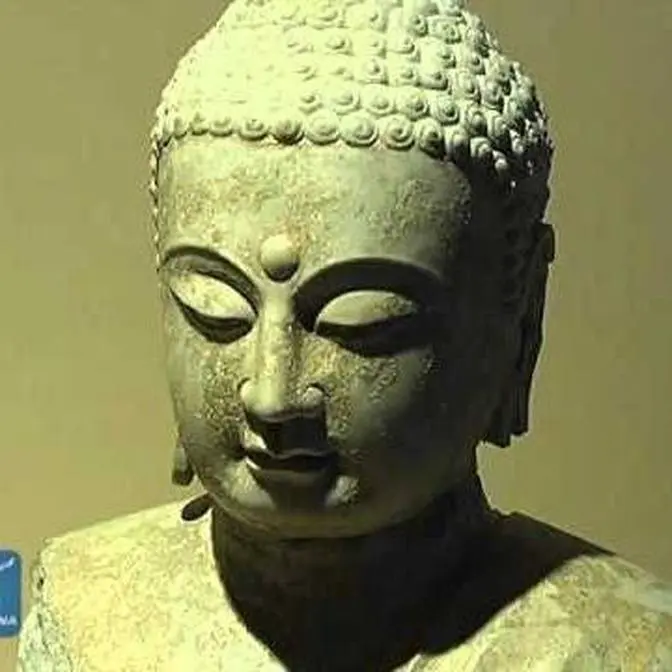
We love this guest's reaction! Robert Waterhouse appraises an early 15th-Century Chinese Bodhisattva gilt bronze in St. Louis, Hour 1.
I think it's a Bodhisattva, it's a figure of the Buddha,
and this is a repose position.
It has guilt, but it's worn off.
There's a missing arm.
I thought it was so beautiful, I didn't mind the damage.
I almost didn't have a chance to acquire it
because I was having 15 people for lunch.
There was a local person who was a colorful character
in Kirkwood, so I really wanted to get to his garage sale.
I rushed out, and the dealers had been there
for two days before, so I thought everything good
would be gone, but when I saw this,
I thought it was so beautiful, I just grabbed it.
May I inquire what you paid for it?
Probably between $75 and $100, which was a lot for me.
It was about 20 years ago.
Well, it is interesting that it was omitted
from consideration by the dealers for two days.
This, in fact, is a guilt bronze figure.
Beautifully seated, Guanshu Bodhisattva of insight.
Beautiful drapery, this ribbon work.
Very fine, reticulated hands.
Wonderful rope and jewelry work.
The royal fly wisp is beautifully cast,
and there is a Rubenesque or a chubby quality to the face,
which is indicative of the age and period.
It's a beautiful face of compassion.
Slightly down, tilted.
Looking at the figure, there are some features
of early Bodhisattvas.
A truncated, or for want of a better word, skinny waist.
The jeweled chest.
The very deep and fine drapery of the robe,
and seated in royal ease.
And royal ease is really a characteristic
of very early Buddhist art.
The dating would be approximately early 15th century
or early Ming Dynasty.
The consensus is that it did have a base.
The base that is often associated and cast
with these objects is a post,
and then a similar conforming lotus base.
So it's raised, it's revered, it's elevated,
as a Buddha should be.
The quality of this Buddha is so fine,
the age is such a golden age of Buddhist art,
that we would not be surprised if the original base
had a inscription, and that it's possible
that that base may have had an imperial inscription.
Oh, really?
It would be very, very difficult to prove
that it was for the imperial household,
or from an imperial workshop, as there's no inscription.
I think those who understand Buddhist works of art
from that period would look at this object
and say it's beyond a very wealthy patron's
quality of bronze.
So it's likely that the quality would indicate
that it's an imperial piece.
Do you think it's Chinese?
It is Chinese.
Okay, that's what I thought.
It's of no real consequence that the gilding is gone.
We would be shocked and suspicious
if the gilding was there.
Yes, you're missing a hand.
Yes, you're missing an arm.
These are old objects.
These are somewhat fragile objects,
although bronze is hardy, it is brittle.
Objects are dropped, they're detached.
Any idea what it may be worth in today's market,
after what I've said?
To me, it was worth $100, or whatever I paid,
so I didn't really care.
A very conservative retail price
would be $100,000 to $125,000.
Really?
Are you really serious?
Oh my goodness.
I can't believe it.
It's a wonderful object.
Well, my goodness, I can't believe it.