
Uncovering the Tale of Buddha Through Sacred Sculptures
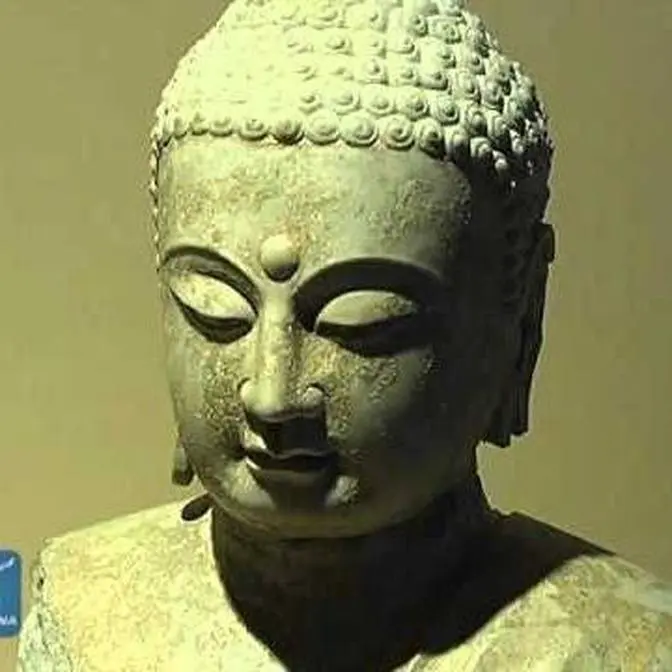
We are in Asian Art Museum in San Francisco, looking at an important very early Buddhist
sculpture that was found in northwestern Pakistan or what it was then called the region of Gandhara.
Gandhara was a center of Buddhist civilization and it was famous for its art, architecture
and sculpture. The sculpture and the reliefs that we will be seeing are from about 1st century AD.
The reliefs and the centerpiece both depict the birth, the journey and the death of historical
Buddha Siddhartha Gautama. The reliefs we are seeing now were originally part of a stupa
which was an earlier form of pagoda that we associate to modern day Buddhism. Now to be
aware the sets we will be seeing are part of two different sets and were not part of one
complete structure. We start with the first relief which is about the conception of Buddha to be.
Just like other historic figures like Jesus of Nazareth or Zoroaster, Buddha was considered
a virgin birth. According to Buddhist teachings, the Buddha was born as a prince in a royal family
in ancient India. His mother Queen Maya is said to have had a dream in which a white elephant
entered her womb indicating that she was carrying a special and auspicious child. The art is very
delicate. We can see the elephant in its full form planting a seed inside Queen Maya. The next
relief shows us the events of the following day when four Brahmins of the king's court
explain the dream to the king. A child has planted itself into the womb of your queen. He will become
a great monarch but if he leave the household life he will become a Buddha. Here we can start
to see the similarities with the ancient Greek art. More on that later. The next relief shows
Buddha being born. Buddha was born in Lumbini, a garden in ancient India on the full moon day
of the month of Vishakha that is the second month. As seen from the depictions, the Buddha was born
from his mother's side and he emerged from her body fully formed and complete with all of his
senses and faculties intact. Upon his birth, Buddha is said to have taken seven steps and declared
I am the chief of the world. This is my last birth and there will be no more. Here we move on to a big
centerpiece which shows Buddha that is Siddhartha Gautama in his full Buddhahood. He has already
left his lavish lifestyle behind and attained the highest state of enlightenment and have become
the Buddha. In his form of Buddha, we see him addressing five monks about the things he have
learnt. The chakra at the bottom of this plate symbolizes the circle of life. Another relief with
the same motive shows this same chakra where the Buddha turns the wheel of the doctrine that is a
is not in a good shape as it was found in ruins about 100 years ago. His robes are draped elegantly
over his body with intricate folds and creases that give the impression of great care and attention
to the details. The statue is made of polished gleaming stone that captures the light and
reflects it in a warm soft glow. The next relief shows Buddha finally meeting his wife Yashodhara
and son Rahula. The statue depicts the Buddha in a seated position, his legs crossed and his
hands resting gently in his lap. He has a serene and peaceful expression on his face and his eyes
are half closed in deep contemplation. This has been many months and many years since Siddhartha
has left his family and has returned an enlightened man. The son Rahula still young
preaches Buddha and asks for his inheritance. The Buddha responds, the wealth only brings
suffering and rebirth. I will give him noble wealth that I attained at the place of enlightenment.
Ordain, Prince Rahula. After this, Prince Rahula lives rest of his life as a monk.
This brings us to the final plate of this series, the final stage of Buddha's life which is called
The Great Departure. Very similar to the Christian art of Lamentation of Christ,
we can see this poster of Buddha all over the world in different forms. Buddha is said to
have passed away in the city of Kushinara lying on his right side between two salt trees.
As he lay dying, the Buddha is said to have given his final instructions to his followers,
telling them to continue practicing the Dharma and to strive for enlightenment. The Buddha is
said to have passed away peacefully, surrounded by his followers and the gods and devas. The face
of Buddha is removed even though the other faces in this picture are fine and still detailed enough
which tells us that this relief was perhaps defaced by a later day conquering army. In the 1930s,
a team of French archaeologists led by Dussartes excavated the famous Gandharan site which yielded
a wealth of Buddhist art and artifacts. The Gandhara region declined in importance after
the fall of Mauryan Empire but its legacy lives on in the art, architecture and religious traditions
of the region. Today, the Buddha's teachings continue to inspire people of all backgrounds
and beliefs. His path to spiritual awakening offers a way out of suffering and into a life
of peace and happiness. May the Buddha's wisdom guide us all on our journey towards enlightenment.
Thank you and see you next time.