
Philippe Lancelot Chouilly 'Le Fond du Bateau' 2018 Grand Cru | Champagne Review
1 Video View·Jan 15, 2025
Whether you're a seasoned champagne sommelier or just exploring how to drink champagne, this review will give you insights into the flavors and craftsmanship of this exceptional cuvée.
Tonight, I'm really excited because I want to go into
and one of the problems that I get, get asked, one of the questions I get asked
quite regularly is what is a vintage? What is a Brute? What is a Blanc de Blanc?
What is a Blanc de Noir?
So I'm going to use one of my favorite examples of vintage tonight.
And I'm excited because this is one of my favorites.
And I think it's a perfect one to go into.
So tonight we are going to talk about and explore the Philippe d'Ancelot
This is a 2018 vintage Grand Cru.
And enough talk.
I'm Daryl, your champagne expert. Let's get bubbly.
What is a vintage?
Well, technically, a vintage is a champagne that was vinified in one year.
Meaning in this case, 2018.
So if a grower has a particularly good year
and all the wine comes from one area, vinified in the vineyard,
slap the name vintage on it and it's vintage.
However, there's a bit more to it than that.
OK, in this case with the Philippe d'Ancelot,
his champagnes, they're not just vintages.
They're more than that.
These are from one area, in this case,
for the Pont du Bateau, which roughly translates to bottom of the boat.
I'm really curious to find out what the inspiration for that is.
He's got some really cool names, really cool labels.
And this November, I'm going to be in France and I'm going to meet with him.
And I've got a couple of questions for him.
It's like bottom of the boat.
I want to see where that came from.
I want to see the bottom of the boat.
Anyway, I digress.
Anyway, the majority of his champagnes, like I said, they're not just single year.
These are single vintage, single parcel, single plot.
He is hyper focused on one little area of his vineyard that he wants to identify.
He takes expression to an extreme.
And that's one of the things I love about his champagnes,
is that they are all truly expressions and they are all a driven focus.
And that's just fantastic to me.
And a lot of houses do this and that this isn't something
that is so out there and so, so amazing, but it is OK.
This comes from Choulet, which is in the Côte de Blanc,
which is just south of the Marne department.
So like I said, 100% Chardonnay, one plot,
one parcel, one vineyard, one year.
The cool thing about this champagne
is that it is coming from a plot
that historically had been used to grow Pinot Noir.
Like we've talked about in the past,
a lot of champagnes usually are specific.
I mean, this plot has been used to grow this great variety for X, Y, Z
of years, and that's what we do.
Every now and then you get a grower who takes a plot or a parcel
that has been growing something like Pinot Noir and decides, you know what?
I'm going to I'm going to change up here.
I'm going to grow some Chardonnay here.
And I love that's bold because the growing conditions for one
does not always translate to the other.
But when you can make that work and your vision is so clear
and your approach is so clear, it works.
So let's get into this here.
See what it means to be single plot, single vineyard, single parcel.
Let's do it.
Right.
Oh, yes.
Every now and then it makes a pop, and that's OK.
Here we go.
The La Femme de Batout 2018.
Oh. Now that.
That's beautiful.
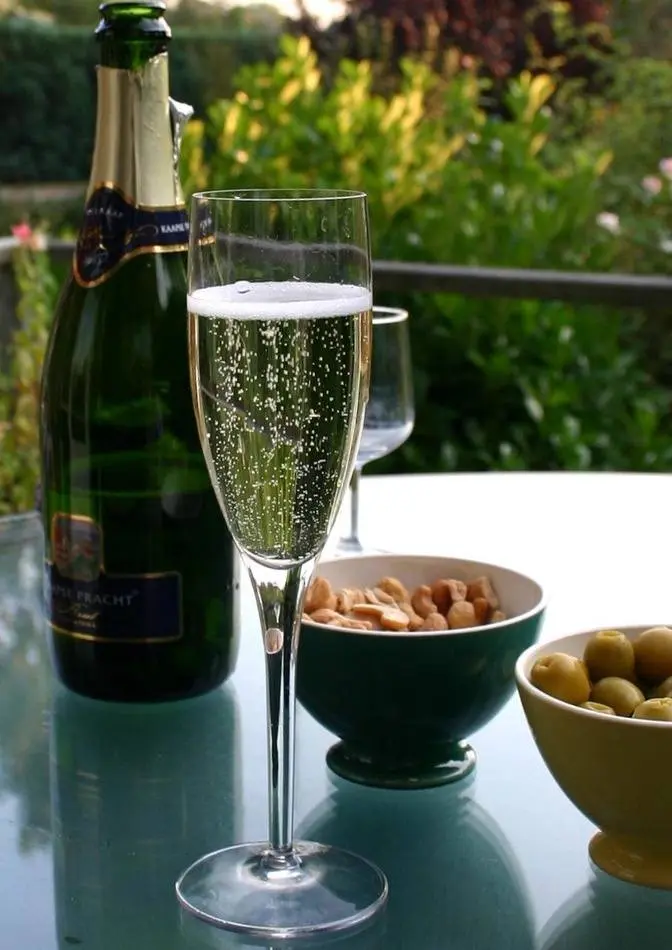
That is a beautiful, beautiful, beautiful glass of champagne.
Have a look at that.
All right.
Let's get the nose.
There's a beautiful vibrancy.
There's a nice citrusy hint.
Some lemon zest.
Some apple.
And there's a sweetness here coming from some pear.
And there's some flowers and I love flowers.
I just love that that light floral white flower aroma.
It is so common.
You know, at the end of the day, it's really what it is for me.
It's calming. It's just very, very, very common.
I like that.
There is some brioche in the nose,
a little bit of butter, which is which is kind of cool,
because lately I've been noticing the butter note in a lot of champagnes
and that's really coming through here.
And these are going to come into factors when we talk about the pairings
a little bit, but we're not there yet.
Let's keep going.
At first, it was brioche.
But now it's more like toast.
That's really nice. Enough talk.
Let's get the attack.
OK, wow.
You're going to get the
you're getting the citrus.
Boom, right in the face.
Love that.
The mouthfeel has that nice butteriness to it.
There's a chalky hint to it about being too minerally.
That's really, really nice.
Wow. That's nice.
Let's go for that taste.
Oh, that's fresh.
That's that's fresh.
Now, the liveliness at first
has changed to just as beautiful freshness.
The acidity is there, but not overpowering.
There is that chalky note, which is perfect and beautiful
when it comes into the neck.
I'm getting some apple, I'm getting some almond.
That buttery note is there,
not just on the mouthfeel, but on the palate, the buttery note is there.
I like that.
Some fresh fruit.
Wow.
On the finish, I'm getting a little bit of the minerality,
but it is kind of helping that acidity kind of
take everything down and kind of smooth it out.
Wow.
That's crisp.
That is lively.
And it pops like this is this is this is a cloy.
Wow. Like this.
This makes this is making me happy.
OK, this is really making me happy.
And that that's an awesome champagne should make you happy.
This is making me smile.
Like this is just really making me smile.
Wow.
So this is an extra route, got one gram per liter,
per dosage, again, 100% Chardonnay.
Grown in a plot that historically grows Pinot Noir.
It is complex, but yet it's structured.
Now, what does that mean?
Complexity simply means that there's a lot of things at play or roundness.
How about that? We use roundness. It's very round.
All the parts are there.
All the parts are independent, but they are playing very, very well together.
And I say it's structured.
It means that I get the point.
I understand what he is trying to express.
He is bringing forth the essence of a unique growth
of Chardonnay in a Pinot Noir plot.
That's the structure.
He's this is the story he's trying to tell.
And you get that.
The crispness is there.
Now, the butteriness in that mouthfeel.
This did spend some time in oak, but it also spent some time in steel.
And that is just the right amount, in my opinion, for the oak.
It's there. You're getting it.
You're getting the malolactic fermentation.
You're getting that mouthfeel. You're getting that butteriness.
You're getting that beautiful almondy, caramelly smokiness, but only a hint of it.
So with this, I would recommend serving this a little bit on the warm side.
I would say go 14 degrees on this one.
You don't want this too cold.
You don't want this cold at all.
You want this just right.
I think that 14 degrees is spot on.
OK, 12 to 14.
Stick to the 14.
If you go up to 15, you'll be fine.
Honestly, that'll be fine.
Wow.
I'm sorry.
That's a.
This is really versatile.
OK, I would do anything with pasta.
OK, anything in a white sauce or a lemon garlic sauce.
Perfect. Stay away from heavy cream sauces.
The acidity is here, but not enough to cut through a heavy cream sauce.
Pork, a good, beautiful roasted pork with rosemary and some garlic.
Oh, perfect.
Roasted potatoes with a little drizzle of one of my personal guilty pleasures.
A little bit of duck fat.
Toss your roasted potatoes and some duck fat with this.
That's a winner right there.
As far as red meat's concerned, um.
Whatever red meat you go with.
So what if you're going to do a steak?
Plain. OK, salt, pepper.
No, no heavy sauce.
Some onions, some some mushrooms, some garlic.
You know, baste it in butter.
There you go.
Definitely baste it in butter.
Always baste your steaks in butter.
Final thoughts.
These are my final thoughts.
I love this grower.
I love this guy.
I love his, I love his champagne.
I love his philosophy.
I love his approach. I love
the boldness of this guy.
I love him. I really do.
I, I, I, I, I do.
I got a lot of respect for him.
This is a great champagne for an expert, for an aficionado.
But it's also a great champagne
for someone who wants an introduction to fine champagne,
who's never had true fine champagne before.
This is a great way to say, OK, you've had that.
Have this.
This is this is this is a threshold.
Once you cross this one, you're hard to go back.
This is the world you're going to live in now.
Get another job.
Listen, thank you all for joining, for watching, for the support.
And I asked everybody a couple of weeks ago.
Like and subscribe.
I wanted to hit a thousand subscribers at the end of the summer.
Here's what you all did.
10 days ago, I was at 500 plus subscribers.
As of today, 10 days later.
We are at four thousand
five hundred subscribers and growing.
I cannot thank you all enough.
I can't. I am touched.
I am touched beyond touch.
I am honored beyond honored.
We went from 500 subscribers
to almost 5000 in 10 days.
From the bottom of my heart,
I wanted to touch a thousand people, and that was my goal.
You all have told me that I'm touching five thousand people
and growing every single day.
Usually I say something like, thank you.
This is the best job a guy could have.
Stay bubbly.
Tonight, I'm going to say simply,
thank you.
I'm Daryl. Champagne expert.
Humble, humble champagne expert.