
Aleksandr Sokurov - Hubert Robert: Una vida afortunada (VOSE - Español)
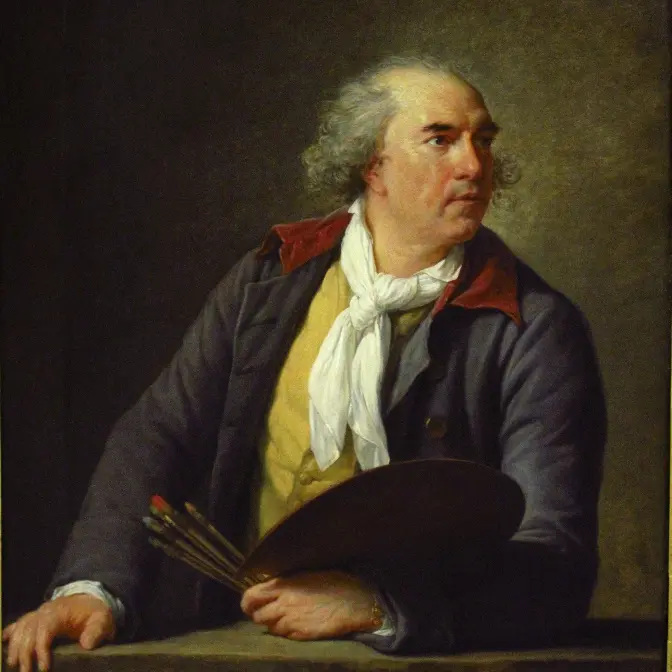
My friends persuaded me to watch a performance of a traditional theater.
It was damp and cold.
The performance began somehow quietly, quietly.
The actors came out of the fog unnoticed.
And they were unnoticed.
Without a doubt, the masks hid the faces of great, eternal actors.
I was looking at this miracle.
And for some reason I remembered what I read once in Dostoevsky.
It seems so.
For me it was not noticeable at all.
I stood on another earth.
Everything was exactly the same as in our country.
But everywhere it shone with the triumph finally achieved.
Tall, beautiful trees stood in all the luxury of their color.
And their countless leaves, I am convinced, greeted me with a quiet, affectionate noise.
As if they were saying some words of love.
And then, and finally, I saw the people of this happy land.
These people came to me and caressed me.
Each of them wanted to calm me down.
They did not ask me anything.
Well, as if everyone already knew.
What an amazing picture.
Who is the author?
And why did it appear in my imagination?
And for me it was not noticeable at all.
I stood on another earth.
Everything was exactly the same as in our country.
Tall, beautiful trees stood in all the luxury of their color.
And their countless leaves, I am convinced, greeted me with a quiet, affectionate noise.
As if they were saying some words of love.
So, who is the author?
Ah, I remembered.
Remembered. Robert.
Gebert Robert.
18th century.
He was born, it seems, in 1730.
No, no.
He was born in 1733.
In France, Louis XV ruled at that time.
And there was a great revolution ahead.
In Russia, Anna Ioannovna, little is known to anyone, rules.
The United States of America has not yet been born.
The Prussian state is strengthening.
England acquires new colonies.
And Japan and Europe know almost nothing.
The Europeans themselves are constantly at war.
And at the same time, love for antiquity, reverence for beauty, multiplication of beauty.
Those who knew him in his lifetime talked about him, that he had a soft look.
Big, radiant eyes.
Tranquility and naturalness of the pose.
All this inspired sympathy.
At the age of 21, Robert comes to Rome.
Begins to study painting.
And studies ancient architecture.
Only at the age of 21.
But it was still Rome.
A city of cities.
But after 5 years, Robert receives his first professional order.
Fate will give him the opportunity to live relatively safely 11 years in travel and study in Italy.
When he returns to Paris, he immediately receives the title of an academician.
The professional environment accepts him without anger.
Well, why not?
In everything he does.
Traces of tradition and skill.
Not his style, not the plot.
He does not irritate anyone.
He loved with his soul what many loved then.
Very many.
How lucky he was.
He coincided with his time.
He did not allow himself to be one step ahead of him.
He walked on the shit.
Second by second.
In the natural death of architecture, there is no disgrace.
There is only sadness.
The simplest of all sadness.
Ruins can be looked at indefinitely.
And this, without a doubt, heals from pride.
The architectural sphere is a box for storing light and shadow.
Bright sunbeam and gray winter twilight.
In St. Petersburg, in the Hermitage, there are many paintings of Robert.
The Russian tsars and nobles did not spare money and paid Robert a lot.
They did not stand for the price.
Then the paintings were forged for a long time.
And for a long, long time.
The camp was taken to the distant, cold Russian palaces.
They said about Robert that he was painting as fast as a letter.
He left behind more than 500 paintings.
A vast world in which a whole civilization could be placed.
Do not believe Robert.
There have never been such buildings in the world.
No fountain, no colossal arches.
He invented all this.
He invented everything.
Yes, without a doubt, my artistic passion was admired in the 18th century.
Paintings, paintings, furniture, porcelain, books.
Romance of landscapes.
The bottomless sky.
Ancient ruins.
Marble sculptures.
The greatness of museums.
The triumph of classical skill.
The more he looked,
the more he was amazed by the extraordinary fertility of the past century.
When and how did they manage to do this?
When and how?
The body of Robert's painting.
This is her skin.
A living skin coat.
This body breathes and very often gets sick.
The Hermitage in St. Petersburg was built just a few meters from a deep, strong river,
which floods the city several times a year.
Robert painted giant canvases without fear, with pleasure.
He painted giant canvases, from parquets to palaces.
And there was no vanity in it,
but only high craftsmanship and a tender love for architecture.
Day after day, life passed.
Year after year.
There was already fame and money and luck.
In the end, many loved him.
He had a light temper, a cheerful disposition.
He was always cheerful. He was always lucky.
However, there was a shadow in his life.
Suddenly, in a short time, one after another,
all his children die.
Gabriella, Adelaida, Charles and Adèle.
Napoleon comes to power.
He evicts academician Robert and his wife from their favorite Louvre apartment,
where they lived for more than 25 years.
And in 1808, at the age of 75,
he dies, falling near Malbert.
Probably because life is over.
Yes, and the old play has already been played.
Only the smell of blooming trees remains.