
Gabon, a land unfamiliar to humans
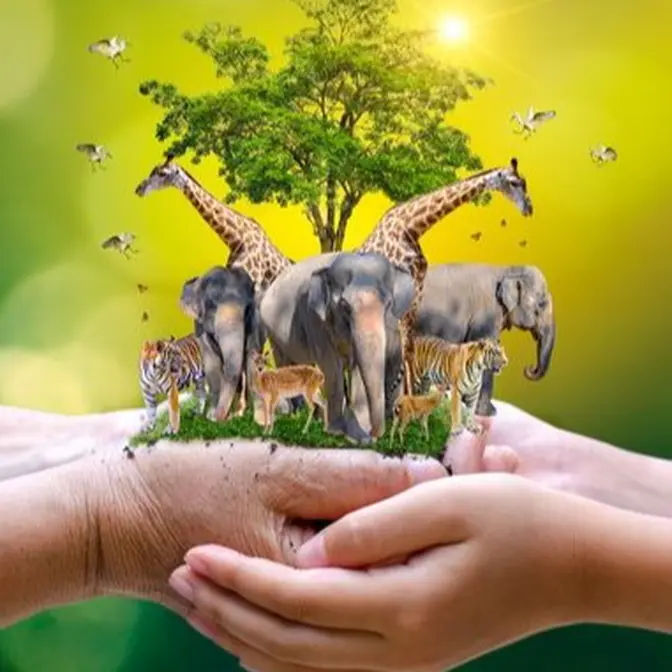
#pets#animalkingdom
The floodplains of Loango National Park in Gabon support extraordinary biodiversity. A rare combination of beach, grassland, lagoon and forest. Humans have never settled here. Elephants, hippos, gorillas and other species living in the park have adapted to different climatic periods.
Deltas, marshland, rivers and flooded wetlands
are essential links between aquatic and terrestrial environments.
These great wetlands play a vital ecological role for the planet.
Whether in the water, at ground level, or high up in the canopy,
an exceptional array of flora and fauna have found shelter here.
And yet, living in these wetland worlds is a constant challenge.
The powerful water cycle reigns over these zones with a relentless hand.
Gabon. In the Luongo National Park, gorillas, elephants, hippopotamus,
and other vulnerable species must adapt to rainy periods when floods invade everything,
and others when water can be scarce.
In order to survive, the animals have no other choice
than to settle for a life of wandering.
During the month of July,
the wild Gabonese coast is the scene of rare and unexpected encounters.
This is the time when the shy forest elephants
will be able to watch the acrobatic ballet of the humpback whales.
The Luongo National Park is the only place in the world
where earthbound and aquatic giants can meet.
It spreads out over 1,550 square kilometers southwest of Gabon.
From the Atlantic coast to the foothills of the Congo Basin.
In this equatorial zone where the rainy season is particularly long,
the flood and drought periods endlessly reshape new networks of habitats.
Here, prairies merge with beach, and mangroves stroll hand-in-hand with swamps.
Luongo is one of the few places on earth
to offer a concentration of such diverse ecosystems.
To the west, the mangroves and lagoons
leave room for the savannas and coastal prairies.
Periodically flooded forests and firm land forests
stretch out towards the east.
Finally, the south is the kingdom of the great swamps.
We are now in the middle of the dry season,
which lasts from June to September.
The coastal savannas are the first to suffer.
Their sandy soil cannot retain a single drop of water.
A few days are enough for the grass to roast.
These savannas don't have much to offer herbivores anymore.
Snout glued to the ground,
the most beautiful pigs in the world have an increasingly difficult time
finding the bulbs or larva they relish.
The river hogs will need to move to another area very soon.
The buffaloes follow in their wake
towards the cooler coastal prairies sprayed by the spoon drift.
At the risk of missing the exodus,
a couple of late comers take time for a break.
This is the ideal mating period.
The females will be able to give birth
during the next rainy season in four months.
There will be an abundant food supply then.
At the end of July,
clouds pass by without shedding a single tear.
Day after day,
the mattress of leaves covering the ground in the undergrowth
loses humidity.
Forest wildlife wanders around
on the lookout for fruit, young shoots or waterholes.
Forest elephants drink 100 liters of water a day.
They will need to find supplies elsewhere.
Prolonged shortage of precipitations on the Great Congo Basin
is the death of ponds and streams.
In August, they disappear in the highland forests.
One after the other,
the elephants will leave this chlorophyll haven
deeply hidden in the second largest tropical rainforest in the world
after the Amazon forest.
Little by little,
they will return to the flood prairies or the southern swamps.
On the beaches sprayed by the sea,
the little red buffaloes have come to seek a little coolness.
It is impossible to draw the limits between land and sea here.
During the dry season, for example,
the sea and fish take advantage of the weakness of the rivers
to rush inland,
while the small red buffaloes cool their feet in the ocean waves
and graze the beach plants.
Out at sea, the tireless migrators have appeared.
Over a thousand humpback whales have made a stop on these coasts
during their migration between the Antarctic and the Arctic.
They came here to mate or to give birth to their calves
in the warm waters of the West African coast.
At the end of July, the waters start receding faster.
In these highly flooded areas,
the rivers have finally left the land to return to their beds.
In some places, their level has already decreased by 1 meter 50.
Loic Macaga, a Gabonese naturalist,
and Jean-Robert Antono, eco-guard,
are part of an observation mission
of the movements of wildlife according to the seasons.
The hippopotamus are back in these rivers,
lined with prairies where the grass grows abundantly.
For Loic, observing these animals is difficult.
In this area, intensive poaching has made them suspicious and shy.
We could say that all the grass here grew after the water receded.
When you come during the damp season, the water level is very high.
You can navigate with a boat here.
During the rainy season, everything is flooded.
You can see by looking at the marks on the trees.
For example, here, you can clearly see the water level during the rainy season.
The same here.
You can see algae, which proves that this tree can stay in the water
for nine months of the year.
See? It's rather high.
Installing cameras helps to understand better
how the wildlife moves during the dry season.
When it reaches that level, it's about the same height as an elephant.
The footage confirms that a great number of pachyderms
have abandoned the forest for the nascent prairies.
But Loic is interested in other colossus that are even more discreet.
The first one is a true monument in Africa,
as high as the towers of Notre Dame in Paris.
The Moabi tree can be as tall as 70 meters.
And its branches can span out 50 meters.
It has become a rare tree.
See? This species is one of the largest trees in Africa.
We call it the giant of Africa.
These marks were made by elephant tusks.
They're not only interested in the fruit, but also in the bark.
When a branch falls off, most of the time elephants usually eat it.
The whole thing.
These trees grow in secondary forests and not very far from swamps.
The Congo basin provides shelter for other giants, endangered as well.
Flatland gorillas are mistrustful and very evasive.
They are different from their close cousin, mountain gorillas,
with a slightly smaller size and shorter, browner coat.
They move discreetly as a family.
This mother and baby have left the nest very early
to roam the forest in search of food.
During the dry season, the dearth of fruit
forces the great apes to constantly be on the move
on a territory of about 40 square kilometers.
It's getting increasingly difficult for Loic to follow their tracks.
In August, the forest is almost soundless.
Three meters above the ground,
this cluster of folded leaves and branches is a large male's nest.
Removing a sample of hair will help identify the great primate's DNA.
At the height of the dry season, the gorilla moved to the swamps
where amaranthus and cypress plants grow, such as these papyrus.
Look, this is the part of the papyrus that the animals eat.
It's soft and tender.
That's what they like.
The decrease in water level is a godsend for the gorillas.
These usually inaccessible aquatic plants are now easily within reach.
Loic returns regularly to the camp he founded some 10 years ago,
an hour's walk away from the first papyrus swamps.
English, German, and French scientists take turns there
to study the exceptional wildlife of the Luongo.
Day after day, the drought spreads through the park.
Ponds and waterholes are drying out.
These silt puddles are perfect nurseries for mosquito larvae
and an ideal spot for malachite kingfishers.
But these mud shrouds, which are no longer linked to the main watercourse,
will also become the tomb of many fish.
Deprived of precipitations, clay grounds show alarming signs.
But appearances are misleading.
Although their skin is cracking, their insides remain damp and very fertile,
thanks to the alluvium brought by the flood.
In the space of a few days,
these grounds battered by the elephant's passage will become a prairie.
More cameras scattered around various places
help to identify who still haunts these deserted savannas.
Activity is at its highest at night.
At the end of a long march,
most of the animals have made it to the swamplands
where the grass has sprouted in the mud.
Citatungas, genets, and waterhogs take turns before the leopard arrives.
In the moist early morning,
misty images reveal the arrival of the primates
who prefer to spend the night perched in the branches,
away from predators.
Just like the gorillas,
white-collar Cercosepis are crazy about papyrus.
But the troops already resume their march towards the south.
Slightly smaller than their savanna cousins,
these forest elephants live exclusively in central Africa.
Their infallible sense of smell
guides them towards the large permanently damp zones.
They can at last easily find the 100 kilos of greens that they need daily.
During the dry season, life thrives in these swamp oases.
The migratory birds are back.
The weavers have colonized the branches of the mangrove trees
along the great swamps.
The mating season has begun for these weaving experts.
To build a spherical nest,
the males choose a forked branch directed towards the ground.
They use the vertical circle they weave as a perch while building.
Competition is tough,
and a number of constructions will be abandoned
for lack of consenting females.
The small groups of forest buffalos
have become the egrets' precious allies.
In these damp areas,
their heavy treading disturbs clouds of tiny wildlife the egrets love.
Now is a time of abundance and carelessness for the young buffalos.
Here, like everywhere else, vigilance is crucial.
Attracted by the concentration of species that have settled in this paradise,
the leopard has left the dark network of the undergrowth
to seek a new stakeout.
He will patiently wait for the concealment of night to attack.
These water hogs have something to worry about.
The coastal strip has turned into a fallback zone
for some of the herbivores.
But even here, the leopard prowls.
At the end of August, when the atmosphere is suffocating,
the river pigs leave this dangerous territory to settle down by the sea.
They are back to roam the sand beaches.
The ghost crabs will pay the price of this foray.
They are on the alert.
Flanked by the small sharks on one side
and the voracious pigs on the other,
the water hogs will be able to find new sources of protein.
Only the crabs who dig the deepest holes
will be lucky enough to escape from these bulldozers.
To do so, they need to bury a meter or more under the surface.
Four full moons have gone by since the last great rains.
At the end of September,
the impeding return of the deluge will upset everything.
In this equatorial region, it rains eight months out of ten.
Starting October, the first showers will inundate the lands,
but the torrential rains will be at their most intense in December.
Once again, algae and ferns are encrusted on the tree trunks.
In the space of only a few days,
the water swallows up the prairies, the rivers overflow,
giving the fish free rain to repopulate the area.
Every year, almost 2 meters 50 of water pours down on the Luongo.
Elephant, hippopotamus, or gorilla prince fade away little by little,
leaving room to write future stories for the trackers to decipher.
Water filters into every pore of this land,
carrying in its wake the indispensable silt
that will feed the plains where it is deposited.
Paradoxically, this damp season that wears out the sky
is the sunniest and most invigorating for the forest.
The water will feed the soil and favor fructification.
Vegetation explodes.
The trees, gorged with water and light,
are now adorned with flowers
and will soon offer a profusion of long-awaited fruit.
That's a sure sign.
The gorillas have abandoned the papyrus swamps
that are now completely flooded.
When 180 kilos of mussel barrel down at great speed,
it's best not to venture out into the area.
Scientific observation has shown that they don't migrate,
but that they zigzag following the seasons
through the maze of ecosystems that the Luongo has to offer.
The great male shows unswerving vigilance
because the ripe fruit that has fallen on the ground
attracts intruders and is coveted by many.
Even though he is sated,
he won't tolerate any intruder on his territory.
The strong perfume of the fermented fruit
has teased an elephant's sense of smell.
This heavyweight is a potential threat for the very young.
The clash of the titans won't happen.
Not only is the large primate intimidating,
he can also bite ferociously.
During the month of November,
the Luongo Park receives as much precipitations as London
in a full year.
Rapidly, the rivers that have come out of their beds
drown out the surrounding prairies.
In December, it engulfs every bit of the ground.
The ponds refill.
The complex Luongo water network,
associated to a rather flat terrain,
has favored the emergence of a multitude of fragmented ecosystems.
Within this drowned world,
the elephants play a major role.
As he walks,
this elephant sculpts and plows the ground.
Then the seeds he scatters over long distances
will germinate there.
In this vegetal labyrinth,
pachyderms open the trails that other animals will use later on.
On a large scale,
they are the gardeners of this rainforest.
However, 62% of the forest elephants
have been slaughtered for their ivory in 10 years.
The extinction of the species has been announced for 2025.
After a few weeks,
the streams have left their bed.
The prairies are navigable again,
but there's not a living soul.
The weaver's dormitory lies abandoned.
The floodwaters have no impact on these coastal savannas.
These sandy grounds that absorb everything
turn green in no time.
Shyly, yellow-backed dukers,
chimpanzees,
and sitatungas repopulate these open spaces
where the rich grass also attracts herds of water hogs.
The gravid females will finally be able to get some rest
while their fellow creatures
scrape at every corner of the forest in search of proteins.
In turn, the buffaloes gather in these large stretches of savanna.
Approximately 30 females and their young
accompany the alpha male.
The yellow-billed oxpeckers are once again riding their mounts
and savoring the parasites that proliferate on their host's skin.
The rainy season attracts large colonies of pinkish-gray
bee-eaters on the coastal savannas.
They came here to enjoy the large stretches of firm, wet sand
and dig terriers that won't collapse to lay their eggs in.
In February,
these migratory birds will fly away deep into the Congo Basin.
On these Gabonese beaches,
sheltered from man,
one of the largest leatherback sea tortoises
nesting sites in the world was recently uncovered.
It was common belief that these giants,
which can weigh up to 900 kilos, had disappeared.
The Luongo beaches are the ideal location
for their eggs to incubate.
They provide constant temperature and hygrometry.
15,000 leatherback sea tortoises
regularly visit the Gabonese coast
to find shelter from the heat and predators.
While sojourning in Africa,
they will come back here
at least once or twice to these beaches
to lay hundreds of eggs
before moving on towards the unknown.
It will take several years
before they come back to the Luongo.
Buried more than a meter under the surface,
tortoise eggs are far from safe.
This nest was ransacked during the night.
Ghost crabs are the most voracious egg thieves.
But this time, the culprit is an ornate monitor.
Victims of its bulimia,
it has a difficult time moving around.
It must immerse itself in the waves
to regulate its body temperature,
which has risen dangerously
after its feast on the hot sand.
Wedged between the long sand littoral
and the coastal forests,
the lagoons,
bloated from several weeks of precipitations,
are filled to the brim.
The next downpours might be fatal.
If the change in climate
has somewhat disrupted the great rain calendar,
when they do finally arrive,
pushed forward by the ocean winds,
their intensity will upset
the topography of the Luongo.
The powerful rise in water level
splits through the sand walls.
Breaches open up in the lagoons,
liberating an avalanche of stagnant water,
sludge, and foam
that spills into the sea,
dragging many fish along.
The lagoon bottoms are higher than sea level,
and they have completely emptied out of their waters,
rich with forest tannins.
The mangrove tree's feet,
freed by the ebb and flow,
attract the white-collared cercocebus.
On the exposed roots of the trees,
they find food that is never accessible
the rest of the year,
oysters.
Abandoned to themselves in these unstable lagoons,
the young crocodiles will need to adapt
to the fluctuations in water level
and amount of fish available.
Their mothers don't have so many worries.
Their hunting territory reaches out to the ocean,
way beyond the mangroves.
In this perpetually moving environment,
the mudskipper is one of the rare individuals
who doesn't suffer from the variations
in water and salt level.
It can easily skip from one lagoon to another.
Unlike humans,
who carry air in bottles to dive into water,
this amphibian holds water in its gills.
It can also breathe through its skin,
just like frogs,
which allows it to remain two hours out of the water.
Now it's the coastal forest's turn
to overflow with fruit,
and the elephants know it.
In small groups,
they are heading for the coastline.
The giants of the earth invite themselves
on these high beaches,
where pioneering plants grow on.
On these sand strips,
whipped by the winds,
the elephants don't settle for just grass.
They are also fond of iboga leaves,
which have euphoric properties.
In this perpetually moving environment,
the animals are forced to live a nomadic life.
This immobile foot soldier on stilts
has adapted to periods
when it sits in briny waters,
others in soft water.
Its halophilic root system
allows it to eliminate salt
and withstand the ebb and flow of the tides.
At the end of November,
through the effect of the roller waves
that tirelessly bring in sand,
the coastal lagoons have closed up
in less than three days
and filled up with fresh water.
They are enticing to the hippopotamus.
At the end of the rainy season,
a unique phenomenon in the animal realm
discreetly occurs here at nightfall.
The nocturnal prowl of this juggernaut,
which weighs over two tons,
leaving the lagoon to dive into the sea
is a rare moment,
almost impossible to capture.
Salt water is not a problem for these mammals
equipped with watertight nose valves.
It even helps them float better.
The hippopotamus can let the ocean drag him away
without having to walk
from one prairie to the next
to search for fresh grass.
The Luongo National Park is a miracle of nature.
As a true architect of this complex universe,
the water cycle has contributed
to shaping a multitude of ecosystems
and helped species that disappeared elsewhere
to thrive.
Here, man has made a non-aggression pact with nature.
But for how long?
This great damp zone is vulnerable,
coveted for its oil,
wood,
and other natural resources.