
The Real Interview With Albert Einstein | Radio Interview Einstein In USA | Real Voice Of Einstein
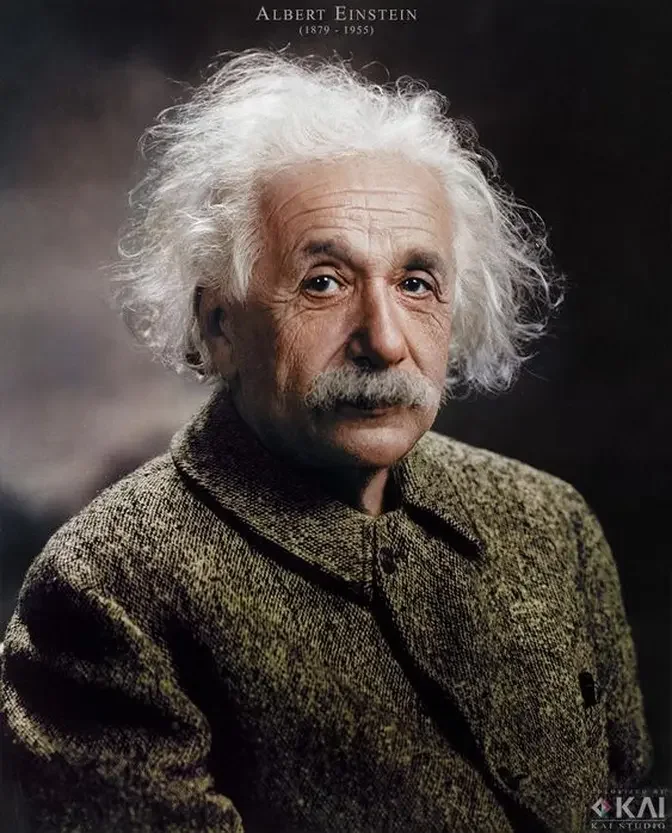
The Immigration and Naturalization Service of the United States, in cooperation with the National
Broadcasting Company, has invited a number of naturalized citizens to talk about the American
citizenship which they have recently acquired, a possession which we ourselves take for granted,
but which is still new and thrilling to them. Today we are delighted to have with us as guests
on this program the distinguished scientist Dr. Albert Einstein, who has this very morning,
just a few hours ago, taken his citizenship examination. Certainly there could be no
better time for Dr. Einstein to discuss with Mr. Marshall Dimmock, the second assistant secretary
of the Department of Labor, some of the reasons for his appreciation of American citizenship.
Dr. Einstein, I know that you seldom give interviews, and so I want to thank you,
on behalf of all of our listeners, for coming here today. I'm sure that what you have to say
will be of real interest and service to your new country. It is clear to me that it was a
self-evident duty to accept this invitation, though I must tell you that I do not think
work alone will solve humanity's present problems. The sound of bombs drowns out man's voices.
In ordinary times, times of peace, I have great faith in the communication of ideas
between thinking men, but today I am afraid the intellectual way to appeal to man
is fast becoming of little avail despite force dominating so many millions' lives.
This morning, Dr. Einstein, I was privileged to be present while you took your final examination
for American citizenship. Will you tell us why you, who are international in your outlook
and by virtue of your scientific interests, prefer to live in America rather than in any
other country? Seven years ago, Mr. Dimmock, when asked for the reason why I have given up my
position in Germany, I made this statement. As long as I have any choice, I will only stay in
a country where political liberty, toleration, and equality of all citizens before the law is
the rule. Political liberty implies liberty to express one's political opinions orally
and in writing, and a tolerant respect for any and every individual opinion.
That is real American doctrine. But tell me, do you feel that America still fulfills the
requirements you mentioned as a place in which to live? Yes, Mr. Dimmock. Making allowance for
human imperfections, I do feel that in America the most valuable thing in life is possible,
the development of the individual and his creative power. There may be men who can live
without political rights and without opportunity of free individual development,
but I think that this is intolerable for most Americans. Here, for generations, men have never
been under the humiliating necessity of unquestioning obedience. Here, human dignity
has been developed to such a point that it would be impossible for people to endure life
under a system in which the individual is only a slave of the state and has no voice in his
government and no decision on his own way of life. I agree with you, Dr. Einstein. We simply will not
be driven about like sheep. We are independent. We are self-reliant. We do not know what it means
to be deferential to class or position. Fortunately for us, obey is a little heard word and cooperate
is a common one. Yes, I think from what I have seen of Americans since I have come here,
they are not suited by temperament or tradition for existence under a totalitarian system.
I think that most of them would not find life worth living so. Therefore, it is very important
that they consider how these liberties that are so necessary to them may be preserved and defended.
I am glad to hear you say that Americans can cooperate because nothing truly valuable
can be achieved except by the unselfish cooperation of many individuals.
Dr. Einstein, you are a scientist and must regard scientific progress as one of
man's highest achievements. And yet it seems to many people nowadays that science and invention
have brought human beings more trouble than good. Technological unemployment,
international quarrels for the raw materials of industry, and finally the weapons of mechanized
warfare. How do you think the discoveries of science might be turned from man's own destruction
to his advantage? Science has provided the possibility of liberation for human beings
from hard labor. But science itself is not a liberator. It creates means, not goals.
Man should use them for reasonable goals. When the ideals of humanity are war and conquest,
those tools become as dangerous as a razor in the hands of a child of three.
We must not condemn man's inventiveness and patient conquest of the forces of nature
because they are being used wrongly and destructively now. The fate of humanity is
entirely dependent upon its moral development. I have often wondered why it was that leaders
in science and culture had so little influence on the cause of political events.
What is your opinion on that matter? I think it is quite understandable. Scientists and artists,
through their works, frequently have had enduring influence even in the realm of politics. But
in order to influence the cause of political events directly, one must also have the gift
to influence people and their actions directly. This is rather a matter of arousing and using
emotion and personal confidence than of clear understanding of causal connections.
For this reason, intellectuals have little chance to impress an audience. Also, they usually do not
have the gift to make decisions swiftly. Among the outstanding American statesmen, Woodrow Wilson
is perhaps the truest example of the intellectual type. But he too did not seem to have mastered
the art of dealing with man. His greatest achievement, the League of Nations, appears today
as a failure on superficial observation. But in spite of the mutilation of his contemporaries
and the boycott of his fellow countrymen, Wilson's work, in my opinion, will be recreated in a more
powerful form. Then only will the importance of this great innovator be fully recognized.
What hope have you, Dr. Einstein, that another League of Nations could prevail
in a nationalistic world with its unevenly distributed resources and its unsettled
economic conditions? I am convinced that a federal organization of the nations of the world
is not only possible, but even an absolute necessity if the conditions of our planet
are not to become unbearable for man. The League of Nations failed because its members were not
willing to give up a part of their rights of sovereignty and because the League was without
any executive power. A world organization cannot ensure peace effectively unless it has control
over the whole military power of its members. Exaggerated nationalism is an artificially
created emotional state resulting from the necessity to be prepared for war. This
exaggerated nationalism would quickly disappear with the elimination of the war danger.
I do not believe that the unequal geographical distribution of raw materials must necessarily
lead to war. As long as a nation has access to the materials which are necessary for its development,
it can very well prosper. This is clearly shown by nations such as Switzerland, Finland, Denmark,
and Norway, which belonged to the most prosperous countries of Europe before the war.
One of the most important functions of such an international organization would be to secure
unharmed distribution of the raw materials and free access to markets. The solution of the
internal economic and social problems could be left largely to the individual states.
I cannot help but wonder if this statement is not a bit too optimistic.
Can one strive towards an international order founded on justice while on the other side of
the Atlantic a brute force is strangling one democratic nation after the other?
I am far from being optimistic. What I have told you is not a prophecy, but a statement of what
must be done to prevent life on this earth from becoming unbearable. Everybody will agree that
we are now farther removed from this goal than seemed to be the case 10 years ago.
This setback could have been avoided if the democracies had then shown the same
solidarity and readiness for sacrifice they have shown now in this hour of great emergency.
Will to sacrifice, solidarity, and wise foresight, however, are most effective before the hour of
necessity has arrived. May our America be spared such an hour through the resolute action of her
citizens and statesmen. You have great faith in your chosen country, Dr. Einstein. I hope we may
be worthy of it through all our acts and decisions and attitudes during these trying times when
emotions often deprive men of ability to see things clearly. I believe that most Americans
act like Americans. By that I mean that they are innately just, tolerant, and reasonable.
But a time of crisis tests the democratic qualities. For example, with eight million
naturalized Americans and four million aliens among us, we are challenged as a democracy to
prove to ourselves and to the world that tolerance is not only an ideal, but a practical possession
of all Americans. I believe that America will prove that democracy is not merely a form of
government bound to a good constitution, but also a way of life supported by a people who have a
good tradition, a tradition of moral strength. And the fate of the human race is more than ever
dependent on its moral strength today. Thank you, Dr. Einstein, for your inspiring message