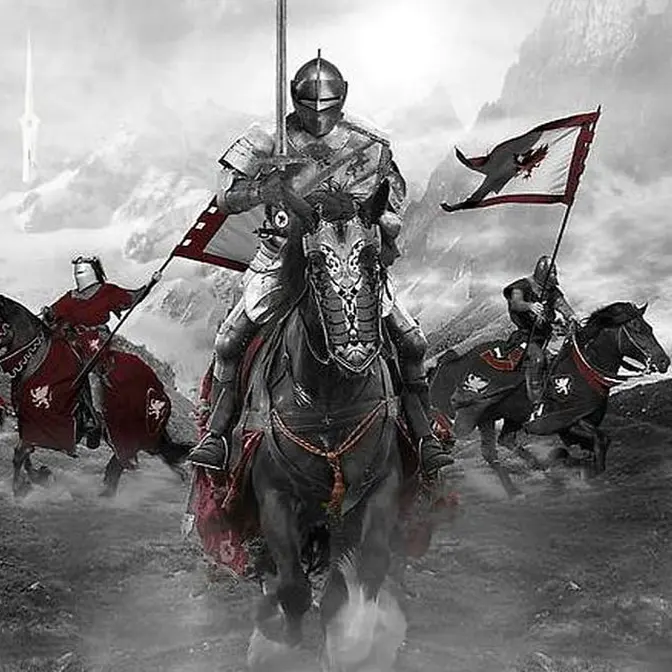
"#RomanEmpire#FallOfRome#AncientRome The fall of the Roman Empire is a pivotal moment in history, marking the end of one of the most powerful civilizations the world has ever known. Although it spanned centuries, the empire's collapse appears rapid when considering its long dominance. A multitude of factors contributed to its downfall, including political instability, economic troubles, and military weaknesses. Internal corruption, heavy reliance on mercenaries, and a series of ineffectual rulers eroded the empire’s strength from within. External pressures, such as invasions by barbarian tribes, including the Visigoths, Vandals, and Ostrogoths, further hastened its decline. The division of the empire into eastern and western halves and the growing influence of Christianity also played critical roles. Despite the empire's vastness, poor governance, dwindling resources, and the inability to manage its extensive borders led to the eventual collapse of the Western Roman Empire in AD 476. The Eastern Roman Empire, or Byzantine Empire, survived for nearly another thousand years, but the fall of Rome marked the end of an era in Western civilization."
The fall of the Roman Empire is one of the most studied and debated events in history,
and the reasons behind its collapse are numerous and complex.
The decline was not a swift, sudden event, but rather a gradual process that took place over
centuries, culminating in the eventual downfall of the Western Roman Empire in AD 476.
Historians have identified a myriad of factors that contributed to the weakening and eventual
collapse of Rome, each interconnected and reinforcing the other, making it difficult
to isolate one single cause. The first factor that played a crucial role in the fall of the
Roman Empire was its sheer size. At its height, the Roman Empire spanned vast territories covering
parts of Europe, the Middle East, and North Africa. Managing such a large and diverse
empire proved to be an immense challenge. The logistical difficulties of maintaining communication,
transportation, and military control over such a vast expanse meant that the empire was constantly
under pressure from external threats and internal instability. The Roman Empire's
administrative structure, although sophisticated, struggled to cope with the demands of governing
such a large territory. Local provinces often operated with significant autonomy,
which made it difficult to ensure the loyalty of provincial governors and military commanders.
The Roman military, which had once been the backbone of the empire's power,
also began to weaken over time. In the earlier centuries of the empire, the Roman legions were
highly disciplined, well-trained, and loyal to the emperor. However, over time, the quality of
the military deteriorated due to various reasons. One of the major factors was the increasing
reliance on non-Roman mercenaries and barbarian soldiers. As the empire expanded, it became more
difficult to recruit Roman citizens to serve in the legions, and the army increasingly depended
on hired soldiers from Germanic tribes and other non-Roman peoples. These mercenaries often had
little loyalty to Rome and were sometimes more interested in personal gain than in defending
the empire. In addition to the internal problems of managing the empire and maintaining a strong
military, Rome faced numerous external threats from invading barbarian groups. Over the centuries,
various Germanic tribes, including the Visigoths, Vandals, and Ostrogoths, put pressure on the
empire's borders. The empire had long been able to repel or integrate these groups, but as internal
problems worsened, it became increasingly difficult to defend the frontiers. The Huns, led by Attila,
also invaded parts of the empire, adding to the strain on the Roman military. The sack of Rome
by the Visigoths in A.D. 410 and the eventual capture of Rome by the Vandals in A.D. 455
were major blows to the prestige of the empire and signaled its weakening power. Political instability
also plagued the Roman empire in its final centuries. The succession of emperors was often
marked by violence, intrigue, and short reigns. Many emperors were overthrown by military coups
or assassinations, leading to a lack of continuity in leadership. The infamous crisis of the third
century, from A.D. 235 to A.D. 284, saw a rapid succession of emperors, many of whom were military
leaders who seized power through force. This period of chaos weakened the central authority
of the empire and further destabilized the political system. Economic factors were another
key contributor to the fall of the Roman empire. The costs of maintaining the vast empire,
defending its borders, and supporting its large bureaucracy were immense. Rome's economy, which
had been built on conquest and plunder in its earlier years, began to falter as expansion
slowed and the empire reached its territorial limits. The heavy taxation required to support
the government and military placed a significant burden on the population, leading to economic
decline and social unrest. Inflation became a major problem as the government debased the
currency by reducing the silver content in coins, which caused prices to rise and further eroded the
value of money. The Roman economy was also weakened by a decline in agricultural productivity.
The agricultural system, which had been the backbone of the Roman economy, began to deteriorate
due to overuse of land, a declining workforce, and invasions that disrupted farming.
Many large estates or latifundia relied on slave labor, but as the empire stopped expanding,
the supply of slaves dwindled, leading to labor shortages. The depletion of soil and poor
agricultural practices further exacerbated the decline in food production, leading to famine
and hardship for much of the population. Social factors also played a role in the collapse of the
Roman Empire. The growing gap between the rich and the poor created significant social tensions.
The elite class, which controlled much of the wealth and political power,
became increasingly detached from the needs and concerns of the common people.
Many wealthy Romans withdrew to their estates, leaving the cities to decay and the urban
population to suffer from poor living conditions and lack of opportunities. This growing inequality
contributed to social unrest and made it more difficult for the government to maintain control.
The rise of Christianity is often cited as another factor in the fall of the Roman Empire,
although its role is more controversial. Christianity, which became the official
religion of the empire under Emperor Constantine in the early 4th century,
brought significant cultural and social changes to Roman society. The Christian Church became a
powerful institution in its own right, sometimes challenging the authority of the emperor.
Some historians argue that the focus on spiritual matters and the afterlife led to a decline in civic
duty and loyalty to the empire, while others believe that Christianity provided a unifying
force during a time of crisis. Regardless of its exact impact, the rise of Christianity marked a
significant shift in Roman culture and values. Another contributing factor to the decline of
the Roman Empire was the division of the empire into eastern and western halves. In AD 285,
Emperor Diocletian divided the empire in an attempt to make it more manageable, while the
Eastern Roman Empire, later known as the Byzantine Empire, would survive for nearly another thousand
years. The Western Roman Empire faced increasing challenges and eventually fell. The division
created two separate centers of power, which sometimes competed with each other and weakened
the unity of the empire as a whole. The Eastern Empire, with its capital in Constantinople,
was wealthier and more defensible than the Western Empire, which was more vulnerable to
invasions and internal decay. The eventual fall of the Western Roman Empire in AD 476
is often symbolized by the deposition of the last Roman emperor, Romulus Augustulus,
by the Germanic chieftain Odoacer. However, by this point, the empire had already been in decline
for centuries, and many of its institutions and structures had eroded. The fall of the Western
Roman Empire did not happen overnight, nor did it mean the complete collapse of Roman civilization.
Many aspects of Roman culture, law, and governance continued to influence Europe for centuries to
come, especially in the Eastern Roman Empire and in the form of the Roman Catholic Church.
In conclusion, the fall of the Roman Empire was the result of a complex combination of internal
and external factors. The vast size of the empire made it difficult to govern and defend,
while political instability, economic decline, and social inequality weakened its foundations.
The deterioration of the military and the increasing reliance on mercenaries left the
empire vulnerable to invasions by barbarian groups. At the same time, cultural and religious changes,
such as the rise of Christianity, transformed Roman society. The division of the empire into
Eastern and Western halves further fragmented the empire and contributed to the eventual fall
of the Western Roman Empire. The collapse of the Roman Empire was not a sudden event,
but rather the culmination of centuries of decline and decay.