
Trip to Egypt Vlog 6: Abu Simbel 🤴🏽
Wait, first you go.
That's it Vinny, stay minimum, take advantage.
Oh, what a beautiful style.
There it is.
It's true, how beautiful.
Oh, wow.
Wow.
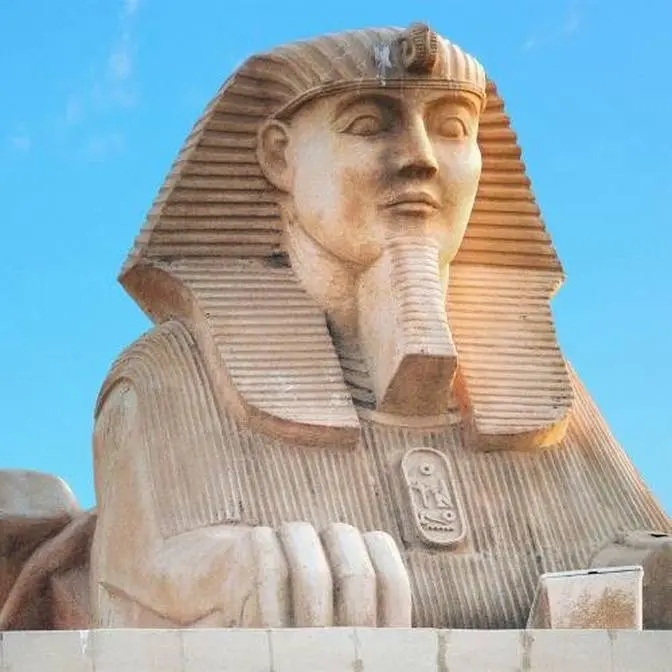
These temples, people, seriously, these temples of Abu Simbel, the one of Pharaoh Ramses II and the temple of Nefertari,
are perhaps the most beautiful and impressive of all of Egypt.
Seriously, I was speechless and I was very, very, very amazed the first time I saw the two temples from the outside.
And once I entered, wow, seriously, it was another experience.
They are impressive, they are beautiful.
Seriously, you wouldn't believe it when you see them.
It's an excursion that usually always has an extra cost.
When they do tours in Egypt, then definitely, please, take that extra, pay whatever is necessary,
but go and see Abu Simbel and the temple of Nefertari, because seriously, it's from another world.
It's one of the most impressive and most beautiful temples in Egypt, so it's really worth seeing it.
Because for this, you have to travel from Aswan to Abu Simbel, which is a 3.5 to 4-hour tour.
So you have to leave very early in the morning to arrive just when they open the temple
and have a free time in which all the other tourists arrive.
Because this temple is full of people very, very, very quickly.
By noon, it's full of people, you can hardly walk being inside their corridors.
And honestly, it's really worth it.
Fortunately, our guide told us to arrive very, very early to be able to enjoy the temple in a freer way,
without so many people.
Precisely, as we were seeing at the beginning of the video, at the entrance, there weren't a lot of people.
But by the time we were in the temple, it suddenly started to fill up a lot
and we almost couldn't walk among all the people there were.
So, well, the recommendation is to arrive early and definitely visit Abu Simbel.
Now, talking a little bit about this temple,
Abu Simbel's rescue operation was due to the call that UNESCO made
to all the member states to collect their help for the rescue of the Nubia monuments.
This, as I had already commented in the previous video,
when we talked about Philae, which had the same fate,
in which, due to the waters of the Aswan dam, which were flooding and reaching dangerous levels to the temples,
they had to dismantle all the temples by very large blocks
and rebuild them in safer areas where the waters of the Nasser lake would not affect them
and the Nile would not rise so much to, you know, to **** up all the temples.
While the dismantling operation was being carried out,
an attack had to be built because the elevation of the Nasser lake waters had already begun.
The gigantic construction game was completed with total success
and the re-settled temples were officially inaugurated on September 22, 1968.
The temple was built in such a way that twice a year,
when the rising sun appeared on the horizon on the edge of the Nile,
its rays penetrated through the door,
projected through the large eight-column room in the shape of the Colossus of the Pharaoh,
the second columned room, the vestibule and the sanctuary,
and it gave this ray of light to the four statues of the niche in the back that lit up completely.
The statues represented the three important state gods of the Ramesside period,
which were Ptah, Amun-Re and the Heliopolitan god Rahorakti.
The third figure was the Pharaoh himself.
The great temple of Abu Simbel testifies to the deification in the life of Ramses II,
with scenes that show the Pharaoh performing some rites before the sacred boat of his divinized being.
And since this pharaoh went crazy with the constructions,
and he wanted to make sure that his legacy was all architectural,
he decided to build a thousand statues of him, a thousand obelisks in his name,
a thousand representations of him being a divinity next to the neters,
of the gods, as they currently call them.
So he just wanted to build, be represented,
and obviously he left us jewels throughout all of Egypt.
He left us many jewels that we can still enjoy today.
The reliefs of the great hall show scenes of historical or symbolic character.
In the long septentrional wall is the battle of Kadesh in Syria,
and on the southern wall, some wars carried out in Syria, Libya and Nubia.
The temple of Nefertari, which is also contemporary and is dedicated to Hathor of Ishbek,
and obviously also to the wife of Ramses, who was Nefertari.
On the facade there are six colossi standing, about 10 meters high,
excavated on the same rock.
Four represent the pharaoh and two the queen,
each flanked by princes and princesses.
On its floor, the small temple of Nefertari is a minimized version of the large one of Ramses II.
So both are beautiful.
Honestly, it is very worth visiting.