
Serapeum Secrets: what was really inside the 100 ton machined boxes?
AI GeneratedMay contain errors
Conventional archaeology propagates the notion that the further we look back into history,
the more archaic the civilizations were and the more inferior their methods of construction. Yet
all over the world are megalithic marvels that were engineered with an ancient lost technology
that confound today's experts that defy our greatest modern engineering and tell us a
different version of history. Case in point, the colossal boxes of the Serapeum of Saqqara.
The Serapeum is one of the most enigmatic ancient sites in all of Egypt, if not the world. For this
is where one of the greatest discoveries ever made on earth took place. Lost under the sands
of time, this labyrinth was rediscovered in 1850 by French Egyptologist Auguste Mariette,
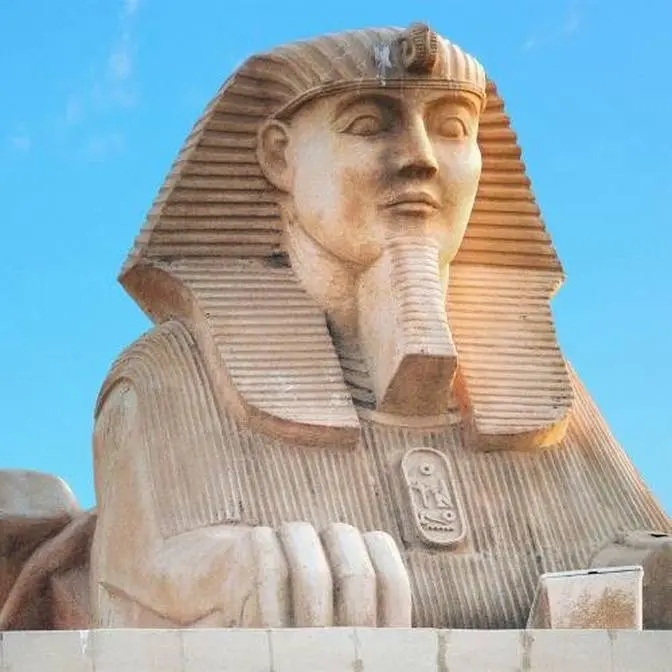
who first found a sphinx head emerging from the sand. After clearing the sand away, he began to
find hundreds more sphinx statues and heads, some 300 plus in all, that had been set up to create an
avenue leading to the Serapeum entrance. Now Serapeum means the place of Serapis. This word
Serapis is a Greek word derived from the ancient Egyptian name for the Apis Bull, which is derived
from the words Osiris and Hap or Asur Hap, which morphed into Serapis, the sacred Apis Bull.
More on this in just a bit. Now today, if you are at this area of Saqqara and you are
approaching the Serapeum, it does not appear that there is a whole lot to see
from the surface ground level, but that's because the real wonders are hidden underground.
As you descend down the steps that lead under the limestone bedrock, you come to two large iron
doors. And once you pass through these doors is when reality starts to smack you upside the head.
As you pass through the iron doors and enter this secret subterranean wonder,
you are immediately greeted with this massive granite block that weighs about 28 tons.
And as you gaze closer, like I did in this video, you can see this piece was made to actually be a
lid to a much larger box. And this lid features this giant protruding squared nub on one end.
And as you go around this lid, you can see the striations
and ancient cut marks all over the lid. Now it's clearly in an unfinished state.
So one of the big questions is why is it in an unfinished state?
Well, we'll definitely try to answer this question later in this video.
Now, as you move past this lid, you begin to realize that you are in a large tunnel system
that although very, very ancient, appears to have almost perfectly curved ceilings like that of a
modern day subway tunnel. According to Egyptologist and author Mohammed Ibrahim,
these tunnels were originally covered with sheets of gold or some type of connective
material. Therefore, it was like a shiny metal tube in ancient antiquity.
As you make your way deeper into the tunnels, you begin to see these enclosures or rooms
that run in a staggered pattern along each side of the tunnels. Now, these rooms feature
vaulted ceilings. And in some of these rooms, you can still make out how they probably looked in
as there are still some vertical slats of material left that used to fully cover the
entire limestone ceiling and the enclosure itself. The point is the original enclosures
don't look how they do today. They were in this finished state with these vertical slats of
material lining each enclosure. Now, what is incredibly remarkable is how these enclosures
or crypts, as some call them, are cut below the level of the tunnel floor itself, meaning that
there is a drop of several feet from the main tunnel floor down to the bottom of the crypt
floor. Now, why this was necessary has long been a mystery. And as author and engineer Christopher
Dunn points out, installing these megaton boxes would certainly have been less difficult
if the crypt floor was on the same level as the tunnel floor. So why did these ancient engineers
of these enigmatic subterranean vaults and these boxes they placed in them make it harder for
themselves by going through all of this extra work to cut the rooms or the crypts way below
the tunnel floor? Now, as you get close enough to peer inside the enclosures or even go inside of
them like I have, you notice that the colossal boxes are centered inside the crypts and they're
also centered and installed into an extra recess in the bottom middle of the floor. So that's an
extra important detail to note. So in this subterranean labyrinth are these 24 boxes,
and most of them appear to be black or this darkish green. And on average, these 24 boxes
measure approximately, get this, 13 feet long, about eight feet wide, and they stand about eight
feet high. Now, these were crafted with laser-like precision and each box weighs approximately
70 tons. There's some that are even a little bit bigger than that, but they also have a matching
lid that's about 30 tons on average that was cut from the same piece of stone. Okay, so in total,
we are talking each box with its lid is approximately 100 tons. Some of them are less
than this. Some of them are more than this. And again, each lid was cut from the bottom side of
matching box. All right, let me hit the pause button here for a minute and tell you what the
mainstream narrative surrounding these boxes is. And then I will present a series of problems or
conundrums as I call them, which I believe debunk the mainstream theory in my humble opinion. And
then I will end this video sharing a possible alternative theory concerning the true purpose
of this amazing tunnel system and these boxes. All right, so let's talk about the mainstream
theory concerning these boxes. And you'll find this mainstream theory if you Google about the
Serapim of Saqqara or if you jump on ChatGPT and ask it about the Serapim boxes. This is
pretty much what you're going to find what I'm about to say here. The mainstream theory states
that the subterranean Serapim of Saqqara was made and used approximately from 1400 to 30 BC
as an animal catacomb or a burial place for sacred bulls. That is the sacred bulls of Apis,
which was this ancient cult at Memphis, Egypt. These Egyptians believed that the bulls were
incarnations of the god Ptah, which would become immortal after death as Osiris Apis,
a name which evolved into Serapis. Now mainstream Egyptologists will state that these dynastic
Egyptians who are of the New Kingdom period simply carved this vast limestone labyrinth
basically by hand with manual tools, with chisels and with hammers. Now, as I will break down in
just a minute, most of these boxes in the Serapim are made of rose granite. The only place you can
find a rose granite like this with quartz inside of it in Egypt is in the Aswan quarry, which is
500 miles away from Saqqara, from the Serapim. And then at some point the lids were cut off of
them and they were fashioned with laser-like precision using softer copper chisels and
hammers. And then an army of men lowered these huge boxes into the tunnels where they used some
winches, rollers and levers. And then to lower them into their final position way down inside
the enclosures, they first filled the enclosures up with sand to the level of the tunnels and then
pushed the boxes in on top of this pile of sand. And then once the box was sitting there level on
top of the sand, they just began to magically pull the sand out to where it dropped down. And
then when the box was ready, they would open the 30-ton lid and they would place their sacred
Apis bulls inside. And if you look into the Apis bull cult, they would have burial ceremonies
that were said to have lasted for like 70 days. The bulls were embalmed for 68 days.
And in the last two days, a series of funerary processions were held and the final one terminated
inside the Serapim. It should also be noted that when you look at the mainstream theory,
when it comes to dating the boxes again, they usually state that the oldest boxes date to
Amasis or Amasis the second, who reigned around 550 BC. Okay, so now that you've heard the
mainstream theory, let me present to you what I believe are several holes that I and many others
see in this theory. And then I'm going to get to the fun part where I am going to share the most
amazing, incredible data points about these boxes that you may have never heard before.
And then I will conclude with an incredible possible alternative theory concerning the
true purpose of these boxes. Okay, first let's talk about the distance and transportation
problem or conundrum. And I kind of hinted at this while sharing the mainstream theory.
So first we have this conundrum about distance and transportation. Now, like I said,
most of the granite boxes came from the Aswan quarry over 500 miles away, a 10 hour plus car
drive. When's the last time you went on a 10 plus hour car drive? That is a long road trip. Now,
have you ever seen a semi truck on the highway or freeway carrying one of those wide loads,
like a double wide mobile home? They always have a smaller truck behind them and in front of them
with yellow lights, it says alert, warning, wide load coming. And it's often like this double wide
mobile home, right? Now I ran some stats just to give us some perspective. A double wide mobile
home weighs max 20 tons. We're talking about 100 ton boxes here each. Now in the US, the max legal
weight that one of these 18 wheeler semi truck tractor trailers can carry, get this, is 40 tons,
four zero, 40 tons. Again, we're talking about 100 ton boxes. Now, some of you might be screaming
at the screen right now saying, well, that's because they didn't transport them on land.
They transported them on the Nile. Now I've been to Egypt multiple times. I've sailed the Nile.
I've been to the Aswan quarry. I've been to Saqqara and the Serapeum. And it's important
to note a couple things. This Aswan quarry is at least one mile from the Nile river. Okay.
Now, once you sail back up the Nile to the Saqqara area, guess how far the Serapeum site is located
from the Nile? About seven miles. My point is there was still land transportation involved here.
Consider with me for a minute, how they got this 100 ton block off land onto their wooden boat,
and then from the boat back onto land before transporting it seven miles to the Serapeum.
Now, today we place cargo onto ships using these huge industrial cranes that can lift 100 tons,
500 tons. They can easily even lift a thousand tons, these modern day super industrial cranes
that we've got at our biggest ports. So how would these dynastic Egyptians of about 2,500 years ago
load and unload these 100 ton boxes on and off their boats without machines? Because the mainstream
laughs at the idea of ancient machines, right? The point I am trying to make here is they
somehow had to move 100 ton granite boxes 500 miles away, whether it was land by sea or both
from the Aswan quarry to Saqqara. That was a big deal. Now let's talk about the light and oxygen
conundrum. Now the mainstream Egyptologists want us to believe that these dynastic Egyptians
carved this vast, huge tunnel system basically by hand. Well, it would seem that this would be
impossible to do with manual hand tools when you consider the nature of limestone.
What do I mean? When you hack into limestone with manual hand tools, like a chisel, like a hammer,
it creates this dusty powder, which is like a sticky cement. Today we call it limestone powder
and it's actually used today in the cement industry and for many purposes. The big takeaway
here is that these supposed Serapim workers who were chiseling away deep into the dark recesses
of these tunnels would probably have died fairly quickly from inhaling this dusty powder into their
lungs with hardly any ventilation. Now these dynastic Egyptians would also need light underground
and would have had to use torches or candles to see inside the pitch black tunnels. Yet there's
no evidence of smoke markings from flame light on the low tunnel ceilings. Add to this that if
they did use candles and torches while they were hacking away with their chisels and hammers,
I believe this would have sucked even more oxygen probably out of the tunnels. Now let's talk about
the space conundrum or problem. Now it is estimated by some that these 100 ton boxes would
need at least 2,000 men to transport them. That is a literal army. But let's be conservative here
and take the average weight of these boxes, which is 100 tons, and then look at the maximum pushing
force. According to ChatGPT here, a maximum pushing force is short bursts with no wheels.
What do laboratory tests show the average man can exert or push continuously? And this says up to
110 to 130 pounds for brief moments. Okay, so if you kind of take that data,
I've heard at minimum they would need at least 250 men in these tunnels pushing,
and that's probably with the help of some kind of levers, ramps, rollers. Okay, so great,
but the problem we have is that these tunnels are only about two feet wider than the boxes
themselves. So how would there have been enough space inside for even 250 men to push these
megaliths to their final resting places inside the crypts? Now, as you can see here in one of
the tunnels, there is this unfinished box that appears to have literally been stuck in time.
It's as if the box was in the process of being transported into the tunnel towards its final
resting place when something suddenly happened, causing production to immediately halt. Okay,
this is one of the other million dollar questions regarding the Serapion. What happened? Obviously,
I believe it was some kind of ancient cataclysm that struck in seconds. Now, as you can see,
as I approach this box stuck in the hall, there is only enough room for really one person to
squeeze by on the one side. Again, no space for 250 men to push this box down the hall. And then
again, we have the other problem of how do they lower these multi-ton boxes from the main tunnel
floor down into the enclosure or the crypt, as I don't buy their sand fairy tale for a second.
All right, finally, let's get to the precision conundrum. Now, again, there's 24 boxes in the
Serapion. Of these 24 boxes, there's one I believe made of limestone, and the other 23 are all made
of granite or granodiorite. Both granite and granodiorite are extremely hard materials,
ranking between a 7 or 8 on the Mohs scale of hardness, with diamond being a 10 on the Mohs
scale of hardness. And this isn't your average granite. This is rose granite from Aswan,
which has between 20 to 60 percent quartz, I believe. So it makes it incredibly hard.
Now, according to the archaeological record that the mainstream Egyptologists use,
the dynastic Egyptians of about 2500 BC, the tools they used were copper chisels and stone
hammers. Now, copper, back to the Mohs scale, is rated a 3 on the Mohs scale of hardness. And
remember, the rose granite and the granodiorite is about a 7 or 8. So how would these dynastic
Egyptians have been able to craft these extremely hard boxes? Again, I hate to use the word
laser-like, but with incredible laser-like precision with softer, archaic hand tools.
Have you ever cut up a cucumber? Cutting a cucumber with a stainless steel kitchen knife
is easy because the knife is a sharper and harder material than the cucumber. Stainless steel is
about a 4 on the Mohs scale of hardness. But have you ever tried to cut through a thick piece of
granite with a stainless steel knife? You might be able to scratch the granite. After many hours
or days of sawing back and forth, you might be able to make a slight indention in the granite,
but you will never be able to cut through the granite, let alone precision shape the granite
with a steel knife. Why? Because the tool is a softer material than the object. This same
principle holds true in the ancient world. The dynastic Egyptians of 2500 BC could not have
precision shaped granite, which ranks a 7 on the Mohs scale of hardness, with diamond being a 10
when they had softer copper chisels and hammers, according to the archaeological record,
which rank a 3 on the same Mohs scale. Likewise, the Inca of the 1400s and 1500s in Peru
could not have precision shaped the granite and andesite there, which ranks a 6 or 7 on the same
Mohs scale, with diamond being a 10, with their softer copper chisels and hammers, which rank a
3 on the same Mohs scale. Now on four of these serapion boxes can be found hieroglyphs on the
outside exterior. And these hieroglyphs, when you look close, are crude looking. They do not
match the precision of the boxes themselves. So like graffiti, it appears that they were scratched
and etched into the boxes much later by the dynastic Egyptians, who I believe found them
already resting in place. All right, so now let's talk about some of the most incredible aspects
concerning these boxes and what their true purpose might have been. Which, spoiler alert,
I believe points towards energy production when we start to consider the following. Now, as I
stated earlier, this rose granite that most of the boxes are made of contains 20 to 60 percent quartz.
So according to Muhammad Ibrahim, Egyptologist, that makes this rose granite kind of like
radioactive stone, which can send and receive waves almost like radio waves. Now when you couple
that with the tunnels and the crypts that are made of the limestone, limestone is highly
conductive material. It's known to absorb negative energy and even air pollution. So limestone can
act almost like an electrical current for granite. So the geology aspect of all of this is very
important and critical when we consider what the original purposes of this labyrinth and boxes were.
Now many of these boxes are in different states of being finished as we'll get into.
On some of the more finished looking boxes on the exterior, you can see these vertical slit lines
that run on the front and sides. And I think these slits have more to do with possibly vibration and
resonance than they do with artistry. Now when the ancient engineers were finishing the box,
it appears that they were covering them with some kind of chemical material, which is why
many of the boxes shine. Many of the boxes have this polished like mirror finish and it's as if
they used a liquid to literally polish the surface. Obviously not all the boxes and lids are identical
as they all have different aspects to them and each one kind of has its own unique look.
But it's important to note several of the lids have the mysterious scoop marks in them.
Why? Now some theorize, and I am one of these, that this is likely because the ancient engineers
who were experts, experts again, masters of geology and stonework, they realized that
some of these lids had developed small cracks near the surface, which if not fixed would expand
eventually when the box began to resonate upon full operation. Therefore they were scooping out
these cracked areas to avoid bigger future problems. Now this scooping step would have
happened likely before the final step, which is probably the polishing step. I say this because
when you look at the scoop marks closely, they are all polished inside just like the rest of the lid's
surface, leading me to believe the scoop happened before the polishing and the finishing. This
brings us to another million dollar question concerning these boxes and the mysteries of
Egypt, and that is how did they do the scoops? What did the tool look like for the scooping?
And did they have the ability to soften stone and scoop the granite out like ice cream?
As you can see inside the boxes, the interior walls are perfectly flat and parallel with each other,
and the corners are all 90 degrees square. Now many have measured the interiors of these boxes,
including author and engineer Christopher Dunn, who did so with his precision straight ledge
and solid square tools. Now the straight ledge tool is precise to within two 10,000 parts of an
inch, that's 0.0002, and Christopher Dunn discovered something amazing. No light was
seen passing through the interface where the steel straight ledge was placed on the granite surface
regardless of how the straight ledge was turned, whether vertically, horizontally, or at an angle.
So as an engineer, Christopher Dunn stated that from a manufacturer's perspective,
this proves the existence of a technologically advanced civilization in Egypt's remote past.
So if you know who Christopher Dunn is, he's a decorated engineer, he's written some incredible
books such as Giza Power Plant, and Christopher Dunn making that statement is remarkable,
that this proves the existence of a technologically advanced civilization
in Egypt's remote past, keyword technologically advanced. Now in light of statements like this
that Chris makes, the skeptics who do not believe that ancient Egyptians were technologically
advanced will ask, so where are the machines? Well as Christopher Dunn points out, we can't
assume that the machines used in ancient Egypt would be similar to and work in the same way
as our modern machines do today. For example, in his book Giza Power Plant, Dunn concludes that the
Great Pyramid must have originally been built to provide a highly technical society with energy.
In short, it was like a large machine, a holistic energy device that was harmonically coupled
with the earth. It was created as this energy harvesting machine that was generating clean power
for their ancient civilization, and by its size and dimensions, it created a harmonic resonance
with the earth and converted earth's vibrational energies basically into microwave radiation.
In the pyramids, numerous chambers and passageways were positioned with deliberate precision to
maximize these acoustical qualities. Now there's another decorated engineer named Arlen Andrews,
and he presents the following argument to critics who demand that the proposed ancient machine tools
be discovered first before admitting that there was manufacturing technologies displayed
at the Serapeum of Saqqara. Arlen states this, quote, let us imagine finding a similar structure
in the future only in the desert of Mars, not Egypt. What would the reaction be? What would
be the most important questions? If those early interplanetary explorers were to come across a
cliffed opening that was the entrance to a long carved tunnel which opened to a series of
enclosures housing incredibly huge black stone boxes weighing many tons, precisely machined
on the inside and situated in the recessed niches, yet having no worker's tools left behind,
do you think that their first reaction would be, where are the machines? Obviously not.
The scientists and engineers report the impressive artifacts, assuming that the application of
machines was a given. They are there. They are massive. They are obviously manufactured. They
are precisely machined because no conceivable human or Martian hand could possibly accomplish
the flatness, the parallelism, or the plethora of other features we have documented unless they
possessed sophisticated guidance mechanisms for cutting tools along with associated metrology
instruments. Our most relevant questions then would be, what advanced civilization made these
monumental artifacts? How did they do it? When was it done? What was the purpose? And most
importantly, where do we go from here with our research? To my mind, present-day researchers
of Egyptian artifacts like those at Saqqara should focus on the available evidence, the boxes.
They are massive. They are obviously precisely machined because no conceivable human hand
could possibly achieve their geometry and exactness without the assistance of precisely
powered machinery. So the relevant questions today are the same questions. What advanced
civilization made these monumental artifacts? How did they do it? When was it done? What was
the purpose? And the most relevant question for today's researchers is, where do we go from here?
Now, as engineer Christopher Dunn points out in his latest book, Giza, The Tesla Connection,
which I highly recommend you purchase, and I'll link to it in the show notes here,
you can walk into any manufacturing plant today and you'll find a product that is in various
stages of production. A rough forging or casting may be seen in one area, and in another area,
a rough forging or casting may be seen in one area, and in another area, the rough forging or
casting will have been rough machined. All of its surfaces may not be required to have the same
texture and precise precision as the final product, but will be left with enough material
for the final machining to remove in order to achieve its required dimensions. The three
finished states of manufacturing to remember when trying to find a reasonable answer to what exists
in the tunnels of the Serapeum are, 1. Rough, as created on site or delivered by the foundry
mill or forge, 2. Semi-finished, as created on site or delivered by the foundry, and 3.
Finished, precisely finished on site. And so it's now been revealed that the boxes in the
Serapeum display all three states of these manufacturing. You can see in the tunnels
there are at least two rough or unfinished lids just lying there, unmovable. There is the one
giant box, unfinished, stuck in the hallway. These are in an unfinished state. And then there's boxes
in the crypts or the rooms that look like they're in a semi-finished state. Some of them are without
lids. And then you see the many boxes with lids that appear to be in a finished state or almost
finished state as they have a much higher order of precision. The big takeaway here is that all
of the evidence indicates that the granite boxes in the Serapeum received their final finish and
calibration after they were placed down into the crypts. The megalithic engineers of ancient Egypt,
they were very advanced in their knowledge of the use of sound and vibration. Therefore,
a possible reason for why it may have been necessary to install the boxes inside the
crypt recesses or niches is that they were subject to vibration. And if not contained,
they might have possibly moved out of position. So this leads us to another question. If the boxes
were stimulated to vibrate, then for what reason? Again, is this pointing to energy production?
Also considering the geometry and the precision of the inside surfaces, Christopher Dunn wonders,
did the inside of the boxes serve as a resonant cavity? Now, in bringing this video to a close,
here are the steps that engineer Christopher Dunn believes the ancient engineers took in creating
the boxes. Number one, specifications were given to the quarry to deliver a piece of granite with
sufficient material left to remove in order to achieve its final dimensions. Two, the granite
was received and brought into the tunnels and received a semi-finished machining. The granite
may be precise to within 0.100 inch with material left for finishing. Three, the boxes were installed
in the crypts prior to final machining. Four, the lids were semi-finished with the exception of the
underside, which is finished flat to a high level of precision. Five, after being surrounded by
water of the correct temperature for an appropriate amount of time necessary for the granite to
acclimate, the top of the box is finished flat with all four sides being on the same precise
plane. And six, an attachment is securely mounted on the top surface and the inside of the box is
precision machined and lapped to achieve the specific finish and tolerances. All right, now
that you've heard all of these incredible engineering data points and alternative theories,
think back to the mainstream theory concerning the boxes of the Serapion. And let me ask you
this question. Could the dynastic Egyptians of 2,500 years ago have discovered these prehistoric
boxes that were made long before, but they found them and they were amazed by them. And so they
repurposed them as sarcophagi for their sacred apis bowls? I think probably so. In fact, I think
something very similar happened in the Valley of the Kings with the largest gigantic tunnels,
which I did a previous video episode on before, if you just search for Valley of the Kings.
So while mainstream Egyptology states that these otherworldly boxes were coffins basically for
mummified bowls, what if there is a deeper meaning and purpose here? As I stated earlier, the word
Serapion means the place of Serapis. It's a Greek word derived from ancient Egyptian name for the
which comes from the words Osiris plus Hap or Osir Hap, which morphed into Serapis,
which was the sacred apis bowl considered to be a son of Hathor. Now, what's interesting
is that there is an ancient Egyptian word known as Bayanbet, if I'm pronouncing that right,
which basically translates as sky metal or iron of heaven. And this refers to meteoric iron.
You see, the ancient Egyptians, they would find and encounter meteorites and they knew the iron
inside of them was very rare and celestial material, and it was stronger than their copper
and bronze, and therefore they believed it had divine qualities. Let's take this a step deeper.
This word Bayanbet means sky metal or iron of heaven. It also refers to the bowl of the sky,
which is the Taurus constellation. The bowl of Taurus was seen as a cosmic force roaming the
And the bowl's celestial symbolism of fertility, order, and cosmic strength was often tied directly
to kingship. The pharaohs were often compared to the bowl of heaven. Was the dynastic Egyptians
worship of the apis bowl around 2500 BC the manifestation of something deeper? Not physical
mummified bowls, but the iron bowl of the sky. Might this word Bayanbet hint that one of the
original functions of the granite boxes was not to house physical dead bowls, but to house the
celestial iron bowl of the sky? Iron meteorites that fell from the constellation Taurus, magnetic
iron. Were asteroids placed inside the boxes? And it's interesting to note that one of the
ancient Egyptian symbols used to spell the apis bowl is the chevron symbol, which looks like an
upside down V, which strangely looks identical to the massive chevrons that make up the original
entrance to the Great Pyramid. Actually, one of the ancient names for the Great Pyramid is
Bull Mountain or Taurus Mountain, depicted by the apis bowl with two chevrons. I'm trying to bring
this full circle here. Was the serapium originally functioning as some type of holistic energy plant
or inside these colossal boxes were iron meteorites? Again, considering the geology of
granite, of the limestone combined with iron, were these boxes operating like some kind of
giant batteries that were creating radioactive energy? Now, at some point in the ancient past,
some theorized around 10,500 BC, possibly in connection with the Younger Dryas impact
in cataclysmic events. At some point, far back, longer than we know,
were the ancient engineers moving this unfinished box through the tunnel towards its enclosure
when suddenly a massive cataclysm struck that immediately halted production. Egyptologist
Muhammad Ibrahim theorizes that maybe the pulse from an electromagnetic wave from a solar disaster
swept through the area and immediately through the tunnels and froze all the tech.
Everything went dark, similar to if we had an EMP blast go off over America.
Well, I hope you enjoyed this video. If you did, please subscribe to my channel,
leave a comment, let me know you enjoyed it,
and share this with as many friends as possible. Until next time, keep exploring.