
Decrypting the Secret Hieroglyphs: the Pyramid of Pepi II I SLICE HISTORY | FULL DOCUMENTARY
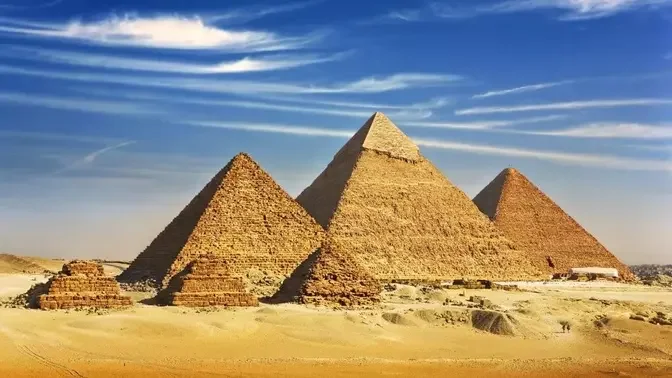
Just kilometres south of Cairo, at the gates to the desert, sit the majestic pyramids,
testimony to the golden age of ancient Egypt.
All these amazing monuments were erected over a 500-year period, referred to by Egyptologists
as the Old Kingdom of Egypt.
Thirty pharaohs from four successive dynasties.
To understand this civilisation, archaeologists search the sands and decipher the vestiges
of bygone days.
This vast expanse is home to hundreds of open-air graves, the Memphite Necropolis.
The Memphite Necropolis is several tens of kilometres long and has been densely occupied
over its entire length.
So there are thousands of graves, dozens of pyramids.
I think there are 120 or 130 known pyramids today.
The Memphite Necropolis alone includes several necropolises built over more than 3,000 years.
From the Plateau of Giza in the north to the Fayyum Oasis in the south, this desert territory
of 1,300 square kilometres contains the famous Great Pyramid and the pyramids of Khafre
and Mankore.
These symbolic monuments are the most visible vestiges, but they contain few clues to the
lives of the pharaohs and their belief in an afterlife.
Further south, 20 kilometres from these iconic pyramids, lies a treasure that's fundamental
to understanding the first dynasties.
From the vast Saqqara Necropolis, one monumental construction in particular catches the eye.
Its atypical architecture fascinates archaeologists as it represents the cradle of ancient Egyptian
construction.
It is here that the Egyptians built the very first pyramid, to the north of the largest
necropolis in Egypt.
For close to 5,000 years, this monument, the oldest elevated construction in human
history, has stood proud of the Sandyans.
This step pyramid is the tomb of the pharaoh Juzair, first king of the third Egyptian dynasty.
This pyramid has a particular shape because it aims to express the pharaoh's divine eternal
dimension.
One of the theories says it was a magnificent ladder leading to the sky, because Juzair,
after his physical death, was supposed to join the divine sphere that was located on
the sky.
This monumental construction was revolutionary for the time, because initially, the pharaohs
used it to construct rectangular funerary buildings, some as big as 40 metres long
and 12 metres tall.
This parallel pipe-shaped structure is a mastaba.
It covers the royal burial chamber for eternity.
A mastaba is a tomb.
The name comes from the Arabic for bench, so in fact it's something rectangular with
slightly sloping faces.
The main characteristic of mastabas is invisible from outside.
It is a huge shaft hidden at the heart of the construction.
The shaft can be up to 15, 20 metres deep, and at the bottom is a chamber that can be
big or small, more or less developed, more or less complex, in which you find the sarcophagus
of the deceased.
Pharaoh Juzair wanted to stand out from his predecessors and assert his authority.
To that end, he called upon a visionary architect, the legendary Imhotep.
The project he put forward would revolutionise the architecture of Egyptian civilisation
forever.
The brilliant Imhotep had the idea of adding to this mastaba, to its rectangular base,
a second rectangular base, and then a third, a fourth, etc., until it formed a pyramid,
a step pyramid, in fact, and that is how the idea of the pyramid was born.
The dimensions of the first pyramid ever created are spectacular.
Its base measures 109 metres across by 121 metres in length.
Stacking six quadrilaterals raises the building's summit to 62 metres.
Never before had a monument reached such a height, an unthinkable structure for its
time.
It's an enormous revolution because it must have constituted a multiple of the amount
of resources that went into creating a royal monument.
It's altogether larger than anything that went before, and it's built of stone and not
of brick, as the earlier ones were.
The first pyramid is really the step pyramid of Juzair.
Although archaeologists were able to unravel the mysteries of this millennial construction,
they found no hieroglyphic engravings on the walls of the burial chamber, nothing to send
them back 5,000 years with keys to understanding this vanished civilisation.
But at the end of the 19th century, an Egyptologist's intuition led to an unprecedented discovery.
The year was 1880.
Contrary to other researchers, the young Gaston Maspero believed that the still unexplored
pyramids housed texts carved in stone.
Even Auguste Mariette, father of archaeology, didn't subscribe to that unlikely theory.
His student, Gaston, dug in his heels and moved heaven and earth to organise an expedition.
In 1880, Gaston Maspero, a Frenchman, became the director of the Egyptian Antiquities Service,
and he wanted to increase knowledge about pyramids.
He had the French government give a small amount of money to Auguste Mariette for his
digs on the express condition that he explore the pyramids of South Saqqara.
The pyramids of the Necropolis of Pharaoh Pepi I, built some 300 years later, south
of Saqqara, revealed information so precious to archaeologists as to forever change our
understanding of ancient Egypt.
In the winter of 1880, Heinrich Bruch, archaeologist and friend of Auguste Mariette, arrived.
Heinrich Bruch explained that he wormed his way inside these pyramids, because everything
inside had collapsed, the corridors, and there, at the end of the corridor, magnificent, he
sees walls covered in hieroglyphs, practically all collapsed.
Some of these pyramids had texts, and this was the first discovery of the pyramid texts.
This major revelation in the history of Egyptology was a heads up to researchers everywhere.
For the first time, archaeologists, through these texts, had direct access to the thoughts
and beliefs of the pharaohs of ancient Egypt.
Today, close to 150 years after this amazing discovery, 15 researchers are still hard at
work on Saqqara's southern site.
In all, 11 pyramids with texts have been unearthed.
Together they constitute humanity's oldest corpus of religious texts.
Religious texts that were found in the pyramids were unique and brand new to scholarship,
and they remain the largest group that's known from that sort of period anywhere in the world.
These are not the first texts found in Egypt, other texts predate these.
Even in Mesopotamia, we have much earlier texts too.
There are older texts, but they're bookkeeping accounts, tablets saying so many sacks of
wheat equal so much.
The purpose of the sacred pyramid texts is to ensure the pharaoh's survival in the afterlife.
Previously, they were inscribed on papyrus, but that didn't withstand the ravages of time.
We had to wait until the ancient Egyptians engraved them in stone for them to reach us
4,300 years later.
It means we have something solid to go on, because these texts tell us about the religious
world of the ancient Egyptians.
It's absolutely breathtaking.
The largest collection of texts was found in the pyramid of the powerful pharaoh, Pepi I.
Pepi I was the second king of the 6th dynasty.
He ruled about 2300 BCE for about 50 years, and he had the most complete pyramid complex
of his period.
So it was here, at the heart of what was once a majestic necropolis, that the first pyramid
texts were found, within the burial chamber of Pharaoh Pepi I, to be precise.
Since that amazing discovery made by the pioneers of archaeology, this site has become a formidable
laboratory, bristling with high-tech tools.
They help us to understand the constructions that protected the royal family and their
precious sacred texts.
But how, with simple resources, did the engineers of the time manage to build this complex with
such a high degree of precision?
Almost a thousand years before the Iron Age, the Egyptians were already erecting extremely
complex buildings.
Compare to ourselves the day when we have lots of tools available.
Back then, the tools were fairly rudimentary.
They had ropes, they had sticks, but they achieved such precision with the few tools
at their disposal.
The burial chamber is dug in a large pit.
They had to make a box within the pit and seal the walls to prevent the upper elements
from collapsing inside.
Stools were raised to secure the structure, a key step that prevented sand from entering.
Then the walls themselves are assembled by high-grade limestone slabs such as Tura limestone.
The sacred texts are engraved on these precious limestone slabs.
To access them, you must walk along a 25-metre corridor before you come to the chamber, located
eight metres underground.
The only team of archaeologists authorised to enter these pyramids is headed by Philippe
Colombert.
For almost 30 years, he has explored the myths and beliefs of ancient Egypt.
The first time we entered, we came down this way.
For the Egyptians, it was the opposite, because the king would take the opposite path from
inside.
He would leave his sarcophagus and take this path which would take him right up there.
The orientation and the angle of the corridor were carefully thought out by the architects
of the time.
As in all the pyramids, the opening faces north towards the pole star.
The pole star is a star that remains in the sky all the time.
It never descends below the horizon.
And we also have a whole series of stars called circumpolar stars that remain around the pole
star and never disappear below the horizon.
He told Egyptians to leave the horizon is to die.
So what he wanted to do was join these stars that the Egyptians in fact referred to as
the indestructibles.
Ensuring the pharaoh's eternal life was the absolute priority for the Egyptians of the
time.
The structure of the pyramid and the scriptures it contained contributed to achieving that
objective.
From corridor to burial chamber, hieroglyphs cover the walls from floor to ceiling.
So here we are in the king's burial chamber with a sarcophagus in which the king was to
rest and he's surrounded by all these texts which are called the pyramid texts because
they were found in the pyramid and whose purpose is to help the king survive in the afterlife.
These hieroglyphs were magic spells at the pharaoh's disposal to help him leave the
sarcophagus and begin his journey.
For example, here we address the king directly and say, arise O Pepe, and thus he will be
able to start his journey to heaven.
These spells are in fact a practical guide.
They allow him to obtain the keys to other worlds, to feed himself and to endure ordeals.
There are of course magic formulas to ward off scorpions, snakes, any pests that can
stand in his way.
In the cannibal spell, the king appears and he eats all the gods and goddesses.
And there are very bits that seem almost humorous in this text where it says he has the little
ones for breakfast and the big ones for lunch and the old ones barbecued for dinner.
In all, 651 spells cover the pharaoh's burial chamber.
Though not evident at first glance, all the hieroglyphs are turned towards the sarcophagus
to favor their interaction with the sovereign.
The common goal of all these spells was to provide the king with a sort of manual how
to reach the afterlife, how to merge with the divine sphere of the world, how to meet
the gods of ancient Egypt.
These ancestral formulas come from the various stories, tales and beliefs that Egyptians
have passed down from generation to generation for thousands of years.
Here we have almost direct access to what the ancient Egyptians thought around 2300
BC, but even more because these texts were engraved in a time of Pepe I, when invented
long before.
So we even come to a time that reminds us of elements of Egyptian religion before the
time when writing even existed.
Through these texts, the Egyptologists managed to immerse themselves in the thoughts of the
time.
But for that, we must observe the hieroglyphs more closely.
All these signs are actually capable, according to beliefs, of coming to life.
Some hieroglyphs are therefore mutilated so as not to endanger the king.
For instance, here we have this little elephant.
An elephant can become a dangerous animal.
To prevent this hieroglyph magically attacking the king, they plastered it.
You can see the elephant's hindquarters have been plastered to prevent it from moving around
in fact.
They actually masked two parts of the elephant, its hindquarters and also its trunk.
Other animals suffered the same treatment.
The pharaoh was thus protected from misfortune, but must also be protected from outside attacks.
The pyramid was designed as a veritable fortress to protect the pharaoh and his sacred texts,
essential to the soul's survival in the beyond.
During their excavations, archaeologists uncovered an ingenious system intended to repel any
attempt at intrusions.
Computer-based image analysis has confirmed the presence of harrows.
A harrow is a dam system often made of hard stone like granite.
Granite was one of the hardest known rocks at that time.
The harrow system weighed more than 14 tons, or the equivalent of three elephants.
The architects had designed a passage with three granite harrows.
These are granite walls and just above are harrows that are raised up but that should
come down and block the passage for eternity.
During construction, the harrows are held in place with the aid of stays.
Once the pharaoh's grave is installed at the heart of the pyramid, the stays are withdrawn.
The granite blocks then seal the corridor forever.
It's impossible to drill through them.
Yet the harrows didn't halt the progress of looters, the ones responsible for the destruction
of the texts.
Obviously, the thieves couldn't care less and went through the limestone walls from
the outside.
They made a detour around these granite walls.
Our researchers, working out how the looters got to the heart of the pyramid, provided
clues to the damage they caused.
To revive the site, the archaeologists would rely on new tools at the cutting edge of technology.
Before, we'd take a sheet of water paper and paint watercolors, etc.
It had freezed the idea but no more.
Today we have new technologies like photogrammetry to support our imaginations.
Photogrammetry can turn thousands of photos into a 3D model.
For the first time, researchers will use this method over 40 hectares.
It's a technique that can throw up new clues and unearth the secrets of the reign of Pepi
I and his dynasty.
The surface that the archaeologists wish to model in 3D is gigantic.
The only way to cover such an expanse is to take a step backwards and upwards, up
to more than 300 meters altitude, to finally take in the whole of the site.
The researchers called upon an archaeologist specialized in photogrammetric reconstruction
along with a drone pilot.
We'd like to cover this kind of area, like 24 hectares at 70 meters high.
So it will be a resolution of about 2 centimeters.
To achieve such a degree of precision, the drone will need to take thousands of snaps
at a frantic rate.
Every nook and cranny of the necropolis must be photographed.
The drone will cover this surface, much like a farmer plowing his field, progressing steadily
and taking photos at regular intervals.
In order to obtain the best possible results, flights and photographs are entirely automated.
Maybe on that area with the necropolis.
After an initial sweep at 70 meters, the archaeologists decided to program a second.
This time the drone will fly closer to the ground, at an altitude of 30 meters, to boost
the precision.
It will carry on its way and each time it moves like that, it will take a photo.
The photos will follow each other and have areas of overlap.
This is how we create a digital model of the terrain, upon which we then reapply the photos
to give an ortho image, rather like a satellite picture, but with much greater resolution.
Because at this height, 2 centimeters equals 1 pixel, whereas Google is at around 50 centimeters
per pixel.
This technology will allow archaeologists to access images 25 times as precise as those
available on the internet.
To achieve this, every spot in the necropolis is photographed over 60 times in different
ways.
Computer processing then synthesizes all these photographs into just one.
This image is an ortho image.
It is totally flat, with no deformation.
The file obtained is an ultra-high-definition photograph, containing 650 million pixels.
In just one click, it can pass from an overall view to the close-up of a pebble.
The final stage is to assemble the thousands of photos, this time to form a three-dimensional
model.
Photogrammetry has now made such huge progress in terms of both algorithms and computing
power that once we have all the photos, we can inject them into a program, enter the
parameters and configure the software correctly to produce a model from these thousands of
photos.
So there are a few operations to do once you have a coherent set.
Here, all the photos taken by the drone are materialized in space.
The GPS coordinates, altitude and shot angles of every snap are recorded.
The necropolis is totally covered by 1,715 photos.
An advanced algorithm analyzes these images and the 3D model begins to take shape.
The photos are laid out with pinpoint accuracy.
To be sure of their location, a final check is carried out using reference points known
to the archaeologists.
In fact, we placed around 20 targets on the ground and now the exercise is to find these
targets in the photos and log them.
The software will then tag all photos with the right coordinates.
What's this one?
It's 101.
So this is a target we put on one of the walls of the store and whose coordinates in space
we know exactly.
So now we log it manually with the software.
Finally, the 3D model of the necropolis of Pepi I is taking shape.
This modeling is a precious tool for archaeologists as they can now see the site from their computer
in a completely new way.
They can inspect every nook and cranny, take measurements and establish new theories about
the history of the necropolis.
In a single view we have a map, a bird's eye view of all the excavations that have
been carried out or the areas still to be excavated.
It's something quite extraordinary.
A map cannot provide this detail.
It means we can perhaps validate certain hypotheses and invalidate others.
The three-dimensional modeling of the necropolis allows us to take measurements in just seconds,
an operation that would take hours on the ground.
With the help of this precious data, it will soon be possible to redraw the necropolis
in its original splendor, but also to create the digital model of humanity's largest
collection of religious texts.
Christelle Alvarez is part of the team.
Her research focuses on a pyramid located south of the necropolis.
The lengthy reconstruction of the texts begins.
She scours the Egyptian desert relentlessly.
The slightest fragment, however small, may be a key to understanding the sacred texts.
Each stone is turned, analyzed, back-breaking work under a blazing sun.
You can pass a spot and not notice that there's a text, because everything depends on the
light.
But early in the morning, when the light is low-angled, the texts suddenly spring out.
We can see a fragment that later we might miss under a strong light, like there is now.
After a few hours of searching, three fragments appear.
They will join the 576 elements already collected by the Egyptologist.
These few square centimeters are a precious testimony of ancient Egypt.
There could be a line from one of the columns, a bit of a sign.
Maybe we'll find another piece that we can complete in the corner.
And sometimes we may be surprised in one way or another.
These fragments will eventually be returned to their original place.
To achieve this, a meticulous classification process must take place.
Work that the Egyptologists carry out in a secret place, a veritable fortress, within
which is part of humanity's oldest corpus of texts.
We were granted exceptional access.
This bank vault of history is referred to by archaeologists as the store.
Here every priceless fragment is ordered, classified and documented.
It's like our archaeological treasure.
This is where most of the work is actually done for the mission.
It's watched over by police, by guards.
Nobody is supposed to know where it is or have access.
Among all these stones, 1600 fragments come from a burial chamber to the west of Pepi
I's pyramid.
Though the vestiges are quite visible today, they were previously buried under five meters
of sand.
When Marie-Noëlle Friss and her team arrived in 2007, they were unaware that under their
feet was a pyramid.
Little by little, an impressive number of fragments have resurfaced.
At the time we gathered maybe two or three hundred pieces, which was quite a lot.
We were all pretty excited at the thought of finding a new one.
And as we progressed in the study of these pieces, we ended up finding the name of the
queen.
It was Queen Behenu, a young queen at the time totally unknown to Egyptologists.
To find out more, the team organised a dig.
One hundred and twenty men worked relentlessly, manually extracting thousands of cubic meters
of sand.
We saw a small piece of wall emerge from the sand, just the top.
The rest was buried in the sand.
That was good, as it showed us there were texts here, that we'd find walls still in
good shape, still legible.
The painting was impeccable.
It was all painted green, but we could only see this much.
Then as we went down, we realised a good part of the walls was intact, and that's irreplaceable
when working on pyramid texts.
If you have texts in place at the bottom of the wall, it allows you place everything
above.
As we know what comes before and after, you can put together 90% of the wall like that,
just by having a strip at the bottom that allows you to link it up.
These are the remains of the queen's tomb, after six months' excavation.
In all, 1,600 fragments are collected and transported to the store.
The Egyptologists are faced with a huge 60-square-metre puzzle to piece together.
The aim is to restore in just a few years what has been destroyed over several centuries.
You can give them a thumbs up, just here.
The outlines and inscriptions are drawn with great precision, so as not to betray the words
of the Egyptians from that time.
The fact of working on them, drawing them, committing them to computer, then classifying
them, reclassifying them, and reclassifying them differently, means we gradually learn
what they mean.
After the stone blocks are traced, the drawings are scanned and copied onto computer, painstaking
work for the epigraphists.
Each stroke, each curve, is meticulously executed.
They thus convert hieroglyphics engraved in the rock 4,300 years ago into vector graphics.
These files are 2,500 times smaller than a photo.
A vector drawing weighs nothing.
They're mathematical formulae, not pixels, so the file is tiny.
And when you come to walls that are six, seven, eight metres long by three metres, 50 tall,
we need lightweight files because otherwise we couldn't handle anything.
Each digitized item has a technical card which contains all block information, size, origin,
as well as the content of their inscriptions.
We have keywords.
If ever we try to reconstruct a swamp scene, we have a keyword, swamp.
So if we just enter swamp in the database, it throws up all blocks linked to this type
of scenery.
It's an essential work tool for us.
This database provides precious help to Egyptologists, as only the human brain can manage to put
together the thousands of pieces of the puzzle.
We don't yet have a computer system that can do the job itself.
Only the human mind can remember that such and such sign or word is found in such a spell,
which allows us to find roughly the location of this text.
Impossible to know exactly the text that should appear on the walls.
But by analogy with the inscriptions of the other pyramids, the Egyptologists managed
to define the plans of the walls, as they must have been at the time.
Here is a part of the fragments virtually restored.
On the north wall, shown here, almost 99 percent of the stones found could be replaced
on a computer.
We must now return them physically to Queen Benhu's burial chamber.
We're almost at the end, so these are the last checks.
It's my last chance to put things back in place.
These circle blocks are the ones we'll try to put back.
These three here, I'm sure it'll work.
This tiny one in the middle, I'm not sure.
This is just to say that we've tried, but I'm not confident.
If it works, the restorer will stick them on the right way.
If it doesn't, we'll bring them back to the store and wait for better days.
Twelve years after the discovery of her pyramid, Queen Benhu will perhaps have some of her
magic spells restored there.
For Marie-Noëlle Fraisse, it's the culmination of a long task.
The Egyptologist will finally be able to check whether her computer simulations can be transposed
to the walls of the royal chamber.
Let's start with the small pieces of the corridor's west wall.
Tell me where we're going to put them.
It depends.
What's this one?
256.
256 is here.
Okay, the continuation of the eye.
Next, is it that way or the other way?
That way.
Yes.
That's good.
We're right opposite.
We'll be able to stick it on.
Barely arrived, four blocks immediately find their home.
This one's perfect too.
Yes, that's really good.
There, exactly.
That's good.
It's a good fit.
For other pieces of the puzzle, the task seems more difficult.
That won't work.
It won't fit.
No, that won't fit.
It's missing a bit there.
Never mind, you can't win them all.
A team of workers accompanies the Egyptologists.
They alone are empowered to restore the precious texts.
It's know-how that demands great accuracy
because the slightest error could irretrievably knock you out of sync.
Each tiny fragment must be placed with pinpoint precision.
It's with little bits, tiny crumbs like that, that we can put things together.
We end up with almost all the text,
but there are 40 fragments here that have to be stuck on.
Tiny bits, slightly bigger bits,
but it's like a jigsaw puzzle.
And you feel like this little bit has no real importance,
but if it allows you to stick the next block on,
then it's the missing link.
Though sometimes you need to assemble dozens of pieces to decipher the texts.
Some walls have fortunately been spared by looters,
like the north wall, on which the offering sign appears.
An offering sign is in fact a dead man's offering.
An offering sign is in fact a dead man's menu.
He's told, you'll have three loaves of this, three loaves of that, beer, wine.
And all that is described on the column
with a gesture of offering underneath there,
the outstretched hand with this little vase inside.
That means four times, so you have to repeat it four times.
And below, we have the description,
the name of the offering and the quantity.
He is entitled to two.
In order to decipher these millennial texts with precision,
Egyptologists interpret these signs in two ways.
Today, there are fewer than 1,000 people worldwide
capable of reading this forgotten language.
What's difficult in writing hieroglyphics
is that these are both sounds but also ideas.
So the same sign, for example, the sign of a house,
will be used to say house.
It will also be used, as in French, in a kind of rebus,
that is, it will be used only for its phonetic value, the value of its sound.
If there's one inscription that Egyptologists are certain to read
in phonetic language, it's the name of the queen who lines the walls.
The leg is a B. That's a leg. You see?
Next to it is an H.
Underneath is the chick, which is an OO sound,
and the little vase here is NU, so it's Behenu.
Egyptologists thus succeeded in deciphering the meaning
of more than 52,000 hieroglyphs found in the burial chamber.
This room is one of the most precious places to Egyptians.
Nobody is allowed within.
The builders did everything to ensure its protection
and built a pyramid as its bank vault.
The burial chamber and its texts would be hidden by a colossal mass.
The pyramid's main function is to protect this holy room,
which accounts for just 1% of the total volume of the construction.
But how did the architects manage to arrange 5,800 cubic metres of stones
to achieve their goals, to preserve the pyramid, texts and the royal remains?
After a 40-year reign, Pepi I died around 2255 BC.
The power reverted to his son, Merenre.
As was possible at the time, the new pharaoh married his aunt,
Ankesen Pepi II, who was also one of his father's former wives.
Merenre reigned for almost ten years.
At his death, his son Pepi II was too young to govern.
His mother, Ankesen Pepi II, took the regency of the kingdom
and reigned for her son throughout Egypt.
All the digs allowed us to paint a portrait of his queen
and to show that she was the major queen of the 6th dynasty, in fact.
It was she who totally dominated the end of the 6th dynasty.
From the start of her reign, Ankesen Pepi II initiated the construction
of the pyramid of her son, Pepi II.
It would be built two kilometres south of the necropolis of Pepi I,
a little further into the desert.
When the archaeologist Gustave Jaquiez arrived in 1930,
he discovered a burial chamber that was intact.
Here, we're in front of Pepi I's pyramid, or what is left of it,
and all of this area is, of course, currently forbidden to visitors.
It has never been examined since 1930, since Jaquiez.
So we're really the first to come back here and study all of this.
For Egyptologist Philippe Colombert,
to penetrate inside a pyramid for the first time
is to discover a new treasure.
A whole section of ancient history reappears.
The colours we see here are almost exactly the same
as those we have seen at the time.
It's as if it was painted yesterday. It's quite extraordinary.
It's one of the rare pyramids to have kept all of these colours
in such a state.
The dry atmosphere of the desert and the absence of light
have preserved this green copper powder,
applied inside the hieroglyphs for more than 4,000 years.
A symbolic colour for Egyptians of the time.
Green is the colour of Azeris,
and it's the colour, as is black also, of resurrection,
because it's the colour of plants.
Plants are green and are reborn every year, in fact.
They die at the end of the year and grow green again the following year.
So green is really the idea of resurrection.
Now that the burial chamber is open,
the hieroglyphs must be preserved at all costs.
The Egyptologists began with an inventory
left by their predecessors some 90 years previously.
We saw that here we had a cement floor that was left by Géquier.
In 1930, a Swiss archaeologist excavated here.
He did a good job, or passed for a good job in 1930.
For example, to level the floor he used cement.
That is impossible for us. We can't keep cement.
It's very bad for the stone. It brings diseases to the stone.
So what do we do?
We pull up the cement and replace it with gravel
that will absorb the humidity, etc.
Natural things that are good for the environment.
It would take days of work for the labourers to remove all the cement
and finally preserve these thousands of hieroglyphs.
The texts are a treasure trove of invaluable information
for the mission's Egyptologists.
These researchers are the first to analyse them with precision.
It's a job that will take years
before they're able to reveal anything to colleagues the world over.
The amount of data to be analysed is colossal.
We'll use a new technique.
That is, we'll have a photogrammetric reproduction
that will take into account the exact distance of the hieroglyphs.
There will be no deformation compared to the photo.
To what end?
If we have a complete transcription of the wall, we can return to France.
It's as if we had the entire wall at our disposal in France
and we can work all year round.
The result obtained is unprecedented.
For the first time, it is possible to move around
the reconstructed burial chamber in three dimensions.
This process allows archaeologists to observe the site from any position
and analyse the writings from a computer.
Today, these technologies even allow archaeologists to see through sand.
During the reign of Pepi I,
the High Dignitaries were taking an increasingly important place in Egypt overall,
so much so that it destabilised the organisation of the pharaoh
that some thought omnipotent.
The story of the rise and fall of the Old Kingdom in Paris
is very similar to our own civilisation.
All this was based on sufficient amount of energy.
The major source of energy, of wealth, of ancient Egypt was the Nile,
because annual Nile flood resulted in a very rich harvest.
And from the harvest, you could subtract your taxes.
And using these taxes to pay for the construction of the complexes,
to pay for the priests, etc., you maintain the social contract.
From year to year, the organisation of the kingdom became more and more complex.
Climatic disturbance disrupted crops.
The taxes on agricultural production were no longer sufficient
to drive the administration.
Egypt was in dire straits.
In the following two generations, during the reign of Pepi II,
there's a clear decline in the importance of Memphis
and in the size of elite tombs.
That's the fragmentation of Egypt.
In fact, a fragmentation of power.
There's no longer a unified empire with a single pharaoh.
The reign of the pharaohs in the Old Kingdom ended after half a millennium.
These extraordinary pyramids mark the golden age of ancient Egypt.
A period of splendour that, more than four millennia later,
bequeathed us the oldest collection of religious texts.
Thanks to the innovative techniques and the spirit of today's Egyptologists,
each stone, each symbol comes back to life
and offers us a tremendous testimony of the first myths and beliefs of humanity.