
Hampton Court Secrets of Henry VIIIs Palace
Hampton Court, a 500-year-old English royal residence,
forever linked to Henry VIII and his many wives.
As soon as you say the words Hampton Court, you think of Henry VIII.
It was at the heart of royal life, at the heart of scandal.
Behind the grand façade lie the dark secrets of the British royals,
extraordinary lives of passion and excess.
This is the world of Hampton Court Palace.
One of the greatest surviving medieval palaces of the world,
just ten miles from London,
the River Thames links Hampton Court with the capital city.
Each year, hundreds of thousands of visitors tour its palatial rooms
and the 60 acres of formal landscaped gardens.
This is the story of the kings and queens who created Hampton Court,
each adding their own taste and style,
each contributing to this unique fusion of architectural styles.
Hampton Court's story is a tale of two palaces.
It's these two palaces abutting each other
with these very, very different architecture, different historical times,
and you can walk over these thresholds from one palace to the other.
Every part of Hampton Court Palace holds its own secrets.
Some of the greatest characters in British royal history
have graced these walls.
For some, the palace became a gilded cage.
Within these walls, they lived out a hidden story,
love and relationships eroded by power and jealousy.
Hampton Court definitely has a darker side.
Yes, it's this splendid, sumptuous, beautiful palace,
but I think the history of it, particularly in Henry's reign,
has left its mark.
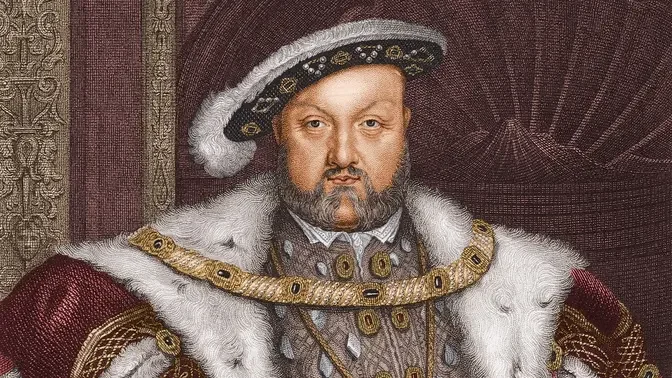
Henry VIII was Hampton Court's first royal resident,
history's most infamous monarch.
Big, brash, larger than life.
Six wives came and went in a brutal and bloody reign.
Divorced, beheaded, died.
Divorced, beheaded, survived.
They heard the centre of everything one minute
and they were having their head cut off the next.
And they all left their mark on Hampton Court.
The palace played host to every wife.
The Great Hall where Anne Boleyn once danced with her king.
The chapel that hides Jane Seymour's heart and lungs beneath its altar.
The haunted gallery where Catherine Howard begged for her life.
Crowned king aged just 18,
young Henry Tudor had almost infinite wealth and infinite power.
With scores of palaces to choose from,
Hampton Court was his summer favourite.
This was his pleasure palace.
Vast parklands for hunting and sport,
sumptuous rooms for entertaining and extravagance.
Henry had between 50 and 60 palaces.
He invested so much money in building and buying palaces
and he could move from palace to palace along the river.
Hampton Court was in the countryside
and it was a place where he could go for fun and to just enjoy himself.
Completed in 1515,
the newly built palace was the pinnacle of Tudor fashion and style.
But the grandest house in the land wasn't built by Henry VIII.
It was designed as the home of the king's closest advisor,
Cardinal Thomas Wolsey.
As Chancellor, Wolsey was the second most important man in the land.
Thomas Wolsey was the king's chief minister for almost 15 years.
He managed all the business of running the estate
and at this time Henry liked to play more than he liked to do business.
So Wolsey kept that all away from him and kept the king happy.
Wolsey is about to become a cardinal in 1515
and it's in January of that year that his workmen arrive
with their cranes and their ropes and their materials
by the side of the River Thames
to transform a pretty humble manor of the Knights Hospitaller
into this extraordinary palace.
It's a cardinal's palace built on a European scale.
Wolsey spent lavishly on the palace.
The patronage of a king had brought him wealth beyond measure.
Dignitaries from across Europe were beating a path to his door
and Wolsey needed a home to match his prestige.
He spared no expense
and used red brick, the new wonder material of the day.
Hampton Court changed the rules of the game.
This thing was absolutely enormous and it glittered,
not just the brick itself,
but the fact that the brick was painted in red
and then it was painted in black to give you the diamond pattern
and then all the white mortar joints were painted on top.
This thing was like an illustration of itself.
It was in technicolour.
But building a home fit for a king can be a dangerous game.
The opulence of Wolsey's home provoked gossip
that it was richer than any royal palace.
The cardinal needed to be careful.
Upsetting Henry could cost you your head.
What Wolsey says is,
I'm building it on your behalf, Your Highness.
Of course I am, of course that's what I'm doing,
cos he's got to keep two people happy.
One is the Pope and the other one is the king.
So you see Roman emperors in the courtyard,
you see the signs of him being a cardinal,
but you also see the accommodation for the king,
who is a frequent visitor.
Wolsey was also keen to ingratiate himself with Henry's wife.
Catherine of Aragon was a blue-blooded Spanish princess
and her marriage to the king cemented a key political alliance.
Her own royal emblem is etched into the stonework of Hampton Court.
The seeds of the pomegranate fruit represent the potency of her kingdom.
It's really poignant, isn't it, because you've got the pomegranates
and you've got the rose, the Tudor rose of Henry VIII,
and this says everything you need to know
about what he thought about their relationship early on,
that that was it, it was permanent, so permanent
that he'd carved it into the very stonework of the palace.
It seems Henry was truly dedicated to his wife.
He and Catherine were together for nearly 24 years,
longer than all his other marriages put together.
Catherine started off as Henry's true love
and she was this beautiful, blonde-haired Spanish princess, very exotic.
He was very gallant in his courtship of Catherine.
Henry and Catherine were frequent visitors to Hampton Court
and kings do not travel light.
The way that Tudor palaces work
is that the king doesn't live in one of them all the time.
When he did come into town, he would bring with him his 800 courtiers
and then the place was absolutely packed.
The logistics were terrifying.
Almost 1,000 people suddenly needing to be fed in regal style.
This is the entrance to Hampton Court's kitchens,
the largest surviving 16th-century kitchens in the world.
When the court of King Henry VIII arrived here at Hampton Court,
these kitchens burst into life.
You're at the heart of a food factory.
It's like the back of a supermarket.
There are carts coming in every minute, being unpacked,
the food being moved to stores.
This dead space suddenly filled with 200 cooks
desperate to get that royal meal on the table.
600, maybe 1,000 people want their dinner twice a day.
The workload was immense.
The cooks would toil from dawn until dusk.
The kitchen's walls were regularly whitewashed
to keep the room as bright as possible,
allowing the cooks to work even as darkness fell.
The palace feasts, headed by King Henry at the top table,
would last for seven hours or more.
These kitchens for Henry are part of his magnificence, his status.
Everything about this palace has to be the very best,
from the decoration upstairs to the clothes the king's wearing
and the food he eats and the food he gives you.
That's more important.
The Tudor court just loved its roasted meat.
It was at the heart of every feast.
You've got a fireplace that belonged to Henry VIII
and there it is, burning still.
Before you can do anything,
you're going to have to have a really big, over-roasting fire.
Looking at about a tonne of fuel a day going onto each fire,
that's a lot of money.
You need something to put the meat on.
You need a spit.
And not one there, but loads for every fireplace.
And to make anything cook on here,
someone's got to turn the handle,
not once or twice, but all the time.
Each fire would hit 1,800 degrees Fahrenheit
and there were at least six in every roasting room.
I'm really starting to get quite hot-stood here
and if I worked here, I'd have to keep getting hot.
Another log to keep it filled.
And they talk about these kitchens being a veritable hell.
The guys sat here are just sweating buckets.
The heat from this fire and the five others
are radiating out into the room.
So it is like being in a furnace.
Now, we know that you're allowed to drink
quite a lot of beer here at Hampton Court.
Just an ordinary worker got one gallon a day as his allowance.
But working by the fires is even better.
There is no limit to the beer you can have.
Hampton Court's bar tab included 600,000 gallons of beer a year,
10,000 gallons and more a week.
The revelry at the palace knew few limits.
And Henry led the festivities from the front.
Contrary to his popular image today,
young King Henry was a handsome and dashing figure.
At the beginning of his reign, he was 18 years old
and he was exceptionally good-looking.
He was 6'2", when the average height for a man was 5'7.5".
He was athletic.
He was good at everything he turned his hand to,
whether it was playing musical instruments,
whether it was surpassing all the archers of his guard at archery
or as a capital horseman.
And he was also said to be very warm, very generous,
very charismatic.
Henry's friends were like-minded young men,
courtiers that could match him for energy and enthusiasm.
In Henry VIII's day, it would have been a place of great fun,
and I think we can understand this best
by realising how young most of the men at court were.
They're in their late teens, they're in their early 20s,
they're boisterous, they're having fun,
and so the court was actually like taking a load of teenagers
travelling around the country.
It would have been a place of noise and naughtiness.
Hampton Court Palace became the ultimate royal playground.
This is the palace's 16th-century tennis court,
one of the oldest sporting venues in the world,
part of a leisure complex designed to entertain the young king
and his courtiers.
There's been a court here for 600 years.
In fact, some of the walls were the ones
that Henry would have hit a ball against.
It's like a living museum.
Real tennis is the modern name for the antiquated form of the sport.
One of its most avid fans
is author and historian Roman Kriznaric.
In Tudor times, this was a vigorous society,
it was full of passion,
and tennis was actually part of that passionate way of living.
I mean, this is where court life was happening.
It wasn't just listening to music and madrigals
over in the palace a few hundred yards away.
I mean, this is where the really exciting stuff was happening.
You can imagine on a court like this,
you wouldn't have just had people playing,
but in the galleries surrounding, behind the netting,
there would have been people watching the game,
gambling on the game, everybody betting money,
bringing out their purses,
losing fortunes left, right and centre,
visiting cardinals from France,
young princes from Spain wanting to get on court with Henry.
And in fact, in 1519,
the Venetian ambassador spotted Henry playing
and made this remark that it is the prettiest thing in the world
to watch the king play at tennis.
To see his fair skin glowing through a shirt of the finest texture,
he's more handsome than the king of France.
He looked really good on court.
He was a great athlete.
He could whack the ball harder than anybody else during his age.
He could reach into the corners, he could move like a cat.
So it was no wonder Henry actually won most of his matches,
at least that's what the records show.
But would you really have wanted to go face-to-face with Henry?
You know what kind of temper he had.
If you beat him in a game, well,
it could be pretty dangerous for your livelihood.
But sport could not satisfy Henry's competitive streak completely.
The king wanted victory on the battlefield.
Three epic paintings on the wall of the palace's Tudor apartments
tell the story of Henry's quest to prove himself on the international stage.
These priceless pieces, more than 400 years old,
were commissioned by Henry VIII himself.
This painting celebrates Henry's first significant military engagement,
the Battle of the Spurs.
According to art historian Linda Collins,
it's little more than Hampton Court propaganda.
There were 30,000 troops assembled by Cardinal Wolsey to be in this battle.
As the French troops rode in,
what they didn't expect to find was a large number of English troops.
It took them off their guard.
And so they turned and they rode away, chased by the English.
And it's called the Battle of the Spurs
because as the French troops turned and ran,
their spurs glinted in the sunshine,
and it was said that they used their spurs more than their swords.
Well, here we have Henry on his white horse in the centre of the battle,
and you're talking maybe sitting duck here.
You're on a white horse in the middle of the battlefield.
So Henry's advisers would not have allowed him onto the front line.
So this is artistic licence.
Henry's warrior ambitions were ultimately frustrated,
but the next two paintings in the series
show he learnt to project kingly power in another way,
outrageous and ostentatious wealth.
Embarking for a peace conference in France,
Henry's fleet of ships is packed with jewels, tapestries and livestock.
The event was so opulent, it became known as the Field of the Cloth of Gold.
The tents were made of gold cloth, everything was gilded.
It was a spectacular event.
And this time he can use a white horse.
This is a glorious procession.
6,000 men erected this huge temporary palace,
Henry's decadent Hampton Court, on the road.
We've got this spectacular palace,
which was actually created on the field
for the royal family to live in during this event.
Outside this palace, we have these two fountains.
This one has been recreated at Hampton Court Palace.
And these fountains should not have water in them.
They should have red wine.
They can drink as much red wine as they want, and they certainly did.
And you do find these men here
who look as though they have either thrown up or are about to throw up.
Excessive consumption and luxury defined Henry VIII.
At the heart of Hampton Court, they came together in a heady mix.
The palace's Great Hall was the place to see and be seen.
This is the Great Hall at Hampton Court.
Isn't it magnificent?
It would have looked so much more magnificent, though,
at the time it was first built,
because it would have had green and white tiles on the floor here.
And on the ceiling, all this incredible hammerbeam ceiling
would have been even more gold and blue and red than it actually is now.
So you come in here and you've got this assault on your senses.
There's an incredible mass of colour surrounding you.
And, of course, what would have been going on in here
would have been lots and lots of fun and festivities.
The 60-foot-high vaulted room was far more than just a royal dance hall.
It was a unique token of love from Henry to his second wife, Anne Boleyn.
Henry spends three years rebuilding the Great Hall to Anne Boleyn's honour,
so there are carvings of her arms with Henry.
It's got H and A with lovers' knots and so on.
As one of the Queen's ladies-in-waiting,
Anne Boleyn had made a big impression at court.
After 20 years of marriage, Henry and Catherine had failed to have a son
and the King's eye had started to stray.
Anne Boleyn was the woman who was known as the Great Whore.
Henry absolutely adored her. I think it was love at first sight.
We think of Anne Boleyn as being this really attractive woman.
In fact, she probably wasn't.
She's described by a friend as being good-looking enough.
And that's a friend, so she obviously wasn't that much of a looker.
But she was cosmopolitan, she was witty, and she was fun to be around.
She was a graceful dancer, and Henry found her company enchanting.
Anne played Henry well.
Refusing to become his mistress, she would only enter his bed as Queen.
Frustrated and lovestruck, Henry wanted a divorce.
But divorcing a Queen was no small matter.
Igniting the fury of Catherine's influential Spanish family,
any annulment would have to come from the Pope himself.
The King knew who to turn to.
Cardinal Wolsey was given the unenviable task of striking a deal with Rome.
One thing that this amazing man couldn't achieve in the end
was to get Henry his divorce,
his annulment of the marriage to Catherine of Aragon
that Henry so desperately wanted.
The Pope refused the divorce.
Henry lost patience and dismissed Wolsey.
Even though the Cardinal had given him Hampton Court
in a desperate attempt to appease him,
the King now had sole control of the palace.
So Wolsey comes to a bad end.
He falls from power, Henry takes his palace,
Wolsey dies in disgrace, just before he can be executed, probably.
The Chapel Royal at Hampton Court.
This glorious azure and gold roof was added by Henry VIII.
Under the King's guidance, the palace became the birthplace
of a Christian denomination that would shape history.
Just downstairs from this office in the council chamber,
Henry VIII was in council one day and he said,
right, the Pope won't give me the divorce I want from Catherine of Aragon
so that I can marry Anne Boleyn.
I'm getting rid of the Catholics and setting up the Church of England.
In 1533, within the walls of Hampton Court,
the King did the unthinkable.
He broke from the Roman Catholic Church
and anointed himself head of the new Church of England.
With the Pope out of the way,
Henry could finally marry Anne after seven years of waiting.
Their marriage triggered raucous merriment at the palace.
Plays and dances ran late into the night.
The King himself would have been in here and there would have been dancing.
He himself liked to dance very much.
We have accounts saying that he leapt like a stag.
He had fine calves, of which he was very proud.
The Queen would invite up to 100 women from noble families to join the revelry.
It was the place for Tudor ladies to be seen in all their finery,
as demonstrated by Hampton Court guide and lecturer Siobhan Clarke.
A young lady, if lucky enough to be offered a position at court,
would need to be suitably dressed to provide an ornament to this magnificent court.
So we're just going to put on the four sleeves here,
which you can see actually match my kirtle,
but they're a separate piece altogether,
which get tied on with a ribbon onto my French gown.
A Tudor lady might wear up to five layers of clothing.
We know that the climate was much colder in the mid-16th century
and the palace is right by the river.
It could be cold and draughty.
I worried about corsets because people always think that,
like the Victorians, that it's going to be really, really tiny waist.
In fact, the Tudors didn't try to achieve those tiny waists.
It was actually fashionable to be a little bit plump.
A lady at this time would have very long hair.
Anne Boleyn had hair so long she could sit on it.
And it's really important to cover your hair.
And if you go about with your head uncovered,
you're really considered immoral, a loose woman.
Now, the reason that this French hood was considered daring and rather racy
is that it's going to leave the front part of my hair uncovered.
Everything at Hampton Court was about display.
While Anne made an impression with her daring fashion,
Henry shone at the joust.
He commissioned a jousting complex to be built at the palace.
These gardens and walls were where the arena, or tiltyard, once stood.
When Henry was barely out of shorts, even if they were cloth of gold ones,
he really concentrated on building things which entertained him.
And the tilt, the joust, the tournament, that was his favourite thing of all.
He saw himself as this great gallant knightly king,
so ladies of the court would be positioned at windows,
and the knights outside, including the king,
would chase up and down either side of a barrier
and try and either snap their lances or knock each other off horses,
and the ladies' hearts would be aflutter as they, like Rapunzel, lent out the window.
Henry invested extravagantly in tournaments and elaborate suits of armour.
Historian Mark Griffin works with a totally accurate replica of one of his suits.
Your armour says a lot about your aesthetic style,
what you like, how much you can afford.
It can be decorated. It could be engraved, embossed.
Gold could be added, silver could be added.
Some of the French kings even had jewels set into their helmets
that they would then pluck out and throw at the audience after they'd finished jousting,
just to prove how rich they are.
But beneath the pomp and ceremony, there was real danger.
Henry's taking an enormous risk taking part in this sport.
Men were very seriously wounded.
They had bits of splinters of wood going into their eyes, blinding them.
You could be cut under the arm, in the groin.
They could bleed to death.
There's no way anybody in the medieval or early Tudor world
who could do anything about those sorts of injuries.
In 1536, the risk of the tournament finally caught up with Henry.
A brutal fall was to change the course of English history.
He's knocked from his horse. The horse rolls over him.
The horse is armoured. He's basically crushed underneath half a tonne of animal and steel.
He's knocked unconscious for two hours. He's very badly injured.
And around that time, Anne Boleyn, who is watching, has a miscarriage,
which, of course, has amazing consequences,
not only for her, but for the kingdom as a whole.
The accident changed the king forever.
Some believe Henry VIII's injury twisted him into an ill-tempered tyrant.
He opened up an ulcer in his leg that would never heal
and would give him constant and debilitating pain for the rest of his life.
So the first place to look for his temperamental change
is the fact that he's in constant pain.
But also, it's possible that he bruised his cerebral cortex when he fell.
The cumulative effect is to change him into a very different man.
Capricious, irascible.
People didn't know what had angered him,
but suddenly he would turn on a dime and then be a completely different person.
And so by that time, I think it must have been nightmarish to be at his court.
High in the roof of the Great Hall, colourful faces peer down on the room below.
They're a warning of the deadly consequences to come.
Hanging from the wooden eaves, these little figures inspired the name Eavesdropper.
If you go in the Great Hall today, you'll see these eavesdroppers
who the architect had actually built into the ceiling.
They're little figures who are looking down on the courtiers below,
and it's almost a warning to those courtiers to say,
look, everything is overheard here.
There was gossip, there was intrigue,
there was plotting for advancement at court.
Anne is becoming a victim of the court she loved so much.
Jealous factions start to spread stories of infidelity and incest.
What's more, Anne has not produced a male heir,
and she's quarrelling with the king.
Looking to escape from the marriage, Henry seizes on the rumours.
In 1536, Anne is arrested.
She had one day where she was celebrating,
jousting May Day celebrations with Henry.
Then he left in a bit of a hurry, and there was much muttering about it,
according to one of the sources.
The next morning, out of nowhere, her reign as queen comes to an end.
Anne faces charges of adultery, incest and treason.
The river flowing past Hampton Court transports her to the Tower of London.
Executioners were trained in hanging people, not in cutting off heads.
We have accounts of someone like Margaret Poole.
When she was executed in 1541, the first blow gashed her shoulder,
and it took ten further blows to separate her head from her neck.
But Henry took pity on Anne Boleyn when it came to her death.
He ordered an expert French executioner to be brought all the way over from France
in order that she might be beheaded with a sword, cleanly, in one blow.
With Anne barely cold in her grave,
Henry wipes all trace of her from Hampton Court.
In their haste, the workmen miss one of her symbols in the woodwork.
It's still there today, a secret memorial to Anne.
When she is executed, Henry marries Jane Seymour,
and so the hall has to start all over again.
Poor Galleon Hone, who did the glass.
He must have been packing his tools up, and then someone said,
Oi, Galleon, you know what's just happened, don't you?
Oh, no, not another eight months, because that's how long it took.
So Hampton Court ends up being this continual building site
for a whole sequence of wives,
and Henry never really gets round to finishing it.
Next to the Great Hall is the Great Watching Chamber.
This fine room was where courtiers would wait to see their monarch.
Henry built it in honour of his new love and wife, Jane Seymour.
Henry VIII would have walked through here,
he would have processed through here on Sundays and Holy Days,
an extraordinary finery, and people would have been trying to petition him.
They'd been waiting all this time to see him,
so they'd been trying to pull at his arm, trying to get his attention.
If you look at the ceiling, you can have a sense
of how much he must have lavished on it,
because there's this incredible, beautiful gilt,
and these badges are leather mâchés.
And this is Jane Seymour's badge.
That's a castle with roses, a rosebush coming out of it,
and a phoenix rising from the top.
And, of course, the phoenix rising from the ashes
is exactly what Jane Seymour did for Henry VIII,
because she provided him with a son and an heir.
And so it's no surprise that he would build something so sumptuous in her honour.
To celebrate, Henry hung a series of extravagant new tapestries.
Less than a year into their marriage,
Jane Seymour had provided him with the son he desperately wanted.
Henry VIII commissioned the tapestries that you can see here,
the Abraham tapestries.
He paid a vast amount of money for them, £2,000.
At the time, that was the cost of a warship,
so these were really expensive.
And the other thing about them is that they would have been utterly splendid,
because they were made with cloth of gold.
Their vibrancy has faded over 500 years,
but modern pigment analysis can bring their 16th-century colours back to life.
The tapestries would have been practically neon.
They were so bright.
They were made with spirals of real gold with silk thread going through them.
And they would have glinted and glimmered in the light.
They would have looked absolutely beautiful.
But this marriage too had a sad end.
It's believed Jane Seymour's heart and lungs
are in a lead box hidden behind the chapel altar.
Jane died from childbirth complications soon after Prince Edward was born.
In Henry's memory, he will look back in years to come with great sentiment.
He will weep and say that she was the best of his wives.
He'd been unfortunate in love with ill-conditioned wives, except for Jane.
I think, actually, there's an element of that that says,
well, perhaps she didn't live long enough
for him to have fallen out of love with her, actually.
Wracked by grief, life is now on a downward slope
for the previously young and sporty king.
Henry's leg injury makes him almost immobile.
Gross obesity creeps up on him,
not helped by his decision to quadruple the size of the palace kitchens.
By the 1540s, the near-sedentary king is comfort eating,
and he weighs over 400 pounds.
Food historian Mark Meltonville has unearthed a recipe
for the artery-clogging food that Henry was served at the palace.
When he was a young man, he ate a lot.
He's given all these dishes at every meal.
When he's an older man, I'm afraid he doesn't do quite so much sport,
but he eats the same, and so we get the bigger and bigger and bigger Henry
that he becomes famous for,
so big that his last suit of armour is 54-inch waist.
That's a big guy.
If we went for a feast at Henry VIII's palace at Hampton Court,
we might be given something called Lombard custard.
It means bone marrow.
So it's got sugar in it, it's got cream in it,
but it's also got the inside of beef bones.
It just gives a really rich, buttery taste,
and rich tastes just say everything about the court of Henry VIII.
And there we go, our custard tart.
Let's give it a little try.
Is this going to be any good?
It actually is beefy.
Very mildly beefy and sweet.
I've eaten worse.
On the wall of the palace's processional gallery
hangs a full-length painting of obese Henry VIII.
The classic piece was inspired
by the king's brilliant court painter, Hans Holbein.
The genius of Holbein has immortalised Henry
as one of history's most imposing figures.
Holbein's paintings of Henry VIII have lasted,
and it's probably true to say
that there may have been an element of propaganda in them.
He is sturdy, strong and magnificent.
What Holbein has done for Henry is to give him substance.
When Henry needed a portrait painted of a foreign princess,
Holbein was the obvious choice.
To protect an image of virility, the king needed a queen.
But Henry's royal matchmakers were not having an easy time.
Famously, one of the foreign brides who was proposed as his future wife
said, I would marry him if I had two heads and then I'd got one to spare.
You know, and you can see why she'd have made that remark.
He was terrifying. He had this formidable reputation.
Holbein returned with Anna Cleve's portrait, and Henry liked what he saw.
The beautiful German princess was invited to England
to become his fourth wife and queen.
Their blind date was a disaster.
He arrived early in disguise,
and the whole game of court was that you were supposed to pretend
both that Henry looked like all the other young, good-looking men
that he was around, even though by this point
he had run to fat in quite a great way,
and also that true lovers would recognise each other.
So she was supposed to see through his disguise
and recognise the regal king.
She did neither of those things.
So this man approaches her, tries to kiss her,
and she's thinking this is just a terrible breach of etiquette.
She tries to ignore this terrible man pawing at her.
So Henry, by this time, is completely put off.
So when it comes to consummating their relationship,
he says that she is smelly, that she is fat,
and that she is not a maid, she's not a virgin.
And obviously there is somebody in the room who is smelly and fat
and not a virgin, but it's not Anna of Cleves.
Wedding plans were too advanced to be cancelled,
but the relationship was going nowhere.
Within months, the unhappy couple agreed to put right their mistake.
She gave him the divorce willingly,
and as a result she got £30,000 a year, five palaces,
she was welcomed at court, she was known as the king's sister,
and she became really one of the most important ladies in England.
So it was an example of history,
how to deal with Henry, give him what he wanted.
Undeterred, Henry was soon back honeymooning at Hampton Court
with Catherine Howard, wife number five.
Beautiful but naive,
Catherine was powerless to resist the king's advances.
Of course, she was a teenager when she married the ageing Henry VIII,
so it certainly wasn't a love match for her,
but Henry VIII couldn't keep his hands off Catherine Howard,
he adored her, he was always sort of petting her in public,
and he was devastated, I think he was genuinely heartbroken
when one of his ministers dared whisper to him
that his young wife had been unfaithful,
and they presented irrefutable proof of Catherine's infidelity.
One morning, Henry entered the Chapel Royal at Hampton Court
to find a letter detailing Catherine's liaisons with other men.
She was confined to her room, and in the Great Watching Chamber
it was announced that she was sentenced to death.
Legend has it that Catherine broke free
and ran down the processional chamber screaming for mercy.
Her protests were in vain. She could not reach the king.
Catherine Howard had been taken up the river to the tower
and she would have passed underneath the heads of her lovers,
which were on spikes, they'd been beheaded,
their heads parboiled and tarred and put there,
and she would have seen that grisly sight as she went to her certain death.
The night before she was executed, the accounts say that she experimented
with putting her head on that block, rehearsed that moment
when she would go to her death at nine the following morning.
Five wives down,
Henry locks himself away in his rooms at Hampton Court for days on end.
He starts mixing homemade remedies from the palace herb garden
to try and cure the wound on his festering leg.
After Catherine Howard was executed,
Henry really goes on a bit of a downer,
and after this he suffers a period of depression in 1541
and is confined at Hampton Court.
Five years later, he restores some of his vigour
and he marries again.
Catherine Parr is a very good wife for his last few years.
But at that point, Henry is no longer the man he once was,
and so by the end of his life, he really...
Although he's not terribly old, he's only 56 when he dies,
he is frail and his obesity has worn him down.
Married in the palace chapel,
Catherine Parr, Henry's sixth and last wife,
nurses him through his final days.
In 1547, the massively obese Henry VIII dies.
After his reign, a succession of monarchs changed little at Hampton Court.
Eventually, it slipped into neglect,
but there was life in the palace yet.
After a century and a half in decline,
Hampton Court blossomed once again as the epicentre of royal life.
This was the result.
In 1689, William III and Mary II
became King and Queen of England.
The royal couple immediately set their sights on Hampton Court Palace.
When William and Mary came to the throne in 1688,
top of their list was building a really grand new palace,
and they got in to Christopher Wren, wanted to rebuild Hampton Court.
He made plans for knocking down practically all of it.
For William and Mary, the palace itself was now unpardonably old-fashioned
and not at all like the regular buildings
that the French monarchy were putting up in places like Versailles.
Wren, the celebrated architect of St Paul's Cathedral in London,
drew up a grand Baroque design
in the style of the Palace of Versailles near Paris.
But money was tight.
For the time being, Wren had to be content
with rebuilding only half the palace.
Henry VIII's royal apartments were replaced
with new staircases and staterooms.
The point of Hampton Court, and in fact the point of any palace at all,
is to really intimidate the pants off anybody who's coming to the place.
It's not supposed to be warm and welcoming and easygoing.
This is about the king.
Every outer room contains a throne.
Courtiers were expected to bow even when it was empty.
William III lived much of his life on display.
The king was notoriously prone to ill health.
The public appearances were designed to prove he was alive and well.
This is King William III's private dining room.
This is where William would enjoy meals with his closest friends.
But the king didn't always get to eat alone or in private with his intimates.
William would often have to indulge
in the bizarre ritual of the king's dining in public.
He would sit alone at a table
with a huge elaborate feast laid out before him.
A paying, invited audience gathered behind a rope,
intently watching the king's every move,
every morsel going into his mouth.
At the end of it, he would retire,
leaving the hugely expensive sugar sweetmeats on the table.
The audience would then descend upon them,
breaking them up and taking home pieces,
just as we might with wedding cake today.
Only deep within the palace could William escape from prying eyes.
The rooms at first floor are actually pretty much a sham,
and the king used downstairs.
He really lived below the shop.
First floor was for display, for decorum.
Downstairs is where he did his writing,
had his library, ate most of his meals,
sulked, did all the things that humans really do
when they're not acting king.
All palaces work like a chain,
so you get your bigger, grander, more impressive outer rooms,
and then the rooms get smaller as you go in.
So it's like a filter, if you like.
Lots of people out here, very few people in the middle here,
and it gets more and more exclusive as you penetrate.
A special few shared the inner sanctum with him.
This is William III's royal lavatory chamber.
The odour from the 300-year-old velvet-seated box
still hangs in the air.
The king himself has people to attend to
even when he's on the toilet.
He has a top servant who's called the groom of the stool
who actually hands him the cloth he uses to wipe his bottom.
And nobody thinks this is weird,
and in fact everybody wants to be the groom of the stool
cos it's a great chance to ask the king for favours.
Some courtiers were certainly more favoured than others.
An exquisite mural sprawls across the ceiling
above William III's bedchamber.
Painted by classical Italian artists,
nude male figures drape over one another.
King William had a selection of male favourites
to whom he was extremely close.
Jealous courtiers made a scandalous connection
with the fresco above his bed.
People in the past have looked at that and thought,
wow, that's Homerotic.
And then people have looked at these scurrilous pamphlets
saying that he was an unperforming puny prig, for example,
and they put the two things together.
Malicious gossip spread that William was a homosexual,
rumours fed by a lack of children from his marriage.
Paul Mary couldn't have children,
and people started attacking the pair of them,
saying, whoa, what's going on here?
Perhaps William is more interested in men than he is in women.
And it was a weakness that the satirists
and the caricaturists exploited.
Then, in 1694, Queen Mary died suddenly from smallpox.
William had to live in the new Hampton Court alone.
A few years later, he fell from his horse
whilst riding in the grounds of the palace.
William died from his injuries.
He left his Hampton Court rebuild only half complete,
and large parts of Henry VIII's palace still intact,
creating the unique fusion of architecture we see today.
They intended to pull down the lot
and just leave the Great Hall standing.
They liked that bit. They thought that was quite good.
And curiously, this wonderful Gothic confection of the Great Hall
would have sat in between two massive classical blocks.
But happily, William III ended up only building half of what he intended,
which means that we now have this wonderful fusion
of two very different ages,
which is a surprise to many visitors
who arrive expecting this Tudor world.
All of a sudden, they're plunged a century and a half ahead.
Only 12 years after William,
the House of Stuart's royal dynasty came to an end.
In 1714, the Georgian era began,
and Hampton Court exploded into life once again.
King George II and his wife Caroline had grand plans for the palace.
They used the landscaped gardens to throw extravagant parties.
The couple would create huge flotillas for the long water
and celebrate with thousands of courtiers.
Inside the house, the formidable Queen Caroline
commissioned an entire wing of plush new apartments.
If you look at Caroline's rooms in Hampton Court,
you can see little bits of her character creeping through.
She actually played a lot of cards.
She introduced a lot of gambling into the Georgian court.
And she also was quite progressive in things like her bathing.
She wanted to be clean, she wanted things to look nice and smell nice.
It was surprising for the Georgians that she liked to bathe so much
because they thought it was dangerous to their health.
And they were actually fascinated by it.
But private bathing could be difficult, even for a queen.
There were no corridors in the Georgian apartments,
so servants would frequently pass through rooms.
She was constantly under the eye of servants,
so I think she really wanted some places where she could retreat
and be alone with George.
It's shown in her bedroom, where she has locks on the door,
that she can actually pull all the way from the bed,
so quite quickly, just to keep someone out of the room.
Unusually for royalty at the time, George and Caroline were close.
But they hated their eldest son, Frederick, Prince of Wales,
and treated him with contempt and suspicion.
It's said that the Hanoverians, the Georgian kings, were like pigs.
They devoured their young.
And it's true, really.
We see throughout the 18th century
all the Georgian kings being really, really horrible to their heirs.
George II and Caroline described Frederick as the greatest ass,
the greatest liar and the greatest beast in nature, and they wished him dead.
For Frederick, the feud with his parents had poisoned Hampton Court.
The prince was forced to stay at the palace
with his heavily pregnant wife, Augusta.
One night, on a back staircase, he took his revenge.
Frederick was determined that the birth of his child
should not happen under his parents' roof here at Hampton Court Palace.
He was determined to escape from his mother's eagle eye.
Augusta's labour started.
Now, Frederick didn't call for the midwife, he called for the carriage.
He led his wife, whose waters had now broken,
she was sodden, onto a staircase,
one of the many back staircases here at the palace,
and led her down it step by step,
all the time stuffing handkerchiefs up Augusta's petticoat
to stop any signs left behind them of her labour.
Well, they got her to the bottom of the stairs eventually.
She was bundled into a carriage and away to London to give birth.
George and Caroline were naturally furious.
George blamed Caroline, she blamed everybody else.
This is a big deal, because people worry that if a baby dies or miscarries,
an imposter will be slipped in,
and the line of the succession will be altered.
Frederick's baby daughter was delivered safely,
but Hampton Court was scarred by bitter memories.
For the palace, centuries of royal occupation were coming to an unhappy end.
George took a mistress and Caroline to eating.
Towards the end of her life,
Queen Caroline's existence at Hampton Court was quite sad.
She was aware that she'd lost the love of her husband, who'd adored her.
She was plagued by ill health.
She was over-fond of chocolate and had become enormously fat.
She could barely walk and spent much of her time
confined to her chambers at Hampton Court.
George and Caroline were succeeded by their grandson, George III,
the king who infamously lost the American colonies.
Mindful of his family history,
George III hated Hampton Court and refused to stay there.
No monarch ever lived at the palace again.
In 1838, Hampton Court was opened for public enjoyment
and a new chapter in its history began.
Tourists now take photos,
where royal lovers once plotted adulterous liaisons.
The palace stands today as a gateway to the past.
Hampton Court is the most extraordinary building
because it survives like no other palace of that period.
You can share the space that Tudor courtiers and queens and kings once knew.
Still, our imagination walks those halls.
That's why the building has a rapport with us,
because you feel like you're occupying this space
between the past and the present.
Next time on Secrets of All Thought, The Spencers.
Explore a grand house displaying the wealth and power
of one of Britain's pre-eminent aristocratic dynasties.
19 generations of Spencers have lived in this house
over more than 500 years.
It was the childhood home of Diana, Princess of Wales.
I remember my sister Diana tap dancing in the main entrance hall.
And now it is her final resting place.
We still get people coming with flowers
and laying them where the princess is buried.
All Thought was the scene of the secret wedding of two star-crossed lovers
and a battleground in a long-standing feud between an earl and a duchess.
She was a difficult woman.
She didn't like people and she fell out with everyone
and she never forgave.
Over five centuries, every English monarch has passed through its doors
to be greeted by great finery and immeasurable treasures.
One of my ancestors was obsessed with books.
He had 43,000 first editions,
including three of Shakespeare's original folios.
A house that boasts a connection
to the first president of the United States, George Washington.
In the churchyard you'll see Washington tombs
and in the aisle of the church, if you lift up a wooden shield,
underneath is the Washington star, their coat of arms.
Uncover these remarkable tales
in Secrets of All Thought, The Spencers.
To learn more about this programme, visit pbs.org.
This episode is available on DVD.
To order, visit shoppbs.org
or call 1800 PLAY PBS.
.