
Queen Victoria (1819-1901) - Pt 1/3
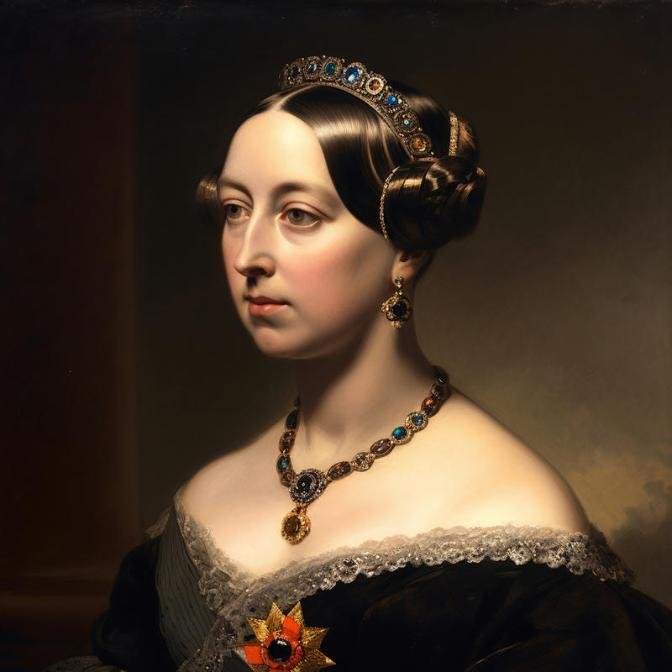
She was tiny, obstinate and famously not amused.
She reigned for longer than any other British monarch.
She put her stamp on the 19th century.
And by the time of her death,
Queen Victoria was at the head of the greatest empire
the world had ever seen.
But this diminutive queen,
who came to symbolise all the energy and the enterprise
of the Victorian era,
was herself a bundle of contradictions.
She hated public life, but she loved being the Empress of India.
She ruled a large part of the globe,
but she did it from her sitting room.
Victoria was born in 1819
into a Hanoverian world of elderly gentlemen
who ran the country.
As a child, she watched her uncles,
George IV and William IV,
leading somewhat disreputable lives.
And when, at the age of 12,
she realised she herself would one day be Queen,
she announced,
I will be good.
She was brought up here at Kensington Palace.
She was only six months old when her father died,
so for most of her upbringing she was with a governess,
and it was, by her own admission, a melancholy childhood.
All the same, one thing was clear,
that although she was a girl who liked to get her own way,
Victoria always needed a father figure.
That was why, through much of her long life,
she came to depend on a string of male advisors,
most of them older than herself,
to whom she was utterly devoted.
One morning in June 1837,
Victoria learned that William IV had died.
She was still only 18.
Just awake, she went downstairs to meet the Lord Chamberlain
and the Archbishop of Canterbury,
who informed her that she was now Queen of England.
Her coronation was a bit of a farce.
One of the attendant lords, going to greet the royal coach,
fell down a flight of steps.
Then the archbishop tried to force the ring onto the wrong finger,
causing Victoria considerable pain.
As the ceremony continued in Westminster Abbey,
outside, a million people were cheering.
They were delighted with their new queen,
and the promise of a new age.
In many ways, the new age was already emerging.
London, Manchester, Birmingham, other major cities,
had doubled in size since the turn of the century,
were developing their infrastructures, such as police forces,
and were now connected by a new network of railways.
A year after Victoria came to the throne,
the first Great Western locomotive
chugged out of here, Paddington Station,
at the grand old pace of 33 miles an hour.
Meanwhile, Victoria was eager to make an impression.
Her uncle William had warned her to go slowly,
not to make any big promises or hasty replies.
But Victoria was renowned for her spirit and determination,
and anyone who was going to advise her
would clearly need a great deal of tact and diplomacy.
Many 18-year-olds would have been intimidated by elderly gentlemen
with years of political experience.
But Victoria faced her privy counsellors with surprising confidence.
She spoke in a small but clear voice,
and the elderly gents were swept away.
She filled the room, said the Duke of Wellington.
Her great adviser was Lord Melbourne, the Whig Prime Minister.
He was generous and witty, and they became close.
I like him very much and feel confidence in him, she wrote.
He is a very straightforward, honest, clever and good man.
Melbourne was devoted to the young Queen,
and Victoria valued his advice.
But on some subjects, she would not budge.
One was the Bedchamber Crisis of 1839,
a strange episode involving Victoria's ladies-in-waiting.
In May, Melbourne's government had been defeated and he resigned.
The Queen was distraught.
Oh, all my happiness gone, she wrote,
in her characteristically melodramatic style.
She couldn't face the idea of the cool, intellectual Tory, Robert Peel,
as her Prime Minister.
And when Peel demanded that she change her Whig ladies-in-waiting
for Tories, she refused.
Peel then declined to form a ministry,
and a rather shamefaced Melbourne crept back to Downing Street.
Victoria, of course, was delighted.
She regarded it as a victory for the monarchy.
She told Melbourne that he'd have been proud of her composure
and great firmness.
They wish to treat me like a girl, she wrote,
but I will show them that I am Queen of England.
A classic example of young Victoria misjudging her power and her importance.
Within two years, there was a general election.
Melbourne was defeated, Peel romped home.
The country wanted Peel as Prime Minister, whatever the Queen thought.
Her ladies-in-waiting were irrelevant.
But Peel never gained much influence over Victoria,
because the Queen found herself a husband.
Prince Albert of Saxe-Coburg-Gotha
was three months younger than Victoria and her first cousin.
He was the nephew of her uncle Leopold, who was keen on their match.
But Victoria wasn't going to be rushed into marriage.
She was wary of being bossed about,
and she certainly didn't want lots of babies.
Victoria's worries melted away only gradually.
When they first met in 1836, she liked Albert's manner,
but claimed to find him rather dull.
Within three years, this had turned into infatuation,
and on Albert's arrival in London, the Queen pronounced him beautiful.
It wasn't possible for anyone to propose to the Queen of England,
so Victoria had to ask Albert.
They were married in February 1840,
and between then and 1857, despite her reservations,
she had nine babies, four sons and five daughters.