
History vs. Henry VIII - Mark Robinson and Alex Gendler
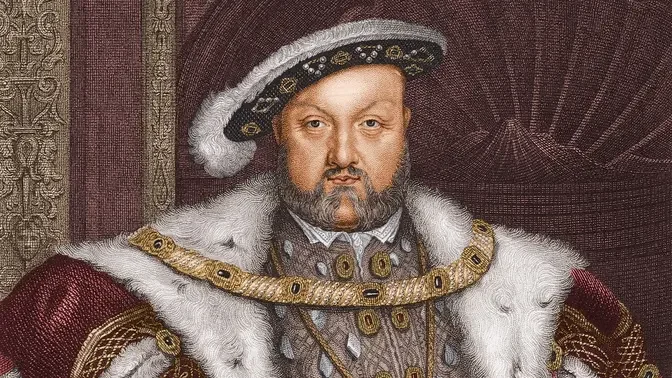
He was a powerful king whose break with the Church of Rome
would forever change the course of English history.
But was he a charismatic reformer or a bullying tyrant?
Find out on History vs. Henry VIII.
Order, order.
Now, who do we have here?
Looks like quite the dashing fellow.
Indeed, Your Honor.
This is Henry VIII, the acclaimed king
who reformed England's religion and government
and set it on course to becoming a modern nation.
I beg to differ.
This is a cruel, impulsive, and extravagant king
who had as little regard for his people
as he did for his six wives.
Six wives?
Your Honor, Henry's first marriage
was arranged for him when he was only a child.
He only married Catherine of Aragon
to strengthen England's alliance with Spain.
An alliance he was willing to toss aside
with no regard for the nation.
Henry had every regard for the nation.
It was imperative to secure the Tudor dynasty
by producing a male heir,
something Catherine failed to do
in over 20 years of marriage.
It takes two to make an heir, Your Honor.
Ahem.
Regardless, England needed a new queen to ensure stability,
but the pope refused to annul the union
and let the king remarry.
Sounds like quite a pickle.
Can't argue with the pope.
And yet that's exactly what the king decided to do.
He uprooted the country's religious foundations
and broke the Church of England away from Rome,
leading to centuries of strife.
All Henry did was give the church
honest domestic leadership.
He freed his subjects
from the corrupt Roman Catholic establishment,
and by rejecting the more radical changes
of the Protestant Reformation,
he allowed his people to preserve
most of their religious traditions.
Objection.
The church had been a beloved and popular institution
that brought comfort and charity to the masses.
Thanks to Henry, church property was seized,
hospitals closed,
and precious monastic libraries lost forever,
all to enrich the crown.
Some of the funds were used to build new cathedrals
and open secular schools,
and it was necessary for England
to bring its affairs under its own control,
rather than Rome's.
You mean under Henry's control.
Not true.
All of the king's major reforms went through Parliament.
No other country at the time
allowed its people such a say in government.
He used Parliament as a rubber stamp
for his own personal will.
Meanwhile, he ruled like a tyrant,
executing those he suspected of disloyalty.
Among his victims were the great statesman
and philosopher Thomas More,
once his close friend and advisor,
and Anne Boleyn,
the new queen Henry had torn the country apart to marry.
He executed his own wife?
That wasn't King Henry's initiative.
She was accused of treason
in a power struggle with the king's minister,
Thomas Cromwell.
The trial was a sham,
and she wouldn't have been convicted
without Henry's approval.
Besides, he wasn't too upset by the outcome.
He married Jane Seymour just 11 days later,
a marriage that, I note,
succeeded in producing a male heir
and guaranteeing a stable succession,
though the new queen tragically died in childbirth.
This tragedy didn't deter him
from an ill-conceived fourth marriage to Anne of Cleves,
which Henry then annulled on a whim
and used as an excuse to execute Cromwell.
As if that weren't enough,
he then married Catherine Howard,
a cousin of Anne Boleyn,
before having her executed, too.
She was engaged in adultery,
to which she confessed.
Regardless, Henry's final marriage to Catherine Parr
was actually very successful.
His sixth.
It only goes to show he was an intemperate king
who allowed faction and intrigue to rule his court,
concerned only with his own pleasure and grandiosity.
That grandiosity was part of the king's role
as a model for his people.
He was a learned scholar and musician
who generously patronized the arts,
as well as being an imposing warrior and sportsman.
And the lavish tournaments he hosted
enhanced England's reputation on the world stage.
And yet both his foreign and domestic policies
were a disaster.
His campaigns in France
and his brutal invasion of Scotland
drained the treasury,
and his attempt to pay for it
by debasing the coinage
led to constant inflation.
The lords and landowners responded
by removing access to common pastures
and turning the peasant population into beggars.
Beggars who would soon become yeoman farmers.
The enclosures made farming more efficient
and created a labor surplus
that laid the foundation for the Industrial Revolution.
England would never have become the great power that it did
without them and without Henry.
Well, I think no matter what,
we can all agree he looks great in that portrait.
A devout believer who broke with the church,
a man of learning who executed scholars,
a king who brought stability to the throne
but used it to promote his own glory.
Henry VIII embodied all the contradictions of monarchy
on the verge of the modern era.
But separating the ruler from the myth
is all part of putting history on trial.