
Pasta Ed Giobbi
69 Video Views·Jul 20, 2023
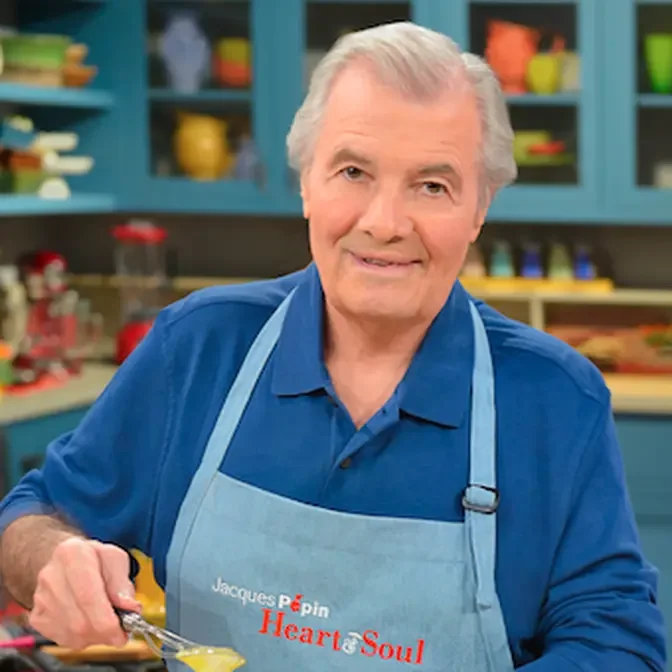
Hi, I'm Jacques Pépin.
Today I'm doing pasta.
Pasta ajiobi, that is a friend of mine
at boiling water here going on.
And I'm going to put the penne right in there.
Of course, you don't have to use penne.
You can use any other type of pasta that you like,
but I like it with penne.
Takes a little longer to cook.
Now, I want to talk to you about that recipe.
This is really the original recipe
for pasta alla primavera.
In like 1976, I think in New York,
I was at Le Cirque and Ciro Maschioni,
they are a well-known restaurant with a friend of mine,
ajiobi, Pierre Franais, and so forth.
And Ciro Maschioni said,
you know, I want to put more Italian recipe
in my restaurant.
And Ed said, well, I have a recipe
that my grandmother always used to make
called pasta alla primavera, that is in springtime.
And he says just for him, it was basically a tomato salad
with some onion, raw, and the pasta tossed into it.
So I've done it many times after that with variation.
And of course, pasta alla primavera now at Le Cirque,
you add cream in it, you add all kind of other things.
But the original recipe was close to that.
So what you do, this has to come back to a boil,
and it is coming back to a boil.
You want to boil it uncovered.
Did I salt it?
Yes, make sure you salt your water.
So onion, this is usually a sweet onion type,
you know, Vidalia onion or something like this, okay.
And you can open your refrigerator
and find all kind of other vegetable that you have there
that you can use in your pasta alla primavera.
I think that's more than enough for my onion.
Put that in a bowl.
Okay, I have zucchini here, cut the end of it.
Little dice, maybe in half, those are nice and firm.
I can see that.
Okay, little dice.
Okay.
I may have close to enough,
or maybe now I put a little more, another half of one.
Maybe, okay.
Now scallion, you can always put scallion.
Make sure that the end you cut with your knife,
you go down and forward or down and backward.
That is, I see many people doing this,
straight down, everything is still attached to the table.
You have to have the motion of down and forward
or down and backward, that is the motion of cutting.
All right.
This, those are so good.
And of course, garlic.
Let's say two clove of garlic should be enough.
I don't want too much garlic there.
Okay.
Again, crush it, remove the skin.
Crush it.
And we will crush the garlic here.
Clean up your knife.
Garlic.
And of course, tomato.
Now you can put the tomato,
what's important really is that the tomato are ripe.
Okay, here.
Then of course, I have basil.
You can put parsley in it.
You can put other type of herb,
other type of vegetable to a certain extent, you know.
It's the type of recipe where you clean up your refrigerator
of all the vegetable.
Even some lettuce I put in it.
A little bit of like Romaine lettuce leftover.
Now I put it in there.
I put it in soup.
Okay.
That's a fair amount of tomato.
Those are Roma tomato, of course.
That should be one more.
Why not?
Okay.
The whole mixture here that I have.
On top of this, I want some salt.
This is salt, huh?
Sometimes people sneak sugar here.
Okay, pepper, a fair amount of pepper.
Olive oil.
We'll put a little more olive oil after.
And then the basil, I think I'll put it later on in it.
So here I have a raw salad.
I don't want it to be too cold
and getting the salad too cold.
So I'm gonna put that in the microwave now.
Put that in the microwave like a couple of minutes
just so that it's lukewarm too.
I'm just starting to soften the vegetable a little bit.
Let's check on the pasta.
And again, the pasta,
it's a question of how you like your pasta.
This is very raw still.
The al dente pasta, that is pasta to the teeth,
is when you break your pasta.
You break your pasta in half or spaghetti
or whatever it is.
And you can see the center of the pasta.
Here, the center of the dough is still slightly white.
It means that there is a little layer
of uncooked dough inside.
That's really al dente.
And some people like it this way.
I don't.
I don't like it mushy, but I like it cooked, more cooked.
When I was in Italy the last time,
we were in Florence and we were in a restaurant
with a group of friends and we had a gratin of macaroni.
And the macaroni were very well done, soft.
And my friend started complaining to the maître d'
that the macaroni were too cooked.
Well, this is the way it's done.
So sometimes you like it, sometimes you don't.
You can always adjust to your own taste.
Okay, this has to be finished cooking now.
And then it will go directly in there into my pasta,
which will go into my vegetable rather.
A bit of herb on top of it.
Some grated cheese.
And we're in business.
Mm, that's fine.
It's cooked.
Okay, so, and they go directly from here.
Maybe with this, get the rest of it.
Very often when I do pasta,
I take a little bit of the water of the pasta
to go in there.
You don't need that here because there is a lot of juice
from the, a bit more olive oil.
Now we're gonna put this.
You pile it up together and again,
cut it in what we call a chiffonade.
Okay.
That goes in there.
Pasta.
I mean, Parmigiano-Reggiano.
A lot of vegetable in there.
Taste it.
Always taste it.
What do you do?
No.
Good.
Fill it up.
Here we are.
Pasta agiobi.
That is the original pasta a la primavera.
Maybe a bit more of this on top.
Pasta agiobi.
Thank you for watching.