
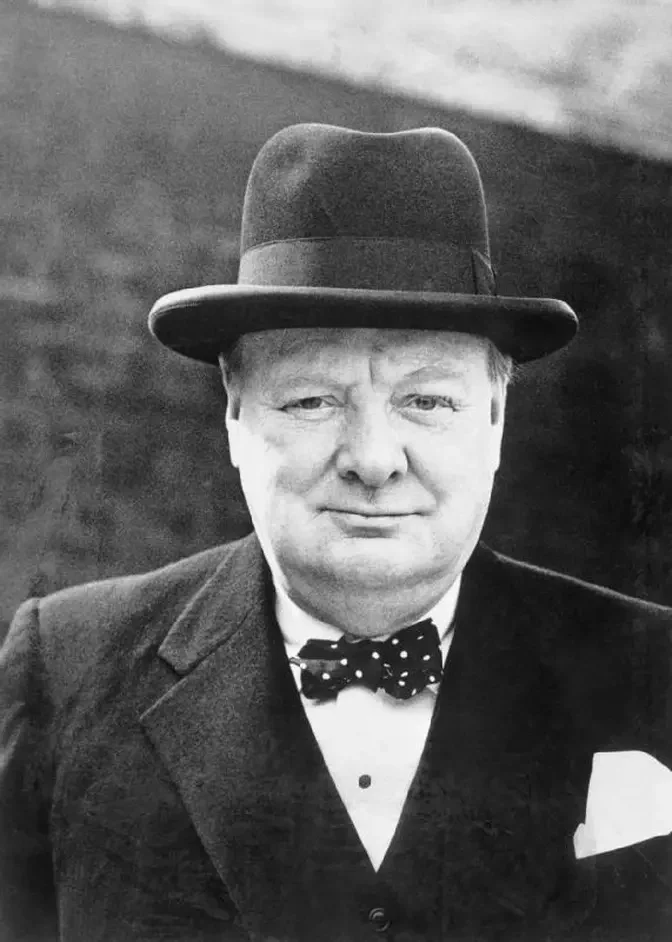
Winston Churchill
20 Video Views·Apr 28, 2023
Dear friends, welcome to another episode of Today in World War II.
Today we'll examine in detail the life and work of one of the most influential personalities of the entire 20th century.
I'll have a Winston Churchill.
Born on 30 November 1874, two months premature, into a noble and aristocratic Spencer family.
His mother was a North American Janey Geron, daughter of North American millionaire Leonard Geron.
And his father was a British politician Lord Randolph Churchill.
Churchill was a rebellious child with mediocre results at school.
But in his teens he devoted himself primarily to mathematics and history, standing out as one of the two best students in his class.
There was no prestigious Harold's College, which he had formed, among many other illustrious ones, two kings, eight prime ministers and several members of parliament.
Since I was young, I had a serious speech problem.
His S's and Z's had a drab sound, but that didn't stop him from developing a great taste for speech.
After failing three times, in 1893 he finally managed to enter the prestigious Royal Military College of Sandhurst,
He graduated eighth in his class of 150 students, joining in 1895 as a second lieutenant in the 4th Cavalry Regiment.
In 1895 he worked as a war correspondent for a British newspaper in Guerra Cubana de Independência,
He was baptized by fire on his 21st birthday.
The following year he went to Bangalore, where he would stay for three years fighting in the Second Anglo-Afghan War.
He would participate in various battles and write various articles for English newspapers and magazines.
In 1898 he was transferred to Egypt, serving in the 21st Regiment of Lance in Sudan.
I would participate in one of the last British cavalry charges in history, the Battle of Ondurman.
In 1899, after losing the elections for a seat in the British Parliament, he went to South Africa to cover the Second Boer War.
During a coverage of the war he was captured and imprisoned, sent to a prisoner of war camp in Pretoria,
But I could escape, walking about 500 kilometers.
His story of flight turned him into a national hero.
However, instead of returning home, he insisted on staying in South Africa,
He would participate in a series of battles, actively contributing to a British victory in that conflict.
Returned to the United Kingdom in 1900, catapulted to fame thanks to his military exploits
And the various articles he wrote on the wars in which he participated in the previous years.
He entered the British Parliament in 1900, joining the Conservative Party immediately.
He met Clementine Hoser in 1904, whom he married in 1908.
Together we would have five children.
In October 1911, he assumed the office of First Lord of the Admiralty,
one of the two most important military cargoes of the United Kingdom,
seen as responsible for the mighty British Navy.
Dedicate yourself immediately to its restructuring and modernization.
Next post, during a First World War,
He was the chief architect of the disastrous Gallipoli Campaign in 1915,
whose objective was to ensure a narrow passage from the Dardanelles,
a single maritime outlet to the Mediterranean Sea,
For the Imperial Russian Navy, stationed at Mar Negro.
The plan idealized by Churchill consisted of attacking the Ottoman coastal defenses no closer,
followed by an amphibious landing which would have had the function of conquering the entire Dardanelles Peninsula,
Allied ships could cross the strait safely.
However, although the British and French managed to land a large force in the area,
The Ottomans were very well entrenched,
And its mighty coastal cannons, protected by the high escarpments,
We're attacking with the freedom of the Allied ships.
A campaign was a complete military disaster,
resulting in the deaths of over 60 million Turks and 50 million British and French.
A repercussion was very much,
lifting Churchill's resignation from the post of First Lord of the Admiralty.
After a Communist Revolution in Russia and the rise of the Soviet Union,
an active voice in the British Parliament against the risk of the expansion of communism through Europe,
Considering a terrible threat.
In his 20s, he began a decline in his political life.
Something that would become more evident after the Conservative Party's defeat in the 1929 general election.
I'd spent most of the last 30 years in relative political isolation.
devoting himself to reading and writing.
During the 1930s, despite being far from the government,
publicly attacked the Indian independence movement,
through the publication of long and contundent articles.
From 1933, after Hitler's rise to power in Germany,
And when it became clear that the Nazi Party was rearming the country,
Churchill was one of the few voices who stood up against what he considered
A serious threat to the stability of Central Europe.
There was constantly a public alerting for the need for the United Kingdom to rearm
And prepare for a conflict that he considered inevitable against Nazi Germany.
I also strongly criticized the government, mainly Prime Minister Neville Chamberlain,
for their passivity in the face of Hitler's increasingly aggressive demands.
After Chamberlain signed the Munich Agreement with Hitler, in September 1938,
which gave Germany a carte blanche to annex vast regions of Czechoslovakia,
Churchill came to the public saying
England had a choice between war and shame.
She chose shame, and so she will have war.
No. 3 of September of 1939,
On the same day that the United Kingdom declared war on Germany after an invasion of Poland,
Churchill was again appointed First Lord of the Admiralty,
The same position he held during the first part of the First World War.
On May 10, 1940, a few hours before the German invasion of France,
And in the face of British failure in defending Norway,
The government of Chamberlain did not resist and fell,
opening the way for the nomination of Winston Churchill for the highest political office, or Prime Minister.
On May 13, 1940, in his first speech as Prime Minister,
In the midst of the German invasion of France, he said:
I have nothing to offer, except blood, suffering, tears and sweat.
He was a tremendous speaker, with a gigantic ability to entertain and engage his audience.
His speeches, mainly those of the first phase of the war,
When the UK was alone in the fight against Nazi Germany,
They have made history, serving to motivate British society in two of its darkest moments.
During the Battle of England, the first battle in history involving exclusively air forces,
When the Luftwaffe launches on the United Kingdom with all its forces,
A Royal Air Force managed to stop the German advance, inflicting a first German defeat in the war.
On that, Churchill would say
Never before in the history of human conflicts, have so many been owed so much to so few.
Referring to the young and fearless pilots of the RAF.
After the fall of France in June 1940, with England completely alone against the might of Germany and its allies,
I'd say one of your most inflammatory and motivating speeches
We'll continue to the end.
We're going to fight in France.
We will fight for our seas and oceans.
We will fight with growing confidence and growing strength in the air.
We're going to defend our island.
No matter how much it costs.
We're going to fight on the beaches.
We're not going to fight in a field of action.
We're going to fight no campo.
It's in the streets.
We're going to fight in the mountains.
We will not surrender.
I'd be devoting a gigantic effort to forging stronger diplomatic ties with powerful allies,
I was very impressed by Franklin Roosevelt, for whom I had great consideration.
It was thanks to this tireless diplomatic effort that the United Kingdom managed to keep itself practically alone in the war.
until the United States officially entered the conflict in December 1941.
I also maintain a close relationship with the Commonwealth member countries,
Com detachment for Canada and Australia.
From 1943, when it became clear that Nazi Germany would be defeated,
There were differences between the British and the Soviets.
A man Churchill accused of conquering Eastern Europe.
These differences would grow more and more, until we reached a critical point in 1945,
When it became clear to Churchill that Stalin would not give up the territories occupied by the Red Army in Eastern Europe.
In 1943, as Southeast Asia was plunged into chaos due to a brutal and bloody Japanese invasion,
A region of Bengal, in British India, suffers from a chronic food shortage.
With supply routes compromised and the war effort draining all resources,
It is estimated that, out of a population of 60 million, about 1.5 to 4 million people died of malnutrition-related diseases.
The situation only began to be controlled in 1944, when the Japanese navy ceased to represent a threat to the region.
The Commission has also approved a proposal for a directive on the introduction of a system for the collection of statistical information on the situation of workers in the European Community.
The Churchill government, which at this moment was entirely devoted to war,
The Commission has been harshly criticized for not taking more active measures to contain a crisis in Bengal.
Critics say the UK could have avoided famine by stopping exports of grain produced in the region.
But defenders claim that in 1943, there was no war in the Pacific and Europe,
as sea routes quite compromised by the Kriegsmarine and the Imperial Japanese Navy,
Churchill could do little or nothing.
In any case, it's a stain that will accompany you forever.
Another rather controversial decision was the Allied bombing of Dresden in February 1945.
When hundreds of British and North American bombers reduced the city of Dresden to a smoldering pile of rubble,
resulting in the deaths of at least 25 million civilians.
Critics attack Churchill, claiming it was a war crime committed against a city that at that time no longer had the capacity to defend itself.
And his defenders claim that, despite the force of the attack being too much,
There is no global effort by the Allies to try to end the war as quickly as possible.
In May 1945, the war in Europe was finally coming to an end and Churchill was reaching the pinnacle of his career.
being recognized by the British population as one of the two main responsible for the Allied victory.
At the time, Churchill was already convinced that the Soviet Union was as big a threat to Europe as Nazi Germany was in 1939,
And so he ordered a plan to attack Soviet forces in Europe.
According to his memoirs, a Third World War should have started on July 1st, 1945,
But the whole plan was rejected by the British Armed Forces.
He would lose the general election of July 1945, taking a seat in the British parliament, this time as an opposition figure.
In 1946, on a trip through the United States, I used the term Iron Curtain to affirm a speech
From the Baltic Sea, no north, to the Adriatic Sea, no south, an Iron Curtain descends over the continent.
Behind it are all the capitals of the former states of Central and Eastern Europe.
The following are the main cities in the European Union:
All these famous cities are in the Soviet sphere of influence.
In the late 1940s and early 1950s, he was a defender of what he called a kind of United States of Europe.
A continent centered on a Franco-German axis, with the United Kingdom, the Commonwealth and the United States acting as sponsors.
Churchill is today recognised as one of the founding fathers of the European Union.
In 1951, he won the general elections, assuming a second term that would last until 1955.
The period also faced serious colonial crises, mainly in Kenya and Malaya, now Malaysia.
This second mandate would mark a turning point in British colonial dominance in the world.
In 1955, with his health considerably deteriorated after successive strokes, he retired from the post of Prime Minister.
He would spend the next few years without parliament, but with a less and less active posture, until finally retiring in 1964.
He died on Sunday, January 24, 1965, at the age of 90, in London.
His funeral was considered the largest in history to date, having been attended by over 350 million people worldwide,
through a great deal of radio and television coverage.
Contrary to tradition, Queen Elizabeth herself made a point of appearing at his funeral, as a sign of respect and gratitude for the work she had done.
He was, without a doubt, one of the greatest British statesmen in history, and a central figure in world history in the 1940s.
He will always be remembered, sometimes hated, sometimes admired, but one thing is undeniable.
He was able, like no other, to lead his people through the darkest phases of human history.