
J. R. R. Tolkien discussing The Lord of the Rings (1960s Interview)
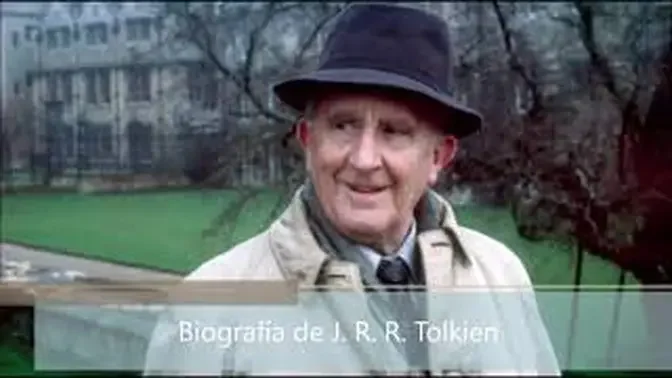
11 Video Views·Mar 19, 2023
Do you feel any sense of guilt at all that as a philologist, as a professor of English language,
with which you were concerned with the factual sources of language, you devoted a large part
of your life to a fictional thing? No, no, I've surely done language all good, you know.
No, I've, I've... No, no, there's quite a lot of linguistic wisdom. I don't feel any
guilt complex about the Lord of the Rings, as many people have said. Now we know what you wasted,
wasted the last 14 years upon. You can now get on and complete some of the
professional tasks which you've neglected. And so, as you doubt right out, I was more busy
working at my proper thing than I've been for a long while. Yes. Is the book to be considered as
an allegory? No, I just like allegory, whenever I smell it. Do you consider the world declining
as the third age declines in your book, and do you see a fourth age for the world at the moment?
Our world? Well, the person my age, you see, is exactly the kind of person who's lived through
one of the most quickly changing periods of narrative history, and that the world is a
totally different place now, at a speed, everybody feels that. Anybody who lives over 70 begins to
feel that. All through history you can see that they do. But surely never been in 70 years so
much change. Oh, surely never. No, this, I mean, one doesn't have to be 70 years old to appreciate
this. The world which I grew up as a small child was indefinitely closer to the world, say, of
Shakespeare. There's an autumnal quality throughout the whole of The Lord of the Rings. There's a
sense of continuous change. Each character feels himself to be part of a story that's forever
continuing. In one case, a character says the story is continuing, but I seem to have dropped
out of it. However, everything's declining and it's fading, at least towards the end of the third
age. Every choice tends to the upsetting of some tradition. Now, this seems to me to be somewhat
like Tennyson's, the old order changeth, yielding place to new, and God fulfills himself in many ways.
Where is God in The Lord of the Rings? You mentioned once or twice. Is he the one above the other? One, yes.
Despite the continuous war between evil, personified in Sauron, and good, you never
personalize or personify goodness. Good is there, but it's totally abstract. You don't attempt to
ascribe any godship to it, particularly. No, no, no, no. It isn't a dualistic
mythology it's based on, no. No, certainly not. But, I mean, the whole book is nevertheless nothing but the
battle between good and evil. Well, that's, I suppose, an actual conscious reaction from the war,
from the stuff that I was brought up in, a war to end wars, okay, which I didn't believe in at the time,
If I can take this a bit further, I may make my point clearer. In battle, Frodo and Sam call on
Galadriel, all their native country. Gimli calls on his ancestor's axe, if I read your appendices
correctly, and the men call only on their swords by name, or on their kings or lords. I would expect
them to call on their gods, and yet amid thousands of names, you don't name the deities of any of the
races you've invented. Why? Have they no gods theirself? I would have thought a story of this sort
was almost dependent upon an intense belief in some theocratic division, some hierarchy.
It is indeed. That's where the theocratic hierarchy comes in. The man of the 20th century must, of
course, see that you must have, whether he believes him or not, you must have gods in a story of this
kind. But he can't make himself believe in gods like Thor, Odin, Aphrodite, Zeus, that kind of thing.
You can't believe that the men in your story would have called on Odin. I couldn't possibly
construct a mythology which had Olympus or Asgard in it, on the terms which the people
who worshipped those gods believed in. God is supreme, the creator. Outside is transcendent,
but the place of the gods is taken. So well taken, I think, that it really makes no difference to
the ordinary reader. It's taken by the angelic spirits created by God, but created before
a particular time sequence which we call the world, which is called in the language AI that which is,
that which now exists. Those are the battle of the powers. It's a construction, you see, a mythology
in which a large part of the demiurgic thing has been handed over to powers which are created
therein under the one. It's certainly likely much more elaborate and more thought out.
C.S. Lewis's businessman is out of the silent planet where you have a demiurgos who's
actually in command of the planet Mars. And the idea there was that Lucifer was really the one
in command of the world, but he fell. So it was a silent planet. That was the idea. Well, this is not
the same as me. Yes, yes. So then you have, in your theocracy, you have an ultimate one
whom you call... It's called the one only. The one only. And then the Valar, who are considered
as living in Valinor. This particular little group of them who moved from other parts of the universe
to this part because they became interested in it. In the book, I get the impression you always see
power as being physically in a high place. You have a high seat with Orthanc, Medusail, Barad-Dur,
the Tars of Minas Tirith and Morgul and Cirith Ungol. They are always high, physically up.
Is power for you always, so to speak, at the top of a mountain or top of a lake? Well, that's just
a symbol, isn't it? Or no, as a matter of fact, it's just a story to anything. You want Tars and
so on that could have them down in the dungeon or underneath it. There are, in fact, Morgul,
the prime mover of evil, of whom Sauron was only a petty lieutenant, lives in a dungeon.
It must be in a fortress or of some kind. Not that Valinor has any high Tars, just...
Well, that is almost without the world you describe, isn't it? It's in the physical world,
according to the myth, until the downfall of Atlantis. I have an Atlantis complex,
in addition to all these others. And quite independent of that, I have a permanent dream
that I had, you know, let's say that the ineluctable wave has been one of my nightmares.
Sometimes coming in over the open country, it always ends by one surrendering oneself.
It comes in all kinds of points. Whenever I used to do a little draw,
nearly always alone, think of the vast oceanic wave coming in. So, of course, I had to write
quite independently the Atlantis stories, which I call Númenor, which means the land of the
extreme West. Well, this is the fable, you see. The whole question of the human, Paul,
is left off the stage, actually. It occurred, but you know, not known since the regrace of
these people. They were given this great island, the first of all West, not in the divine world,
not in the immortal world, to live on. Then, of course, we always come up seemingly
meeting this band, like the throat of the tree of evil. Lewis used the same thing
in his parallel. Their band was, they mustn't say, a West. They did.
Hence the ultimate downfall.
It then became an intellectual. It lived then only in memory. It lived in time,
but not present time. And, of course, Númenor was drowned, and the Earth,
the paradise was moved, and so then you could then get South America.
So, the world became round. It always had been a vast globe, but people can now sail around,
discover it. That's where my solution of the thing. I also wanted to give the former Atlantis some
universal application. The point is really, I've written some stories about it, which,
as they get to that, you suddenly see the view coverage of the world going down like a bridge.
You're on a line which leads to what was, because I don't want your theory of time
what is. If it ever had an existence, it still has that same existence.
But you can't go too deep in those things, but they really are sailing back to a world of memory.
In this world which you might have created, had you been given the power to do so,
had you been one of the Valar, had you been, say, the Marked God,
would you have created a world which is so solidly feudal as the Lord of the Rings?
Yes, very much so. Yes, I think the feudal... I mean, you mean feudal...
In the widest sense. Not in the strict way.
Oh, no, no, no, no, no. In the widest sense.
Hierarchical, rather, yes.
Hierarchical, exactly.
I mean, that power should descend by a line of kings to their sons, this sort of thing.
Yes, yes, yes. I don't know about that. No, it's a very potent story-making and motive thing, but
how far I would say it has really worked better than any other system in looking at the history
of the world, one doubts pretty much. It's never been worse, at any rate, than the
struggle for power that always ensues when you haven't got some
line of descent which can't be questioned.
You're wedded to the feudal system.
In a sense.
Not, I don't mean the medieval feudal system, but the idea of power descending through blood or
marriage or...
Yes, I'm rather wedded to those kind of loyalties, because I think, contrary to most people,
touching your cap to the squire may be damn bad for the squire, but it's damn good for you.
Do you find a continuing interest in The Lord of the Rings by people?
Do people still write to you, despite the fact that the book's been out for 10 years?
Dozens of letters a week, you know. Always have to keep it safe as you answer them, you know.
Were you surprised at its success?
Nobody would have been more staggered, you know, unless it was possibly for Stanley Edmund.
I was up at Stanley Edmund's birthday celebration, and a bookseller came up to me.
I don't usually greet him since forever, but he said that while he got a copy,
it sold so well it practically kept him going for a while.
Well, he gets his guinea off the set, you see.
Almost the last question.
Do you, in fact, believe yourself, not in the context of this book,
believe in the sense of straightforward, strict belief,
in the Eldar or in some form of governing spirit?
Well, the Eldar must be distinguished. The Eldar are only...
The Valar, I mean, I'm sorry.
Are you, in fact, a theist?
Oh, I'm a Roman Catholic.
Without Roman Catholic, yes.
But I don't know about angelology.
Yes, I should have thought almost certainly.
I mean, yes, certainly.
Well, they seem to me to be the saints, or the equivalent of the saints.
Well, sure, in some way, yes.
Take the place in this book of the things which in many Hebrew and other legends
you have the gods and the invocation to the saints, which are lesser angels.
Yes, they do.
Oh, well, obviously, many people have noticed the
appearance of the Lady of the Queen of the Stars,
which is almost like Roman Catholic invocations of Our Lady.
Do you wish to be remembered chiefly by your writings on
philology, on other matters, or by the Lord of the Rings and the Hobbit?
I shouldn't have thought of that.
I've got very much choice.
And if I remember at all, if it were by the Lord of the Rings, I'd take it.
I wouldn't mind the other being remembered,
but I am conscious that the small are not very important.
Wouldn't it be rather like the case of Longfellow, wouldn't it?
They remember, people remember Longfellow wrote Hiawatha,
and perhaps one day they'll quite forget he was a professor of modern languages.