
Winston Churchill - Prime Minister - Mini Bio - BIO
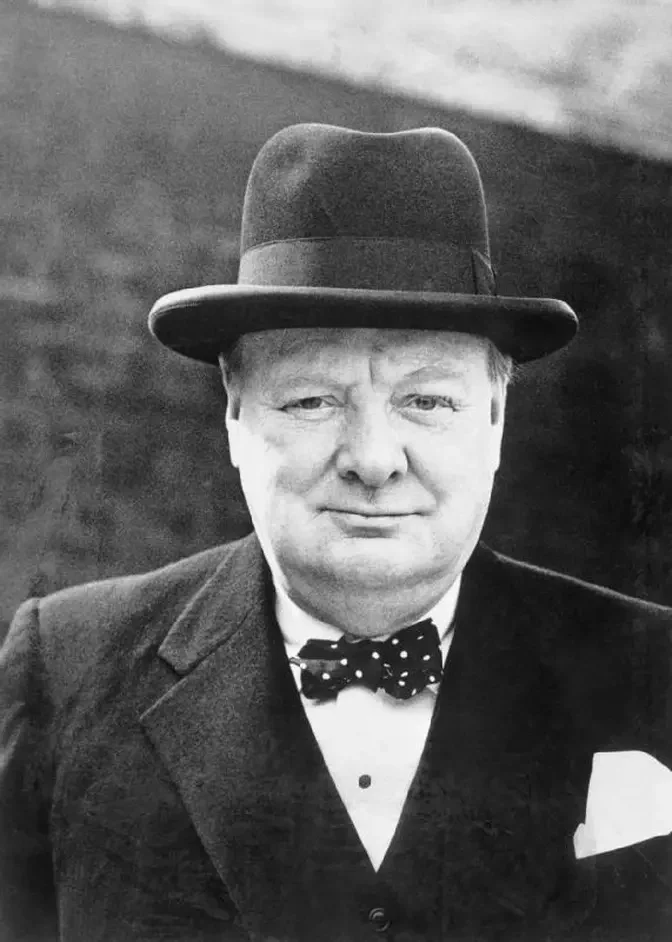
54 Video Views·Jan 20, 2023
He was an action hero. He was a historian. He was a journalist.
He combined incredible decision-making, very clear decision-making, with amazing rhetorical skills.
Sir Winston Leonard Spencer Churchill was born into a wealthy family on November 30, 1874,
in Blenheim Palace, Oxfordshire, England.
He went off to war very early, first as a correspondent and then as a combatant.
He had this dramatic escape from prison camp in the Boer Wars in South Africa.
That was printed, and he became a kind of national figure at a very early age.
Just before World War I, in 1911, he was the first Lord of the Admiralty.
In 1915, he resigned his position in the government and went to France to fight
on the front lines until his unit was disbanded in 1916.
After World War I, he was out of favor with the British.
He'd made a decision about Gallipoli, about going ashore there and having that invasion,
trying to cut off the Turks. It turned out to be a disaster.
So he retreated to his country estate, wrote, lectured, stayed attuned to what was going on.
He was something of a maverick politician, and not everyone got along with Winston.
It took the 1930s, with the international circumstances of the rise of Nazi Germany,
that made people consider Winston Churchill a potential national leader.
When World War II began to rise out of the darkness of Nazi Germany and Great Britain
knew that it was in peril, there were lots of Tories who said that Churchill
needs to be brought back into government. Churchill returned as first Lord of the
Admiralty the day Britain declared war on Germany, September 3rd, 1939.
Less than a year later, he became prime minister.
Churchill brought a great clarity of thinking of the reality of the threat that Adolf Hitler
and Nazi Germany meant, not just to that island nation, but to the world.
He also brought an ability to mobilize the English language as a fighting force.
In his speeches, in his radio interviews, in his reports to the nation, he gave them hope.
In the summer of 1940, Hitler launched what Churchill termed the Battle of Britain.
At the time, it was the largest sustained aerial bombing campaign in history.
In London alone, more than one million houses were destroyed
and more than 20,000 civilians were killed.
Churchill offered full support for the Soviet Union in June of 1941,
when Nazi Germany attacked the USSR. He famously said,
if Hitler invaded hell, I would make a favorable reference to the devil in the House of Commons.
The story is that when he got the word that Pearl Harbor had been bombed,
he was joyful, not because the United States had been attacked,
but because he knew that the United States would have no choice
but to get into the war, and now it could be won.
On May 7, 1945, Germany surrendered to the Allies.
More than 300,000 British soldiers and 60,000 civilians died during the war.
In July 1945, Churchill lost the prime ministership, but remained a force in government.
In 1951, he was again elected prime minister,
under the impression of a potential expansionist Soviet Union,
and people felt that Winston Churchill was the right person to stand up against tyranny.
In 1953, Churchill was awarded the Nobel Prize in Literature and knighted.
He served as prime minister until 1955,
and afterwards continued to serve in the House of Commons until 1964.
On January 24, 1965, when Churchill died,
the state burial was one of the greatest meetings of political leaders of the 20th century.
I think Churchill will be a great man down through the ages,
and you could not have had a better ally in every sense of the phrase.
He gave voice to the common hope of free people.
I think he's one of the great men, not just of our time, but of all time.