
Auguste Escoffier, au fil du temps
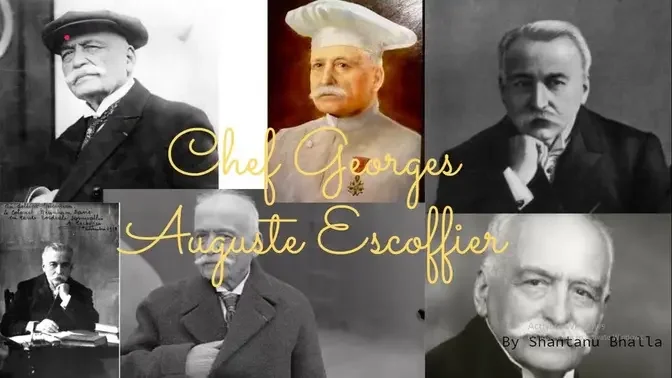
32 Video Views·Dec 25, 2022
Beaches, palaces, gastronomic restaurants,
the prestige of the Côte d'Azur is at the rendezvous and its authenticity is just as much.
Overflowing with tastier products,
chefs do not hesitate to come and settle on the French Riviera to develop their art.
Niché, between Nice and Cannes,
the Musée Escoffier welcomes you for a gourmet visit at the heart of culinary history.
It is here, in the pretty village of Villeneuve-Loubet,
that the story of the greatest ambassador of French gastronomy began.
Auguste Escoffier was born in Villeneuve-Loubet.
At the age of 13, he had to learn a trade.
He would have liked to be a sculptor, but his father told him that sculpting was not a real job
and that he had to learn cooking,
which he did with his uncle who had a restaurant in Nice.
He spent five years in difficult conditions.
At the time, in particular, the working conditions were very difficult.
Once he became a chef, he swore to do everything in his power
to improve the working conditions and even the status of chef,
which at the time was not very considered.
Curious, observant and entrepreneurial,
Auguste Escoffier then climbed all levels of the profession.
The traces of his exceptional career are now well kept in the heart of the Musée.
The only museum on the history of gastronomy in France.
It is unique, it is located in the house of the master
and we have, through ten large rooms, collections from the 19th century,
menus, tables, a pastry art room,
a room dedicated to children with the expressions of Argaud,
such as Bring back your strawberry or have a heart of artichoke.
We also have different collections
that remind us a little bit of the history of the hotel and restaurant
at the time of Ritz and Escoffier.
Throughout his career, Auguste Escoffier has changed his habits.
His only words of order, transform, change, create,
without forgetting the basics of cuisine.
A innovative spirit, a real model today.
Escoffier, I would say, was the father of modern cuisine.
First of all, he really got into the history of the product
and then he left us a considerable number of recipes,
of cuisine and then, I would say, of recipes, of management.
Because when you read the great book of menus,
of course the reading of the great book of menus is interesting,
but above all it was the conduct, the sense of work,
the managerial sense, as we could say today,
that this man managed to impose in this world,
which was still a rather hard world,
he explains it in the great book of menus,
with this type of management, with 60 collaborators,
I serve 500 cuvées in two hours.
So he had invented everything.
He was an educated man, he was an educated man,
so he left this culinary heritage,
but also a managerial heritage for all the brigade chiefs today.
At 37, Auguste Escoffier enters the sphere of the great international hotelry
and inaugurates the Ere des Palaces.
In 60 years of professional life,
man has shaken up the culinary landscape,
rationalized the work of the cooks and created the parties,
a method of work still popular today.
We have a lithography here from 1865,
which is made for the Paris Universal Exhibition.
We find the post of the food guard,
right on the left, the cook,
a key post for us too,
because it is the work, one of the first,
of Auguste Escoffier after his apprenticeship.
And then everyone who deals with the furnace,
the central piano, where we have the intermediaries,
the fishmongers, the commissorier.
And we finally find in front of the furnace,
the chef who works with the cook,
who sets the plates on this table,
which bears the same name since the end of the 18th century until today,
the pass.
And so everything is done above,
to then go to the dining room.
Passing on passion and technique
was also one of Auguste Escoffier's points of honor,
skillfully distilled advice,
thanks to his meetings,
one of which gave birth to this museum.
So he was the head of Carleton in London in 1906,
at the top of his art.
He comes back to Villeneuve-Loubet to visit his family.
He is the guest of the Marquis de Panispasside,
who is therefore the owner of the castle at the top of the hill.
And that night, it was the young Donon,
who at the time was 18 years old,
who is in charge of the dining room.
And at the end of the dinner, with the permission of the Marquis,
Escoffier offers Donon to come and work with him in London,
which of course, for an 18-year-old,
was an unexpected opportunity.
After a return to France in 1914,
he made an extraordinary career in the United States
and became the promoter of French cuisine,
that of Auguste Escoffier.
Donon always kept a very large number
for his master, Auguste Escoffier,
and also a great recognition.
He had the idea of creating a foundation
in the name of their great master, Auguste Escoffier.
To do this, the Escoffier family,
and in particular my uncle Bernard,
donated most of the house
to install this museum of culinary art.
A museum that is full of the very essence
of the father of modern cuisine.
Piano or professional ovens from the 1950s,
turntables, moulds, daubières, braisières, tri-pierres,
utensils, inventions and other sometimes surprising writings,
went through the years without even taking a ride.
What does Auguste Escoffier represent for modern cuisine?
An extraordinary heritage.
French, but above all planetary.
That is to say that you cannot visit a cuisine in the world,
a palace cuisine, a great hotel cuisine,
without finding in French or English
the culinary guide or the great book of menus.
A modernity that can also be found
by touring certain rooms of the museum,
such as the most greedy of them all.
Beware of the eyes and the splashes,
the smell of chocolate sculptures
will surely not leave you indifferent.
The pastry art room is a room
dedicated to this extraordinary work of the pastry chefs
who helped us to make it.
Where we find chocolate sculptures,
some are made from 12 to 40 kg of material.
We also have a work on sugar,
whether on the pastillage or on the cooked sugar,
where we have, for example, the sugar pulled,
the sugar strained, the sugar bubbled.
And this is a work that we owe to the artist Stéphane Klein.
Friends, collaborators, family,
all are there for the desire to perpetuate
the memory and work of Auguste Escoffier,
through the museum first,
then thanks to the Escoffier Foundation,
recognized as a public utility.
The Auguste Escoffier Foundation today
has first of all as its first task
to make this museum work,
to manage the Musée de l'Art Culinaire.
Then to always be involved
in professional training in particular.
And then now we are also linked
to an American group of investors
who have created two schools
named Auguste Escoffier School of Culinary Art
in the United States.
And they started Escoffier Online about two years ago,
where people who do not have the time or means
to go to school for a long time
can learn techniques or recipes.
And who says passion says transmission.
In love with French gastronomy,
it was unthinkable for Auguste Escoffier
not to share his knowledge.
Today thousands of disciples are gathered
around the world and pass on his legacy.
I think that today Auguste Escoffier
would indeed be very proud to see
how this association has developed
called the Disciples of Escoffier International,
which has 25,000 members around the world
in the five continents.
Including for example in Japan,
we have 1,200 disciples
who are all perfectly able
to make high-level French cuisine.
At the head of this Association of Disciples,
a brand new president, Thierry Marx,
always inspired by the work of Auguste Escoffier.
There is no serious conflict
between tradition and innovation.
And he shows cooks
what is absolutely necessary to do,
which is to learn,
not to consider things
as acquired indefinitely.
So we have to show
that the reading of the Guide Thuner,
the reading of the great book of menus,
allows young cooks
to learn recipes,
but then to have a look
a little further
on the development of their profession.
That's the word of Escoffier,
that's what he left us in heritage
in the French Patrimoine Thuner,
so we have to continue
to promote this image
and this know-how,
and then make the desire
clear among young cooks
to be interested
and to show
that this French gastronomy is doing well
because it has the heritage
of Auguste Escoffier,
as Escoffier had the heritage
of Urbain Dubois or Antonin Carrel.
In 60 years of professional life,
Auguste Escoffier changed
the culinary landscape
and laid the foundations
of French gastronomy.
His work was the first French cook
to receive the Legion d'Honneur
before being made an officer.
Today, his history persists
and continues to be perpetuated
by his disciples,
true ambassadors of the famous
cook of kings, king of cooks.
A story to be discovered
in the heart of the only French museum
of gastronomy and culinary history,
the Auguste Escoffier Museum.