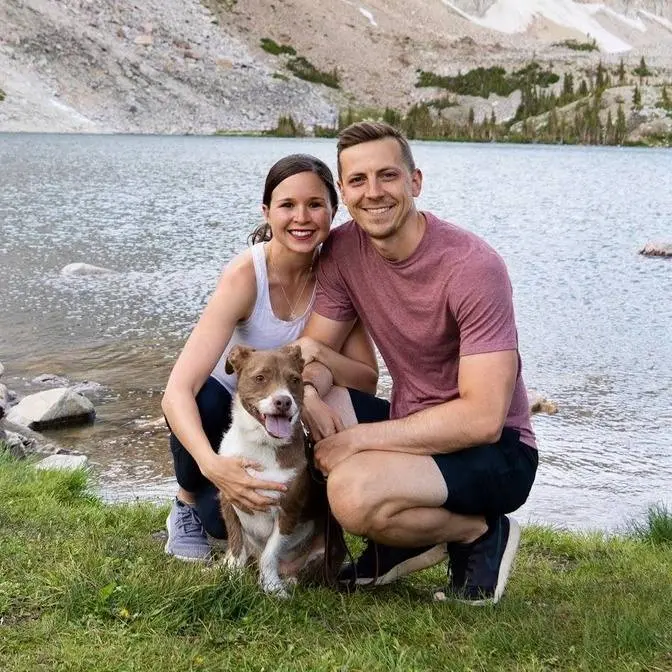
We have officially made it to New England! For our first stop we're in Vermont and we couldn't think of a better way to start out our time in the state than experiencing the #1 thing we think of when we think of Vermont...maple syrup! 🍁 We went on a free tour of the AMAZING Baird Farm where we learned all about the process to make maple syrup, sampled different grades of maple syrup, and then tried maple creemees for the first time!
👋🏼 About us Hi y’all! We’re Adam, Kathryn, and Kona, an adventurous married couple (+ pup!) living on the road in our self-converted sprinter van! You can often find us driving all around the US and Canada, scoping out the best coffee shops, eating tacos and ice cream (we're a 5+ taco and 2+ scoop household), and enjoying nature.
We help travelers spend less time (and stress!) planning their trip and more time enjoying it! Our detailed travel guides, YouTube videos, and travel resources share the must-visit local eats, popular and off the beaten path sights, and tons of tips to make planning your next adventure a whole lot easier.
Note: We’ve linked a handful of items so you can see exactly which products we take with us. Full disclosure--if you click on these links and make a purchase, we get a small commission at no extra cost to you. We will only ever recommend products we truly love, actually use during our adventures, and think you can benefit from too!
I'd say it was a pretty sweet first day here in Vermont. Literally.
Oh, that's really good.
We have officially made it to new England.
Visiting new England in the fall has been a goal of ours for years.
And we are so pumped to spend the next month visiting a few different new
England States, checking out small towns, seeing fall foliage,
going for hikes and so much more.
And to kick off our new England adventures we're spending this week in Vermont.
And today we are experiencing the number one thing we think of when we think of Vermont,
maple syrup.
Vermont is the largest maple syrup producer in the United States,
with just over two million gallons produced last year,
over half of the total of production for the U.S.
And today we're going on a free tour of Baird Farm,
which is a maple farm in central Vermont,
and has been in the Baird family for over four generations.
Although it's not sugaring season,
which typically starts in late February and goes for four to six weeks,
and that's when maple syrup is actually made,
we're going to hopefully still learn all about the process to make maple syrup,
and most importantly, try some treats.
This is Jacob,
and today he's going to teach us all about maple syrup and Baird Farm.
Baird Farm has been in the family since 1918 and started as a dairy farm,
but in the mid-90s the farm shifted to maple syrup as the primary crop,
and is now home to almost 14,000 sugar maple trees.
There are many different types of maple trees.
For the most part we have these trees, sugar maple trees, right?
Which a lot of people associate with like the fall,
because they turn bright reds and oranges and yellows.
We're certified organic here,
so we have to abide by stricter standards than most farms
when it comes to like forest management practices, right?
And we want to wait until a tree is maybe 11, 12 inches in diameter
before we start tapping it.
Maybe that tree is then 25, 30 years old.
It really varies.
Like this tree probably looks older than it is.
Kind of how some people look older.
How do trees make energy?
Photosynthesis, right?
Big science word, photo, meaning light, right?
The leaves are like little solar panels and they dance in the sun,
and they take in CO2 and they put out oxygen,
and as part of that process they're making little nuggets of energy,
little nuggets of carbohydrates, sucrose, right?
That's where the sugar from maple is found.
It gets smashed together with water content
that the tree brings up from the roots.
Folks call that transpiration in science.
And it's the dumbed down 101 version of like, what is sap?
In the wintertime, most of the sap is hanging out in the base of the tree,
like the lower trunk and the roots of the tree, right?
And when it freezes and thaws and freezes and thaws
in this late winter, early spring, right?
Things expand and contract.
Think about ice in your freezer, right?
There's a pressure dynamic there, right?
As things freeze and thaws and they expand and contract,
the sap and also gas, there's a lot of gas in a tree,
fun fact about trees, it gets forced up that xylem.
13,726 trees, so it takes us weeks and weeks and weeks
to tap all these trees.
What do I mean by tapping trees?
Let's back up.
Tapping trees, this quick snapshot of the season.
We drill 13,726 holes into these trees every year.
Every year you have to tap.
Every year, fresh hole.
Every year we pound a tiny little spigot or a spout
or a tap into that hole
and then we fix the tubing onto the spout.
Then it'll go drip, drip, drip out that wound,
down this tubing, down these lines
that are all plumbed on a slope
to lead to larger and larger lines.
These larger lines then go into tanks
in one of the pump houses
where the sap is then pumped up to the sugar house
and goes into another tank.
And if you kept sap in a tank
and it's getting hot towards April,
it gets a little funky, right?
So we wanna work with it fast.
The best maple syrup, whether you're in Minnesota
or Vermont or Quebec is in a tree
and it's in a barrel as fast as you can move it, right?
This tank holds like 6,500 gallons, right?
We boil when this tank fills
and this tank can fill really fast.
On a good day this year,
this tank can fill up in like two, three hours, right?
And so we can do that over and over and over again.
It's like a river of sugar water coming off the mountain.
So you need to move it
because it will overflow like your bathtub, right?
And so from here, we talked about this,
we hinted about it.
We use reverse osmosis machines.
Remember high school bio class?
Someone out there, maybe he nodded yes.
How it works is like there's really fine filters,
high density, well,
really kind of like fine micron rapid membranes
and you force sap through it
and clean H2O can pass through these really fine filters
but everything else can't.
Like all the particulates,
you end up separating like the sugars, right?
And the minerals, everything else we love
about Naples, Europe.
So from here, you get two things.
You get a lot of clean water
and you get a little bit of concentrated sap.
Then we pump the concentrated sap to tanks up there.
See there's more tanks up there.
There's about 25,000 gallons of liquid storage here.
And then we run it into a machine like this.
These are big burners, like big flame throwers
that do flames out underneath, right?
There's different pans with baffles and flues.
And so as it comes in,
the concentrated sap at this point,
it's not 2% after the reverse osmosis machine.
We're boiling typically maybe 18 to 20%
concentrated sap here.
Then it will boil and bubble and steam, right?
You create a flow.
So as you feed it more sap,
it gets thicker and thicker and thicker.
Maple syrup occurs generally at 219 degrees Fahrenheit
when the sugar density reaches 66.9%,
which is determined by a hydrometer.
It is then filtered and whatever syrup
they do not sell to the bulk market
is bottled for their store.
From getting the sap from the trees to bottling,
it takes about 45 to 55 gallons of sap
to make one gallon of syrup.
And for the final part of the tour,
we're going to try four different grades of maple syrup
ranging from light to dark,
which is determined by when in the season it is made.
It's all like personal preference
on whether you like a light syrup or a dark syrup.
This syrup we're trying right now
is called Golden Delicate.
It's kind of light and subtle and passive
in its mapleness.
From here, it will only get more kind of like caramely
and malty-ish.
Mm.
Oh, that's really good.
Is it good?
Oh, it's so good.
Oh, it just tastes like dessert.
This one's called Amber Rich,
which survey says is the most popular.
When syrup?
Mostly to make a big, you know, like,
so when you reach...
Oh, this one is even better.
...it tastes like Kirkland every single time, right?
This tastes just like pancakes.
Like, basic nature facts,
like a kernel of corn is like a sugar-dense little thing.
I'm telling you, it's getting better and better.
...to make sugar syrup.
It's a stronger flavor.
Tastes different, but I can't say why.
I don't know why.
Darker and robust.
That last one we tried, Dark Robust,
Jenna's favorite.
It's normally what we have in the fridge.
It's like a good versatile syrup.
Lots of times, the darker syrup is marketed
as like a cooking syrup
because it just has stronger flavors, right?
This one is the strongest one we make.
It's called Very Dark Strong.
Well, it's not the strongest syrup we make,
but it's the strongest syrup we're allowed to sell
to folks like you.
Technically, you can't sell that
really late season syrup to consumers.
Folks, locals call that Buddy Syrup or Ropey Syrup.
The season really ends when it stops freezing
and the buds come out.
Because when the buds come out,
the energy inside the sap go towards leaf production
and that wound is healing up
so you get less drips per sap, per spout.
And the sap that we are collecting
gets a little beezy, kind of like we talked about, right?
This is the one like a lot of younger Vermonters
or New Englanders will just tell you
is the best.
Dudes tend to like it more too.
There's like a machismo thing.
Puts hair on your chest.
It tastes like almost like chocolatier.
Yeah, roastier.
Like sometimes it almost has like a bite on it.
It has a different flavor, so.
Like entang that molassiness.
I like the stronger and stronger.
They're all so good.
Those are the four main grades.
Golden, amber, dark, very dark.
In addition to that, we make these infused syrups.
The new trendy thing to do in Mapleland
is to like stick vanilla beans in maple syrup
or cinnamon or things like that.
We make two infused syrups
that come from stuff that we forge
like spruce tips and mint leaves.
It smells a little different.
Spruce tips.
A lot of these are also geared towards
like the cocktail market.
Oh, wow.
It's good though.
I do taste that rosemary.
Yeah, it's really good.
The mint, we go out and we cut 66 quarts
of wild spearmint from the pasture
and then we hot steep it in a drum of maple syrup.
So it gets, like it turns into
like a liquid Andy's mint bar, essentially.
Mint maple syrup.
It smells like mouthwash.
Oh.
I'm not a big mint fan, but I could do that.
That's good.
I think we all tried to do it.
Everybody try everything.
This would be super good with like a dessert.
There'll be more.
We had such a hard time deciding
which maple syrup to buy.
Every single one was so delicious,
but we went with the dark robust,
which is the second darkest one.
Going into the tasting,
I thought I'd like the lightest one the best.
It just tasted so sweet.
I was like, how does it get better than this?
But each one got tastier and tastier
and they all taste different,
but it's really hard to explain
how they taste different.
They just do.
And the infused ones are really, really good too.
But the tour was just so much fun and educational.
You learn so much about the behind the scenes
of what goes into making this product
that you know and love.
But this is the legit stuff.
It was really cool to see the care
and craftsmanship that goes into this.
And it's a one ingredient product.
It's just the sap that's boiled down,
turned into maple syrup.
But there's so much work that goes into
making this one ingredient product.
It was just really, really interesting to learn about.
And Jacob was hilarious.
So such a fun tour.
So a big thank you to Jenna and Jacob
for letting us film the tour
and just teaching us so much about this.
This is probably like the most like
true authentic Vermont experience
we could start out with.
I hope so, yeah.
But our maple syrup adventures
are not quite over for the day.
I have a huge sugar rush right now,
but we're not stopping yet.
Okay, but before we continue
our maple syrup adventures,
Jenna was telling us about this
giant pumpkin growing subculture worldwide
where people just grow massive pumpkins
this time of year.
And hers didn't end up growing very big this year.
Last year, it was almost a thousand pounds.
But her friend is bringing over
his 875 pound pumpkin.
So we're going to wait around a minute
and try to see it
because I can't even fathom how huge that is.
There's not one, but there are two
giant pumpkins here.
Holy cow.
Correction, it is 895.
It's not every day you get to see
an 895 pound pumpkin.
We had really good timing.
That was super cool to see.
But now it's on to more maple deliciousness.
So maple syrup isn't just consumed
in its purest form here in Vermont.
It's also popular as a frozen treat
called a creamy,
which is basically just soft serve ice cream.
You can get it in different flavors,
but maple creamies are all the rage.
We just drove 30 minutes north of Baird Farm
to a place called Vermont Maple Market
to try our first ever maple creamy.
All right, in A plus K fashion,
ice cream fashion, it's melting.
Oh no!
But we got two large maple creamies
with a maple crunch candy on top
and there's a bee attacking us.
All right, it's dripping.
It's go time.
Oh yeah.
Oh my God.
Crunchy with the maple candy on there.
It's like a subtle, like sweet maple flavor.
It tastes just so good.
It doesn't taste like artificial.
Yeah.
Like super overpowering.
It's sweet, but it's not like...
Doing just maple syrup is super sweet, obviously,
but this just has like a subtle creamy sweetness.
Perfect balance of sweet and just creamy.
We're now covered in maple products.
We have sticky fingers.
I've got drippage here
from my maple syrup chugging photo shoot
we did for the thumbnail of this video.
And we have a little bit of a sugar coma,
but I'd say it was a pretty sweet first day
here in Vermont.
Literally.
We're now going to head north
to stay at a Harvest Host Farm
and then tomorrow we're going to get up
and explore the city of Burlington.
We sleep in a lot of cracker barrels.
Don't knock a cracker barrel.
It's our home.
Liz, fast draw and a good listener.
15 points.
Yeah.
I think that one's worth 20.
It's worth 20, she's fishing.
You know, you don't win anything,
but it keeps you competitive.
But like squirrels and chipmunks are like the...
Nemesis.
Yeah.
Good vocab.
That's a T word.
20 points.
Nemesis.
Yeah.
I just think like squirrels...
Chipmunks are the worst.
Honestly.
They're just like look a little more...
Good thing we killed one this morning.
That's right.
I'm trying to help you out.
Do me a favor.
Trying to help you out.
Sugaring is basically like outdoor plumbing
is like the unromantic way to think about it.
Adam knows about this
because he has a nature's head composting toilet.