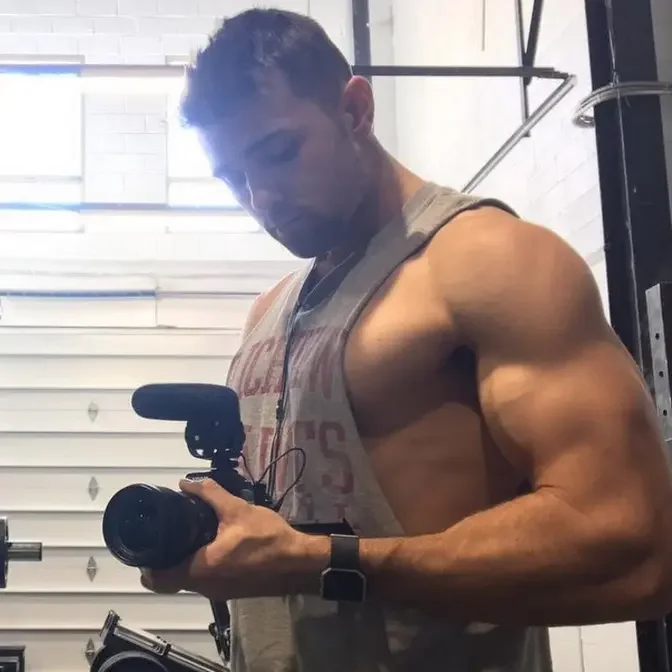
In this video, I show you how to do a proper dumbbell curl for the best results possible. I want you to continue to get the results you deserve, so listen to these tips and add them in every-time you do hammer curls.
What is going on everyone? Josh from Kloss Fitness. Today I'm going to teach you how
to properly perform the dumbbell bicep curl. To grow those biceps, I'm going to
waste no time. Let's jump right into it. So first things first, it's weight
selection. Start lighter. You don't need to be a hero. People that start really
heavy are putting themselves in a bad position. Especially if you're learning, I
really recommend you start supinated. So you're starting with the dumbbells in
front of you open. The reason for this is some people really struggle with coming
through with this motion. They won't engage as much as their bicep. They're
going to kind of turn into a hammer curl with a late turn. So instead, just start
open and really work on that contraction. Next up is your elbow positioning. We
don't want to be behind us or it's not going to work. We don't want to be too in
front of us. We're going to be bringing our shoulders, our back, and just really
building a bad habit. So instead, start strong. Elbows are a little bit in front
of you. I've got my feet dug in the ground. I'm bracing my abs. I'm going to
curl up the dumbbell towards me. And what I'm going to do, and what I'm not going to
do, is I'm going to envision I'm curling through that bicep. I'm not swinging up
my elbows. I'm not using my shoulders. So we want to actually be able to contract
those biceps first. As silly as it is, if you want to stand there at the computer
and practice doing it, you can see the difference between me squeezing my bicep
and me just flinging my arms. It's a big difference and you're going to want to
use this in movement. So I recommend starting open, curl up into your bicep,
big squeeze, nice slow control down. So biceps in particular, you want to pay
attention to that negative at least two seconds. Get a strong powerful squeeze.
Squeeze that muscle. Come down. One, two, and we're back. One, two. So that's just a
really quick intro on how to do it. So now we're going to break down some common
mistakes, how to avoid them, and how to ensure you're doing this right. Before I
show you my three common mistakes, I've got a free gift for you down below. A full
form guide filled with exercises, before and afters, all the common mistakes
neatly listed. You can see it on the screen. No screens attached. Just my gift
to you. Pick that up. It's going to help you in the gym, personal training in your
pocket. But number one, as you could probably guess, is not utilizing full
range of motion. So where a lot of people go wrong is you'll see half curls, people
just kind of repping it out, you know, grabbing the heaviest weight they can, feeling
good. This doesn't really have a place. In particular, biceps is a small muscle.
Burn it out. Really push it. Really engage it. You can get a lot of alternative work
for the bicep, you know, obviously through stabilization of the deadlift, through
chin-ups, pull-ups, different movements like that. But with curls in particular,
I like a lighter weight. I really like to see a full range of motion. So what that
means is, first and foremost, that you're coming all the way up and squeezing. And
secondly, and most importantly, that you're coming all the way down. But what
you don't want to do is lock out that elbow. The second we lock out that elbow,
we're putting a lot of tension on that joint. That's how you can cause a lot of
pain, get tennis elbow, a lot of negative things. So instead, you're curling up and
we're coming and we're stopping just before we lose that tension on the bicep.
So here, tension is transferred from my bicep to my elbow joint. Once again, we
don't want to try and strengthen joints. That's not how it works. We want to
strengthen the muscles. So I'm up, I'm stopping just below while I still have
tension, and coming back up. And this way, we're safely engaging the muscle
throughout the whole movement and we're not engaging joints. So once again, it's
gonna look like me coming all the way up, big squeeze, coming just below just
before I lock into those elbows. This is my safe space. Coming up. Me coming to my
elbows would look like this. I'm fully losing tension, I'm minimizing the
movement. Keep that tension, big squeeze, come down with control, up, big squeeze,
keep that tension, rinse and repeat. Number two is something called hooking.
So this is pretty common, especially when you do do the open arm curl. So when
you're starting in a neutral grip and we're curling up. So for me, naturally
your body's smart. It wants to do the most efficient thing. And in it's mind,
it's like my back's strong, I can hinge, I bring my shoulder, and I can hook up. So
hooking is best described when the elbow comes in front of you, you're bringing in
some shoulder, you're bringing in some back, some momentum, maybe even the hips, and
you're hooking up. We don't want that. Yes, you can lift heavier, but you really need
to think like, is it good if you can curl 60s but you're doing it improperly and
your arms look like crap? No. You know, use the lighter weight, do it right, learn how
to really do it. This is a movement where you really want great hypertrophy, you
want great contractions. So avoid hooking, keep that form tight, keep those elbows
pinned, and that will go into number three, which is if you need an aid, use an
aid. So you can get whole like arm curls, stabilization mechanisms, we'll put what
they look like on the screen. I don't mess with that. I think the easiest thing
you can do is find a wall, put yourself up against it. This is gonna force me to
not hook, to not swing my back. And you can see I actually look a little bit
weaker, and that's because I'm not able to have those natural supports of
momentum with my body. And even better, just use an incline bench. Put yourself on
an incline bench, sit back, curl it out, you're gonna feel great because of it. But
that is how to curl pretty much from top to bottom. Try to mix in some higher
level topics because that's what we're all about. You know, if you want the best
training available on the internet, the best online coaches, look more into us.
That'll be the second link in the description. We would love to help you
out and help you go from good to great. Thank you so much for watching. We'll
see you in the next one. Peace and love.