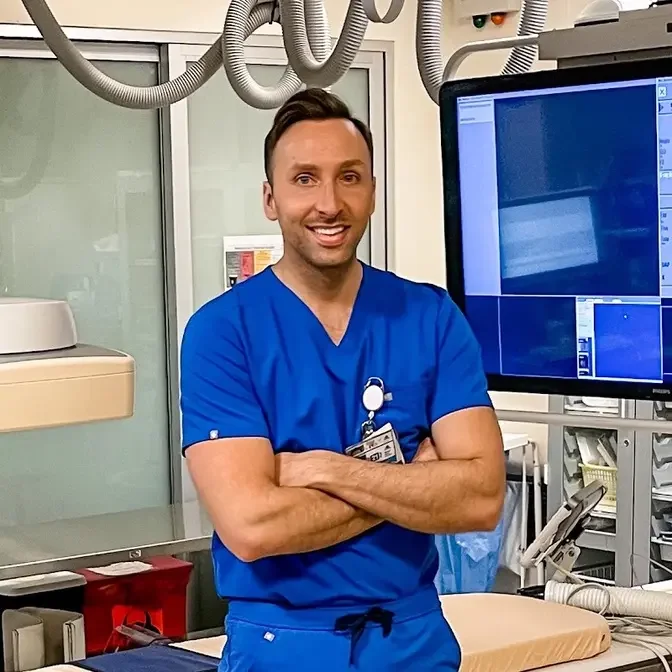
So after countless comments and messages I finally gave in and decided to do a Reaction video of me watching a medical tv show/drama! In today's reaction video we will be watching Grey's Anatomy! I used to watch this show all the time as a premed and med student but have not watched it in many years.
Someone told me they have some Radiology in this particular episode, so obviously this is the episode I chose. It is season 11, episode 15.
I was actually very surprised how they did such a great job portraying a Radiologist as such a nice, put-together, doctor...not that I'm biased or anything (😜). In all seriousness though, I always have loved the drama this show brings, especially during my pre-med and medical training years. Sometimes we need a little drama to keep us going in our grueling training. After all, who doesn't love a little Meredith Grey Drama. If only Mcdreamy were back....
If you want me to do more of these drama, trauma, medical reaction videos, leave a comment below and tell me which one you want me to do!!
If you get this video to 15,000 likes/thumbs up, I will do another one soon....and make sure to SUBSCRIBE!!!
What is up YouTube? Welcome back to my channel. I've decided to jump on the trend of doctors
reacting to medical TV dramas. I think Dr. Mike was the first one to do this like way back in 2018,
but I've gotten tons of requests to do it. So today we're going over Grey's Anatomy, which as
you guys know I love this show or I used to love this show and watch it in med school and you may
have seen this video right here in which I talked about that. I haven't seen this show since like
2011 or 2012 or something. So I figured I'd dive right in to season 11 episode 15 and let's get
into it. And on to some Grey's Anatomy right now. I just went to prep Lizzie Higgins for a biopsy
and it was already done. By you at 5 a.m? You're welcome. I thought you were going to DC.
So this actually doesn't happen unless they're working together in a group of surgeons. You
don't just poach on other people's procedures. So for instance if Grey saw a patient in clinic
and scheduled a biopsy for that patient, Alex Karev would not go swoop in and steal that
biopsy from her because it is her patient. And that's just not good. When the earth literally
quakes. Do you remember your list? That's not good.
Did you guys see all those CT scans in the background there?
We're not moving. Yeah safety feature. It did this to me after the last earthquake.
Last earthquake? They don't happen too often. Only when you ride in elevators apparently.
Apparently. Remind me not to ride in an elevator with you again. Sure Dr. Pierce or I guess I could
start taking the stairs. It is Dr. Pierce right? Yeah. Ethan. Sorry. Ethan. Yeah.
Oncology right? Radiology. Sorry. No problem.
She's catching feelings for a radiologist. You see that?
Hello. How are you? Good. See you around.
We need to double take. Obviously I'm super pumped there is a radiologist in this episode.
Someone told me there was some radiology action going on here but they didn't tell me what it was.
So I love seeing a good looking radiologist on camera. It makes me happy. The only thing I don't
like is that he's wearing a short white coat which is something a med student would wear.
So that's kind of strange because usually once you finish med school and you're a resident or
an attending physician you wear a long white coat. Some people don't know that.
I was paged about a hit? Yes. Gene Domini, 75 angioplasty patient discharged last week
brought in today with shortness of breath after a fall. You can fix it right? I'll tell you what
we're gonna get you some films and then we'll go from there okay? Okay. Films first. You always
need radiology. Sounds right. Is somebody going to answer that call? That is, you know, all yours.
All right so let's hold off right there. So first off attending physician will not answer the main
line to the emergency department. We usually have receptionists who answer the phone because it is
ringing off the hook constantly and I'd imagine if a kid called with this kind of scenario they
would just tell them to call 9-1-1 and we wouldn't spend all this time talking to him.
That's the reason I don't work in the emergency department because things can get heated pretty
quickly and I don't know how people don't lose their cool more often. I prefer a more chill
laid-back environment. That's just me. Ruby I am going to move to another phone so I can hear you
better. Don't hang up. No no no I'm just I'm just moving to another phone. I'll be right there okay?
Screw this up. What? No no no nothing. Don't worry. I'll be right back. Just hang up. I'd be worried about
switching phones because I try to transfer phone calls all the time when people call the reading
room and I try to transfer it to another station or another department and I screw up like 95% of
the time so this is not the time you'd want to screw up. It's fine these injuries look pretty
superficial. This is not his fault. It's not his fault he can't sit in a chair because... Now so she has an
ultrasound machine on his abdomen which means she's probably looking for fluid also called a
FAST exam or a focused assessment with sonography for trauma test or a FAST exam which is what we
do we just scan the abdomen in a couple different spots to look for fluid. I'm not really sure why
she has the doppler on as you can hear that because she's in like the right upper quadrant
liver area so I don't know what she's doing with that. Well you have what is called a below the
Alright so as you can see before she even says this I'm going to go over the imaging because
obviously love imaging. So she has a right hip arthroplasty or a right hip replacement. What
she's saying is the portion that she's pointing to right now is the distal stem of the femoral
component of the arthroplasty and it's very common for those things to shift around and cause a
So that's probably what she's going to say here.
So I think she's doing a very good job here trying to protect the patient
because it's easy to get swayed or convinced that she needs the surgery even though she's not a good
candidate for surgery. So someone with a history of heart disease needs to have a full workup to
make sure they can tolerate anesthesia and tolerate the procedure before they go into the operating
room. Sorry you called me for my opinion. Look I do hip replacements all the time on far older
patients with far weaker hearts. She is clearly still active. I think her heart's in pretty good
shape. That's not your call. So it's important to have conversations with your colleagues.
Surgeons always want to operate. Cardiologists always want to make sure the surgeon can operate
safely. So it's good to have a good conversation and talk it out before a surgery which is why
most surgeons will consult a cardiologist before the surgery to make sure they can tolerate the
surgery. They don't usually get in arguments. They kind of just trust each other's professional
opinion. Kepner told me about the little girl. What can I do? Can I help? We are trying to get an
airway. Put your head on your mom's chest on the left side and listen. I don't hear anything.
What am I listening for? Breathing. Do you hear her breathing? No. All right so now we're trusting
that a child is making a physical exam diagnosis of absent breath sounds which I mean he may just
not be hearing the breathing because he doesn't have his ear on the chest or he has his ear over
a rib. So they're trusting the clinical acumen of this young child with no training that she has
absent breath sounds. Okay could be attention. Ruby um now just push the phone into your mom's chest
right where you were just listening. Just push the phone in and and move it.
It's so pure to hear that. All right this is all right this is getting a little crazy here.
They're diagnosing tension pneumothorax and subcutaneous emphysema or the crackles you're
hearing all over the phone. It's pretty amazing. So if it is a true tension pneumothorax I hope
they don't ask this kid to stick a needle in the chest because I mean I don't know if he can do
that. She's going to need to release the trapped air with a chest tube or something but it's it's
the only way her mom's going to suffocate. What do you mean? You're not going to ask her. Ruby
you're going to ask me to try something. It's going to be fine. See Dr. Weber has the same
concerns I do here. You're going to ask a young child to put a chest tube in and decompress the
not ideal. All right so now we're in the CT scanner and I love that Alex Karev who is a
tending physician Meredith Gray who is an attending physician and I think the other
female is a resident physician but they are all down operating the CT scanner by themselves.
This is a very complicated job which is why we have specific CT technologists who do this.
I don't even know how to operate the CT scanner so I don't know how these non-radiology folk
can do that. Got a straw. Great now we're gonna need you to get it. I don't want to ask. A knife?
Ruby we're gonna we're gonna need you to get a knife not a big one but a sharp.
You're making s'mores? Are the skewers there? Yes yes got one. Oh god I need to stick this in
order don't you? Ruby you can do this you can it's gonna help your mom okay we just need you to find
I mean a lot of physicians don't even like doing this procedure so I can't imagine a young child
able to do this. Touch your mom's left collarbone the one that looks like a wing coming out from
her neck now walk your fingers down from it two steps you got it. So you're supposed to go to the
mid clavicular line second intercostal space above the rib in order to do a decompression
so let's see if they can walk them through this. Now slide your finger right underneath that rib
with your other hand right above that finger push the skewer in about an inch. So you're actually
supposed to go on top of the rib because the vascular and the neurovascular bundle lies
underneath the ribs so if you were to insert a skewer underneath the rib you could nick the
intercostal artery and cause a bleed so go above the rib. Now you don't have to actually go in that
far you can just insert the needle right through the pleura and you can release the air so I don't
know if he so hopefully he didn't stab all the way through through the back but you never know.
All right let's take a look. All right so you can see here so she has a right hip arthroplasty like
we spoke of and you can see at the very bottom portion of the femoral stem component there are
two fracture lines going through the cortex those are the peri-hardware fractures that we were
talking about. Also my boy Ethan up here.
So you see all those films hanging up in the background nobody uses films anymore.
Good so she could stay on her blood thinners substantially lowering the risk to her heart.
Oh I wasn't I wasn't serious before I was.
I'm not actually taking the stairs. Oh okay. I would like to take you out though sometime
maybe for coffee. Let's go. The point is I'm flexible.
This is coming out all wrong. I'm gonna stop you actually. I'm sorry then you seem really
tall. I'm nice but I'm just I'm not I don't. Sure that's okay I understand.
All right so obviously I love that interaction that's awesome.
They have news on Mike. Mike is stable but I'm afraid his injury is worse than we thought.
His spleen is ruptured and he's lost a lot of blood. He had a cardiac episode in CT and his
heart's not beating. Oh god we're taking him to surgery now we do have to remove his spleen.
So splenic lacerations are actually where interventional radiology can play an important
role. We embolize splenic lacerations all the time especially in the case of trauma like this.
The only time you actually take them to the OR is if they are acutely decompensating
or coding like this patient from his hypovolemic shock. Otherwise you if they're stable you can at
least try to give interventional radiology a call and we can try to embolize them.
So it looks like the helicopter got the patient and brought him to the hospital.
So I used to go up to the helipad all the time when I was volunteering in the emergency department
at a level one trauma center and it was like my favorite part of the job watching the helicopter
come in going to the helicopter on the helipad looking over at the entire city and getting the
patient down to the OR and getting them to the trauma bay. That was like the most fun thing
ever. That was before I went to med school and it was like so pumped. So if you are ever
volunteering make sure you go to the helipad. How is she? Subdural hematoma with a shift.
Subdural hematoma with a shift. That is a subdural hematoma with
midline shift of the brain into the opposite side
secondary to mass effect from the bleeding clot that's sitting on top of the brain.
It's not because he's a radiologist okay and it's not just because I don't date people from work.
I just I kind of don't date. Hey listen I was just kidding. It better not have anything to
do with him being a radiologist. He's still bleeding from the short gastric arteries.
I see it. That's the pancreas. I see it. No I can't get to it from here.
How many units did it use? Four units. If everyone would just shut up and give me two freaking
seconds I can get the suture to hold. So these short gastric arteries are small arteries arising
from the distal splenic artery and they supply some of the stomach. So if a spleen is injured
in trauma or it's lacerated because it jostles back and forth it can kind of rip off some of
those short gastric arteries in the process. All right so that was a whirlwind show of emotions
and drama and we got through it and hopefully you guys liked it and hopefully you learned
something in the process. We had some good radiology stuff in this episode which was
awesome. If you like this video and want me to do more let me know in the comments below.
If you want me to do a different show also let me know. So smash that like and subscribe button.
Turn on post notifications so you know when I post a new video. Follow me on Instagram if you
don't already. Otherwise I'll see you guys on the next video.