
Babe Ruth - The Man, The Myth, The Legend
32 Video Views·Sep 12, 2022
Babe Ruth - The Man, The Myth, The Legend
Babe Ruth was my roomie. It was an experience unlike anything I've ever had in doing my
course in baseball, which covers over 60 years. The Babe made baseball more than a mere game.
He made it a personal drama of the diamond. No matter whether he was barnstorming or playing
in the big leagues, Ruth always stole the show. The most colorful figure the game has ever known,
Babe Ruth numbered President Harding among his admirers.
Here you see him with Eddie Collins, Ty Cobb, and Tris Beaker, heroes of bygone days.
Babe Ruth, 40 years after his death, 60 years after he was in his prime, there still has never
been anyone quite like him. But that's the trouble with legends. The passage of time
tends to polish the surface, turning the stories into truth and obscuring the real person.
Who was he, really? What kind of man? I'm Mel Allen, fans. Most Americans today
weren't alive, of course, during the Babe's career, but they all know his name.
The rest is consigned to that gray area where myth and reality meet. But how much of him is
legend? How much fact? What was he to his contemporaries, the fans, to the press,
before the next generations began to embellish the story in the telling?
And what was his peculiar place in history? Well, today, with some personal accounts,
some famous material, and some rare archival footage, we'll see not so much a chronicle of
his career as an examination of the phenomenon and why it endures. We're going to put Babe Ruth
back into perspective. You know, many people think that the story of Babe Ruth begins and
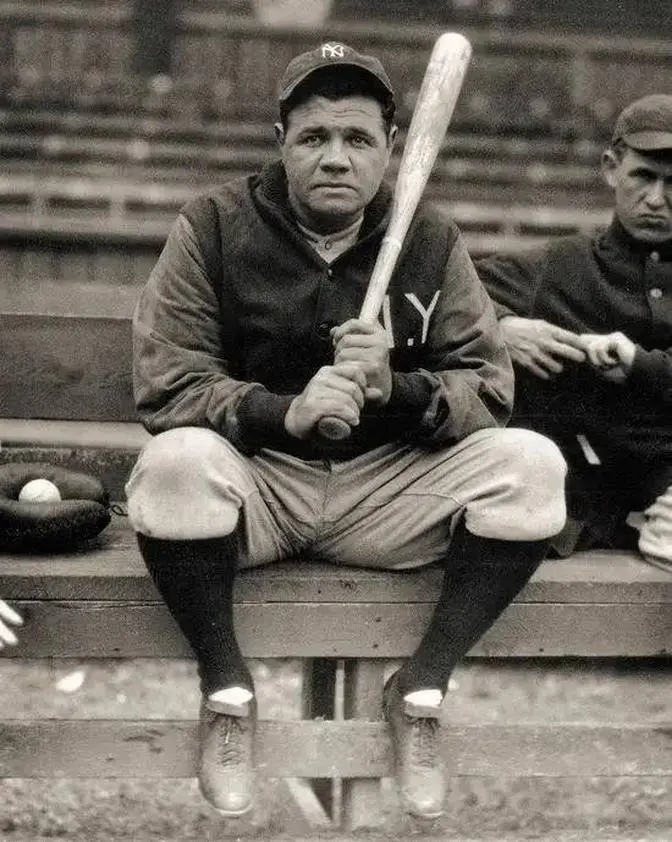
ends with this, his incredible 52-ounce bat. When he broke into the majors,
he signed with the Boston Red Sox as a hot young pitcher. 1895, George Herman Ruth begins life as
a tough kid on the Baltimore waterfront. His mother dies when he's six, and his father,
a saloon keeper, sends him to St. Mary's Industrial School for boys to learn the trade and to gain a
sense of discipline. In his 12 long years there, the discipline never catches on,
but what he does gain is a sense of baseball. As he says later, I think I could hit the first
time I picked up a bat. He soon shows an all-around talent and a knack for pitching
that catches the eye of the Baltimore Orioles, who sign him at the age of 19 for $600 a season.
He is on his way. After pitching 10 straight victories for Baltimore, he's bought by the
Boston Red Sox. He's introduced as Jack Dunn's new babe, and the name sticks. He quickly becomes
their star pitcher, winning 46 games in two years. World War I hits home, and the issue of drafting
baseball players is never resolved, but the babe does his part for morale by delivering autographed
bats to the training camps and putting on impromptu exhibitions. On the field, his bat is already
out performing his arm, and in 1919, Boston manager Ed Barrow puts Ruth in right field
so he can play every day. At the time, it was a simple managerial decision, and no one had any
idea that it would change the game forever. In six days, the babe is leading the league in hitting.
No one had ever seen a hitter like this. The game had been what today is called
little ball. Singles, bunting, stealing bases, sacrifices, strategy, and hitting was considered
a lesser art than pitching, but suddenly, here's a man hitting balls out of sight. It's exhilarating.
Power baseball. League leader in the American League was a fellow named Home Run Baker. I think
he hit seven that year. He led the league, and in the National League, they had a fellow named
Gabby Cravat. He had about the equal number, but when he came along, he changed the whole aspect
of the game. When they first started, the balls were a little, they were dead. They're much
livelier now because the average fan felt that a home run drew a lot of people to the ballpark.
Of course, nobody could hit them as far as he could. How did the babe do it when no one else
could? Was he special in some God-given way? As it turned out, yes. Researchers at Columbia
University did a scientific study of Ruth and reported in Popular Science Magazine that the
babe was blessed with incredible vision and an almost inhuman reaction time, and it turned the
game of baseball right on its ear. The game would change more between 1917 and 1921 than it would
for the next 40 years. Ruth's first homer ever, by the way, was against the Yankees, and when he hit
29 home runs in 1919, it was by far an all-time record. I swing big with everything I've got, he
said. I hit big or I miss big. In any case, I sure like to live as big as I can. And there in a nutshell
is the emerging metaphor of Babe Ruth, because it quickly became obvious that this young man
not only swung hard at a baseball, but he swung hard at life itself. He was just the type that
America was looking for as the Roaring Twenties came into view. Brash, high-living, talented. I
tell you, the Boston media loved him. But in 1920, Boston owner Harry Frazee, deeply in debt,
sold Ruth to the New York Yankees for $125,000. Colonel Jake Rupert paid that much for him and
also gave him a $350,000 loan. It was easily the most anyone had ever paid for a player.
But it was baseball's all-time bargain. Suddenly, the Babe found himself in the media capital of the
world. Now, what did he do under the crush of attention with all the expectations? I'll tell
you what he did. He took that record of 29 homers and buried it. When Ruth joins the Yankees,
they've never won a pennant, much less the World Series. They're using the Giants Park,
the polo grounds, where the fans at first come out to see just what it is that has enticed Yankees
owner Colonel Rupert to pay this kid $20,000 a year. They don't have to wait long. Ruth hits
54 home runs in 1920. By midsummer, they pass the Giants' attendance record. And by season's end,
they're the first team in history to draw over a million people.
They came to see the Babe. Even when he missed, it was exciting.
The Great War was over. The boys were back home. The economy was sound. It was time to enjoy life
again. So the stage is set for a dizzy, rollicking spin through the 20s, with a hefty hero leading
the way. And then the bottom dropped out. The specter of corruption threatened to destroy
the national pastime. Branch Rickey, who was managing in St. Louis at the time,
tells the story. By 1919, baseball had embarked upon a new prosperity. The world was said to have
been saved for democracy, you'll recall. And at home, people celebrated by going to the ballpark
as never before. The 19 and 19 World Series, the great teams, the Chicago White Sox and the
Cincinnati Red. Chicago highly favored. And then everything happened. The White Sox faltered,
or did they? This series is lost to Cincinnati. It seems a natural upset. And yet, a year later,
the series is baseball's biggest scandal. Due to one man and one man only, the insistence
of Ben Johnson that something was wrong. Then came Judge Landis into the picture.
He relieved Mr. Johnson of all authority and all the guilty players for a lifetime. These were the
20s and the young nation letting go. The past was past. The byword was action. And what happened
was scintillatingly attractive. A new breed of heroes accommodates the scene. On the range,
in the streets of reality, the hero in reverse. The angry young man from Manassas, Jack Dempsey.
In the glamorous rectangle of tennis, Bill Tilden. Golf provided the champion in Bobby Jones.
These would one day be called baseball's golden years. Yet in the 20s, only one chief clown,
one chief hero, one chief everything in the game, George Herman Ruth. The Bambino, the Keed,
the Sutton of Swat. Baseball needed a revival of faith. And in the 20s, Babe Ruth was exactly that.
A necessary focal point of public confidence and adulation. He was the Babe. Honest, outspoken,
and with the Babe to believe in, baseball went on. For Babe Ruth, every honor. Mayor Jimmy Walker,
what the papers called the Great Unwashed. People came to pay him homage, to watch him practice
the art of something he seemed almost to have invented, the home run. With the exception of
1925, he traveled the land, engaged in breaking records. He made 714 home runs in his career.
To pay him homage, as Mr. Rickey put it, how could a young man fit his head through the door
when he's being called the savior of the national pastime?
How did he handle the constant badgering from a hungry press
with their exciting new toy, the movie camera?
Happy birthday to you.
Like Gene Tunney, Bobby Jones, Jack Dempsey, and all the other sports heroes of the day.
He never stepped too far out of character though. He always seemed to be wearing a baseball uniform.
In this scene from Heading Home, Babe plays a local rube who fills in when the visiting team
is a man short. Though his girlfriend is rooting for him, the whole town turns on him when he hits
a home run to win the game for the other side. His acting left everything to be desired, but the
loved him even more for it, and Ruth was paid a fortune. If Ruth was accessible to anyone,
it was the kids. He always had time for autographs, stopping to talk to them on the street,
being what they desperately want him to be, a hero. Kids and me get along just fine, he says.
The media love him for it. He has a soft spot in his heart for children that will become part of
Babe Ruth legend. Babe especially liked the idea of appearing on camera with kids
so that he could reach as many as possible. It was mostly basic inspirational stuff,
encouraging them to stay in school and never give up on their dreams. He realized that only a small
number of kids would ever get to see him at all. Aside from the ballpark, the silver screen was it.
Mr. Ruth, it's a mighty nice thing of you to come up here and see these boys, say a word to them.
Now the best and largest smile I'm going to give this autograph also,
so why don't you cut the pie first?
I'll do.
That's a funny, oh look at that guy.
Sometimes it seemed to be never ending, as Jimmy Reese, now on the coaching staff of the
Angels, tells the story.
We were playing Sunday afternoon, we had a dinner engagement, that is I was invited over to Babe's
house for dinner. Sunday afternoon there was a big crowd and after the game was over, we went
out through the side door, we thought we wouldn't run into too many kids. There must have been a
thousand kids out there waiting for Babe's autograph. Babe's car is sitting out there,
he had a 16 cylinder Cadillac and he said you'll have to wait a while, I gotta sign all these.
All these kids, he can't, he won't turn anybody down. One particular time a little girl came out
to out in the left field where he's playing left field that day and during the course of the game,
she sneaked out out of the stands and walked out and said and Babe put up his hand and says
hold it a while and this little girl says what do you want? He says I want you to sign a little
autograph. He says all right, so he signed it and gave her a little patent and off she went.
Made a big hit with the fans and he liked it, he enjoyed doing it. He never turned anybody down.
Of course it wasn't just a joy ride. Ruth was headstrong and he was in danger of becoming
bigger than the game itself. As a matter of fact, just a year after the Black Sox scandal,
Ruth defied Commissioner Kennesaw Mountain Landis's ban on barnstorming. You know going
around to the small towns of America and playing exhibition games, billed as the World Series
players. It was one of Ruth's favorite pastimes. Ruth's team, the Bustin' Babes, would play
Garrick's team, the Larrapin' Loons, and though they were often the only Yankees on the teams,
they drew huge crowds. Ruth loved barnstorming and not just because he made some pretty good
money in the offseason. Touring the backwaters of America, where the fans are as rabid as any in
New York, kept him in touch with the grassroots of the game. He knew he was giving these people
memories they'd carried forever and now Commissioner Landis wanted to take it all away.
So Ruth defied him. Commissioner Landis declared we're playing a game called baseball, not a game
called Ruth, and he suspended him for 40 days. The Babe got angry and fought with the other players
and the press. He even chased a fan into the stands. He never recovered in that 1922 season,
but his attitude was so bad he did set one record, five suspensions in one year. How about that?
So it wasn't just success upon success. The 20s were tumultuous for the Babe as well.
The press adored him, but as with stars of any era, they'd turn on him when he let them down.
Same with the public. He fought constantly with Miller Huggins, then the Yankee manager,
to the point that Huggins fined him $5,000, 10 times more than the largest fine ever for being
late to a game. Ruth later hung him by his feet over the back end of a train, but his only real
enemy year in and year out was himself. This was New York in the 20s. Gorgeous women coming at him
from all directions, the best cigars, the finest restaurants proud to have him there and on the
house, and speakeasies that couldn't open the door fast enough when they saw his face through the
peephole. The players assigned to travel with him used to say they roomed with Babe Ruth's suitcase.
Yes, the Bambinos sure loved to celebrate. Ruth's stomach and his back would spend his career at odds
with one another. After a miserable 1922 season, he declares, I'm gonna work my head off and maybe
part of my stomach. I want to tell the newspapers and the fans that I've had my last drink until
the middle of next October. No kidding. Yankee Stadium, the house that Ruth built, completed in
the spring of 1923 at the unheard of cost of two and a half million dollars. Opening day, April 18,
100,000 fans tried to get in, buying for the 62,000 seats, all waiting to see if the Babe
could return to form. Can the Babe come back, or has he consumed his way out of a career?
The answer comes in the third inning with two men on. A tremendous shot to the seats in right
center field, the first home run in Yankee Stadium. The Babe goes on to hit .393, his all-time high,
and the Yanks win their first ever World Series.
In 1924, Ruth hits 46 home runs and bats .378, easily winning the batting crown. Time to celebrate
again. All winter long, he eats and drinks, then shows up at training camp in 1925 with a belly
that even his huge bat couldn't get around. The spring of 1925, the time of the big bellyache.
The story goes that on the ride up from Florida, Ruth stopped off at a train station,
and in the space of a few minutes consumed about a dozen hot dogs,
washed them down with eight bottles of soda, then collapsed a little while later on the train.
Well, that's probably a slight exaggeration, but I'll tell you this, the Babe was truly sick.
He was rushed to a hospital in New York and didn't see a ballpark again until June.
One English newspaper even reported him dead. He played in only 98 games,
had his worst season ever, and confessed the error of his ways to his public.
The fact is, you can't talk about Babe Ruth without eventually turning to his eating and
drinking habits, because the way the Babe lived was crucial to his legacy. In 11 years as a
professional ball player, he had blown half a million dollars and had nothing to show for it
but a pot belly. But you know what, if he'd been a simple farm boy who never broke training,
and by the way hit 714 home runs, he would be nothing more than a name from the past
or a record to shoot for. He was so much more, more of a man, a character, and his appetite
became a part of the Babe Ruth lore. But was that all it was? Legend? Did the media make a big deal
out of nothing just because it fit his bigger-than-life image? Hardly. Take it from someone
who had to sit there and watch him eat. Once in a while it affected, his stomach was a little upset
at times, and when Babe would come in the clubhouse and it bothered a little bit, he would call the
trainer and tell him he went a little by. He meant bicarbonate of soda. That started straightening
him out and he went out and he kept hitting the ball just as hard as before. He recovered very
quickly. But one day he came home late, get up, he was quite ill, to get up in the middle of the
night and asked me to call the trainer. And when he said please, I knew that there was something
wrong. So I called the trainer and he was awfully sick. We were playing an exhibition game at that
time, and the trainer took, you know, got him straightened out a little bit, and we dressed at
the hotel. And the trainer says he'll never be able to play today, but we got to get him out there
to show him off to the fans. Well, they got him some coffee and dressed him and got him cleaned up
and came out and the fresh air had him a while. When the game started, he started the game and
he had two home runs, two doubles, and a single. And two hours before, I thought he was going to die.
By anyone's account, 1925 was a disaster for Ruth. Mayor Jimmy Walker told him, you have a sacred
duty to the Dirty-Faced Kids of America and you're throwing them down. Well, that hit Babe where it
hurt. So once again, he promised to whip himself back into shape for the next season. In a well-publicized
fitness binge, at least by day, Ruth spends the winter working out, boxing, medicine balls, leg work,
something approximating a diet. The press follows his every move, not only because he's such good
copy, but because from City Hall to the Sandlots, the world wants to know, can he come back again?
1926, a big sports year. Jack Dempsey loses the heavyweight title to Gene Tunney.
Newt Rockne is in his prime at Notre Dame. But Yankee manager Miller Huggins and the rest of
baseball world have their sights set on the Babe. He's making $52,000 a year now,
but newcomer Lou Gehrig is starting to push the King just a little. The pressure on the Babe is
enormous. But from opening day on, he's up to the challenge. He clobbers 47 home runs in 1926
and takes the Yankees all the way to the World Series, where he hits four more in a Yankee sweep.
His salary jumps to $70,000. Then, the great year, 1927. 22 home runs by June 1st, 43 by September.
With two games left in the season, the Babe has already equaled his single season mark of 59
home runs. 70,000 people are holding their collective breath. 60 home runs, only the Babe,
only the Babe. The next year, he hit 54. Now, people these days have tried to say, well,
it was different then. When Roger Marris was approaching 60 home runs in 1961,
he was battling the ghost of Babe Ruth, the legend, something that Ruth himself never had
to contend with. But that couldn't be farther from the truth. When Ruth hit 29 home runs in 1920,
it was so far beyond what anyone had seen that they figured he'd hit the limit. Then, he hit 54
the next year, more than all but one team in the major leagues. It was downright confusing.
The standards for human performance went right out the window. Look at this headline from the
Los Angeles Evening Herald. This is on the front page, and it was just an exhibition.
Then, he hit 59 the next year, and for the next six years, he was the only man with a hope of
breaking that record. In short, as his totals mounted in 1927, he had his own ghost to contend
with. The pressure day to day was unbelievable, but he did it. He hit 60, broke the record.
Now, did he have the inevitable letdown? Well, he hit 54 in 1928, but 1929 began with a tragedy
for Ruth and never let up. It was a tough, tough year for everybody. On January 11th, 1929,
Helen Ruth was trapped alone in a burning house in Watertown, Massachusetts.
She died in that fire. Helen and Babe had been separated for three years,
and it was an open secret that he would soon marry Claire Hodgson, a model and actress.
It happened in the spring of that year. A bright and resourceful woman, she would work hard to
bring some order to the runaway train that was his playboy life, but she only had limited success.
They had a good relationship, although Babe was a social lion, that's all. He loved to go out and
meet people, and hardly ever turned anybody down. But his wife would watch him very closely,
as close as she could. Didn't always have the best of good luck, but she did pretty well,
considering. In September of 1929, Miller Huggins died, leaving the managerial spot open,
and the Babe desperately wanted to manage. Already 34, he knew his days on the field were numbered,
and he had proven his point as a player. Colonel Rupert knew the fans came to see him play,
so instead, he hired Jack Shockey and gave Ruth another raise. $80,000 for each of the next two
years. Babe thought he should be named manager of the ball club, and the owner, Mr. Rupert,
felt that Babe should get some experience in the minor leagues. Babe didn't agree with him,
and it caused quite a strain between them. He accepted, but he wasn't too happy about it.
But he always felt he was capable of becoming a manager without any minor league experience.
He knew why he'd been passed up, because he couldn't shake the image of an irresponsible
playboy. The public wasn't interested in Ruth's managerial hopes. They were more fascinated with
his salary, but by now, he was a bit jaded. And when someone asked him why he should make more
than President Hoover, he answered, why not? I had a better year than he did.
When Colonel Rupert himself stated that $80,000 marked the limit of any star's possibilities at
the gate, Ruth had a lot more to say. Why $200,000 a year for a motion picture actor,
and not $80,000 for the chief figure in a sport that interests millions of people
and represents more than $50 million in investment capital? Why not $100,000?
Well, this was clearly a man who knew his place in the game as a player,
but as a manager, well, the colonel's refusal was only the first.
Meanwhile, there was baseball to be played. But Ruth is clearly slowing down. His legs hurt him,
and he has to apply a heating pad to them after every game. More and more often,
it takes Gehrig to drive him home, where he arrives barely ahead of Lew.
The game is getting hard to play. By now, the babe is pushing 40, and though he publicly states,
I'll play until they take my uniform away from me, he's already looking ahead. He's
financially secure now, thanks to the efforts of Claire and a man named Christy Walsh,
who was managing his career. Christy Walsh was a brilliant man who actually got to the babe when
he was least accessible. That was during the early 20s. He posed as a beer delivery boy,
and before Ruth could even throw him out, Christy had convinced him that he should have someone
managing his businesses for him, and that he was the man. A shrewd manager and a fine promoter,
the relationship was just what the babe needed. Christy even talked him into selecting the first
all-star teams. Babe Ruth, at the insistence of Christy Walsh, is just completing the selection
of the All-American baseball team for 1933. Babe Ruth is host here at the New York Athletic Club
tonight to the All-America Board of Baseball, which includes leading sport writers and Christy
Walsh, its sponsor. Christy Walsh, seen here with Ruth, was the man who finally, belatedly,
got the babe's life in order. He convinced Ruth that despite his record paycheck, his days were
numbered as a player. He began with getting Ruth top dollar for his weekly articles on baseball,
even though they were ghostwritten by Walsh, and it was the world's worst-kept secret.
They struck deals with movie studios and radio networks. They set up a trust fund for $200,000
and established a $50,000 annuity policy. He spent his money just as fast as he earned it.
It didn't make any difference, and his wife came to Christy Walsh, who was then a newspaper man,
and asked him if in some way they could work out so Babe could need somebody to take care of him.
Christy became his manager and made a deal. They signed it, and they gave Babe $35 a week for
spending money. He was making $80,000. It killed him, but they caught him in a weak mood, and then
Babe saved enough money. When he passed away, Mrs. Oost was pretty well set for the rest of her
life. The babe turns 40, and a pattern begins that would frustrate him to no end. He says,
let me manage or I quit, and the ultimatum backfires. While on tour in Japan, where they
adore him and call him the god of baseball, Colonel Rupert offers Ruth a contract for $1,
the minimum allowed. Ruth gets the message. He quits the Yankees and heads for the Boston Braves
for the promise of managing in a year. It was a carrot held out to an aging player who was
desperate to manage. He posed, he took batting practice, attendance soared in Boston. In fact,
they got everything out of his presence that they had hoped for. But after a dismal season,
Babe was not hired as manager, so he quit. The same thing happened with the Dodgers a year later.
More staged batting practices, more handshaking and posing. They just wanted him there because
he still packed them in just by coaching first base. That didn't last either, and by 1936,
he was out of the game. His health began to deteriorate. In 1939, he had a heart attack,
and it was downhill from there. He developed cancer of the throat.
June 1948, a deathly ill Ruth appears at Yankee Stadium to celebrate the 25th anniversary of
Yankee Stadium. No one has told him that he has cancer, but he confides to his friends.
They haven't told me, but I know what I've got. A pale, frail man of 52. He gets an ovation
that still echoes throughout the stadium. He says, I'm proud to have hit the first home run
in this stadium. Lord knows who'll hit the last. The only real game, I think, in the world of
baseball. It's his last public appearance. In eight weeks, the babe is dead. The zest for living,
the moon-faced smile, the pigeon-toed trot around the bases, all stilled forever. Babe Ruth,
was he all that history says he was? As Jimmy Reese would put it, you haven't heard the half of
it. Was he the greatest player ever? Probably. He was certainly the greatest figure, the greatest
influence of any man in any sport in history. And when he died, he was waked in Yankee Stadium
where over 150,000 people came to pay their last respects,
and he was afraid of being forgotten. How about that?