

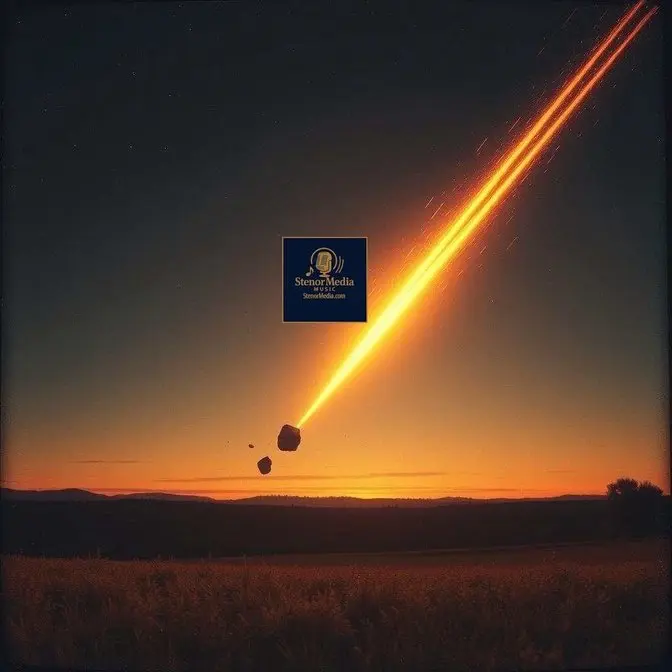

It was a Sunday evening in March when the world paused for the first time. Around 7 p.m., a blinding streak of light cut through the sky over Rhineland-Palatinate, so bright that for a fraction of a second, dusk became midday. From Mainz to Darmstadt, from the Eifel region to the Western Palatinate, people reached for their phones. Police control centers were jammed with calls. A spokesperson in Mainz simply said, "We're receiving countless calls from everywhere."
Ingo B. was cycling in Koblenz-Güls when he heard a hissing sound, followed by a bang that felt like a car crash right next to him. He looked around. Nothing. Only minutes later did he learn that three streets away, a burnt-up celestial body had crashed through the roof of a house. A football-sized hole gaped in the tiles. In the bedroom, chunks of rock lay among shattered tiles. The residents had been in the kitchen. They were alive.
Giuliano K. was standing in his workshop in Kenn when he saw the flash of fire. "I saw something flying at breakneck speed," he reported, "it was definitely four times faster than a jet engine." Three minutes later, there was a bang. He called the police. He couldn't get through for ten minutes.
The fire department examined the debris. No chemical hazard. No radioactive radiation. A rocket impact was ruled out after consulting with Spangdahlem Air Base. The German Weather Service confirmed: It was fragments of a meteorite that had broken up upon entering the atmosphere. The media ran headlines, experts reassured the public, and insurance companies took notes. A rare natural phenomenon. Nothing more.
But it was more than that. It was the beginning.
Three days later, a second meteorite struck. This time in the Swabian Alps. It hit a barn outside Münsingen and set the dry hay ablaze. The fire department extinguished the flames, and the newspapers reported on page four. On Friday of that same week, rocks rained down on the Sauerland region. Small pieces, no bigger than walnuts, but dozens of them. They smashed through windshields, dented car roofs, and tore down a power line.
In April, everything accelerated. Impacts in Brandenburg. Near Erfurt. In the Allgäu region. At night, they could be seen: bright streaks that sliced through the sky like claws. University seismographs recorded faint tremors. Too weak for earthquakes, too regular to be coincidental. The European Space Agency (ESA) established a special commission. Its press releases sounded concerned, but controlled. Nevertheless, the population felt the change.
Pews filled up in churches. Prayer times in mosques were extended. People stood in the streets with handwritten signs. "The end is near," they read, and for the first time in decades, no one looked away. Videos of fireballs spread faster than official explanations on social media. Comment sections filled with fear and prophecies. Some spoke of divine punishment. Others of coincidence. No one was right, and everyone suspected it.
In May, a discovery in the Chinese province of Guizhou made headlines, changing everything. A team of archaeologists had unearthed a cave in the limestone mountains near Zhijin, its entrance hidden under rubble for millennia. The cave wasn't large—perhaps ten paces deep, barely tall enough for a person. But its walls were covered in characters, carved into the bare rock with a precision that astonished the researchers.
Radiocarbon dating of the organic remains revealed an age of almost five thousand years. Inside the cave, they found the remains of a simple sleeping place, clay pots, and a stone meditation cushion, worn smooth by countless hours of silence. It was the hermitage of a Daoist cultivator, a recluse who had retreated to the mountains to seek the Way.
The inscriptions were written in an archaic form of Chinese that only a few scholars could read. Professor Li Changming of Peking University took three weeks to decipher the characters. When he published his translation, the world held its breath.
The prophecy spoke of a year that, according to the Western calendar, could be identified as 2026. It spoke of stones falling from the sky, of an earth rising up, of water overflowing the shores. "These are the harbingers," it was carved into the rock, "the signs of the great sorting out." Humanity would be tested. Only those with pure faith in the Cosmic Three would be preserved. "Heaven protects the kind," was the final sentence, etched into the cold stone five millennia ago.
What the Cosmic Three were remained unclear at first. No scholar could say for certain. Some interpreted them as the three treasures of Daoism: compassion, contentment, and humility. Others saw them as a universal trinity that resonates in all faiths. The prophecy didn't name them. It named a principle.
In June, the impacts began to intensify. What began as a regional phenomenon across Central Europe spread like wildfire. In the first week of June, meteorites struck Belgium, the Netherlands, and northern France. A fragment the size of a refrigerator hit an uninhabited field in Picardy, creating a crater large enough to fit a small car. In Switzerland, a fragment smashed through the glass roof of Zurich's main train station. Shards rained down onto the tracks. No one was injured, but the images went around the world.
Then the horror spread. In Japan, the earth shook. On June 13th, a magnitude 7.8 earthquake struck the coast of Sendai. It was as if the earth had remembered the 2011 catastrophe and decided to repeat the horror. Buildings collapsed. Tsunami warning sirens wailed. This time the waves didn't come, but the ground cracked open, and steam rose from the fissures.
In the western United States, the San Andreas Fault awoke. Los Angeles trembled for days. Small quakes, one after another, like a heartbeat gone haywire. People slept in their cars, in parks, in parking lots. Fear was etched on their faces.
In the Middle East, the ground trembled daily. In Turkey, in Iran, in Syria. Cities that had only recently been rebuilt from the rubble of previous earthquakes crumbled once again. Aid organizations couldn't deliver as quickly as the earth was taking.
And then the volcanoes erupted. Mount Etna in Sicily spewed a column of ash into the sky, paralyzing air traffic across the entire Mediterranean. Two weeks later, Vesuvius awoke. Naples was evacuated. A million people fled north, on foot, in cars, on overcrowded trains. The highways became refugee routes. Volcanic activity increased worldwide. New fissures opened in Iceland. In Indonesia, three volcanoes erupted simultaneously. The ash darkened the sky. The sun disappeared behind a gray veil, and temperatures plummeted.
The worst day came in August. It was a Tuesday, the fifth. At 3:47 a.m. local time, an underwater earthquake of unprecedented force struck the North Atlantic, southwest of the Azores. Its magnitude was later estimated at 9.4, but that number paled in comparison to what followed. The seabed ruptured along a stretch of 300 kilometers. Billions of tons of rock broke away and slid into the depths. A gigantic underwater landslide, an avalanche of rock and sediment that swept the sea away like a hand slamming into a bathtub.
The wave that formed was no ordinary tsunami. It was a mountain range of water. A hundred meters high, perhaps more, it moved east and west at the speed of a jet engine. The early warning systems sounded the alarm. Sirens wailed along the coasts of Europe and North America. But there were only minutes. Far too few.
The wave struck the coast of Portugal with a force that shattered Lisbon. It rolled on, over the beaches of the Algarve, over the ports of Spain, into the estuaries of France. It hit the Channel Islands, the coast of England, the fjords of Norway. On the American East Coast, it was smaller, but still enormous. New York, which had considered itself invulnerable since Hurricane Sandy, was flooded up to its second row of buildings. The Chesapeake Bay overflowed like a bathtub.
The satellite images showed a world transformed. Coastlines had vanished. Ports were gone. Ships lay stranded in fields, miles from the sea. And the water receded, leaving behind mud, debris, and silence.
In the days that followed, the scale of the devastation intensified. The earthquakes continued. The volcanoes erupted. Meteorites rained down, one after another, as if someone were throwing stones at a pane of glass to see when it would break. Infrastructure collapsed. Power grids failed. Supply chains were disrupted. Panic gripped the major cities. Supermarkets were empty within hours. Fear reigned supreme in the streets.
People prayed. In churches, temples, mosques, and in the open streets. They prayed on their knees, with raised hands, with bowed heads. They prayed in languages they hadn't spoken since childhood. They prayed to a God many of them had stopped believing in. The prophecy from the Chinese cave circulated in every language, on every screen, on handwritten notes stuck to lampposts. "Heaven protects the kind."
And amidst the destruction, there they were: the kind. People who opened their doors. Who shared what they had. Who took in strangers, carried children, supported the elderly, bandaged wounds. Not because they had read the prophecy. But because it was in their nature. Because kindness requires not knowledge, but a heart.
It happened on September 22nd, a Monday, around noon. The sun had been hidden behind ash for weeks. People had grown accustomed to the darkness. To the tremors. To the fear. To the dull anticipation of what would come next.
And then the sky opened.
It began as light. Not the cold light of a meteorite, not the flickering light of a fire. It was a warm, golden glow that came from above, through the ash clouds, as if the darkness were nothing but a curtain drawn aside. The light spread out, beyond the horizon, in all directions, and where it touched the ground, the earth ceased to tremble.
People stepped outside their doors. They emerged from bunkers, cellars, and emergency shelters. They raised their heads and looked up.
In the light, a figure took shape. Gigantic. So large that it filled half the sky. A figure of such majesty and such gentleness that everyone who beheld it began to weep. Not from fear. From relief. From a beauty that no word or image had ever captured.
The figure raised a hand. It was a simple movement, slow and calm, like a conductor bringing an orchestra to silence. And the world obeyed.
The volcanoes fell silent. The lava solidified. The fissures in the earth closed. The sea, which had lashed against the shattered shores, became smooth as a mirror. The meteorites that had been hurtling toward it burned into dust that fell as a fine, warm rain. The ash clouds dissipated. The sun broke through, its light mingling with the golden glow in the sky, and for the first time in months, the air was clear.
People in the West saw God in the figure. People in the East saw Buddha. Each saw what their heart was capable of perceiving. And all saw the same thing: a love greater than anything they had ever known.
In the streets, people embraced each other. Strangers hugged strangers. Children laughed without knowing why. Old people wept silently, their hands folded across their chests, their faces turned toward the sky. In Tokyo. In New York. In the ruins of Lisbon. In the refugee camps near Naples. In the small villages of the Hunsrück region, where it had all begun.
The survivors folded their hands. All of them. Simultaneously. Without consultation, without command, without tradition. It was a reflex as old as humanity itself. Hands folded across their chests, fingers pressed together, heads bowed. A silent, universal expression of gratitude. Gratitude for what had saved them. For what had always protected them, even when they had forgotten it.
In the weeks and months that followed, the world changed in a way no one had thought possible. There were no conferences, no resolutions, no treaties. None of that was needed. People had seen. They had understood.
The guns fell silent. Not because they were banned, but because no one wanted to shoot anymore. The borders remained, but they no longer divided. Nations helped each other rebuild without sending bills, without imposing conditions. A Japanese engineering team helped in Lisbon. Brazilian doctors worked in Naples. German firefighters cleared rubble on the American East Coast. It was as if humanity had remembered that it was one family.
Faith experienced a renaissance, but it was a different faith than before. Not a faith that divided. Not a faith that judged. A faith that united. People went back to churches and temples, but they went with a new humility. They now knew that heaven knew no denomination. That the Cosmic Three—as the scholars eventually interpreted them—lived in everyone, in every language, in every heart ready to receive them.
Stefan B., the grandson of Ingo B., who had heard a hissing sound one March evening in Koblenz and seen nothing, stood years later before the plastered hole in the roof of that house in Güls. It had been repaired, but a small plaque had been attached. "This is where it began," it read.
He placed his hand on the plaque. The stone was warm from the sun. He thought of his grandfather, who had told him the story so often. The hissing. The bang. The fear, and then, months later, the light. Stefan looked up at the sky. It was blue. As blue as hope. He folded his hands across his chest, a brief, silent moment, and smiled.
The world had survived. Not because it had been strong. But because it had been good.
S.
Your support keeps ideas alive — and stories in motion. 👉 https://www.paypal.com/donate/?hosted_button_id=5NGG6XB67BZ4N 🙏
🇩🇪 My lyrical thoughts between two book covers: blau pause zimmerlautstärke - lyrik über die zeit - zurzeit
BoD Bookshop: https://buchshop.bod.de/blau-pause-zimmerlautstaerke-stefan-noir-9783695118779
Amazon-Shop: https://amzn.eu/d/1TvOBUO
🇺🇸 / 🏴 / 🏴 My lyrical thoughts between two book covers: blue pause room volume: poetry about time – currently
Amazon (English edition): https://amzn.eu/d/3b3GUF4
Comments