


War of the Third Coalition
Main article: War of the Third Coalition

Napoleon in his coronation robes by François Gérard, c. 1805
Great Britain had broken the Peace of Amiens by declaring war on France in May 1803.[134] In December 1804, an Anglo-Swedish agreement became the first step towards the creation of the Third Coalition. By April 1805, Britain had also signed an alliance with Russia.[135] Austria had been defeated by France twice in recent memory and wanted revenge, so it joined the coalition a few months later.[136]
Before the formation of the Third Coalition, Napoleon had assembled an invasion force, the Armée d'Angleterre, around six camps at Boulogne in Northern France. He intended to use this invasion force to strike at England. They never invaded, but Napoleon's troops received careful and invaluable training for future military operations.[137] The men at Boulogne formed the core for what Napoleon later called La Grande Armée. At the start, this French army had about 200,000 men organized into seven corps, which were large field units that contained 36–40 cannons each and were capable of independent action until other corps could come to the rescue.[138]
A single corps properly situated in a strong defensive position could survive at least a day without support, giving the Grande Armée countless strategic and tactical options on every campaign. On top of these forces, Napoleon created a cavalry reserve of 22,000 organized into two cuirassier divisions, four mounted dragoon divisions, one division of dismounted dragoons, and one of light cavalry, all supported by 24 artillery pieces.[139] By 1805, the Grande Armée had grown to a force of 350,000 men,[139] who were well equipped, well trained, and led by competent officers.[140]
Napoleon knew that the French fleet could not defeat the Royal Navy in a head-to-head battle, so he planned to lure it away from the English Channel through diversionary tactics.[141] The main strategic idea involved the French Navy escaping from the British blockades of Toulon and Brest and threatening to attack the British West Indies. In the face of this attack, it was hoped, the British would weaken their defence of the Western Approaches by sending ships to the Caribbean, allowing a combined Franco-Spanish fleet to take control of the English channel long enough for French armies to cross and invade.[141] However, the plan unravelled after the British victory at the Battle of Cape Finisterre in July 1805. French Admiral Villeneuve then retreated to Cádiz instead of linking up with French naval forces at Brest for an attack on the English Channel.[142]
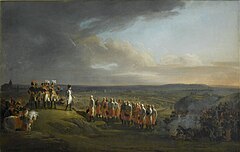
Napoleon and the Grande Armée receive the surrender of Austrian General Mack after the Battle of Ulm in October 1805. The decisive finale of the Ulm Campaign raised the tally of captured Austrian soldiers to 60,000. With the Austrian army destroyed, Vienna would fall to the French in November.
By August 1805, Napoleon had realized that the strategic situation had changed fundamentally. Facing a potential invasion from his continental enemies, he decided to strike first and turned his army's sights from the English Channel to the Rhine. His basic objective was to destroy the isolated Austrian armies in Southern Germany before their Russian allies could arrive. On 25 September, after great secrecy and feverish marching, 200,000 French troops began to cross the Rhine on a front of 260 km (160 mi).[143][144]
Austrian commander Karl Mack had gathered the greater part of the Austrian army at the fortress of Ulm in Swabia. Napoleon swung his forces to the southeast and the Grande Armée performed an elaborate wheeling movement that outflanked the Austrian positions. The Ulm Maneuver completely surprised General Mack, who belatedly understood that his army had been cut off. After some minor engagements that culminated in the Battle of Ulm, Mack finally surrendered after realizing that there was no way to break out of the French encirclement. For just 2,000 French casualties, Napoleon had managed to capture a total of 60,000 Austrian soldiers through his army's rapid marching.[145] Napoleon wrote after the conflict: "I have accomplished my object, I have destroyed the Austrian army by simply marching."[146]
The Ulm Campaign is generally regarded as a strategic masterpiece and was influential in the development of the Schlieffen Plan in the late 19th century.[147] For the French, this spectacular victory on land was soured by the decisive victory that the Royal Navy attained at the Battle of Trafalgar on 21 October. After Trafalgar, the Royal Navy was never again seriously challenged by a French fleet in a large-scale engagement for the duration of the Napoleonic Wars.[148]
Following the Ulm Campaign, French forces managed to capture Vienna in November. The fall of Vienna provided the French a huge bounty as they captured 100,000 muskets, 500 cannons, and the intact bridges across the Danube.[149] At this critical juncture, both Tsar Alexander I and Holy Roman Emperor Francis II decided to engage Napoleon in battle, despite reservations from some of their subordinates. Napoleon sent his army north in pursuit of the Allies but then ordered his forces to retreat so that he could feign a grave weakness.[150]

Napoleon at the Battle of Austerlitz, by François Gérard, 1805. The Battle of Austerlitz, also known as the Battle of the Three Emperors, was one of Napoleon's many victories, where the French Empire defeated the Third Coalition.
Desperate to lure the Allies into battle, Napoleon gave every indication in the days preceding the engagement that the French army was in a pitiful state, even abandoning the dominant Pratzen Heights, a sloping hill near the village of Austerlitz. At the Battle of Austerlitz, in Moravia on 2 December, he deployed the French army below the Pratzen Heights and deliberately weakened his right flank, enticing the Allies to launch a major assault there in the hopes of rolling up the whole French line. A forced march from Vienna by Marshal Davout and his III Corps plugged the gap left by Napoleon just in time.[150]
Meanwhile, the heavy Allied deployment against the French right flank weakened their center on the Pratzen Heights, which was viciously attacked by the IV Corps of Marshal Soult. With the Allied center demolished, the French swept through both enemy flanks and sent the Allies fleeing chaotically, capturing thousands of prisoners in the process. The battle is often seen as a tactical masterpiece because of the near-perfect execution of a calibrated but dangerous plan—of the same stature as Cannae, the celebrated triumph by Hannibal some 2,000 years before.[150]
The Allied disaster at Austerlitz significantly shook the faith of Emperor Francis in the British-led war effort. France and Austria agreed to an armistice immediately and the Treaty of Pressburg followed shortly after on 26 December. Pressburg took Austria out of both the war and the Coalition while reinforcing the earlier treaties of Campo Formio and of Lunéville between the two powers. The treaty confirmed the Austrian loss of lands to France in Italy and Bavaria, and lands in Germany to Napoleon's German allies.[151]
It imposed an indemnity of 40 million francs on the defeated Habsburgs and allowed the fleeing Russian troops free passage through hostile territories and back to their home soil. Napoleon went on to say, "The battle of Austerlitz is the finest of all I have fought".[151] Frank McLynn suggests that Napoleon was so successful at Austerlitz that he lost touch with reality, and what used to be French foreign policy became a "personal Napoleonic one".[152] Vincent Cronin disagrees, stating that Napoleon was not overly ambitious for himself, "he embodied the ambitions of thirty million Frenchmen".[153]
Middle-Eastern alliances
Main articles: Franco-Ottoman alliance and Franco-Persian alliance

The Iranian envoy Mirza Mohammed Reza-Qazvini meeting with Napoleon at the Finckenstein Palace in West Prussia, 27 April 1807, to sign the Treaty of Finckenstein
Napoleon continued to entertain a grand scheme to establish a French presence in the Middle East in order to put pressure on Britain and Russia, and perhaps form an alliance with the Ottoman Empire.[76] In February 1806, Ottoman Emperor Selim III recognised Napoleon as Emperor. He also opted for an alliance with France, calling France "our sincere and natural ally".[154] That decision brought the Ottoman Empire into a losing war against Russia and Britain. A Franco-Persian alliance was formed between Napoleon and the Persian Empire of Fat′h-Ali Shah Qajar. It collapsed in 1807 when France and Russia formed an unexpected alliance.[76] In the end, Napoleon had made no effective alliances in the Middle East.[155]
War of the Fourth Coalition and Tilsit
Main article: War of the Fourth Coalition
After Austerlitz, Napoleon established the Confederation of the Rhine in 1806. A collection of German states intended to serve as a buffer zone between France and Central Europe, the creation of the Confederation spelled the end of the Holy Roman Empire and significantly alarmed the Prussians. The brazen reorganization of German territory by the French risked threatening Prussian influence in the region, if not eliminating it outright. War fever in Berlin rose steadily throughout the summer of 1806. At the insistence of his court, especially his wife Queen Louise, Frederick William III decided to challenge the French domination of Central Europe by going to war.[156]

Napoleon reviewing the Imperial Guard before the Battle of Jena, 14 October 1806
The initial military manoeuvres began in September 1806. In a letter to Marshal Soult detailing the plan for the campaign, Napoleon described the essential features of Napoleonic warfare and introduced the phrase le bataillon-carré ("square battalion").[157] In the bataillon-carré system, the various corps of the Grande Armée would march uniformly together in close supporting distance.[157] If any single corps was attacked, the others could quickly spring into action and arrive to help.[158]
Napoleon invaded Prussia with 180,000 troops, rapidly marching on the right bank of the River Saale. As in previous campaigns, his fundamental objective was to destroy one opponent before reinforcements from another could tip the balance of the war. Upon learning the whereabouts of the Prussian army, the French swung westwards and crossed the Saale with overwhelming force. At the twin battles of Jena and Auerstedt, fought on 14 October, the French convincingly defeated the Prussians and inflicted heavy casualties. With several major commanders dead or incapacitated, the Prussian king proved incapable of effectively commanding the army, which began to quickly disintegrate.[158]
In a vaunted pursuit that epitomized the "peak of Napoleonic warfare", according to historian Richard Brooks,[158] the French managed to capture 140,000 soldiers, over 2,000 cannons and hundreds of ammunition wagons, all in a single month. Historian David Chandler wrote of the Prussian forces: "Never has the morale of any army been more completely shattered".[157] Despite their overwhelming defeat, the Prussians refused to negotiate with the French until the Russians had an opportunity to enter the fight.
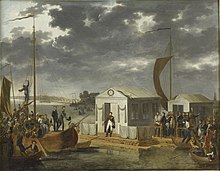
The Treaties of Tilsit: Napoleon meeting with Alexander I of Russia on a raft in the middle of the Neman River, 7 July 1807
Following his triumph, Napoleon imposed the first elements of the Continental System through the Berlin Decree issued in November 1806. The Continental System, which prohibited European nations from trading with Britain, was widely violated throughout his reign.[159][160] In the next few months, Napoleon marched against the advancing Russian armies through Poland and was involved in the bloody stalemate at the Battle of Eylau in February 1807.[161] After a period of rest and consolidation on both sides, the war restarted in June with an initial struggle at Heilsberg that proved indecisive.[162]
On 14 June Napoleon obtained an overwhelming victory over the Russians at the Battle of Friedland, wiping out the majority of the Russian army in a very bloody struggle. The scale of their defeat convinced the Russians to make peace with the French. On 19 June, Tsar Alexander sent an envoy to seek an armistice with Napoleon. The latter assured the envoy that the Vistula River represented the natural borders between French and Russian influence in Europe. On that basis, the two emperors began peace negotiations at the town of Tilsit after meeting on an iconic raft on the River Niemen. The very first thing Alexander said to Napoleon was probably well-calibrated: "I hate the English as much as you do".[162] Their meeting lasted two hours. Despite waging wars against each other the two Emperors were very much impressed and fascinated by one another. "Never," said Alexander afterward, "did I love any man as I loved that man."[163]
Alexander faced pressure from his brother, Duke Constantine, to make peace with Napoleon. Given the victory he had just achieved, the French emperor offered the Russians relatively lenient terms—demanding that Russia join the Continental System, withdraw its forces from Wallachia and Moldavia, and hand over the Ionian Islands to France.[164][full citation needed] By contrast, Napoleon dictated very harsh peace terms for Prussia, despite the ceaseless exhortations of Queen Louise. Wiping out half of Prussian territories from the map, Napoleon created a new kingdom of 2,800 square kilometres (1,100 sq mi) called Westphalia and appointed his young brother Jérôme as its monarch.[165]
Prussia's humiliating treatment at Tilsit caused a deep and bitter antagonism that festered as the Napoleonic era progressed. Moreover, Alexander's pretensions at friendship with Napoleon led the latter to seriously misjudge the true intentions of his Russian counterpart, who would violate numerous provisions of the treaty in the next few years. Despite these problems, the Treaties of Tilsit at last gave Napoleon a respite from war and allowed him to return to France, which he had not seen in over 300 days.[165][full citation needed]
Peninsular War and Erfurt
Main article: Peninsular War
The settlements at Tilsit gave Napoleon time to organize his empire. One of his major objectives became enforcing the Continental System against the British forces. He decided to focus his attention on the Kingdom of Portugal, which consistently violated his trade prohibitions. After defeat in the War of the Oranges in 1801, Portugal adopted a double-sided policy.

Joseph Bonaparte, Napoleon's brother, as King of Spain (1808–1813)
Unhappy with this change of policy by the Portuguese government, Napoleon negotiated a secret treaty with Charles IV of Spain and sent an army to invade Portugal.[166] On 17 October 1807, 24,000 French troops under General Junot crossed the Pyrenees with Spanish cooperation and headed towards Portugal to enforce Napoleon's orders.[167] This attack was the first step in what would eventually become the Peninsular War, a six-year struggle that significantly sapped French strength. Throughout the winter of 1808, French agents became increasingly involved in Spanish internal affairs, attempting to incite discord between members of the Spanish royal family. On 16 February 1808, secret French machinations finally materialized when Napoleon announced that he would intervene to mediate between the rival political factions in the country.[168]
Marshal Murat led 120,000 troops into Spain. The French arrived in Madrid on 24 March,[169] where wild riots against the occupation erupted just a few weeks later. Napoleon appointed his brother, Joseph Bonaparte, as the new King of Spain in the summer of 1808. The appointment enraged a heavily religious and conservative Spanish population. Resistance to French aggression soon spread throughout Spain. The shocking French defeats at the Battle of Bailén and the Battle of Vimiero gave hope to Napoleon's enemies and partly persuaded the French emperor to intervene in person.[170]
Before going to Iberia, Napoleon decided to address several lingering issues with the Russians. At the Congress of Erfurt in October 1808, Napoleon hoped to keep Russia on his side during the upcoming struggle in Spain and during any potential conflict against Austria. The two sides reached an agreement, the Erfurt Convention, that called upon Britain to cease its war against France, that recognized the Russian conquest of Finland from Sweden and made it an autonomous Grand Duchy,[171] and that affirmed Russian support for France in a possible war against Austria "to the best of its ability".[172]
Napoleon then returned to France and prepared for war. The Grande Armée, under the Emperor's personal command, rapidly crossed the Ebro River in November 1808 and inflicted a series of crushing defeats against the Spanish forces. After clearing the last Spanish force guarding the capital at Somosierra, Napoleon entered Madrid on 4 December with 80,000 troops.[173] He then unleashed his soldiers against Moore and the British forces. The British were swiftly driven to the coast, and they withdrew from Spain entirely after a last stand at the Battle of Corunna in January 1809 and the death of Moore.[174]
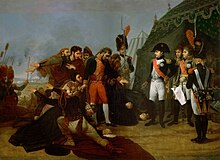
Napoleon accepting the surrender of Madrid, 4 December 1808
Napoleon would end up leaving Iberia in order to deal with the Austrians in Central Europe, but the Peninsular War continued on long after his absence. He never returned to Spain after the 1808 campaign. Several months after Corunna, the British sent another army to the peninsula under Arthur Wellesley, the future Duke of Wellington. The war then settled into a complex and asymmetric strategic deadlock where all sides struggled to gain the upper hand. The highlight of the conflict became the brutal guerrilla warfare that engulfed much of the Spanish countryside. Both sides committed the worst atrocities of the Napoleonic Wars during this phase of the conflict.[175]
The vicious guerrilla fighting in Spain, largely absent from the French campaigns in Central Europe, severely disrupted the French lines of supply and communication. Although France maintained roughly 300,000 troops in Iberia during the Peninsular War, the vast majority were tied down to garrison duty and to intelligence operations.[175] The French were never able to concentrate all of their forces effectively, prolonging the war until events elsewhere in Europe finally turned the tide in favour of the Allies. After the invasion of Russia in 1812, the number of French troops in Spain vastly declined as Napoleon needed reinforcements to conserve his strategic position in Europe. By 1814 the Allies had pushed the French out of the peninsula.
The impact of the Napoleonic invasion of Spain and ousting of the Spanish Bourbon monarchy in favour of his brother Joseph had an enormous impact on the Spanish empire. In Spanish America many local elites formed juntas and set up mechanisms to rule in the name of Ferdinand VII of Spain, whom they considered the legitimate Spanish monarch. The outbreak of the Spanish American wars of independence in most of the empire was a result of Napoleon's destabilizing actions in Spain and led to the rise of strongmen in the wake of these wars.[176]
Comments