


Napoleon Bonaparte (born Napoleone Bonaparte;[1][b] 15 August 1769 – 5 May 1821), later known by his regnal name Napoleon I, was a French military commander and political leader who rose to prominence during the French Revolution and led successful campaigns during the Revolutionary Wars. He was the leader of the French Republic as First Consul from 1799 to 1804, then of the French Empire as Emperor of the French from 1804 until 1814, and briefly again in 1815. Napoleon's political and cultural legacy endures as a celebrated and controversial leader. He initiated many liberal reforms that have persisted through the years, and is considered one of the greatest military commanders in history. His campaigns are still studied at military academies worldwide. Between three and six million soldiers and civilians died in the Napoleonic Wars.[2][3]
Napoleon was born on the island of Corsica to a native family descending from Italian nobility.[4][5] Napoleon was resentful of the French monarchy, and supported the French Revolution in 1789 while serving in the French army, even going so far as to try and spread its ideals to his native Corsica. He rose rapidly in the ranks after saving the governing French Directory by firing on royalist insurgents. In 1796, he began a military campaign against the Austrians and their Italian allies, scoring decisive victories, and became a national hero. Two years later he led a military expedition to Egypt that served as a springboard to political power. He engineered a coup in November 1799 and became First Consul of the Republic. In 1804, to consolidate and expand his power, he crowned himself Emperor of the French.
Differences with the United Kingdom meant France faced the War of the Third Coalition by 1805. Napoleon shattered this coalition with victories in the Ulm campaign and at the Battle of Austerlitz, which led to the dissolution of the Holy Roman Empire. In 1806, the Fourth Coalition took up arms against him. Napoleon defeated Prussia at the battles of Jena and Auerstedt, marched the Grande Armée into Eastern Europe, and defeated the Russians in June 1807 at Friedland, forcing the defeated nations of the Fourth Coalition to accept the Treaties of Tilsit. Two years later, the Austrians challenged the French again during the War of the Fifth Coalition, but Napoleon solidified his grip over Europe after triumphing at the Battle of Wagram.
Hoping to extend the Continental System, his embargo against Britain, Napoleon invaded the Iberian Peninsula and declared his brother Joseph the King of Spain in 1808. The Spanish and the Portuguese revolted in the Peninsular War aided by a British army, culminating in defeat for Napoleon's marshals. Napoleon launched an invasion of Russia in the summer of 1812. The resulting campaign witnessed the catastrophic retreat of Napoleon's Grande Armée. In 1813, Prussia and Austria joined Russian forces in a Sixth Coalition against France, resulting in a large coalition army defeating Napoleon at the Battle of Leipzig. The coalition invaded France and captured Paris, forcing Napoleon to abdicate in April 1814. He was exiled to the island of Elba, between Corsica and Italy. In France, the Bourbons were restored to power.
Napoleon escaped in February 1815 and took control of France.[6] The Allies responded by forming a Seventh Coalition, which defeated Napoleon at the Battle of Waterloo in June 1815. The British exiled him to the remote island of Saint Helena in the Atlantic, where he died in 1821 at the age of 51.
Napoleon had an extensive impact on the modern world, bringing liberal reforms to the lands he conquered in Europe, especially the regions of the Low Countries, Switzerland, modern Italy and Germany. He implemented many liberal policies in France and Western Europe.[c] Napoleon also sold the Louisiana Territory to the United States in 1803, instantly doubling the size of the United States.[2][13] His role in the Haitian Revolution and decision to reinstate slavery in France's overseas colonies are controversial and affect his reputation.[14]
Early life
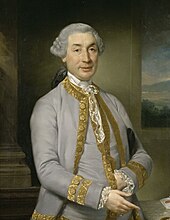
Napoleon's father, Carlo Buonaparte, fought for Corsican independence under Pasquale Paoli, but after their defeat he eventually became the island's representative to the court of Louis XVI.
Napoleon's family was of Italian origin. His paternal ancestors, the Buonapartes, descended from a minor Tuscan noble family that emigrated to Corsica in the 16th century and his maternal ancestors, the Ramolinos, descended from a minor Genoese noble family.[15] His parents Carlo Maria Bonaparte and Maria Letizia Ramolino maintained an ancestral home called "Casa Bonaparte", known nowadays as Maison Bonaparte, in Ajaccio. Napoleon was born there on 15 August 1769. He was the family's fourth child and third son.[d] He had an elder brother, Joseph, and younger siblings Lucien, Elisa, Louis, Pauline, Caroline, and Jérôme. Napoleon was baptised as a Catholic, under the name Napoleone.[16] In his youth, his name was also spelled as Nabulione, Nabulio, Napolionne, and Napulione.[17]
Napoleon was born one year after the Republic of Genoa ceded Corsica to France.[18] The state sold sovereign rights a year before his birth and the island was conquered by France during the year of his birth. It was formally incorporated as a province in 1770, after 500 years under Genoese rule and 14 years of independence.[e] Napoleon's parents joined the Corsican resistance and fought against the French to maintain independence, even when Maria was pregnant with him. His father Carlo was an attorney who had supported and actively collaborated with patriot Pasquale Paoli during the Corsican war of independence against France;[5] after the Corsican defeat at Ponte Novu in 1769 and Paoli's exile in Britain, Carlo began working for the new French government and in 1777 was named representative of the island to the court of Louis XVI.[5][22]

Madame Mère, painted by Joseph Karl Stieler (1811)
The dominant influence of Napoleon's childhood was his mother, whose firm discipline restrained a rambunctious child.[22] Later in life, Napoleon said, "The future destiny of the child is always the work of the mother."[23] His maternal grandmother had married into the Swiss Fesch family in her second marriage, and Napoleon's uncle, the cardinal Joseph Fesch, fulfilled a role as protector of the Bonaparte family for some years. Napoleon's noble, moderately affluent background afforded him greater opportunities to study than were available to a typical Corsican of the time.[24]
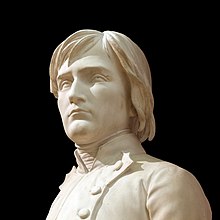
Statue of Bonaparte as a schoolboy in Brienne, aged 15, by Louis Rochet [fr] (1853)
When he turned 9 years old,[25][26] he moved to the French mainland and enrolled at a religious school in Autun in January 1779. In May, he transferred with a scholarship to a military academy at Brienne-le-Château.[27] In his youth he was an outspoken Corsican nationalist and supported the state's independence from France.[25][28] Like many Corsicans, Napoleon spoke and read Corsican (as his mother tongue) and Italian (as the official language of Corsica).[29][30][31][28] He began learning French in school at the age of around 10.[32] Although he became fluent in French, he spoke with a distinctive Corsican accent and never learned to spell in French.[33] Consequently, Napoleon was routinely bullied by his peers for his accent, birthplace, short stature, mannerisms, and inability to speak French quickly.[30] He became reserved and melancholy, applying himself to reading. An examiner observed that Napoleon "has always been distinguished for his application in mathematics. He is fairly well acquainted with history and geography ... This boy would make an excellent sailor".[f][35]
One story told of Napoleon at the school is that he led junior students to victory against senior students in a snowball fight, showing his leadership abilities.[36] In early adulthood, Napoleon briefly intended to become a writer; he authored a history of Corsica and a romantic novella.[25]
On completion of his studies at Brienne in 1784, Napoleon was admitted to the École Militaire in Paris. He trained to become an artillery officer and, when his father's death reduced his income, was forced to complete the two-year course in one year.[37] He was the first Corsican to graduate from the École Militaire.[37] He was examined by the famed scientist Pierre-Simon Laplace.[38]
Early career

Bonaparte, aged 23, as lieutenant-colonel of a battalion of Corsican Republican volunteers. Portrait by Henri Félix Emmanuel Philippoteaux
Upon graduating in September 1785, Bonaparte was commissioned a second lieutenant in La Fère artillery regiment.[g][27] He served in Valence and Auxonne until after the outbreak of the French Revolution in 1789. Bonaparte was a fervent Corsican nationalist during this period.[40] He asked for leave to join his mentor Pasquale Paoli, when Paoli was allowed to return to Corsica by the National Assembly. But Paoli had no sympathy for Napoleon, as he deemed his father a traitor for having deserted the cause of Corsican independence.[41]
He spent the early years of the Revolution in Corsica, fighting in a complex three-way struggle among royalists, revolutionaries, and Corsican nationalists. Napoleon embraced the ideals of the Revolution, becoming a supporter of the Jacobins and joining the pro-French Corsican Republicans who opposed Paoli's policy and his aspirations to secede.[42] He was given command over a battalion of volunteers and promoted to captain in the regular army in 1792, despite exceeding his leave of absence and leading a riot against French troops.[43]
When Corsica declared formal secession from France and requested the protection of the British government, Napoleon and his commitment to the French Revolution came into conflict with Paoli, who had decided to sabotage the Corsican contribution to the Expédition de Sardaigne by preventing a French assault on the Sardinian island La Maddalena.[44] Bonaparte and his family were compelled to flee to Toulon on the French mainland in June 1793 because of the split with Paoli.[45]
Although he was born "Napoleone Buonaparte", it was after this that Napoleon began styling himself "Napoléon Bonaparte". His family did not drop the name Buonaparte until 1796. The first known record of him signing his name as Bonaparte was at the age of 27 (in 1796).[46][16][47]
Siege of Toulon
Main article: Siege of Toulon
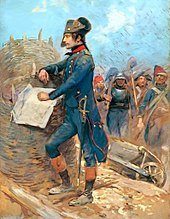
Bonaparte at the Siege of Toulon, 1793, by Edouard Detaille
In July 1793, Bonaparte published a pro-republican pamphlet, Le souper de Beaucaire (Supper at Beaucaire), which gained him the support of Augustin Robespierre, the younger brother of the Revolutionary leader Maximilien Robespierre. With the help of his fellow Corsican Antoine Christophe Saliceti, Bonaparte was appointed senior gunner and artillery commander of the republican forces that arrived at Toulon on 8 September.[48][49]
He adopted a plan to capture a hill where republican guns could dominate the city's harbour and force the British to evacuate. The assault on the position led to the capture of the city, and during it Bonaparte was wounded in the thigh on 16 December. Catching the attention of the Committee of Public Safety, he was put in charge of the artillery of France's Army of Italy.[50] On 22 December he was on his way to a new post in Nice, promoted from colonel to brigadier general at the age of 24. He devised plans to attack the Kingdom of Sardinia as part of France's campaign against the First Coalition.
The French army carried out Bonaparte's plan in the Battle of Saorgio in April 1794, and then advanced to seize Ormea in the mountains. From Ormea, it headed west to outflank the Austro-Sardinian positions around Saorge. After this campaign, Augustin Robespierre sent Bonaparte on a mission to the Republic of Genoa to determine that country's intentions towards France.[51]
13 Vendémiaire
Main article: 13 Vendémiaire
Some contemporaries alleged that Bonaparte was put under house arrest at Nice for his association with the Robespierres following their fall in the Thermidorian Reaction in July 1794. Bonaparte's secretary Bourrienne disputed the allegation in his memoirs. According to Bourrienne, jealousy was responsible, between the Army of the Alps and the Army of Italy, with whom Bonaparte was seconded at the time.[52] Bonaparte dispatched an impassioned defence in a letter to the commissar Saliceti, and was acquitted of any wrongdoing.[53] He was released within two weeks (on 20 August), and due to his technical skills, was asked to draw up plans to attack Italian positions in the context of France's war with Austria. He also took part in an expedition to take back Corsica from the British, but the French were repulsed by the British Royal Navy.[54]
By 1795, Bonaparte had become engaged to Désirée Clary, daughter of François Clary. Désirée's sister Julie Clary had married Bonaparte's brother Joseph.[55] In April 1795, he was assigned to the Army of the West, which was engaged in the War in the Vendée—a civil war and royalist counter-revolution in Vendée, a region in west-central France on the Atlantic Ocean. As an infantry command, it was a demotion from artillery general—for which the army already had a full quota—and he pleaded poor health to avoid the posting.[56]

Journée du 13 Vendémiaire, artillery fire in front of the Church of Saint-Roch, Paris, Rue Saint-Honoré
He was moved to the Bureau of Topography of the Committee of Public Safety. He sought unsuccessfully to be transferred to Constantinople to offer his services to the Sultan.[57] During this period, he wrote the romantic novella Clisson et Eugénie, about a soldier and his lover, in a clear parallel to Bonaparte's own relationship with Clary.[58] On 15 September, Bonaparte was removed from the list of generals in regular service for refusing to serve in the Vendée campaign. He faced a difficult financial situation and reduced career prospects.[59]
On 3 October, royalists in Paris declared a rebellion against the National Convention.[60] Paul Barras, a leader of the Thermidorian Reaction, knew of Bonaparte's military exploits at Toulon and gave him command of the improvised forces in defence of the convention in the Tuileries Palace. Bonaparte had seen the massacre of the King's Swiss Guard there three years earlier and realized that artillery would be the key to its defence.[27]
He ordered a young cavalry officer, Joachim Murat, to seize large cannons and used them to repel the attackers on 5 October 1795—13 Vendémiaire An IV in the French Republican Calendar. 1,400 royalists died and the rest fled.[60] He cleared the streets with "a whiff of grapeshot", according to 19th-century historian Thomas Carlyle in The French Revolution: A History.[61][62]
The defeat of the royalist insurrection extinguished the threat to the Convention and earned Bonaparte sudden fame, wealth, and the patronage of the new government, the Directory. Murat married one of Bonaparte's sisters; he also served as one of Bonaparte's generals. Bonaparte was promoted to Commander of the Interior and given command of the Army of Italy.[45]
Within weeks, he was romantically involved with Joséphine de Beauharnais, the former mistress of Barras. The couple married on 9 March 1796 in a civil ceremony.[63]
First Italian campaign
Main article: Italian campaigns of the French Revolutionary Wars

Bonaparte at the Pont d'Arcole, by Baron Antoine-Jean Gros, (c. 1801), Musée du Louvre, Paris
Two days after the marriage, Bonaparte left Paris to take command of the Army of Italy. He immediately went on the offensive, hoping to defeat the forces of Kingdom of Sardinia (1720–1861) before their Austrian allies could intervene. In a series of rapid victories during the Montenotte Campaign, he knocked Piedmont out of the war in two weeks. The French then focused on the Austrians for the remainder of the war, the highlight of which became the protracted struggle for Mantua. The Austrians launched a series of offensives against the French to break the siege, but Bonaparte defeated every relief effort, winning the battles of Castiglione, Bassano, Arcole, and Rivoli. The decisive French triumph at Rivoli in January 1797 led to the collapse of the Austrian position in Italy. At Rivoli, the Austrians lost up to 14,000 men while the French lost about 5,000.[64]
The next phase of the campaign featured the French invasion of the Habsburg heartlands. French forces in Southern Germany had been defeated by the Archduke Charles in 1796, but Charles withdrew his forces to protect Vienna after learning of Bonaparte's assault. In the first encounter between the two, Bonaparte pushed Charles back and advanced deep into Austrian territory after winning the Battle of Tarvis in March 1797. The Austrians were alarmed by the French thrust that reached all the way to Leoben, about 100 km from Vienna, and decided to sue for peace.[65]
The Treaty of Leoben, followed by the more comprehensive Treaty of Campo Formio, gave France control of most of northern Italy and the Low Countries, and a secret clause promised the Republic of Venice to Austria. Bonaparte marched on Venice and forced its surrender, ending 1,100 years of Venetian independence. He authorized the French to loot treasures such as the Horses of Saint Mark.[66] On the journey, Bonaparte conversed much about the warriors of antiquity, especially Alexander, Caesar, Scipio and Hannibal. He studied their strategy and combined it with his own. To a question from Bourrienne, asking whether he preferred Alexander or Caesar, Bonaparte said that he placed Alexander in the first rank, the main reason being his campaign in Asia.[67]

Napoleon at the Battle of Rivoli, by Henri Félix Emmanuel Philippoteaux
His application of conventional military ideas to real-world situations enabled his military triumphs, such as creative use of artillery as a mobile force to support his infantry. He said later in life:[when?] "I have fought sixty battles and I have learned nothing which I did not know at the beginning. Look at Caesar; he fought the first like the last".[68]
Bonaparte could win battles by concealing troop deployments and concentrating his forces on the "hinge" of an enemy's weakened front. If he could not use his favourite envelopment strategy, he would take up the central position and attack two cooperating forces at their hinge, swing round to fight one until it fled, then turn to face the other.[69] In this Italian campaign, Bonaparte's army captured 150,000 prisoners, 540 cannons, and 170 standards.[70] The French army fought 67 actions and won 18 pitched battles through superior artillery technology and Bonaparte's tactics.[71]
During the campaign, Bonaparte became increasingly influential in French politics. He founded two newspapers: one for the troops in his army and one for circulation in France.[72] The royalists attacked him for looting Italy and warned that he might become a dictator.[73] Bonaparte's forces extracted an estimated $45 million in funds from Italy during their campaign there, another $12 million in precious metals and jewels. His forces confiscated more than 300 priceless paintings and sculptures.[74]
Bonaparte sent General Pierre Augereau to Paris to lead a coup d'état and purge the royalists on 4 September—the Coup of 18 Fructidor. This left Barras and his Republican allies in control again but dependent upon Bonaparte, who proceeded to peace negotiations with Austria. These negotiations resulted in the Treaty of Campo Formio. Bonaparte returned to Paris on 5 December 1797 as a hero.[75] He met Talleyrand, France's new Foreign Minister—who served in the same capacity for Emperor Napoleon—and they began to prepare to invade Britain.[45]
Comments