


Egyptian expedition
Main article: French campaign in Egypt and Syria

Bonaparte Before the Sphinx (c. 1886) by Jean-Léon Gérôme, Hearst Castle
After two months of planning, Bonaparte decided that France's naval strength was not yet sufficient to confront the British Royal Navy. He decided on a military expedition to seize Egypt and thereby undermine Britain's access to its trade interests in India.[45] Bonaparte wished to establish a French presence in the Middle East and join forces with Tipu Sultan, the Sultan of Mysore, an enemy of the British.[76] Bonaparte assured the Directory that "as soon as he had conquered Egypt, he will establish relations with the Indian princes and, together with them, attack the English in their possessions".[77] The Directory agreed in order to secure a trade route to the Indian subcontinent.[78]
In May 1798, Bonaparte was elected a member of the French Academy of Sciences. His Egyptian expedition included a group of 167 scientists, with mathematicians, naturalists, chemists, and geodesists among them. Their discoveries included the Rosetta Stone, and their work was published in the Description de l'Égypte in 1809.[79]
En route to Egypt, Bonaparte reached Malta on 9 June 1798, then controlled by the Knights Hospitaller. Grand Master Ferdinand von Hompesch zu Bolheim surrendered after token resistance, and Bonaparte captured an important naval base with the loss of only three men.[80]
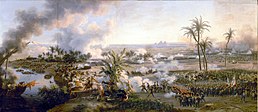
Battle of the Pyramids on 21 July 1798 by Louis-François, Baron Lejeune, 1808
Bonaparte and his expedition eluded pursuit by the Royal Navy and landed at Alexandria on 1 July.[45] He fought the Battle of Shubra Khit against the Mamluks, Egypt's ruling military caste. This helped the French practise their defensive tactic for the Battle of the Pyramids on 21 July, about 24 km (15 mi) from the pyramids. Bonaparte's forces of 25,000 roughly equalled those of the Mamluks' Egyptian cavalry. Twenty-nine French[81] and approximately 2,000 Egyptians were killed. The victory boosted the French army's morale.[82]
On 1 August 1798, the British fleet under Sir Horatio Nelson captured or destroyed all but two vessels of the French fleet in the Battle of the Nile, preventing Bonaparte from strengthening the French position in the Mediterranean.[83] His army had succeeded in a temporary increase of French power in Egypt, though it faced repeated uprisings.[84] In early 1799, he moved an army into the Ottoman province of Damascus (Syria and Galilee). Bonaparte led these 13,000 French soldiers in the conquest of the coastal towns of Arish, Gaza, Jaffa, and Haifa.[85] The attack on Jaffa was particularly brutal. Bonaparte discovered that many of the defenders were former prisoners of war, ostensibly on parole, so he ordered the garrison and some 1,500–2,000 prisoners to be executed by bayonet or drowning.[86] Men, women, and children were robbed and murdered for three days.[87]
Bonaparte began with an army of 13,000 men. 1,500 were reported missing, 1,200 died in combat, and thousands perished from disease—mostly bubonic plague. He failed to reduce the fortress of Acre, so he marched his army back to Egypt in May. To speed the retreat, Bonaparte ordered plague-stricken men to be poisoned with opium. The number who died remains disputed, ranging from 30 to 580. He also brought out 1,000 wounded men.[88] Back in Egypt on 25 July, Bonaparte defeated an Ottoman amphibious invasion at Abukir.[89]
Ruler of France
Main articles: 18 Brumaire and Napoleonic era

General Bonaparte surrounded by members of the Council of Five Hundred during the Coup of 18 Brumaire, by François Bouchot
While in Egypt, Bonaparte stayed informed of European affairs. He learned that France had suffered a series of defeats in the War of the Second Coalition.[90] On 24 August 1799, fearing that the Republic's future was in doubt, he took advantage of the temporary departure of British ships from French coastal ports and set sail for France, despite the fact that he had received no explicit orders from Paris.[91] The army was left in the charge of Jean-Baptiste Kléber.[92]
Unknown to Bonaparte, the Directory had sent him orders to return to ward off possible invasions of French soil, but poor lines of communication prevented the delivery of these messages.[90] By the time that he reached Paris in October, France's situation had been improved by a series of victories. The Republic, however, was bankrupt and the ineffective Directory was unpopular with the French population.[93] The Directory discussed Bonaparte's "desertion" but was too weak to punish him.[90]
Despite the failures in Egypt, Bonaparte returned to a hero's welcome. He drew together an alliance with director Emmanuel Joseph Sieyès, his brother Lucien, speaker of the Council of Five Hundred Roger Ducos, director Joseph Fouché, and Talleyrand, and they overthrew the Directory by a coup d'état on 9 November 1799 ("the 18th Brumaire" according to the revolutionary calendar), closing down the Council of Five Hundred. Napoleon became "first consul" for ten years, with two consuls appointed by him who had consultative voices only. His power was confirmed by the new "Constitution of the Year VIII", originally devised by Sieyès to give Napoleon a minor role, but rewritten by Napoleon, and accepted by direct popular vote (3,000,000 in favour, 1,567 opposed). The constitution preserved the appearance of a republic but, in reality, established a dictatorship.[94][95]
French Consulate
Main articles: French Consulate and War of the Second Coalition

Bonaparte, First Consul, by Ingres. Posing the hand inside the waistcoat was often used in portraits of rulers to indicate calm and stable leadership.

Silver coin: 5 francs_AN XI, 1802, Bonaparte, First Consul
Bonaparte established a political system that historian Martyn Lyons called "dictatorship by plebiscite".[96] Worried by the democratic forces unleashed by the Revolution, but unwilling to ignore them entirely, Bonaparte resorted to regular electoral consultations with the French people on his road to imperial power.[96] He drafted the Constitution of the Year VIII and secured his own election as First Consul, taking up residence at the Tuileries. The constitution was approved in a rigged plebiscite held the following January, with 99.94 percent officially listed as voting "yes".[97]
Napoleon's brother, Lucien, had falsified the returns to show that 3 million people had participated in the plebiscite. The real number was 1.5 million.[96] Political observers at the time assumed the eligible French voting public numbered about 5 million people, so the regime artificially doubled the participation rate to indicate popular enthusiasm for the consulate.[96] In the first few months of the consulate, with war in Europe still raging and internal instability still plaguing the country, Bonaparte's grip on power remained very tenuous.[98]
In the spring of 1800, Bonaparte and his troops crossed the Swiss Alps into Italy, aiming to surprise the Austrian armies that had reoccupied the peninsula when Bonaparte was still in Egypt.[h] After a difficult crossing over the Alps, the French army entered the plains of Northern Italy virtually unopposed.[100] While one French army approached from the north, the Austrians were busy with another stationed in Genoa, which was besieged by a substantial force. The fierce resistance of this French army, under André Masséna, gave the northern force some time to carry out their operations with little interference.[101]
After spending several days looking for each other, the two armies collided at the Battle of Marengo on 14 June. General Melas had a numerical advantage, fielding about 30,000 Austrian soldiers while Bonaparte commanded 24,000 French troops.[102] The battle began favourably for the Austrians as their initial attack surprised the French and gradually drove them back. Melas stated that he had won the battle and retired to his headquarters around 3 pm, leaving his subordinates in charge of pursuing the French.[103] The French lines never broke during their tactical retreat. Bonaparte constantly rode out among the troops urging them to stand and fight.[104]

The Battle of Marengo was Napoleon's first major victory as head of state.
Late in the afternoon, a full division under Desaix arrived on the field and reversed the tide of the battle. A series of artillery barrages and cavalry charges decimated the Austrian army, which fled over the Bormida River back to Alessandria, leaving behind 14,000 casualties.[104] The following day, the Austrian army agreed to abandon Northern Italy once more with the Convention of Alessandria, which granted them safe passage to friendly soil in exchange for their fortresses throughout the region.[104]
Although critics have blamed Bonaparte for several tactical mistakes preceding the battle, they have also praised his audacity for selecting a risky campaign strategy, choosing to invade the Italian peninsula from the north when the vast majority of French invasions came from the west, near or along the coastline.[105] As David G. Chandler points out, Bonaparte spent almost a year getting the Austrians out of Italy in his first campaign. In 1800, it took him only a month to achieve the same goal.[105] German strategist and field marshal Alfred von Schlieffen concluded that "Bonaparte did not annihilate his enemy but eliminated him and rendered him harmless" while attaining "the object of the campaign: the conquest of North Italy".[106]
Bonaparte's triumph at Marengo secured his political authority and boosted his popularity back home, but it did not lead to an immediate peace. Bonaparte's brother, Joseph, led the complex negotiations in Lunéville and reported that Austria, emboldened by British support, would not acknowledge the new territory that France had acquired. As negotiations became increasingly fractious, Bonaparte gave orders to his general Moreau to strike Austria once more. Moreau and the French swept through Bavaria and scored an overwhelming victory at Hohenlinden in December 1800. As a result, the Austrians capitulated and signed the Treaty of Lunéville in February 1801. The treaty reaffirmed and expanded earlier French gains at Campo Formio.[107]
Temporary peace in Europe
See also: Haitian Revolution
After a decade of constant warfare, France and Britain signed the Treaty of Amiens in March 1802, bringing the Revolutionary Wars to an end. Amiens called for the withdrawal of British troops from recently conquered colonial territories as well as for assurances to curtail the expansionary goals of the French Republic.[101] With Europe at peace and the economy recovering, Bonaparte's popularity soared to its highest levels under the consulate, both domestically and abroad.[108] In a new plebiscite during the spring of 1802, the French public came out in huge numbers to approve a constitution that made the Consulate permanent, essentially elevating Bonaparte to dictator for life.[108]
Whereas the plebiscite two years earlier had brought out 1.5 million people to the polls, the new referendum enticed 3.6 million to go and vote (72 percent of all eligible voters).[109] There was no secret ballot in 1802 and few people wanted to openly defy the regime. The constitution gained approval with over 99% of the vote.[109] His broad powers were spelled out in the new constitution: Article 1. The French people name, and the Senate proclaims Napoleon-Bonaparte First Consul for Life.[110] After 1802, he was generally referred to as Napoleon rather than Bonaparte.[39]

The 1803 Louisiana Purchase totalled 2,144,480 square kilometres (827,987 square miles), doubling the size of the United States.
The brief peace in Europe allowed Napoleon to focus on French colonies abroad. Saint-Domingue had managed to acquire a high level of political autonomy during the Revolutionary Wars, with Toussaint L'Ouverture installing himself as de facto dictator by 1801. Napoleon saw a chance to reestablish control over the colony when he signed the Treaty of Amiens. In the 18th century, Saint-Domingue had been France's most profitable colony, producing more sugar than all the British West Indies colonies combined. However, during the Revolution, the National Convention voted to abolish slavery in February 1794.[111] Aware of the expenses required to fund his wars in Europe, Napoleon made the decision to reinstate slavery in all French Caribbean colonies. The 1794 decree had only affected the colonies of Saint-Domingue, Guadeloupe and Guiana and did not take effect in Mauritius, Reunion and Martinique, the last of which had been captured by the British and as such remained unaffected by French law.[112]
In Guadeloupe slavery had been abolished (and its ban violently enforced) by Victor Hugues against opposition from slaveholders thanks to the 1794 law. However, when slavery was reinstated in 1802, a slave revolt broke out under the leadership of Louis Delgrès.[113] The resulting Law of 20 May had the express purpose of reinstating slavery in Saint-Domingue, Guadeloupe and French Guiana, and restored slavery throughout most of the French colonial empire (excluding Saint-Domingue) for another half a century, while the French transatlantic slave trade continued for another twenty years.[114][115][116][117][118]
Napoleon sent an expedition under his brother-in-law General Leclerc to reassert control over Saint-Domingue. Although the French managed to capture Toussaint Louverture, the expedition failed when high rates of disease crippled the French army, and Jean-Jacques Dessalines won a string of victories, first against Leclerc, and when he died from yellow fever, then against Donatien-Marie-Joseph de Vimeur, vicomte de Rochambeau, whom Napoleon sent to relieve Leclerc with another 20,000 men. In May 1803, Napoleon acknowledged defeat, and the last 8,000 French troops left the island, and the slaves proclaimed an independent republic that they called Haiti in 1804. In the process, Dessalines became arguably the most successful military commander in the struggle against Napoleonic France.[119][120] Seeing the failure of his efforts in Haiti, Napoleon decided in 1803 to sell the Louisiana Territory to the United States, instantly doubling the size of the U.S. The selling price in the Louisiana Purchase was less than three cents per acre, a total of $15 million.[2][13]
The peace with Britain proved to be uneasy and controversial.[121] Britain did not evacuate Malta as promised and protested against Bonaparte's annexation of Piedmont and his Act of Mediation, which established a new Swiss Confederation. Neither of these territories were covered by Amiens, but they inflamed tensions significantly.[122] The dispute culminated in a declaration of war by Britain in May 1803; Napoleon responded by reassembling the invasion camp at Boulogne and declaring that every British male between eighteen and sixty years old in France and its dependencies to be arrested as a prisoner of war.[123]
French Empire
Main article: First French EmpireSee also: Coronation of Napoleon I and Napoleonic Wars

The Coronation of Napoleon by Jacques-Louis David (1804)
During the consulate, Napoleon faced several royalist and Jacobin assassination plots, including the Conspiration des poignards (Dagger plot) in October 1800 and the Plot of the Rue Saint-Nicaise (also known as the Infernal Machine) two months later.[124] In January 1804, his police uncovered an assassination plot against him that involved Moreau and which was ostensibly sponsored by the Bourbon family, the former rulers of France. On the advice of Talleyrand, Napoleon ordered the kidnapping of the Duke of Enghien,[125] violating the sovereignty of Baden. The Duke was quickly executed after a secret military trial, even though he had not been involved in the plot.[126] Enghien's execution infuriated royal courts throughout Europe, becoming one of the contributing political factors for the outbreak of the Napoleonic Wars.
To expand his power, Napoleon used these assassination plots to justify the creation of an imperial system based on the Roman model. He believed that a Bourbon restoration would be more difficult if his family's succession was entrenched in the constitution.[127] Launching yet another referendum, Napoleon was elected as Emperor of the French by a tally exceeding 99%.[109] As with the Life Consulate two years earlier, this referendum produced heavy participation, bringing out almost 3.6 million voters to the polls.[109]
A keen observer of Bonaparte's rise to absolute power, Madame de Rémusat, explains that "men worn out by the turmoil of the Revolution […] looked for the domination of an able ruler" and that "people believed quite sincerely that Bonaparte, whether as consul or emperor, would exert his authority and save [them] from the perils of anarchy."[128][page needed]
Coronation

Napoleon's throne room at Fontainebleau
Napoleon's coronation, at which Pope Pius VII officiated, took place at Notre Dame de Paris, on 2 December 1804. The ceremony, more or less, lasted around three hours, so the guests who arrived earlier became dull or bored and had to go in and out of the cathedral, to at least rejuvenate their spirits and also to buy food and drink.[129] Two separate crowns were brought for the ceremony: a golden laurel wreath recalling the Roman Empire, and a replica of Charlemagne's crown.[130] Napoleon entered the ceremony wearing the laurel wreath and kept it on his head throughout the proceedings[130] since the laurel wreath symbolized victory, peace and civic virtue.[129] For the official coronation, he raised the replica Charlemagne crown over his own head in a symbolic gesture, but never placed it on top because he was already wearing the golden wreath.[130] After the crown was placed on his head, everyone in the Notre Dame Cathedral stood up spontaneously, the men waving their feathered hats.[131] Josephine, his wife, knelt in front of Napoleon where he then placed the crown on Josephine's head, the event commemorated in the officially sanctioned painting by Jacques-Louis David.[130] Josephine became only the second queen to be crowned and anointed in French history, other than Marie de' Medici.[132]
Napoleon was then crowned King of Italy, with the Iron Crown of Lombardy, at the Cathedral of Milan on 26 May 1805. He created eighteen Marshals of the Empire from among his top generals to secure the allegiance of the army on 18 May 1804, the official start of the Empire.[133]
Comments