
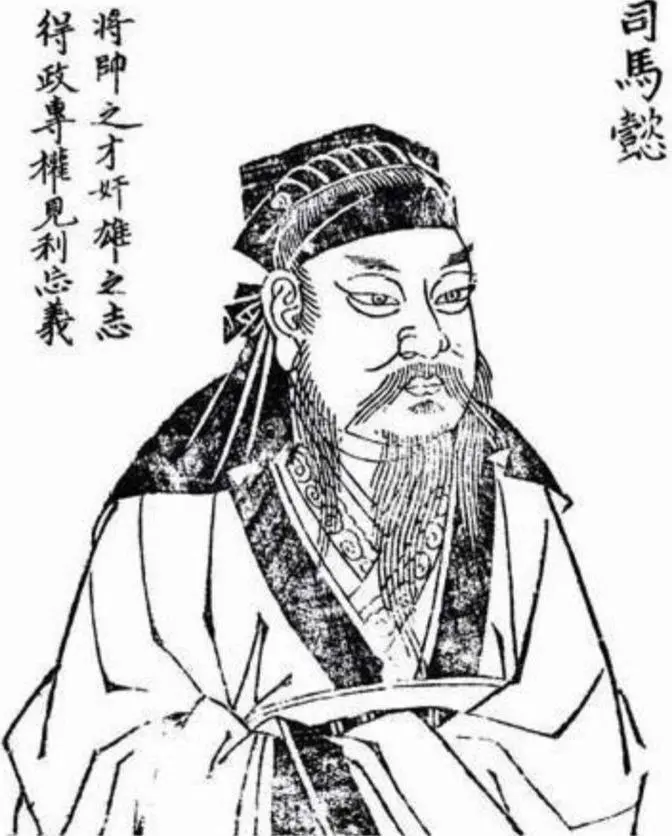

Sima Yi (

pronunciation Chinese: 司馬懿; 179 – 7 September 251), courtesy name Zhongda, was a Chinese military general, politician, and regent of the state of Wei during the Three Kingdoms period of China.
He formally began his political career in 208 under the Han dynasty's Imperial Chancellor Cao Cao; quickly rising through the ranks. His success in both handling domestic and military affairs, such as in governance and the promotion of agriculture, serving as a capable adviser, repelling incursions and invasions led by Shu and Wu forces, speedily crushing Meng Da's rebellion, and conquering the Gongsun-led Liaodong commandery, all managed to garner him great prestige over the decades. He is perhaps best known for defending Wei from a series of invasions between 231 and 234 led by Wei's rival state Shu.
In 239, he was made to preside as a regent for the young Cao Fang—after the latter's adoptive father, Cao Rui, had died—along with another co-regent, Cao Shuang. Although amicable at first, the relationship soon deteriorated in light of Cao Shuang's corruption, extravagance, and attempts to curtail Sima Yi's political influence. In 249, after carefully planning and building up support, he ousted Cao Shuang from power in a coup d'état and had him and his associates executed.
Sima Yi would go on to serve as the de facto primary authority in Wei after this event, although in 251 he faced some opposition in the form of Wang Ling's rebellion, which he swiftly dealt with. He died later that year, on 7 September 251, at the age of 71 or (more likely) 72, with his eldest son, Sima Shi, succeeding his position.
For the remainder of Wei's history, state power would increasingly rest in the hands of the Sima clan, which paved the way for the establishment of the Jin dynasty, which was founded by Sima Yi's grandson, Sima Yan, in 266. After Sima Yan became emperor, he honoured his grandfather with the posthumous title Emperor Xuan of Jin (宣皇帝) and the temple name Gaozu (高祖).
FAMILY BACKGROUND
Sima Yi's ancestral home was in Xiaojing Village (孝敬里), Wen County (溫縣), Henei Commandery (河內郡), which is in present-day Zhaoxian Town, Wen County, Henan. His ancestor was Sima Ang, the King of Yin (殷王), who was briefly a ruler of one of the Eighteen Kingdoms during the transition period from the Qin dynasty to the Western Han dynasty, before Liu Bang's general, Han Xin, conquered his territory, capturing him and his capital city based in Zhaoge (朝歌; present-day Qi County, Hebi, Henan) in the process. In the early Han dynasty, Sima Ang's former kingdom, which had been largely situated in Henei (河內; in present-day northern Henan), became a commandery of the Han Empire, and his descendants had lived there since.
Sima Jūn (司馬鈞), an eighth-generation descendant of Sima Ang, and the great-great-grandfather of Sima Yi, served as a general of the Han Empire; holding the position of General Who Conquers the West (征西將軍). Sima Jūn's son, Sima Liang (司馬量), held the position of Grand Administrator of Yuzhang (豫章太守), and Sima Liang's son, Sima Jùn (司馬儁), served as Grand Administrator of Yingchuan (潁川太守). Sima Jùn's son, Sima Fang, served as the Prefect of Luoyang (洛陽令), Intendant of Jingzhao (京兆尹), and later in his life as Cavalry Commandant (騎都尉) towards the end of the Eastern Han dynasty. Sima Yi (Zhongda) was Sima Fang's second son.
Sima Yi had one elder brother, Sima Lang (Boda), and six younger brothers (in decreasing order of seniority): Sima Fu (Shuda), Sima Kui (Jida), Sima Xun (Xianda), Sima Jin (Huida), Sima Tong (Yada), and Sima Min (Youda). The eight Sima brothers were collectively known as the "Eight Das" because their courtesy names all ended with da (達).
EARLY LIFE
Sima Yi displayed intelligence and great ambitions at a young age. He was knowledgeable and well-versed in Confucian classics. When chaos broke out in China towards the end of the Eastern Han dynasty, Sima Yi often expressed sympathy and concern for the people. Before he reached adulthood around the age of 19, Sima Yi once met Yang Jun (楊俊), a commandery administrator who was known for spotting talents. Yang Jun described him as an "extraordinary talent". Cui Yan, a friend of Sima Yi's elder brother, Sima Lang, once said: "(Sima Yi) is intelligent, decisive, and unique. (Sima Lang) can't be compared to him."
Sima Yi and his family used to live in the imperial capital, Luoyang, where his father, Sima Fang, served as a government official. Sima Yi was raised in a strict Confucian manner: He was not allowed to visit his father unless summoned, to speak to his father without being explicitly addressed, and neither was he allowed to be seated in the same room as his father. In 190, when the warlord Dong Zhuo dominated the Han central government and wanted to relocate the imperial capital to Chang'an, Sima Fang ordered Sima Lang to bring the Sima family out of Luoyang and return to their ancestral home in Wen County, Henei Commandery. Some months later, as Sima Lang foresaw that chaos would break out in Henei Commandery, he relocated his family to Liyang Commandery (黎陽郡; around present-day Xun County, Henan), where they stayed with Sima Lang's kinsman, Zhao Weisun. In 194, when war broke out between the warlords Cao Cao and Lü Bu, Sima Lang brought his family out of Liyang Commandery and again returned to their now-ravaged ancestral home in Wen County, Henei Commandery, where Sima Yi and his brothers largely sustained themselves by living as farmers; fending off local groups of bandits while studying diligently during their free time.
Around 201, the administrative office of Henei Commandery nominated Sima Yi to serve in the government by holding local office, possibly as a clerk in charge of the records, and in 202 he was sent as a Reporting Officer (上計掾) to the capital. Around the same year, he married a woman named Zhang Chunhua, possibly at the instigation of his father. At the same time, the warlord Cao Cao, who then held the position of Minister of Works in the Han imperial court, heard of Sima Yi's talent and wanted to recruit him to serve in the administration. Sima Yi declined, presumably on grounds of illness, with the Book of Jin more specifically mentioning that he, seeing that the Han Empire's future was bleak, declined and lied by supposedly saying that he suffered from paralysis; staying at home, with Cao Cao's spies reporting that they saw Sima Yi lying motionless in bed.
One day—in a story that may be apocryphal—while Sima Yi was drying his books under the sun, there was a sudden downpour, so he rushed out to grab his books and was seen by a maid. Sima Yi's wife, Zhang Chunhua, feared that the maid would leak out news that Sima Yi was well and get their family into trouble, so she killed the maid to silence her.
SERVICE UNDER CAO CAO
When Cao Cao became the Imperial Chancellor in 208, he sent an official to recruit Sima Yi to serve as an assistant clerk in his administration. He also allegedly instructed the official to arrest Sima Yi if he dawdled. Sima Yi apparently became afraid, so he accepted the appointment. Although he was initially assigned to be an attendant to the crown prince, he was later reassigned to other positions, including Gentleman of the Yellow Gate (黃門侍郎), Consultant (議郎), Officer in the East Bureau of the Imperial Chancellor's Office (丞相東曹屬), and Registrar in the Imperial Chancellor's Office (丞相主簿).
Advising Cao Cao to attack Yi Province
In 215, Sima Yi accompanied Cao Cao on his campaign against the warlord Zhang Lu, whom Cao Cao defeated in Hanzhong Commandery at the Battle of Yangping, and afterwards Sima Yi urged him to capitalise on the momentum to press on and attack his rival, Liu Bei, who was in the neighbouring Yi Province (covering present-day Sichuan and Chongqing). Sima Yi pointed out that since Liu Bei had only recently seized control of Yi Province from Liu Zhang, he had yet to establish a strong foothold in the province. However, Cao Cao rejected Sima Yi's idea and said that he was already content with having Longyou (隴右; covering parts of present-day Gansu and Shaanxi). He then turned his attention towards his other key rival, Sun Quan.
Urging Cao Cao to usurp the throne
Sun Quan sent an emissary to meet Cao Cao, requesting to make peace and expressing his willingness to pledge allegiance to Cao Cao. He also urged Cao Cao to seize the throne from Emperor Xian and declare himself emperor. In response to Sun Quan's suggestion, Cao Cao remarked: "This rascal wants me to put myself on top of a fire!" However, Sima Yi told him: "The Han dynasty is in decline. Your Lordship controls nine-tenths of the Han Empire. You are in a position to take the throne. Sun Quan's submission is the will of Heaven. Previously, during Yu's time and throughout the Xia, Shang, and Zhou dynasties, the rulers who did not hesitate when they should take the throne were the ones who truly understood Heaven's will." Cao Cao ultimately never usurped the throne from Emperor Xian and remained nominally a subject of the Han Empire until his death.
In 216, after Emperor Xian promoted Cao Cao from a duke to a vassal king under the title "King of Wei" (魏王), Sima Yi became an adviser to Cao Cao's son and heir apparent, Cao Pi. Cao Pi highly regarded and respected Sima Yi for his brilliance. Along with Chen Qun, Wu Zhi, and Zhu Shuo (朱鑠), Sima Yi was one of Cao Pi's close aides and one of his "Four Friends". Before Cao Pi became his father's heir apparent in 216, he engaged in a power struggle against his younger brother Cao Zhi over the succession. During this time, Sima Yi was believed to be among those who secretly backed Cao Pi and helped him win the position of heir apparent. He also allegedly had a hand in Cao Zhi's demotion and removal from politics after Cao Pi became the emperor.
When Sima Yi was appointed as an Army Major (軍司馬), he suggested to Cao Cao to stockpile food supplies and maintain their defences at the same time because there were more than 200,000 people who were unable to sustain themselves through farming. Cao Cao accepted his idea and implemented a policy for the people to farm and stockpile grain.
Battle of Fancheng
Sima Yi also warned Cao Cao about Hu Xiu (胡修) and Fu Fang (傅方), who respectively served as the Inspector of Jing Province and the Administrator of Nanxiang Commandery (南鄉郡; in Jing Province) at the time. He said that Hu Xiu was violent while Fu Fang was arrogant, so they should not be entrusted with the important responsibility of guarding the border at Jing Province. Cao Cao ignored him. In 219, during the Battle of Fancheng, while Cao Cao's general Cao Ren was besieged by Liu Bei's general Guan Yu in Fancheng (樊城; present-day Fancheng District, Xiangyang, Hubei), Cao Cao ordered Yu Jin to lead reinforcements to lift the siege on Fancheng. However, the reinforcements were destroyed in a flood and Yu Jin surrendered to Guan Yu. As Sima Yi foresaw, Hu Xiu and Fu Fang defected to Guan Yu, placing Cao Ren in an even more perilous situation.
Upon learning of Yu Jin's defeat, Cao Cao felt that the Han imperial capital, Xuchang, was too near enemy territory, so he considered moving the capital further north into Hebei. Sima Yi and Jiang Ji said: "Yu Jin's defeat was not due to flaws in our defences, nor would it significantly affect us. Moving the imperial capital is showing our weakness to the enemy. It will cause panic in the regions around the Huai and Mian rivers. Sun Quan and Liu Bei seem close to each other, but they actually don't trust each other. Sun Quan will feel very uneasy upon seeing Guan Yu's victory, so we should incite him to attack Guan Yu's base in Jing Province. This will lift the siege on Fancheng." Cao Cao heeded their advice. Sun Quan later sent his general Lü Meng to attack Gong'an County and invade Jing Province in the winter of 219–220. Guan Yu was captured and executed by Sun Quan's forces.
Cao Cao wanted to relocate residents in Jing Province and Yingchuan Commandery (潁川郡) further north as he felt that they were too close to enemy territory in the south. Sima Yi, however, advised him against doing so and said: "The Jing and Chu regions are unstable. The people are easy to move but hard to pacify. As Guan Yu has been recently defeated, bad people will go into hiding. If we move the good people, we might cause them to feel distressed and unwilling to return to our side." Cao Cao heeded Sima Yi's advice. The people affected by the Battle of Fancheng later managed to revert to their original livelihoods before the battle.
When Cao Cao died in Luoyang in March 220, there was much apprehension in the imperial court. Sima Yi supervised the funerary arrangements to ensure that everything was going to be carried out in an orderly fashion, and thereafter accompanied the funeral cortège to Ye (present-day Handan, Hebei), whereby in doing so he earned the respect of officials both within and outside the central government.
SERVICE UNDER CAO PI
After Cao Pi succeeded his father as the (vassal) King of Wei (魏王) and Imperial Chancellor of the Han Empire in early 220, he enfeoffed Sima Yi as the Marquis of Hejin Village (河津亭侯) and appointed him as his Chief Clerk (長史).
Later, when Sun Quan led his forces to attack Cao Pi's territories in Jing Province, some officials rejected the idea of resisting Sun Quan since Fancheng (樊城; present-day Fancheng District, Xiangyang, Hubei) and Xiangyang lacked food supplies. At the time, Cao Ren, who was defending Xiangyang, had been reassigned from Fancheng to defend Wancheng (宛城; present-day Wancheng District, Nanyang, Henan). Sima Yi said: "Sun Quan has recently defeated Guan Yu. At this time, he will be thinking of defending his newly acquired territories (rather than attacking us), so he will definitely not pose a threat to us. Xiangyang's land and water routes are crucial to its defences against enemy attacks, so we cannot abandon the city." Cao Pi ignored Sima Yi's advice. As Sima Yi predicted, Sun Quan did not attack them after Cao Ren gave up on Xiangyang and Fancheng. Cao Pi regretted not listening to him.
Throughout the course of 220, Sima Yi would go on to serve as one of the leading officials in court to support and urge for Cao Pi's seizure of the throne, joined as he were by a number of other officials.
In late 220, Cao Pi usurped the throne from Emperor Xian, ended the Eastern Han dynasty, and declared himself emperor of the newly established state of Wei. Cao Pi first appointed Sima Yi as a Master of Writing (尚書) but later reassigned him to be an Army Inspector (督軍) and Palace Assistant Imperial Clerk (御史中丞). He also promoted Sima Yi from a village marquis to a district marquis under the title "Marquis of Anguo District" (安國鄉侯).
In 221, Sima Yi was removed from his post as an Army Inspector and was appointed as a Palace Attendant (侍中) and Right Supervisor of the Masters of Writing (尚書右僕射).
In 222, when Cao Pi visited Wancheng (宛城; present-day Wancheng District, Nanyang, Henan), either because the city wasn't celebratory enough, or because a local market had failed to produce a type of medicine Cao Pi had requested, the Governor of Nanyang (南陽太守), Yang Jun (楊俊), under whose authority the city fell, was arrested. Sima Yi, among other officials, was on good terms with Yang Jun, whom he had previously met during his youth and considered capable and intelligent, and therefore pleaded on his behalf; knocking his forehead on the ground until it started bleeding, but Cao Pi dismissed the appeal. Yang Jun, admitting that he was at fault, committed suicide. Sima Yi was greatly saddened at such a loss.
Two years later, in September 224, Cao Pi went on a tour of the south to inspect his forces in the areas near the Wei–Wu border. Sima Yi remained behind to defend Xuchang and his marquis title was changed to "Marquis of Xiang District" (向鄉侯).
In the spring of 225, he was appointed General Who Pacifies the Army (撫軍將軍) and placed in command of 5,000 troops, in addition to holding the positions of Official Who Concurrently Serves in the Palace (給事中) and Manager of the Affairs of the Masters of Writing (錄尚書事). When Sima Yi declined to accept these appointments, Cao Pi told him: "I am so busy with state affairs that I have been working through both day and night and have hardly a moment for rest. (When I entrust you with these responsibilities,) I am not commending you, but rather, I need you to help me share my burden."
In 226, Cao Pi led his armies to attack Sun Quan and left Sima Yi behind to defend and govern the imperial capital in his absence, as well as providing reinforcements and supplies for his armies at the frontline. Before departing, Cao Pi issued a decree: "I am deeply concerned about what happens after I die. This is why I entrust you with this responsibility. Even though Cao Shen made many contributions on the battlefield, Xiao He played a more important role than him. Can I be free of worries I have about the west (referring to the rival state Shu in the west)?" Cao Pi later returned from Guangling Commandery (廣陵郡) to Luoyang and he told Sima Yi: "When I am in the east, you will be in charge of the west; when I am in the west, you will be in charge of the east." Sima Yi remained behind to guard Xuchang.
In mid 226, when Cao Pi became critically ill, he summoned Sima Yi, Cao Zhen, Chen Qun, and possibly Cao Xiu to meet him in the south hall of Chonghua Palace (崇華殿), where he ordered them to assist his son Cao Rui after his death. Cao Pi also told Cao Rui: "There may be those who would alienate these Three Ducal Ministers from you, but be careful and do not doubt them."
In mid 226, when Cao Pi became critically ill, he summoned Sima Yi, Cao Zhen, Chen Qun, and possibly Cao Xiu to meet him in the south hall of Chonghua Palace (崇華殿), where he ordered them to assist his son Cao Rui after his death. Cao Pi also told Cao Rui: "There may be those who would alienate these Three Ducal Ministers from you, but be careful and do not doubt them."
See more :
https://www.ganjing.com/news/1ft6jgm18d74sU1IC68B0jxMg1rl1c
Comments