


Sima Yi (179 – 7 September 251), style name Zhongda, was a general and politician of the state of Cao Wei in the Three Kingdoms period. He is perhaps best known for defending Wei from Zhuge Liang’s Northern Expeditions. His success and subsequent rise in prominence paved the way for his grandson Sima Yan’s founding of the Jin Dynasty, which would eventually bring an end to the Three Kingdoms era. In 265 after the Jin Dynasty was established, Sima Yi was posthumously honoured as Emperor Xuan of Jin with the temple name of Gaozu.
Service under Cao Pi
Even before Cao Cao’s death, Sima Yi was close to his successor, Cao Pi. When Cao Pi was designated heir apparent to the vassal state of Wei in 216, Sima Yi was made his secretary. When Cao Cao wavered on choosing between Cao Pi and his younger brother Cao Zhi, Sima Yi was believed to be among those who backed Cao Pi and helped him secure the succession. Due to the fact that Sima Yi had been a long-time friend of Cao Pi since the latter held the position of General of the Household, he became greatly trusted when the latter ascended the throne. Sima Yi was also involved in Cao Zhi’s demotion and removal from politics.Sakaguchi 2005:160
In 225, Cao Pi advanced against the rival state of Eastern Wu, and entrusted Sima Yi with command over the capital in his absence. He compared Sima Yi to Xiao He, whose quiet contributions behind the battle lines earned him much praise. Upon returning from the military expedition, Cao Pi once again praised his servant, saying "As I did battle in the east, you stayed in the capital and guarded our state against Shu in the west. When I go to battle in the west against Shu, I’ll entrust you with defence against Wu in the east." Sima Yi was soon given the post of Lushang Shushi (録尚書事), which at that time held the same real power and responsibilities as Imperial Chancellor.
Modern references
Sima Yi appears as a playable character in Koei’s Dynasty Warriors and Warriors Orochi video game series.
In the collectible card game Magic: The Gathering there is a card named "Sima Yi, Wei Field Marshal", in the Portal Three Kingdoms set.
Chan Mou’s manhua series The Ravages of Time is a fictionalised retelling of the history of the late Eastern Han Dynasty and the Three Kingdoms, with Sima Yi as the central character.
Legends
One legend about Sima Yi is that he could turn his head 180° around on his neck to look backwards without turning his body. This characteristic was called the "turning-back of the wolf" (狼顧), supposedly based on the fact that wolves are cautious and aware of everything going on around them as though they had eyes in the back of their heads. It is said that Cao Cao heard this rumour and wanted to test it for himself. According to the legend, he came up behind Sima Yi and called out his name, and indeed Sima’s head did turn completely around. According to the Book of Jin, when Cao Cao saw this, he grew cautious of Sima Yi, saying "This man is hiding great ambition". Cao Pi would comment on Sima Yi, "This man probably has no intention of ending his life as a mere servant."
Early life
Sima Yi was one of eight brothers, all of whom were famous due to their lineage. Each of them had a style name ending with the character Da (達). Because of this, the brothers were known collectively as the "Eight Da of Sima" (司馬八達). This was a term of respect, as other groups of eight talented administrators in previous eras had been referred to in this way.Sakaguchi 2005:158 His family resided in Luoyang when Dong Zhuo occupied the city, destroyed it, and moved the capital to Chang’an. Sima Yi’s elder brother Sima Lang led the family to their ancestral home in Wen County (温縣; present-day Wen County, Henan), and then, correctly predicting that it would become a battlefield, moved them again to Liyang (黎陽; present-day Xun County, Hebi, Henan). In 194, as Cao Cao battled Lü Bu, Sima Yi accompanied his family back to Wen County.
Service under Cao Rui
In 226, as Cao Pi laid on his deathbed, he entrusted his successor Cao Rui to the care of Sima Yi, Cao Zhen, and Chen Qun. When Cao Rui became Emperor of Wei, he trusted Sima Yi greatly and appointed him General of Agile Cavalry (驃騎大將軍)Watanabe 2006:283 and military commander of Yu and Jing provinces, placed him on the border between Wei and Wu to defend against Sun Quan’s forces, and created him Marquis of Wuyang.
Meng Da Rebellion
In 220, Meng Da surrendered to Wei and Cao Pi entrusted him as Administrator of Xincheng. Sima Yi did not trust him, and argued his case to Cao Pi, but his advice was not taken. In 227, Meng Da began making overtures to Wu and Shu, promising to turn against Wei when an opportunity presented itself. He was very slow to move in response to Zhuge Liang’s urgings, however, and Zhuge Liang attempted to spur Meng Da into action by leaking his rebellious intentions to Shen Yi, the administrator of Weixing (魏興). When Meng Da learned that his plans had been discovered, he began raising troops in preparation for action.
Fearing quick action by Meng Da, Sima Yi sent him a letter saying "Long ago, you surrendered to our state, and we put you in charge of the defence of our borders against Shu. The people of Shu are foolish, and still hate you for not coming to Guan Yu’s assistance. Kongming is the same, and he has been looking for a way to destroy you. As you probably suspect, the news of your rebellion is only his plot." Meng Da now believed that he was safe, and did not rush his preparations. He believed that Sima Yi, posted on the border of Wei and Wu, would require a month to go to Cao Rui and request permission to raise troops, then to reach Xincheng. However, Sima Yi was already on his way and reached Xincheng in eight days, quickly defeating the unprepared Meng Da, who was killed in the battle. This action contributed indirectly to the success at the Battle of Jieting and earned Sima Yi much praise.
Zhuge Liang’s Northern Expeditions
When Cao Zhen, who had been leading the defence against Zhuge Liang’s Northern Expeditions died in 231, Sima Yi took his position in command, and faced Zhuge Liang’s armies for the first time in battle. Sima Yi kept his armies safe in fortifications, his strategy being to wait out the Shu armies who had a very difficult time keeping their armies supplied with provisions. He did not attempt to do battle with Zhuge Liang whatsoever, and was mocked by his own subordinates, who claimed he was the laughing stock of the world.Sakaguchi 2005:161 Unable to resist doing battle any longer, he allowed his generals to attack Shu’s positions, but they were badly defeated and suffered losses including 3,000 soldiers, 5,000 suits of iron armour, and 3,000 crossbows.Records of Three Kingdoms note Spring and Autumn Annal of Han and Jin. When Zhuge Liang finally did retreat, Sima Yi ordered Zhang He to pursue, but Zhang was ambushed and killed.
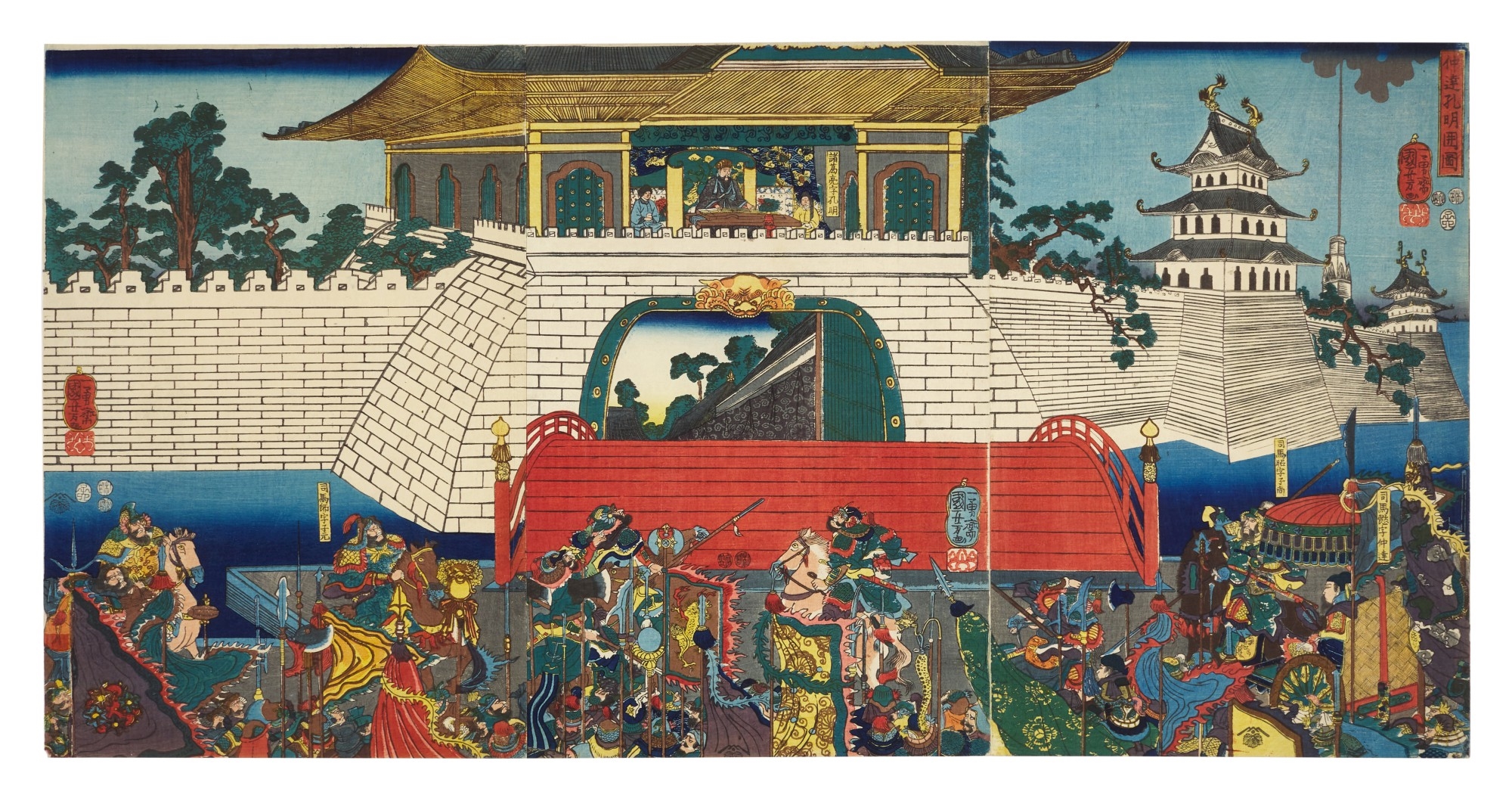
The second battle between Sima Yi and Zhuge Liang was in 234. Cao Rui again identified Shu’s problem being keeping their army supplied, and ordered Sima Yi to keep his armies fortified and wait the enemy out. The two armies faced each other at Wuzhang Plains. Although being challenged many times by Zhuge Liang, Sima Yi did not send his armies to attack. To provoke Sima Yi, Zhuge Liang sent women’s clothes to him, suggesting that he was a woman for not daring to attack. The Wei officers were enraged by this, but Sima Yi would not be provoked. To appease his officers, Sima Yi asked the Wei emperor Cao Rui for permission to engage the Shu forces. Cao Rui, understanding the situation, sent his advisor Xin Pi to Sima Yi telling the Wei forces to be patient.Watanabe 2006:270 In an attempt to engage the Wei forces, Zhuge Liang sent Sima Yi an emissary urging him to battle. Sima Yi, however, would not discuss military matters with the emissary, instead enquired about Zhuge Liang’s tasks. The emissary replied that Zhuge Liang personally managed all major and minor matters in the military, from military tactics to meals for the night, but he consumes very little. Sima Yi then told an aide that Zhuge Liang would not last long.Watanabe 2006:272
See more : https://www.ganjing.com/news/1ftr0sbnp534bHf47R119OIG31ru1c
Comments