


A New Beginning
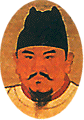
In 1352, Zhu Yuanzhang -then 25 years old- joined the rebellion against the Mongolian rule. By 1368 he controlled most of China and declared himself founder of the Ming dynasty in Nanjing with a reign title of Hongwu ("Abundantly Martial").
Born a poor peasant in 1328 he early in life lost most of his family to famine and was raised in a monastery where he learned to read and write and acquired unique organizational skills. These skills assisted him greatly in his battles for supremacy but also later in managing state affairs.
Having established his dynasty in 1368, he soon reintroduced Chinese imperial traditions in line with the former golden eras of the Tang (618-907 AD) and Song (960-1279 AD). Once again ancient Chinese custom would dominate the empire.

A realistic portrait?
He repaired canals and dykes, embarked upon a huge reforestation and resettled peasants to cultivate waste land, heavily subsidized by taxes and incentives. Soon, the empire prospered and the economy grew at a rapid pace.
Zhu Yuanzhang -the individual

Far from handsome
He might have been born a peasant and received little education, but he was still a highly self-conscious individual. Adding to his plight, his looks were far from enviable; he had a protruding jaw and a face like a pig. Many excellent painters lost their lives when painting the emperor too close to reality.
The oval picture top left is the by the emperor himself approved portrait. A resolute, stern, handsome ruler. Compare that to the other ones in this section, all portraying Zhu Yuanzhang ...
Peace in the North?
Zhu Yuanzhang first task as the Hongwu Emperor was to suppress rebellions around China. He started with a military expedition against the Mongols and expelled them from their capital of Dadu (today's Beijing) and renamed the city to "Beiping", meaning 'the north is pacified'.

Realism?
By 1379 he had finally taken control of all of China and made Korea a vassal state. He divided up the fringe areas of his empire into fiefs and gave his sons one each. They were bestowed the title of 'prince' and were equipped with an army to protect the borders of the empire.
Under punishment of death, he banned the princes from ever returning to the imperial capital of Nanjing so as to prevent an internal rebellion. But one sad consequence hereof was that none of them actually attended the funeral of their own father.
But despite his efforts, peace eluded Zhu Yuanzhang. Already in 1380 Lan Yu, one of his chancellors, was accused of treason and executed, followed by a ferocious purge of some 30,000 of Lan Yu's supporters and family. During the rest of his reign and till his death in 1398 Zhu Yuanzhang ruled as an autocrat.

Crown Prince Zhu Biao (left)
Apart from creating a prospering economy, he did many other good things for the empire. For example, he reinstated the examinations for civil servants, registered the population and implemented a fairer, albeit more complex, tax system.
In the final analysis, Zhu Yuanzhang was on the one hand praised for having reintroduced a genuine Chinese Han rule of China but, on the other hand, he was accused of having been a gruesome tyrant.
Succession difficulties
Zhu Yuanzhang appointed his son, Zhu Biao, to Crown Prince and heir to the Ming dynasty. In line with tradition, his heir was intensively trained to assume the heavy responsibility later in life.
But this was not to be. Zhu Biao died of illness already in 1392 and was buried in Dongling -adjacent to Zhu Yuanzhang's own tomb of Xiaoling and often referred to as the "19th imperial tomb of the Ming dynasty".
He now instead chose Zhu Yunwen, son of Zhu Biao, as his "Crown Grandson" to succeed him. But Zhu Yunwen ruled for a mere four years as 2nd Ming emperor with reign title of Jianwen until dethroned by his uncle, Zhu Di, the 3rd Ming emperor with reign title of Yongle.
Comments