
Viking Reading - The Saga of Erik The Red pt. 1
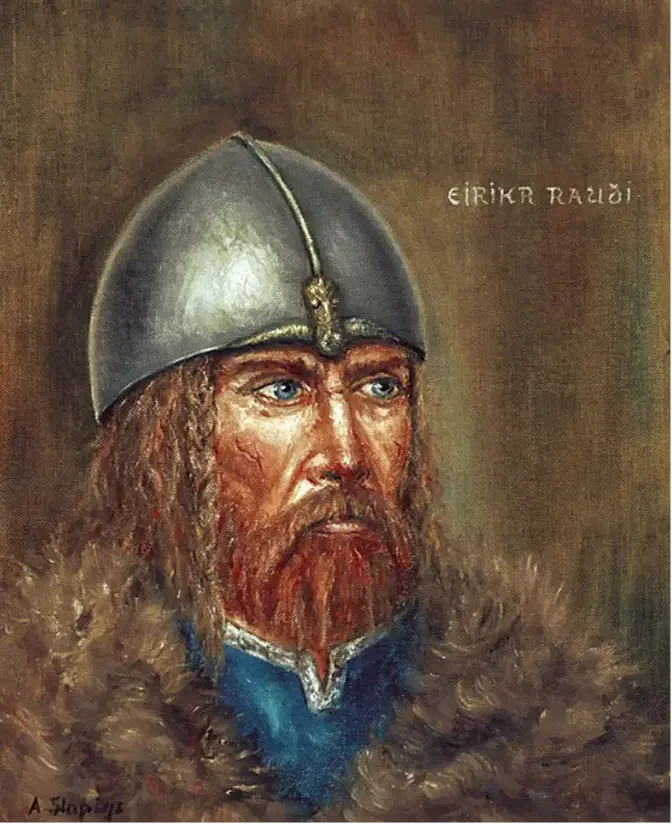
1880 Translation to English by J. Sefton from the original Old Norse Eirik Saga Ryða.
The Saga of Eirik the Red.
Olaf, who was called Olaf the White, was styled a warrior king.
He was the son of King Ingjald, the son of Helgi, the son of Olaf, the son of Gudrid,
the son of Halfdan Whiteleg, king of the Uplands in Norway.
He led a harrying expedition of sea rovers into the west and conquered Dublin in Ireland
and Dublinshire, over which he made himself king.
He married Odd, the Deep-Minded, daughter of Cædil Flatnose, son of Bjorn the Unguarded,
a nobleman from Norway.
Their son was named Thorstein the Red.
Olaf fell in battle in Ireland and then Odd and Thorstein went into the Sudreyr, the Hebrides.
There Thorstein married Thorid, daughter of Avon the Easterling, sister of Helgi the Lean,
and they had many children.
Thorstein became a warrior king and formed an alliance with Earl Sigurd the Great, son
of Eystein the Rattler.
They conquered Caithness, Sutherland, Ross, and Moray, and more than half of Scotland.
Over these, Thorstein was king until the Scots plotted against him and he fell there in battle.
Odd was in Caithness when she heard of Thorstein's death.
She caused a merchant ship to be secretly built in the wood, and when she was ready,
directed her course out into the Organs.
There she gave in marriage Thorstein the Red's daughter, Gró, who became mother of Greyland,
whom Earl Thorfinn the Skull Cleaver married.
Afterwards, Odd set out to seek Iceland, having twenty free men in her ship.
Odd came to Iceland and passed the first winter in Bjarnahafn, or Bjornshaven, with her brother Bjorn.
Afterwards, she occupied all of the Dale country, between the Dagurdarra, the Daymeel River,
and the Skramhulapsa, the River of the Giantess's Leap, and dwelt at Váhm.
She had prayer meetings at Krosshullar, the Cross Hills, where she caused crosses to be erected,
for she was baptized and deeply devoted to the faith.
There came with her to Iceland many men worthy of honor, who had been taken captive in sea-roving
expeditions to the west, and who were called bondmen.
One of these was Vifil, he was a man of a high family, and had been taken captive beyond
the western main, and was also called a bondman before Odd set him free.
And when Odd granted dwellings to her ship's company, Vifil asked why she gave no abode
to him like unto the others.
Odd replied that it was of no moment to him, for, she said, he would be esteemed in whatever
place he was, as one worthy of honor.
She gave him Vifilsdallr, or Vifilsdale, and he dwelt there and married.
His sons were Thorbjorn and Thorgir, promising men, and they grew up in their father's house.
There was a man named Thorvald, the son of Asvald, the son of Ulf, the son of Ingsathors.
His son was named Eirik.
Father and son were moved from Jadar in Norway to Iceland because of manslaughter, and occupied
land in Hornstrandir, and dwelt at Dragna.
There Thorvald died, and Eirik married Thjordhild, daughter of Jorund, the son of Atali, and
of Thorbjörg the shipbreasted, whom afterwards Thorbjörn of the Hakodalr, Hockdale family,
married.
He it was who dwelt at Eirikstadir, after Eirik removed from the north, is near Vatyon.
Then did Eirik's thralls cause a landslip in the estate of Valthjof at Valthjofstadir.
Eirik the Foul, his kinsmen, slew the thralls beside Skísdabrekir, the slopes of the race
course above Vatyon.
In return, Eirik threw Ælf the Foul.
He slew also Hafinn the Dúl at Laegskalar.
Girstein and Odd of Jorfi, kinsmen of Ælf, were found willing to follow up his death
by a legal prosecution, and then was Eirik banished from Hakodalr.
He occupied then Broki in Eiksni, and dwelt at Traðir in Sudru the first winter.
At this time did he lend to Thorgist pillars for seat-stocks.
Afterwards Eirik were moved into Eiksni, and dwelt at Eirikstadir.
He then claimed his pillars, and got them not.
Then went Eirik and fetched the pillars from Bríðabolstadir, and Thorgist went after
him.
They fought at a short distance from the hay-yard at Drangar, and there fell two sons
of Thorgist, and some other men.
After that they both kept a large body of men together.
Steyr gave assistance to Eirik, as also did Ælf of Svíni, Thorbjörn Vifjölsson of
Abdathjörðr, but the sons of Thor Gaelir, as also Thorgir, of Hítadalr, Aslak of Langadalr,
and Ilugi his son gave assistance to Thorgist.
Eirik and his people were outlawed at Þórsnes Thing.
He prepared a ship in Eiriksvagn, and Eilf concealed him in Dimungavagn, while Thorgist
and his people sought him among the islands.
Eirik said to his people that he proposed to seek for the land which Gunnbjörn, the
son of Ulf the Crow, saw when he was driven westward over the ocean, and discovered Gunnbjörnssakr,
also known as Gunnbjörnsrock or scary.
He promised that he would return to visit his friends if he found the land.
Thorbjörn and Eilf and Steyr accompanied Eirik beyond the islands.
They separated in the most friendly manner, Eirik saying that he would be of the like
assistance to them, if he should be able to so be, and they should happen to need him.
Then he sailed oceanwards, under Sneyfjalljökull, the Snow Mountain Glacier, and arrived at
the glacier called Blasakr, or Blue Shirt.
Hence he journeyed south, to see if there were any inhabitants of the country.
He passed the first winter at Eiriksi, near the middle of the Vestrbygd, the Western Settlement.
The following spring, he proceeded to Eiriksjöldur, and fixed his abode there.
During the summer, he proceeded into the unpeopled districts in the west, and there was a long
time, and was there a long time, giving names to the places far and wide.
The second winter, he passed into Eiriksholmar, the Isles, Afhjavsgunnpr, the Peak of Disappearance,
Cape Farewell, and the third summer, he went altogether northwards, to Sneyfjalljökull,
and into Hrafnsfjörður, or Ravensfjörður.
Considering then, that he had come to the head of Eiriksfjörður, he turned back, and
passed the third winter in Eiriksi, before the mouth of Eiriksfjörður.
Now afterwards, during the summer, he proceeded to Iceland, and came to Bryðafjörður, or
Brodfjörður.
This winter, he was with Ingolf, at Holmater, Island Litter.
During the spring, Thorghist and he fought, and Eirik met with defeat.
After that, they were reconciled.
In the summer, Eirik went to live in the land which he had discovered, and that which he
called Greenland, because, said he, men will desire much more to go there, if the land
has a good name.
Thorgir Viflsson married, and took to wife, Arnora, daughter of Einar, from Laugabraka,
the slope of the hot spring, the son of Sigmund, the Aeon of Kettil Thistil, who had occupied
Thistilfjörður.
The second daughter of Einar, who was named Halvík, Thorbjörn Viflsson took her to wife,
and received with her the land of Laugabraka, at Hallsvoll, the cave hill.
To that spot, Thorbjörn removed his abode, and became great and worshipful.
He was the temple priest, and had a magnificent estate.
Thorbjörn's daughter was Gudrun, the fairest of women, and of peerless nobility in all
her conduct.
There was a man named Orm, who dwelt at Arnorstopi, the Eagle Rock, and he had a wife, who was
named Haldís.
He was a well-to-do Franklin, a good friend of Thorbjörn, and Gudrun lived at his house
as his foster child for a long time.
There was a man named Thorgir, who dwelt at Thorgir's Fjall.
He was mighty rich in cattle, and had been made a freedman.
He had a son, whose name was Einar, a handsome man, well-mannered, and a great dandy.
Einar, at this time, was a traveling merchant, sailing from land to land with great success,
as he always passed his winter either in Iceland or in Norway.
Now after this, I have to tell how that one autumn, when Einar was in Iceland, he proceeded
with his wares along Snaefjallsnes.
With the object of selling, he came to Arnorstopi.
Orm invited him to stay there, and Einar accepted his invitation, because there was friendship
between him and Orm's people, and his wares were earned into a certain outhouse.
There he unpacked his merchandise, showed it to Orm and the housemen, and bade Orm take
therefrom such things as he would.
Orm accepted the offer, and pronounced Einar to be a goodly gallant traveler, and a great
favorite of fortune.
When now they were busy with the wares, a woman passed before the door of the outhouse.
Einar inquired of Orm, who that fair woman might be passing before the door.
I have not seen her here before, said he.
That is Gudrid, my foster child, said Orm, daughter of Thorbjorn the Franklin, the Mlaugr
Brekka.
She must be a good match, said Einar.
Surely she has not been without suitors who have made proposals for her, has she?
Orm answered, Proposals have certainly been made, friend, but this treasure is not to
be had for the picking up.
It is found that she will be particular in her choice, as well also as her father.
Well in spite of that, quoth Einar, she is the woman who I have it in my mind to propose
for, and I wish that in this suit of mine you approach her on my part, and apply yourself
to plead diligently for me, for which I shall pay you in return a perfect friendship.
The Franklin Thorbjorn may reflect that our families would be suitably joined in the bonds
of affinity, for he is a man in a position of great honor, and owns a fine abode, but
his personal property, I am told, is greatly on the decrease.
Neither I nor my father lack lands or personal property, and if this alliance should be brought
about, the greatest assistance would accrue to Thorbjorn.
Then answered Orm, Of a surety I considered myself to be thy friend, and yet am I not
willing to bring forward this suit, but Thorbjorn is of a proud mind, and withal a very ambitious
man.
Einar replied that he desired no other thing than that his offer of marriage should be
made known.
Orm then consented to undertake the suit, and Einar journeyed south again until he came
home.
A while after, Thorbjorn had a harvest feast, as he was bound to have because of his great
rank.
There were presented Orm, from Arnur Stappi and many other friends of Thorbjorn.
Orm entered into the conversation with Thorbjorn, and told him that Einar had lately been to
see him, from Thorgyrsfjall, and was becoming a promising man.
He now began the wooing on behalf of Einar, and said that an alliance between the families
would be very suitable on account of certain interests.
There may arise to thee, Franklin, he said, great assistance in thy means from this alliance.
But Thorbjorn answered, I did not expect the like proposal from thee, that I should give
my daughter in marriage to the son of a thrall, and so thou perceivest that my substance is
decreasing.
Well, then my daughter shall not go home with thee, since thou considerest her worthy of
so poor a match.
Then went Orm again, and each of the other guests to his household, and Gudrud remained
with her father, and stayed at home that winter.
Now in the spring, Thorbjorn made a feast to his friends, and a goodly banquet was prepared.
There came many guests, and the banquet was of the best.
Now at the banquet, Thorbjorn called for a hearing, and thus spake, here I have dwelt
a long time, I have experienced the goodwill of men and their affection towards me, and
I consider that our dealings with one another have been mutually agreeable.
But now do my money matters begin to bring me uneasiness.
Although to this time my condition has not been reckoned or contemptible, I wish, therefore,
to break up my household before I lose my honor, to remove from the country before I
disgrace my family.
So now I propose to look after the promise of Eirik the Red, my friend, which he made
when we were separated at Breidefjordur.
I propose to depart for Greenland in the summer, if events proceed as I could wish.
These tidings about his design appeared to the guests to be important, but Thorbjorn
had long been beloved by his friends.
It felt that he would only have made so public a declaration, that it might be held of no
avail to attempt to dissuade him from his purpose.
Thorbjorn distributed gifts among the guests, and then the feast was brought to an end,
and they departed to their own homesteads.
Thorbjorn sold his lands, and bought a ship which had been laid up on shore at the mouth
of the Hralnhofn, the harbor of the lava field.
Thirty men ventured on the expedition with him.
There was Orm, from Arnastapi, and his wife, and those friends of Thorbjorn who did not
wish to be separated from him.
When they launched the ship, they set sail with a favorable wind, but when they came
out into the open sea, the favorable wind ceased, and they experienced great gales,
and made but an ill-sped voyage throughout the summer.
In addition to that trouble, there came fever upon the expedition, and Orm died, and Haldus
his wife, and half the company.
Then the sea waxed rougher, and they endured much toil and misery in many ways, and only
reached Hjörálfsnes in Greenland at the very beginning of winter.
There dwelt Hjörálfsnes, the man who is called Thorkell.
He was a useful man, and most worthy, frankly.
He received Thorbjorn and all his ship's company for the winter, assisting them in
right noble fashion.
This pleased Thorbjorn well, and his companions in the voyage.
At that time, there was a great dearth in Greenland.
Those who had been out on fishing expeditions had caught little, and some had not returned.
There was in the settlement a woman whose name was Thorbjorn.
She was a prophetess, and was called Dittivolva, or Little Sibling.
She had nine sisters, and they were all spay queens, and she was the only one now living.
It was a custom of Thorbjorn, in the wintertime, to make a circuit, and people invited her
to the houses, especially those who had any curiosity about the season, or desired to
know their fate.
And inasmuch as Thorkell was Chief Franklin thereabouts, he considered that it concern
him to know when the scarcity which overhung the settlement should cease.
He invited therefore the spay queen to his house, and prepared for her a hearty welcome,
as was the custom wherever a reception was accorded to a woman of this kind.
A high seat was prepared for her, and a cushion laid thereupon in which were poultry feathers.
Now when she came in the evening, accompanied by the man who had been sent to meet her,
she was dressed in such wise that she had a blue mantle over her, with strings for
the neck, and it was inlaid with gems, quite down to the skirt.
On her neck she had glass beads, on her head she had a black hood of lambskins, lined with
ermine, a staff she had in her hand, with a knob thereon.
It was ornamented with brass, inlaid with gems round about the knob.
Around her she wore a girdle of soft hair, and therein was a large skin-bag, in which
she kept the talismans needful to her and her wisdom.
She wore hairy calfskin shoes on her feet, with long and strong looking thongs to them,
and great knobs of latin at the ends.
On her hand she had gloves of ermine skin, and they were white and hairy within.
Now when she entered, all men thought it their bounden duty to offer her becoming greetings,
and these she received according as the men were agreeable to her.
The Franklin Thorkell took the wise woman by the hand, and led her to the seat prepared
for her.
He requested her to cast her eyes over his herd, his household, and his homestead.
She remained silent altogether.
During the evening the tables were set, and now I must tell you what food was made ready
for the spakeman.
There was prepared for her porridge of kid's milk, and hearts of all kinds of living creatures.
Their found were cooked for her.
She had a brazen spoon, and a knife with a handle of walrus tusk, which was mounted with
two rings of brass, and the point of it was broken off.
When the tables were removed, the Franklin Thorkell advanced to Thorbjörg, and asked
her how she liked his homestead, with the appearance of the men, and how soon she would
ascertain that which he had asked, and which the men desired to know.
She replied that she would not give answer before the morning, after she had slept there
for a night, and when the next day was far spent, the preparations were made for her,
which she required for the exercise of her enchantments.
She begged them to bring to her those women who were acquainted with the lore needed for
the exercise of the enchantments, and which is known by the name of weird songs, but no
such women came forward.
Then was a search made throughout the homestead, if any women were so learned.
Then answered Gudrid, I am not skilled in deep learning, nor am I a wise woman, although
Halldís, my foster mother, taught me, in Iceland, the lore which she called weird songs.
Then art thou wise in good season, answered Thorbjörg, but Gudrid replied, that lore
and the ceremony are of such kind, that I propose to be of no assistance therein, because
I am a Christian woman.
Then answered Thorbjörg, thou mightest perchance afford thy help to the men in this company,
and yet be none the worse woman than thou wast before, but to Thorkell give I charge
to provide here the things that are needful.
Thorkell thereupon urged Gudrid to consent, and she yielded to his wishes.
The women formed a ring round about, and Thorbjörg ascended the scaffold and the seat prepared
for her enchantments.
Then sang Gudrid the weird song, in so beautiful and excellent a manner, that no one there
did it seem that he had ever heard the song in voice so beautiful as now.
The Spey Queen thanked her for the song.
Many spirits, said she, had been present under its trunk, and were pleased to listen for
the song, who before would turn away from us and grant us no such homage, and now are
many things clear to me, which before were hidden both from me and others.
And I am able this to say, that the dearth will last no longer, the season improving
as spring advances, the epidemic of fever, which has long oppressed us, will disappear
quicker than we could have hoped, and thee, Gudrid, will I recompense straight away, for
that aid of thine, which has stood us in good stead, because thy destiny is now clear to
me and foreseen.
Thou shalt make a match here in Greenland, a most honorable one, though it will not be
a long-lived one for thee, because thy way lies out to Iceland, and there shall arise
from thee a line of descendants both numerous and goodly, and over the branches of thy family
shall shine a bright ray.
And so fare thee now well and happily, my daughter.
Afterwards the men went to the wise woman, and each inquired after what he was most curious
to know.
She was also liberal of her replies, and what she said proved true.
After this came one from another homestead after her, and she went then there.
Thorbjorn was invited, because he did not wish to remain at home while such heathen
worship was performing.
The weather soon improved, when one spring began, as Thorbjörn said.
Thorbjörn made ready his ship, and went on until he came to Bratallit, the steep slope.
Eirik received him with the utmost cordiality, saying he had done well to come there.
Thorbjörn and his family were with him during the winter, and in the following spring Eirik
gave to Thorbjörn land at Stockness, and handsome farm buildings were built for him,
and he dwelt there afterwards.