
The Secret History of Auschwitz’s Seven Dwarfs
5 Video Views·Jun 3, 2025
Mirror, mirror on the wall, who is the fairest one of all?
Mirror, mirror on the wall, who is the fairest of them all?
One of the most famous questions in the world.
From one of the best-loved fairy tales in the world.
But not so long ago, it was one of the most dangerous questions in the world.
Mirror, mirror on the wall, who is the fairest of them all?
I'm going to tell you the magical story of the real Seven Dwarfs.
There comes a time in every man's life when he must go out into the world to seek his fame and fortune.
What shall I do? Go into politics?
Warwick Davids, Prime Minister and Leader of the Nation.
How old was he?
I don't know, 12.
Are you serious?
What's the matter with that?
This is a film about me getting the part of an Ewok.
Could you tell me where Ewoks have to report?
Ewoks?
Yeah, Ewoks.
It wasn't easy, but we couldn't have done it without you.
That's all right.
Thanks a lot, you worked really hard.
Yeah.
Bye-bye.
That was 30 years ago.
I went on to do films like Willow and Harry Potter.
And I even met my wife Sam, also a dwarf, while performing in Snow White.
Am I not three Ewoks?
Sure, Will.
What is this?
I'm perfectly comfortable with my size, and I actually don't think I could do my job if I wasn't.
OK, there we go.
Very good.
But I've always been fascinated by other short performers through the ages.
From Court Jesters to Tom Thumb.
Some were successful because they were seen as freaks.
Others simply because they were great entertainers.
Extra leg room.
There's a dwarf family who really shed light on all the complexities of being a dwarf entertainer.
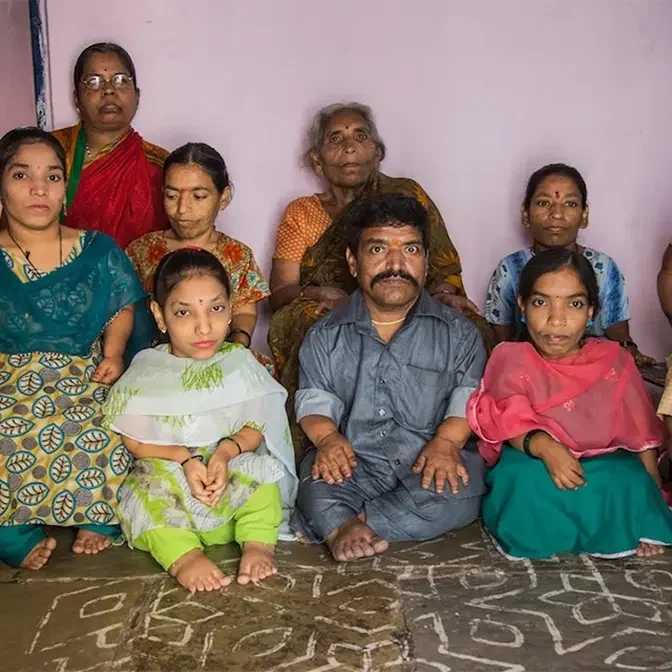
The Ovitz brothers and sisters.
And, wait for it, there were seven of them.
Elisabeth, Franziska, Rosika, Miki, Avram, Frieda, and the youngest, Perla.
There was a dwarf, a small dwarf, but he was expensive.
And so was I.
Small, but worth something.
I've always wanted to know more about the Ovitz siblings,
so I've come to Transylvania, northern Romania, where their story begins.
They were born in a village that, according to an ancient fairy tale,
was named after a giant who fell in love with a dwarf.
Hi there, hi there.
They've all got, like, tools on them.
They should be singing hi-ho.
Erm...
I'm not sure whether...
I don't know where to agree. My name's Warwick.
Warwick Davies.
How do you learn about them?
I've known of them and their story for a number of years now,
and it's always interested me and always something I wanted to investigate further.
You know, I'm looking at it through the eyes of a little person
and also a person who is an entertainer in the same business that they were.
Why do you think it's important, the word, to know?
The idea that they didn't let their size get them down.
I've met Johnny Popescu, a local radio host who's also something of a historian.
He's agreed to show me around.
So tell me about where we are now.
Well, we are in exactly the place that Ovitz's house used to be many, many years ago.
And he is the one who owns the house now.
Hello, nice to meet you. I'm Warwick. Hi.
And by chance, he is the person, almost I guess the only one in the village,
who actually met the Ovitz's.
Really? Have you got a good memory of them?
So I've got some pictures of the...
The Ovitz's were an unusual family.
Their father was a dwarf, but their two mothers and three other siblings were tall.
Whereas my parents and sister are all average-sized.
And when I was born in 1970, I came as a bit of a shock.
That we will never be separated.
That we will be connected to each other like a chain.
If the mother was a bad worker, what job could she have?
She could bring a piece of bread with her.
Or she could learn music.
Or simply, actors also live.
Our theater was called Liliput Theater.
Because we were small.
Did you ever see them before?
Yes, of course.
They also performed here at school.
They also sang at weddings, at dinners.
They usually sang in musical instruments.
The population didn't exist to have a shirt or trousers.
This picture here, he looks like a silent movie actor.
You know what I mean?
It reminds me of Harold Lloyd or Buster Keaton's look.
Above all else, the Ovitz's were committed entertainers.
And that's something I've always tried to be as well.
Being just over three feet tall, you are more vulnerable.
You tend to make up for that with a much larger-than-life personality.
And that's what other dwarfs were doing all over the world in show business.
It was really the heyday of the interest in dwarfism.
The public was really fascinated by dwarfs and they were part of freak shows.
There were 75 different agents, dwarf agents, all over Europe.
And they were really knocking on doors, hunting new dwarfs.
In Coney Island, New York, there was a Liliputian city where dwarfs were paid to live there.
There was the barber shop where a dwarf was the barber.
A fire brigade operated by dwarfs.
And it is estimated that by 1939, about 1,500 dwarfs were making their living out of show business.
They were basically making a living out of exhibiting their deformity.
And this is what exactly the Ovitz family tried to avoid.
They wanted that people would come to see them because they were able actors or singers.
Amongst all the other dwarf acts of the era, the Ovitz family really stood out.
They spent time practicing building props, making costumes, so that their act was the best it could be.
They could hold an audience. It wasn't a gimmick. From the beginning, they were thinking big.
They really appeared in the largest halls in Europe.
Places for 800, for 1,000, for a huge audience.
The Ovitzes used to play a lot.
Here?
Yes. You can see the room as it was.
So this is where we are now?
Exactly. It was the largest restaurant of the time, and kings visited it.
That's amazing.
They weren't just entertainers because they were small.
They were entertainers because they were very good at what they did.
I think their reputation as great entertainers was what carried them through a career.
That's kind of the philosophy that I have throughout my career.
I got started in acting because I was short, but I didn't rely on that.
I thought, to maintain this, I need to hone the craft of performing and acting.
Ultimately, it would be nice to be known as an actor who just happens to be short, which I think the Ovitz family were.
To plant flowers, chocolate, with lots and lots of berries.
There was a time when I could speak.
It was the end of the 1930s, and dwarfs were everywhere.
And by 1937, when Disney released Snow White and the Seven Dwarfs,
the craze for little people as entertainers had reached its height.
Most entrancing of all, Disney's Snow White and the Seven Dwarfs.
But no one could have foretold who one of the film's greatest fans would be.
Like all good fairy tales, Disney's Snow White had a darker side.
Much like the Wicked Queen in Snow White, the Nazis' obsession with physical perfection would prove deadly,
especially for the Ovitzes.
Hitler loved Disney's Snow White so much, he made his own version.
As Nazi propaganda.
In the German version of Snow White, she's a beautiful Aryan maiden,
who's threatened by an evil, shapeshifting outsider.
People who had any kind of physical deformity, including dwarfs like me,
became an obsession for the Nazis.
They would either kill them through their euthanasia program,
or they'd use them as guinea pigs in laboratory experiments,
in their quest to create a master race.
So when the Nazis started tearing through Europe,
what would that mean for the Ovitzes, who were not only dwarfs, but also Jews?
For them it was far away Germany.
They didn't feel that it has any implication upon them.
It's simply a terrible thing which happens elsewhere.
As if nothing changed.
Show must go on.
They simply hoped the war will be somehow over before the fire reached them.
Thanks very much.
Thank you.
Cheers.
Jews leave their homes and go to the ghetto.
What is a ghetto?
Nobody knows what a ghetto is.
And this is where they were kept?
And how many people would be here?
But when they were here, they wouldn't have known what was going on, would they?
No, no.
They thought they would be taken to labor camps.
So if you tried to leave...
Shooting on the spot.
These pictures were taken here, in this area.
So this is when they would have just arrived?
Yeah, the picture was taken when they arrived.
And they had this hand from the cart.
I mean, this is an unbelievable photo.
That this was taken here.
We're here, there's a cart here.
It's amazing.
Who is this here?
A simple soldier to compare.
And it's written here that's an average height.
This is telling you that he's average size?
So you could see how short they were?
They mocked them.
They considered them as luggage.
That's the word in Hungarian.
Okay, the luggage has arrived at Dragomirest
and they have to be thrown out of the cart.
I don't know what to say about that.
So this is a journal
in which he wrote daily
what happened in that period.
That's amazing.
1944.
Does he talk about
the ghetto here in the diary anywhere?
So this was in April 16, 1944.
On the third day of Easter
they were deported here to Dragomirest.
They were embarked on carts
that were forced to be transported.
So they left the commune, all the Jews,
to an unknown destination.
On this occasion, some died while walking.
It's tiring.
Some, opposing to leave, were shot.
When I write these lines,
all the Jews have already left Dragomirest.
It's kind of hard to imagine
what happened here.
You know, for the Ovitz family,
suddenly they're brought here on a horse and cart,
sort of dumped here.
It must have been so frightening.
I wonder if the children that play out here realise
what their playground once was.
So, finally we arrived here,
as the Ovitzes did.
I mean, this place looks like it probably did in the 1940s.
Definitely, yes.
But the Ovitzes weren't a cattle wagon.
I mean, that's impossible.
That's impossible. I wouldn't know even where to start.
Just even to get on this.
This is meant for passengers to get on,
but a cattle truck isn't even designed with steps.
And the cattle truck is like that.
There are no steps for it.
I mean, I'm not getting in there.
Whatever happens.
Don't try it.
There were 40 cattle trucks,
each with 80 people crammed inside.
The Ovitzes thought they were going to be rehoused,
so they brought the tools of their trade.
Make-up, costumes,
instruments.
I wonder, what did they talk about on the train?
Did they discuss?
I wonder what's going to happen?
Working?
Do you think they discussed a strategy?
You know, what were their thoughts?
If you go to a place where you don't return.
As Ovitz was a working camp,
but also an extermination camp,
they needed to decide who will live and who will die.
And so the person who's deciding this?
Is the doctor.
The people who live were people who were more fit to work.
Even though it was not a rule,
you could be very fit and be sent to die.
So, by general, I would say women with children,
the elderly,
and people who they perceived as crippled,
were automatically sent to die.
Most of them have no idea
that in 30 minutes they are going to be dead.
30 to 45 minutes.
This person here would have been...
This is a dwarf.
What's interesting, did he live or did he die?
Basically, I would say no chance that he would live.
You don't see a house, you don't see anything,
just fires and firewood coming out.
Like a human being.
All the firewood comes out like a human being.
The soldier asked him,
what is there?
Don't ask, it will be better for you.
There is the tomb of Israel, he said.
Even there, Miki was so self-assured,
and he had in his pocket the fan cards.
Miki there, on the ramp,
took from his coat a fan card
and distributed it to the SS guard.
It's amazing.
You can see here Mengele.
Mengele.
He was part of the mainstream
of the German academic milieu at the time.
But as you can see,
he has a very striking appearance.
He was a handsome man.
He was also a war hero.
He arrives at Auschwitz, where he was in the front.
So...
Very powerful man.
He was collecting all kinds of people
who were very short or tall,
always pointed their head,
all kinds of deformities, actually.
And all the other soldiers knew
that he was collecting
for what was called Mengele's zoo.
The selection on them would have been,
right, yeah, we're not going to exterminate you
because I think you're going to be of interest.
Yes.
It's incredible.
The Owitzes were brought here because they were Jews,
but they managed to buy some time
because they were dwarves.
We heard about it for 20 years.
We were shocked.
We didn't know what would happen
20 years in a place like this.
Doctors have always been interested in little people
for genuine medical reasons.
I was in and out of hospital when I was a kid
because of the medical problems
that come with being a dwarf.
But I want to understand
why the Nazi doctor, Josef Mengele,
was so interested in the Owitzes.
This is Charlie O'Brien, or Charles Byrne,
known as the Irish giant in his day.
One of the tallest men who's ever lived.
Astonishing, isn't it?
I know a few tall individuals like this,
Peter Mayhew, who played Chewbacca in Star Wars.
He's pretty tall.
Nobody's perfect.
You're in a slightly different design.
You are in a slightly different design.
Let's just say that.
Mengele is absolutely coming out
of a tradition of comparative biology,
comparative anthropology.
Lots of skull measuring happening
in early 20th century Germany.
It's becoming a bit more sophisticated.
Lots of interest in genetics.
Hence the interest in the Owitz family.
It wasn't just him.
His former boss, Verschuur,
a famous scientist,
a famous anthropologist,
sent him to Auschwitz.
Told him, said,
you're going to have a fantastic opportunity
to do experiments there,
to do things that you can't do anywhere else.
Mengele did indeed believe
that somehow the Owitz family
have the secret of growth.
We could learn something from him.
And do you know something?
At heart, he was right.
But the things that he did,
the experiments that he did
on this family,
couldn't have possibly told them anything.
They were just bizarre,
irrelevant, appalling experiments.
It's a sort of a moral vacuum
in which scientists
have the opportunity
to do anything they want,
no matter what the cost
or the consequences.
Gets the right over life and death.
It's like that.
Children, twins, gypsies.
Mengele experimented on many people.
But what did he have in store
for the Owitz family?
Here we have documents
from so-called SS Hygiene Institute.
This was a big, large medical laboratory.
And there's the Owitz name there.
Yes, exactly.
He took blood.
He took good tests.
Why do I have so much cancer?
Well, I had a lot to eat.
And he took the same thing for everyone.
And he took out the intestines from here.
He even took it out from here
to see if it was the same
for every adult.
What is this telling us?
This is the order to
the test of the blood.
This document shows us the blood
that was taken on the 20th of June 1944
from this prisoner, Owitz Perlam.
And also the signature of Mengele here.
Is that his signature there?
There was nine cups of hot water,
like a kettle.
We did it like this.
And after that,
hot water was poured from the kettle.
We said, we can get drunk from this.
Even to die.
I mean, he seems obsessed with blood tests.
Mengele took their blood day by day,
very, very often.
He's not exactly learning a lot, really, is he?
You know, keep testing blood.
It doesn't really tell you an awful lot.
He had a very strong impression.
It's very important
for the future of the Federic.
I say.
This is where the Owitz's slept.
The barrack was to be for 400 people.
But as the camp was overcrowded,
the number was doubled.
Some of the survivors are saying
even about 1,000 people in each.
1,000 people in here?
Yeah.
The Owitz family,
they would have slept on one of these.
Probably on the bottom.
Yes.
Bottom was not very safe
because of the diarrhea,
which was quite frequent.
People could not control the disease.
The top was also not good
because of the leaking roof.
So that was just the reality
that they have to fight
every single day, live.
We look at pictures
and we read stories
and accounts of things.
Somehow you feel remote from it.
But it's when you go to the places
that you really start to
realize that hang on a minute,
these aren't stories.
These are not tales.
This is something that happened
and this is where it happened.
My children are dwarfs.
My wife's a dwarf.
But in another time,
another place.
Around 100 dwarfs
were killed in Auschwitz.
So being short
wasn't going to be enough
to save the Owitz's.
To buy more time,
they'd have to use another
of their assets.
One that chimed with
the strange logic of Mengele
and the other officers.
The average life was
about three months.
You got so used to fear.
Anita, like the Owitz's,
was something that appealed
to the people who ran Auschwitz.
Whoever could do something
that was useful to them
was a commodity,
but if you couldn't, dispensable.
We arrived there in the night.
We were put in a barrack,
waited.
I don't know what prompted me to...
She must have asked me
what did you do before the war.
I said I play the cello.
She said fantastic.
There's a band here.
It's a four-story.
And the Owitz family,
because they were different.
Anything that was a bit
out of the ordinary
was suddenly interesting.
If it hadn't been Mengele
with an interest in that,
I don't see how they
could have survived.
They brought us powder.
They took our hand.
And Odeb and Tomek
said if there was any
story to tell,
He sang.
When he felt good among us,
he would say in German
Ob die sieben Bergen
hab ich sieben zwergen.
And he would sing it.
One time, twice,
to make us feel good.
So he said
you don't know the song?
He said we do know the song,
but there's no music.
So he said
I also sing without music.
You want to hear it?
So he sang it to us.
Ob die sieben Bergen
hab ich sieben zwergen.
In a way, I'm not surprised
that the Owitzes were using
all their skills as performers
to give themselves a chance.
That's the spirit of a dwarf.
Of a little bass.
Wearing their artistic persona
helped them to distance themselves
from what was happening there.
For them it was another play.
But they are actors in it.
And they're playing for the live.
The Germans could at any time
come into our block
and ask for some music.
They had to be ready.
And this was the moment
that for instance Dr. Mengele,
the famous guy
who did the experiment
on unusual people,
came into the block
and wanted to hear
the Troimerei by Schumann.
And I played that.
It was on my repertoire.
I do find it interesting
that the Nazis wanted
to have music.
And I'm sort of wondering why
at the end of the day
they were killing people.
It was entertainment
to want music.
Was it a therapy?
In a way.
In a way it must have been.
Must have been.
And you know we actually
played concerts on Sunday.
And you know people came
and listened.
It was a completely ludicrous idea really.
Yeah.
We heard it
as if it gave us
a little courage.
But his courage
told us
not to take it seriously
because he could get
a bullet in the head
and kill us all at once.
I can't imagine it.
I mean I think I would be
I'd be foolish to try and
imagine what they went through.
You know and even
what I can imagine
I don't think I would have coped very well.
It's so so hard
to live under
under the terror
under the fear
constantly.
The Ovitz's knew
that the moment Mengele
got bored of them
they could end up here
in the little wood
the waiting room
for the gas chamber.
The crematoria were huge.
The producer of the crematoria
were saying that per day
they could burn
five thousand corpses.
It makes me angry
this part.
Yeah it's really
I find it very difficult
to be here.
You know I can really feel
not what it must have been like
but what it
what it's all about.
Yeah this is
difficult being here.
The Ovitz's nightmare
ended in January 1945.
Eight months after
they'd arrived at Auschwitz
the camp was liberated.
Along with most of the other SS officers
Mengele had already fled
taking his research with him.
The dwarfs were transported away by cart
and arrived back in their village
a year later.
The fact that the Ovitz's
came out alive is incredible.
They were the only family
to survive the camp intact.
I don't hate Mengele.
I'm not even allowed
to say this word
because
to tell the truth
I need to hate him
but he gave us life
with what he wanted to learn
so I can't hate him.
To have followed their story
and talked to the people I have
you know I feel like I've got
a really great insight
into their lives
and what made them
the people they were.
It does
have a happy ending
not for everybody but
for the Ovitz's
it did.
But that wasn't without price.
They had to live with their ordeals.
It's left me shocked
and amazed
and I find them
even more inspirational
than I did before.
In 1949
the Ovitz's emigrated
to Israel.
They started performing again
to packed out theatres
just as they'd done
before the war.
And Perla
the last of these
inspirational dwarfs
passed away in 2001
at the age of 80.
That's why some folks
have a million
and can't even
write their name
That's why you gotta
handle them
with a little, little muzzle
Muzzle means good luck
cause with a little muzzle
you always have a buck
Muzzle, muzzle, muzzle
as it's so festive
so glücklich sein, habibi
is ma so merry gay