
The Entire History of Ancient Egypt in Just 11 Minutes
9 Video Views·Aug 23, 2025
# Culture#Ancient Egyptian
Before Rome rose. Before Greece dreamed. There was Egypt, a land carved by gods and ruled by
living deities. A cradle of civilization, science, mystery, and majesty that defy time for over
three thousand years. This is the story of ancient Egypt, from its divine birth. To its unforgettable
fall. It all began along the Nile, the world's longest river. Every year, it flooded, leaving
rich black soil behind. In the 10th millennium BCE, a culture of hunter-gatherers and fishers
was replaced by a grain-grinding culture. This gift of nature allowed early farmers to thrive,
transforming Egypt into one of the first true civilizations. By about 6000 BCE, a Neolithic
culture took root in the Nile Valley. During the Neolithic era, several pre-dynastic cultures
developed independently in Upper and Lower Egypt. The Badarian culture and the success
of Nakada series are generally regarded as precursors to dynastic Egypt. The earliest
known Lower Egyptian site, Maramda, predates the Badari by about 700 years. Contemporaneous
Lower Egyptian communities coexisted with their southern counterparts for more than 2000 years,
remaining culturally distinct, but maintaining frequent contact through trade.
Around 3100 BCE, a powerful king named Menes, united Upper and Lower Egypt. With a single
crown and a single kingdom, Egypt was born. This led to a series of dynasties that ruled
Egypt for the next three millennia. Egyptian culture flourished during this long period and
remained distinctively Egyptian in its religion, arts, language and customs. The first two ruling
dynasties of a unified Egypt set the stage for the Old Kingdom period, circa 2700 to 2200 BCE,
which constructed many pyramids, most notably the 3rd Dynasty Pyramid of Djoser and the 4th
Dynasty Giza Pyramids. Ancient Egypt was a cultural superpower. They developed hieroglyphics,
one of the oldest writing systems. They mastered medicine, mathematics, and astronomy, creating a
365-day calendar long before the modern world. Death was seen not as an end, but a journey.
Hence the obsession with mummification, tombs, and the afterlife. Egypt's population was ethnically
diverse, a mix of indigenous Africans, Nubians, Libyans, Levantines, and Semitic peoples from
across the region. This melting pot enriched its culture, language, and traditions. The Egyptians
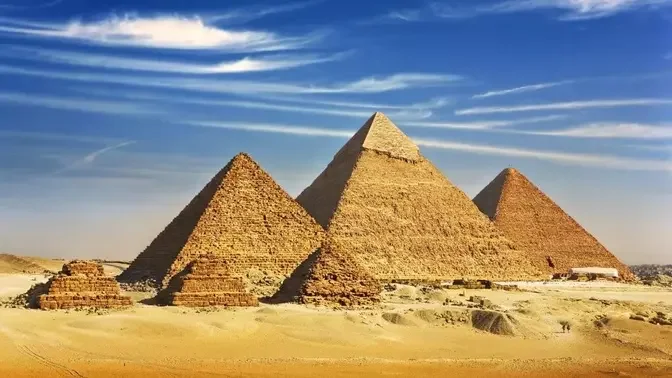
built monuments not for decades, but for eternity. The Great Pyramid of Giza, built for Pharaoh Khufu,
stands over 480 feet high, built with over 2 million stone blocks. It remains the only surviving
wonder of the ancient world. Temples like Qarnak and Abu Simbel weren't just places of worship,
they were cosmic gateways where Earth met the Divine. The First Intermediate Period ushered in
a time of political upheaval for about 150 years. Strong annual floods and stabilization of
government brought back renewed prosperity for the country in the Middle Kingdom circa 2040 BCE,
reaching a peak during the reign of Pharaoh Amenemhat III. A second period of disunity
heralded the arrival of the first foreign ruling dynasty in Egypt, that of the Semitic Hyksos.
The Hyksos invaders took over much of Lower Egypt around 1650 BCE and founded a new capital at Avaris.
They were driven out by an Upper Egyptian force led by Omos I, who founded the 18th
Dynasty and relocated the capital from Memphis to Thebes. The New Kingdom circa 1550 to 1070 BCE
began with the 18th Dynasty, marking the rise of Egypt as an international power that expanded
during its greatest extension to an empire as far south as Tombos in Nubia, and included parts of
the Levant in the east. This period is noted for some of the most well-known pharaohs.
The rulers of Egypt were seen as gods in human form. They held absolute power, commanding armies,
shaping laws, and even directing the weather through ritual. Some names still echo through
history. Khufu, builder of the Great Pyramid, Hatshepsut, the female pharaoh who ruled like a
king, Ramses the Great, a military titan and master builder, Akhenaten, the heretic who
worshipped one god and Thutmose III. But Tutankhamun is the most famous among the pharaohs.
Tutankhamun or as he is commonly known, King Tut, ruled from 1332 to 1323 BCE during the late 18th
Dynasty of ancient Egypt. He instituted the restoration of the traditional polytheistic form
of ancient Egyptian religion, undoing a previous shift to the monotheistic religion known as
Atenism. His reign is considered one of the greatest restoration periods in ancient Egyptian
history. He became pharaoh between 8 and 9 years of age, following the short reigns of pharaoh
Akhenaten's successors, Smenkhari and Nefeneferu Aten. On ascending the throne, he took the name
Nebkhpur and reigned for about 9 years. During Tutankhamun's reign the position of vizier,
the highest ranking official after the pharaoh, was split between Upper and Lower Egypt.
The principal vizier for Upper Egypt was Uzumuntu. Another figure named Pensthu was also vizier but
it is unclear of which lands. The country was economically weak and in turmoil following the
reign of Akhenaten. Diplomatic relations with other kingdoms had also been neglected,
and Tutankhamun sought to restore them, in particular with the Matoni, a Hurrian-speaking
state in northern Syria and southeast Anatolia, modern-day Turkey. Evidence of his success is
suggested by the gifts from various countries found in his tomb. Despite his efforts for
improved relations, battles with Nubians and Asiatics were recorded in his mortuary temple
at Thebes, both victories for Egypt. Also, as far as is known, Tutankhamun's military reign was
undefeated, and is one of several other undefeated reigns in ancient Egypt's history.
He eventually died around 1323 BCE, at approximately age 18 or 19. His death remains
mysterious, with theories ranging from illness, like malaria, a genetic disorder, or even an
accident such as a chariot crash. His tomb, discovered in 1922 by Howard Carter, was nearly
intact and is considered one of the greatest archaeological finds in history. Egypt's glory
didn't come without scars. Over centuries, the land of the Nile faced invasions by the Libyans,
Nubians, and Assyrians, civil wars, and dynastic feuds. But time and again,
Egypt rose from the ashes, proud, defiant, eternal. Fast forward to 525 BCE, the Achaemenid
Empire, led by Cambyses II, began their conquest of Egypt, eventually capturing the pharaoh
Psamtik III at the Battle of Pelusium. Cambyses II then assumed the formal title of pharaoh,
but ruled Egypt from his home of Susa in Persia, modern Iran, leaving Egypt under the control of
Asatrap, a governor of the provinces. The entire 27th dynasty of Egypt, from 525 to 402 BCE,
except for Pertubestis III, was an entirely Achaemenid-ruled period. A few temporarily
successful revolts against the Achaemenids marked the 5th century BCE, but Egypt was never able to
permanently overthrow the Achaemenids. The 30th dynasty was the last native ruling dynasty during
the Pharaonic epoch. It fell to the Achaemenids again in 343 BCE after the last native pharaoh,
King Nectanebo II, was defeated in battle. This 31st dynasty of Egypt, however, did not last long,
as the Achaemenids were toppled several decades later by Alexander the Great.
The Macedonian Greek general of Alexander, Ptolemy Soter I, then founded the Ptolemaic dynasty
for over 3,000 years. Egypt wasn't just a kingdom, it was the heartbeat of the ancient world.
But nothing lasts forever. One by one, foreign powers swept in, the Persians, then the Greeks
under Alexander the Great. Egypt's own voice grew quieter, replaced by the tongues of conquerors.
Then came the last queen, Cleopatra VII, a woman of brilliance, beauty, and unmatched
political cunning. She ruled during Egypt's final days of independence, aligning with Julius Caesar,
and later Marc Antony of Rome, to preserve her kingdom. But when the Roman tide turned,
Cleopatra's world crumbled. In 30 BCE, facing defeat by Octavian, the future Augustus Caesar,
she took her own life. With her death, Egypt fell into Roman hands. The age of pharaohs was over.
By the early 4th century AD, Egypt had been part of the Roman Empire for more than three centuries.
When Emperor Constantine the Great moved the imperial capital to Constantinople in 330 AD,
Egypt then became part of the Eastern Roman Empire, what we now call the Byzantine Empire.
From then on, Byzantine Egypt was essentially Roman Egypt under a new eastern administration.
Its cities filled with Greek-speaking elites, Roman law, and Christian churches. The Byzantines
prized Egypt as the empire's breadbasket, shipping vast quantities of grain to Constantinople.
Byzantine rule wasn't entirely smooth. The empire faced waves of internal unrest,
religious tensions and occasional incursions from outside forces. Despite these challenges,
Egypt remained firmly under Byzantine control for nearly three centuries, until 641 AD.
Arab forces of Amorib and Alas stormed into Egypt, taking it from Byzantine hands.
A new faith, a new language, and a new order rose along the Nile. The gods of the pharaohs
The temples became relics. And Egypt, once the master of empires, became a jewel in the crown
of someone else's world. The age of Egypt's world-ruling glory was over. But its legacy?
Carved forever. In stone. The tale of ancient Egypt isn't just a chapter in history.
It's the prologue of civilization. If you were captivated by this journey through time,
like, subscribe, and ring the bell for more breathtaking history. Tell us in the comments,
which ancient civilization should we explore next? Thank you for watching and see you next time.