
Ancient Egyptian DNA Finally Reveals Their True Ancestry
#Archaeology#archaeological artifacts
For more than a century, one question has refused to die.
What race were the ancient Egyptians?
Every few years it resurfaces in debates, viral videos, or social media posts,
and every time it gets forced into a false choice.
Were they black? Were they white? African or European?
But that framing is already the problem.
If you could uncover the DNA of one unknown ancient Egyptian,
pyramid worker, queen, or soldier, who would you want it to be and why?
Tell us in the comments.
Ancient Egypt lasted over 3,000 years.
It stretched from deserts to river valleys, evolving politically, culturally, and genetically.
Trying to squeeze it into a single modern racial category
is like describing the ocean with a single drop of water.
For a long time, European scholars framed Egypt as separate from Africa,
emphasizing Mediterranean features and minimizing African connections.
This narrative fit colonial ideologies that denied African civilizations their achievements.
In response, black scholars and Pan-African thinkers
emphasized Egypt's deep African roots, its connections to Nubia and the Nile Valley.
Both sides reacted to historical distortions,
but over time the debate hardened into absolutes.
Then genetics entered the picture.
For decades, ancient DNA from Egypt was thought nearly impossible to recover.
Heat, humidity, embalming resins, and microbes destroyed genetic material.
Many believed usable DNA simply didn't survive.
That changed in 2025 when scientists successfully sequenced a full genome
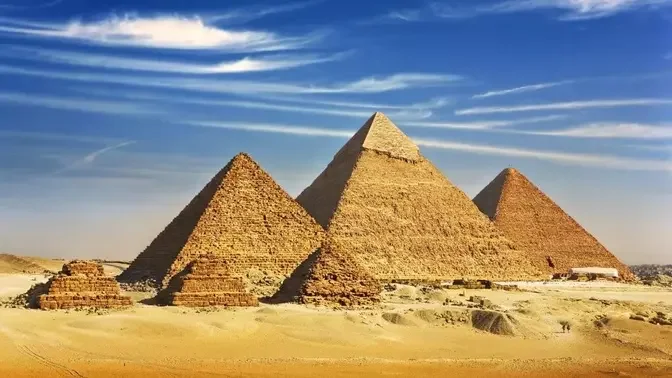
from an individual buried during Egypt's old kingdom, the Age of the Pyramids.
Not fragments, a complete genetic blueprint of someone who lived over 4,000 years ago.
The analysis revealed ancestry primarily rooted in indigenous Northeast African populations
with a notable Near Eastern component.
Predicted traits included brown eyes, brown hair, and dark to very dark skin.
One genome cannot define all Egyptians,
but it provides a glimpse into who existed in the Pyramid Age
and shows that Egyptians could be both African and connected to the Near East at the same time.
It was a real person walking along the Nile,
living, working, and dying under the same sun that shines on the pyramids today,
and their DNA finally lets us hear their story.
To understand the broader picture,
we must also look at the 2017 study that caused so much confusion.
In 2017, a study sequenced DNA from 90 mummies at Abusir el-Melek in Middle Egypt,
spanning roughly 1400 BCE to 400 CE.
For the first time, scientists had genome-wide data from a large group of ancient Egyptians
across more than 1,000 years.
The headlines exploded.
Ancient Egyptians were more European than African.
DNA proves Egyptians weren't black.
None of that was accurate.
The mummies showed genetic affinity to ancient populations in the Levant and Anatolia.
Compared to them, modern Egyptians have about 8% more sub-Saharan African ancestry.
That's the full result.
Context matters.
Abusir el-Melek is in Middle Egypt, not Upper Egypt or Nubia,
where African ancestry was stronger.
These individuals lived long after the Old Kingdom,
during periods of Persian, Greek, and Roman influence.
The study itself cautioned that one site could not represent all of Egypt.
Yet nuance doesn't trend.
Many misread the findings as a verdict on all ancient Egyptians.
In reality, the study shows continuity and change.
Egypt's population absorbed gene flow over millennia,
but the local Nile Valley population remained dominant.
Another common misconception is equating Near Eastern ancestry with European.
It doesn't.
Affinity with the ancient Levant reflects connections to Southwest Asia,
not modern Europe.
This is why the 2025 Old Kingdom genome matters.
It predates these later samples by over a thousand years,
showing that Egyptians during the Pyramid Age
already carried a mix of indigenous Northeast African ancestry
and Near Eastern-related ancestry.
Geography is crucial to understanding ancient Egyptian ancestry.
The Nile wasn't a border.
It was a corridor connecting people, trade, and culture.
Populations moved north and south, east and west,
constantly reshaping the gene pool.
Upper Egypt, closer to Nubia, likely had more Sub-Saharan African ancestry.
Lower Egypt, connected to the Mediterranean,
had stronger Near Eastern and later European X mixture.
Middle Egypt, where much of the DNA evidence comes from, reflected a mix.
Physical anthropology supports this.
Skeletal studies show biological continuity from pre-dynastic cultures
through the Old Kingdom.
Indigenous Nile Valley populations formed the majority,
though heterogeneity was always present.
Even within single cemeteries, cranial and dental traits vary.
State formation in Egypt was mostly local coalescence with some external inputs.
Cultural and genetic influence from the Near East existed,
but Egyptians evolved largely from indigenous populations.
Foreign rulers and traders left small genetic traces,
but the majority population remained local.
Art and burial practices reflect this diversity.
Some individuals are depicted with darker skin, others lighter.
Some have features resembling Nubians, others Near Eastern neighbors.
Ancient Egypt was diverse, visually, genetically, and culturally.
The Old Kingdom genome confirms this.
Dark to very dark skin, brown eyes, brown hair,
and a mix of local and Near Eastern ancestry.
Later mummies from Abu Sir el-Melek show increased Levantine affinity,
but local continuity persists.
Across three millennia, Egyptians exhibited a wide range of appearances.
Modern racial categories—black, white, or any other—
cannot describe ancient Egyptians.
These are social constructs, not biological realities.
Ancient populations were shaped by ancestry, migration, and adaptation,
not arbitrary modern labels.
The Old Kingdom genome shows a Nile Valley individual
with deep African roots and Near Eastern connections.
Later populations show stronger Near Eastern influence, but still retain continuity.
Upper Egypt likely had more sub-Saharan African ancestry.
Lower Egypt more Near Eastern.
Across Egypt's long history, appearances and ancestry shifted regionally and temporally.
Headlines claiming ancient Egyptians were white or they weren't black oversimplify.
They force modern categories onto a civilization that existed long before those concepts.
The real story is nuanced.
Egypt was a crossroads, a dynamic corridor between Africa and the Near East,
shaped by trade, migration, and cultural exchange.
Every new genome adds a voice,
helping us see the population as a living mosaic rather than a single category.
We still lack data from Upper Egypt, Nubia, and royal cemeteries.
Each new discovery will deepen the picture of who ancient Egyptians were
and how they changed.
So when you ask, were they black or white?
The answer is clear.
They don't fit modern boxes.
Ancient Egyptians were primarily Nile Valley Africans with connections to the Near East,
their appearances varying by region and era.
The better question is, how did Egyptians change along the Nile over three millennia?
Every new genome brings us closer to that answer,
showing continuity, diversity, and connection.
The story of Egypt is not a single identity.
It's a mosaic of people, place, and time.
If you found this breakdown fascinating,
hit that like button and subscribe for more deep dives into history and science.
We want to hear from you.
Which Egyptian site should scientists sequence next?
Upper Egypt cemeteries, the workers' village at Giza, or royal tombs?
Drop your thoughts in the comments below.
Every voice helps us piece together the real story of ancient Egypt.
And don't forget to share this video if you think evidence and nuance matter more than hot takes.