
Stuart England - James I, Charles I & the English Civil War
Oct 5, 2023
Hello, and welcome to the continuation of our lecture series on the Age of Absolutism
in Europe.
Today, we're going to chart on off to England and cover the beginning of the Stuart reign,
here at Learning the Social Sciences.
The Stuarts came to the throne after the death of Queen Elizabeth I in 1603.
She died without an heir, and so James I, the son of Mary, Queen of Scots, also the
King of Scotland, came to the throne.
Now he was somebody who quickly alienated a parliament that was grown accustomed to
working with the Tudor monarchs.
For him, he was a strong believer in the divine right of kings, and he was not one who wanted
to go and dabble around with parliament when it came to taxes.
For example, a speech that he gave to the House of Commons, he stated, I am surprised
that my ancestors should ever be permitted such an institution to come into existence.
I am a stranger, and found it here when I arrived, so that I am obliged to put up with
what I cannot get rid of.
Of course, right there, he is saying loudly that he is not one that wants to work with
parliament.
However, parliament is in charge of taxation, so what is he going to do when he wants to
raise taxes?
Well, for him, he would go and levy new customs duties known as impositions to raise money.
In other words, he's changing up the vocabulary and kind of changing the system a little bit
to raise some money.
Now this is going to be causing, obviously, some issues.
On top of the issue of taxation, he also has a rising religious conflict of ruin.
So the Puritans, who started under Elizabeth I as a Calvinist group, is growing in numbers.
In fact, a whole bunch of gentry, very wealthy landowners that are just a notch below the
nobility, are converting to Puritanism, and they want to see some changes to the Anglican
Church.
However, James I is not going to do it.
He is also going to cause issues with the Puritans when he made peace with Catholic
Spain and when he relaxed penal laws against the Catholics.
Finally, they really became angered when he did not support any of the Protestants on
the continent during the Thirty Years' War.
And so with the Stuarts, they're already kind of gaining up some enemies, or at least some
conspiracy theories, within England.
However, James I is able to kind of see the storm brewing, and he is one to go and appease
the people.
He has the King James Bible published in 1611, and he gives it to the masses.
So they have a well-studied and translated version of the Bible.
Of course, it does contain a lot of these and those, but for the time period, the people
are very happy to have that.
And he is able to kind of squash any of that big resentment movement from gaining hold.
However, his son Charles I is not going to be as politically savvy as his father.
He is also going to be seen as rather inflexible, and he really just had to learn at least one
point of his life to say, I'm sorry.
But he never does.
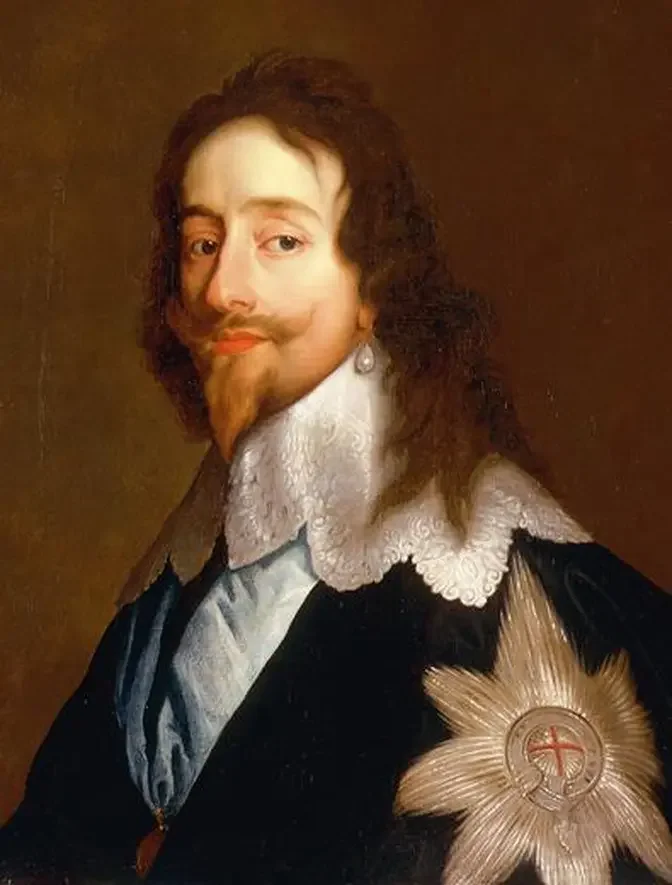
Charles I started to reign in 1625, and he is also a believer in the divine right of kings.
He also follows his father's footsteps by funding his wars with Spain and his court
life by levying tariffs, duties, and those impositions.
He is not one that wants to work with Parliament.
However, he does call them from time to time just to see if he can actually get some taxes
through.
And when I'm saying from time to time, it comes later in his reign, because for 10 years,
he never called Parliament once.
However, whenever he does call Parliament, they want him to sign the Petition of Rights.
With this, they are saying that the king was subject to the law, and he could not levy
taxes without the approval of Parliament.
He could not impose forced loans on his subjects, and he could not declare martial law in peacetime.
When he would imprison citizens, they have to have a trial.
And they also put in there that he could not quarter troops in private homes.
Now, of course, whenever Parliament came to Charles with the Petition of Rights, he went
and, well, disbanded them and sent them home.
Instead, he went on and continued to collect those impositions, and he collected something
called ship money, a tax on coastal towns to pay for their defense.
I guess it kind of sounds a little mafia-esque, but he would kind of say, hey, coastal cities,
if you want to ensure that there's no pirate ships outside your harbor, give us some money
and we'll make sure that the Royal Navy protects your harbor.
Not really the nicest thing, but it was something that happened.
He caused controversy when he went and married the Catholic sister of Francis King Louis
XIII, and it was so controversial that he actually sent over somebody to stand in for
him for the actual Catholic wedding in France, which is probably not the best thing if you
are the future Queen of England to get married to a stand-in.
However, it's what kind of needed to have happen.
Of course, the Puritans, just like under James I, are pushing to have some changes happen
to the Anglican doctrine and to make it more Calvinist, but Charles is not budging on that
either.
And so there are some people that are fearing a Catholic revival, just like they did under
James I.
Now in terms of Parliament, we are having a lot of tensions grow in the 1640s, so much
so that we are going to actually have a civil war break out in 1642.
In 1640, the King desperately needed money, and so he called Parliament into session in
April, and it only lasts three weeks before he dissolved them because they demanded reforms.
In August, he calls them back for what is known as Long Parliament.
However, with this, the same thing happens, and nothing gets really done, and the King
just kind of says, nope, not going to do it.
Now, in the summer of 1642, Charles went to go have the leaders of Parliament arrested
for not doing the course of government.
Now, during this, though, they were able to escape, and they went off and formed their
own army, the Roundheads.
And so war broke out between the Royalists, the supporters of Charles I, known as the
Cavaliers, and the Parliamentarians, or those Roundheads, named after the shape of their
metal helmets.
So the Royalists predominantly were backed by the House of Lords and the aristocracy,
or the large landowners.
Also the church officials usually backed up Charles I.
And when I'm saying church officials, I'm saying Anglican church officials.
So predominantly for the population, the rural population were following the Royalists
or the Cavaliers, and they were predominantly found in the north and west of England.
In terms of those Parliamentarians, their backers were mainly from the south and the
east of England, and were Puritans.
We also have merchants and town people, and a more urban population following and supporting
them.
Now, of course, there's going to be numerous battles that happen throughout this war.
In the beginning, it seems like, yes, it is going to be Charles' victory, but the Parliamentarians
have a good streak where they are winning.
Oliver Cromwell, a farmer that no one knew prior to the war, that had done some time
in Parliament, but really had not been a standout, created a new effective army called the New
Model Army.
And with this, he was able to defeat the Cavaliers at the Battle of Naseby and other battles.
And eventually, long story short, they were able to take the King prisoner, after a little
kind of mix-up there by the King with Scotland.
Now as the Civil War drew to an end, Parliament became divided between moderates and radicals,
and what should happen to Charles I and his role with the government.
Cromwell and others wanted to see an end to the monarchy.
And with that, we are going to have Charles put on trial.
Now can a King actually commit treason against the King?
Huh.
Or is it that a King could actually commit treason against his country?
Well for that, we have something called Rump Parliament happen.
A man by the name of Colonel Thomas Pride went in and executed 96 moderates from the
House of Commons to be able to sway the votes to have a guilty verdict be called.
Now Charles, throughout the trial, maybe would have been able to save himself if he kind
of said, I'm sorry, and actually worked with Parliament, but he is one that stood by, well,
what he thought was right.
And so he was found guilty and was beheaded in January of 1649.
And with that, we then have a new system coming into play in England.
For a period of time, we have the government being run as a republic, but they're not really
effective at pushing through the needed items that need to be dealt with.
And so Oliver Cromwell eventually comes to rule England, much like a dictator.
Now with this, he goes and passes various pieces of legislation that are very puritan.
For example, no more sports, no more theater, no more dancing, and definitely no Christmas.
No Christmas?
What?
Why no Christmas?
Well, there is no talk about the celebration of Christmas in the Bible.
Yes, we have Christmas happening in the Bible with the birth of Jesus, but we don't have
this, like, every year celebration for this, and so Christmas is cancelled.
Don't practice that.
Don't do that.
Now, after the Civil War, we have an obvious depopulation of some skilled individuals,
and so Oliver Cromwell does actually open England up to allowing Jewish people to come
in in 1655.
Now that could be seen as something like a, wow, great move towards religious tolerance.
However, we then have a lot of issues with Oliver Cromwell with Scotland and with Ireland.
In 1649, Cromwell invaded Ireland to put down an Irish uprising that had favored royalist
forces in England.
He then passes the Act of Settlement in 1652, where the land from two-thirds of the Catholic
property owners was given to Protestant English colonists.
This is going to cause a lot of problems within Ireland, and we are going to have around 15
to 20 percent of the Irish population perish under Cromwell's policies.
It is going to be brutal in Ireland.
He also goes in and causes a lot of problems in Scotland.
From 1651 to 1652, he moved on in and conquered Scotland.
Now, the Scots do have a continued strong support of Presbyterians in England, and with
that, he can't push and have as much happen in Scotland as he did in Ireland.
However, things are also just not necessarily the greatest there.
In terms of Puritan society, the Puritan controlled the government and sought to regulate the
moral life of England by commanding that people follow strict moral codes that were enforced
by the army.
This seriously alienated many of the English people from Cromwell's rule.
Remember, Elizabethan theater is huge, and now you can't do it?
You can't go and play sports?
You can't even celebrate Christmas?
What?
So, when Cromwell died in 1658, and it seemed that his son Richard did not want to rule
and was also going to be an ineffective ruler, the people of England called for the monarchs
to return, and we are going to have the Restoration with King Charles II happening.
However, that will be for our next lecture.
If you have any questions or comments, please leave them down below, and thank you very
much for listening.
Bye-bye.