
SEGOVIA & TOLEDO Daytrip from Madrid
81 Video Views·Apr 1, 2024
I'm Angel from The Tour Guide and I'm in a hot air balloon in Segovia, Spain.
Today we're leaving Madrid to explore the historic towns near the capital.
Both Segovia and Toledo are easy day trips from Madrid.
Each is about an hour from Madrid by car and accessible by train or bus.
I hired a car to take a road trip with my good buddies Sean and Brandon
to find out what these juggernauts of history are all about.
But if you don't feel like driving, we got you.
You can easily jump on one of our day trip tours.
Just check the links in the description below.
I can't think of a better way to get a new perspective on a place
than to go in a freaking hot air balloon.
Here we are.
Hasta la vista, baby.
This morning I'm starting off with an epic hot air balloon ride over Segovia
before exploring one of the most extraordinary Roman ruins.
Then there's the cathedral and a castle that inspired Walt Disney himself.
All of that in one tiny medieval town near Madrid.
All right and that concludes the hot air balloon ride here in Segovia.
Pretty cool.
I was unfortunately told by production that we had to end our hot air balloon experience early.
Unfortunately for me, I had to skip the champagne brunch
that's included in the hot air balloon experience
because I had to continue filming and get picked up early.
Break up it!
Aqueducts were essential to the Roman Empire
and the Romans were the greatest aqueduct builders in the ancient world.
The Romans developed a complex system of conduits and pipes
to bring water directly into the cities.
The word aqueduct comes from the Latin words aqua
meaning water and ducere which means to lead water or duct.
What we see in Segovia today is only a portion of the aqueduct system.
One of the first things that you'll probably notice
on your day trip in from Madrid to Segovia
is the first century Roman aqueduct.
It is super impressive and you don't want to leave the city without exploring it.
It has a long history from the first century.
It was damaged during the Reconquista
and Queen Isabel had it put back together
and it was a working aqueduct up until the 19th century.
I mean just look at this thing.
Touch, feel the first century.
The ancient Romans were such incredible civil engineers
that many European cities were built on top of Roman cities.
You know as a history geek,
this city sort of represents everything I love in history
because it's tactile and I can make it relevant.
For example, here with this aqueduct,
you don't really start to appreciate Roman engineering until you get really close.
You can sort of see the perfection of the arches,
the keystones there in the middle and then the top part of the aqueduct.
It's just extraordinary.
Something smells so good here.
I want to go with you.
Don't forget the Ponce de Segovia.
It is that good that I'm doubting whether I should give Joshua a piece or not.
All right, I'm in the shadows of this first century Roman aqueduct here
trying a typical Segovian treat called Ponce de Segovia
and it's made with marzipan and cream.
Check that out.
Looks absolutely delicious.
I'm gonna give it a go.
Oh yeah, oh yeah.
Not too sweet.
The cream and the marzipan combination is quite nice.
This is good stuff.
This is what I'm talking about people.
Oh yeah, I'm not sharing this one.
I was gonna say you better share some for the camera.
It's pretty dang good, yeah.
I made it to the top of town here in this beautiful open square
and right behind me you see the Segovia Cathedral.
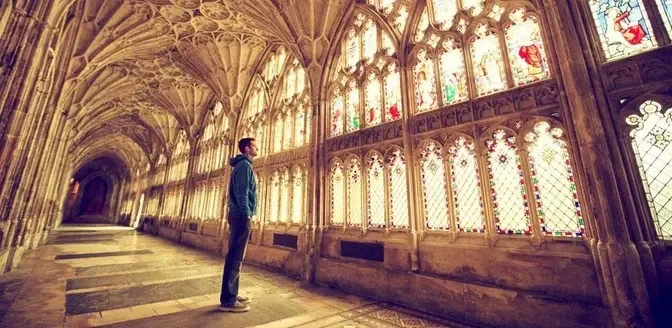
It has a gothic exterior, renaissance interior.
So like many things in Spain, it's layers and layers
and a mixture of different architectural styles.
The Segovia Cathedral is the last major gothic building in Spain.
Once you step inside, you'll see that the interior
is just as fascinating as the exterior.
The central aisle here is called the nave
which typically leads to the altar which in this case is this way
and one thing that you should definitely consider seeing
is the choir which is completely crafted right there in the middle.
Typically in churches in Italy, you don't find them a lot
but in the gothic churches in England and the gothic churches here in Spain
you will still see choirs, huge organ right on top of it
and then surrounding the nave, surrounding the whole church
are different little chapels dedicated to different saints
and they have different relics inside of them.
You can step inside of them, check out the pieces of art
or just simply have a quiet moment to yourself.
After the cathedral, the last stop in Segovia
is the fairytale-like castle known as the Alcázar.
Look at this castle that is right here.
There is an amazing cathedral just right across the street,
narrow winding lanes and exactly the sort of break you need from Madrid.
It originally started off as a fortress then became a royal palace
and in 1862, the whole thing burnt down
so it was rebuilt in this sort of romantic fairytale style
and that's what we see today.
Like most sites in Spain, it opens at 10 a.m. and the cost is 9 euro
but if you're on our day trip from Madrid, we got that covered.
This is exactly what Americans wish for when they come to Europe.
A small quaint town, small little alleys, incredible history
but history that you can touch and feel that you can sort of make relevant for yourself
and when you come to Segovia, don't forget to visit the Alcázar Cathedral
aqueduct and then finish the day off with a Ponche de Segovia.
We had so much fun exploring this medieval town
but our time in Segovia has ended.
The day trip continues as we are now visiting the former capital of Spain
and a town so important, the whole city is a national monument.
We plan to soak up the vibes of this well-preserved historic town
by exploring the small pedestrian-only streets,
sitting down for lunch and I plan to check out the work
of one of the most famous Spanish painters who also lived here.
I haven't even gotten into the old city yet
and I'm already surrounded by some pretty amazing stuff.
It is so well-preserved that if Charles V or El Greco were here today,
they would recognize this town.
So me and Brandon were driving the car, we're going to park it
and we found like a legit, what appeared to be locals only,
bar for tapas, check it out.
Yeah, that's my vibe, let's do it.
Sean was right, this place is our vibe
because it's full of locals having a good time.
I asked the owner Antonio what he recommended for a tapas lunch
so he served up some of his favorite dishes.
Us up, we got some albondigas, we would call them polpete, right?
Carcamusa, which is the typical like kind of pork stew of this area.
Some tuna with olives and peppers, it looks amazing.
And then croquetas, you can't go wrong with croquetas, right?
It's three o'clock in the afternoon, I'm surrounded by locals,
there's no English, they are having a good time.
Happy hour has started for sure.
In 1586, local artist El Greco was commissioned to paint
the burial of the Count of Orgath, which happened 300 years earlier.
The work is still currently above the tomb of Orgath,
who is the former mayor of Toledo.
El Greco considered this to be his best work.
The pale, serene faces, crowds of well-dressed nobles,
elongated gestures, surreal colors,
and precise separation of heaven and earth epitomize El Greco's style.
Jesus is at the dead center of the piece,
pointing to Saint Peter in a gesture of authority.
This scene is a direct reference to the papacy
and a reminder, in the most Catholic country,
during the Counter-Reformation, who was boss.
Seeing this painting the way it was meant to be seen,
in situ, is absolutely worth the drive.
You know, the Alcázar here in Toledo is so different
from any Alcázar that you might see in Spain
because it was remodeled during the time of Charles V,
the most powerful man in Europe during the 16th century.
And look at it, it just towers over the town.
So my suggestion is that you drive around to this lookout point here,
when you can see the description in the links below,
and that way you can have an excellent view,
not only of the Alcázar, but of the whole town below us.
Well, that wraps up our day visiting two historic towns,
just each an hour away from Madrid.
Segovia has a lot going on.
There's a castle, Roman aqueduct, and Gothic cathedral,
and we even took a hot air balloon ride.
Seeing the small winding streets of the former royal capital of Toledo
was another highlight.
The El Greco painting and hanging out with my friends
made the drive absolutely worth it.
I'm Angel Castellanos for the Tour Guide.
Don't forget to comment, like, and subscribe,
and ring that bell so you can find our next video.
Happy travels!