
Robert E. Lee: General and Educator
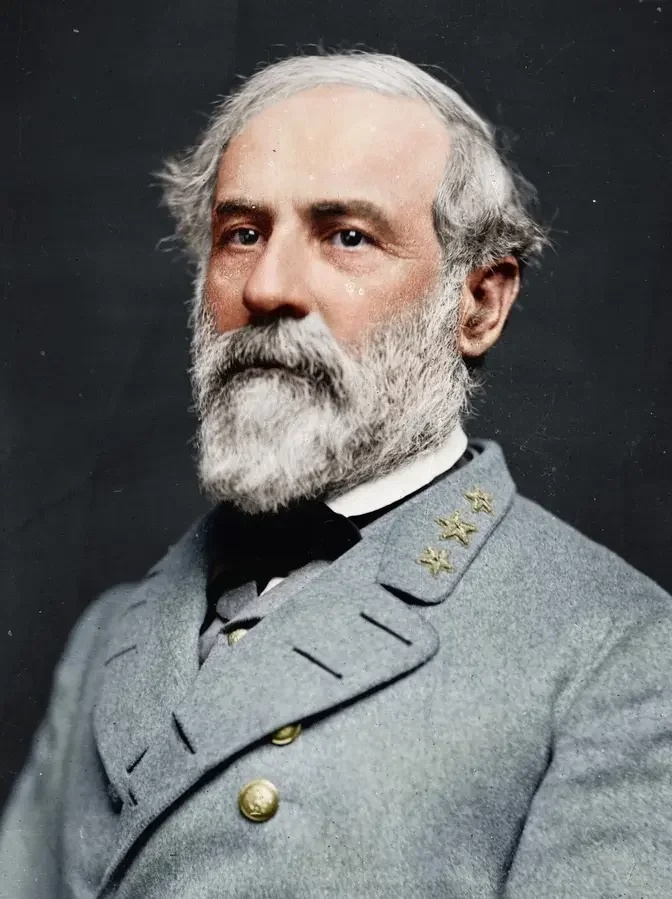
Any historian claiming that Robert E. Lee was only esteemed because of postbellum legends
has revealed his past work. He is not concerned with the truth. Thousands upon thousands of
contemporary diaries, letters, and newspapers document pervasive admiration for Lee during
his lifetime. After one of the general's three corps returned to Virginia from eight months
in Tennessee and Georgia, they hosted a review. One soldier wrote,
When the men caught sight of Lee, a wild cheer filled all hearts and rose to the heavens,
while hats were thrown high. Seven days later, the men marched into a battle where Lee's defense
line was collapsing. The soldiers redeemed the moment. As the mounted general prepared
to lead them on a charge to turn back the enemy attack, the men would not allow it.
They turned his horse around before checking the federal assault by themselves. There are three
reasons that no other Civil War general achieved such ubiquitous respect among their troops.
First, Lee shared his soldiers' hardships. While other commanders often appropriated
a nearby residence for their army headquarters, Lee slept in a tent.
Second, Lee took responsibility for his failures. When the men of Pickett's charge returned
from their repulse at Gettysburg, he rode out to meet them.
All of this is my fault, he said. I alone am to blame. Third, Lee focused on enabling
his subordinates and soldiers to succeed and abjured personal glory. Trust in Lee
even prompted his men to support his urgings that black soldiers be recruited.
As Congress debated the matter, one politician asked for Lee's opinion in January 1865.
The general applied that blacks should be enrolled, quote, without delay, close quote,
and granted freedom for volunteering to be followed by a general emancipation plan
throughout the South. His soldiers quickly voted their approval, but it was late in the war.
After his Appomattox surrender, Lee received numerous visitors at his Richmond home,
many asking for advice. Go home, he said, and help rebuild the shattered fortunes of our state.
Shortly thereafter, President Andrew Johnson required ex-Confederates with former federal
service to apply directly to him for a pardon and to take a new union loyalty oath. No single
act of compliance more angered diehard secessionists against Lee. Nonetheless, he hoped
to be an example to others. When the son of a former Virginia governor told his dad that he
had taken the oath, the father barked, you have disgraced the family. His son replied, but General
Lee told me to do it. Oh, said the father, that alters the case. Whatever General Lee says is all
right. Four months after Appomattox, Lee became president of Virginia's remote Washington College.
It had but four professors, only 40 students, and had been left ransacked by Union armies.
But he accepted the modest salary because his priority was reconstructing the South,
not personal profit. When Lee died five years later, the school had over 300 students.
Educator Lee believed you should not force young men to do their duty, but let them do it
voluntarily and thereby develop their characters. Thus, when one freshman asked for a list of the
college's rules, Lee replied, we have but one rule here, and it is that all students
must be gentlemen. Lee's one rule maxim evolved into a still-functioning honor system.
As WNL alumnus and former CBS News anchor Roger Mudd recalls, the professors loved it because
they didn't have to monitor the classroom as students took their exams. Lee's reputation
today would be uncontested but for the stain of slavery. Like Union General Ulysses Grant, however,
Lee's personal connection to slavery was mostly through his wife's family.
Before the Civil War, Grant worked the slaves on his father-in-law's manor near St. Louis,
as well as his own proximate farm. Even during the war, Grant's wife brought a slave when she
visited her husband at his army camps. Not until January 1865 were her family's slaves freed,
which was two years after Lee had released those of his deceased father-in-law,
which was five years after the latter's death. Lee converted two of the ex-slaves into salaried
employees at his army headquarters tent, and it helped many others obtain employment as free
blacks. In the months before he died, Lee tried to recover his health with a trip to Florida.
His biggest greeting along the way was in Savannah, where blacks were among the celibates.
The day of Lee's funeral, the New York Tribune wrote,
quote, all classes of the Lexington community seem to be affected, even the colored people
who walked along in silence with sorrowful countenance, close quote.
To conclude, an African proverb cautions, if a man throws away his traditions, he had better
first make certain that he has something of value to replace them. The ecstasy of sanctimony that
saturates our culture today is a poor substitute for the spirit of W&L's honor system.
This is Phil Lee, and thanks for watching.