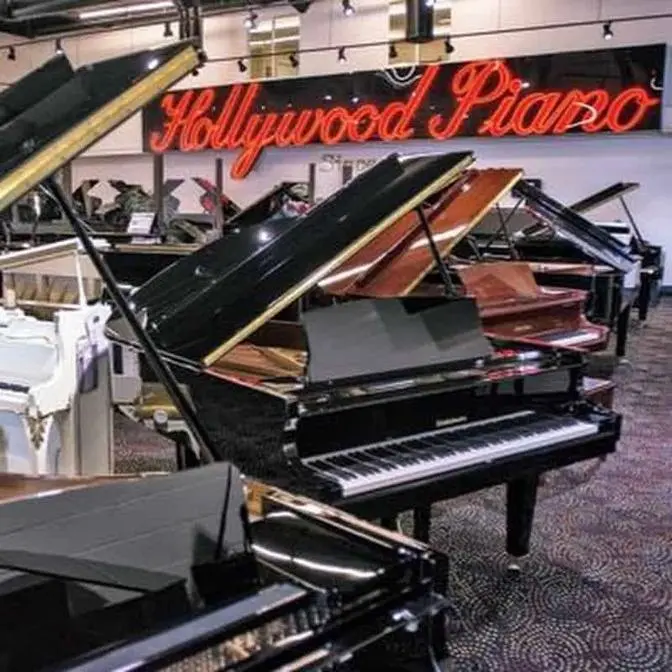
We were completely OVERBOOKED in our recital hall… so we had to take this one ONLINE ONLY 👀🔥 And this ended up being one of our MOST IMPORTANT seminars yet. 🎹 Roland Sale-Abration Seminar 💻 Online Only Event 🎯 Topic: How Digital Brands Differ from Each Other If you’ve ever wondered… 👉 What actually makes one digital piano better than another? 👉 Is Roland really different from Yamaha, Kawai, or others? 👉 What should YOU be looking for before buying? This is where we break it all down. We cover: 🎧 Sound technology 🎹 Keyboard action 📲 Features & connectivity ✅ Which brand is RIGHT for YOU Couldn’t make it in person? No worries — we’re uploading our first two seminars here so you don’t miss out 🎥 📘 BONUS: Come into the store and get a FREE booklet from the seminar — just ask your sales expert or ask for Glenn Treibitz 👀 💬 Be honest… what digital piano brand are you currently using (or thinking about buying)? Drop it below 👇 🔥 If you’ve ever felt overwhelmed choosing a digital piano… this video is for YOU. #fyp#piano#music#viral#technology
Hey everyone, this is Glenn Tribetz for Hollywood Piano
and we're in our Roland Celebration Month
here at Hollywood Piano.
You know, we are one of the largest
Roland digital piano dealers in the entire United States.
And we have every model of Roland on display
and most models of Casio on display
and a number of other brands.
So we have a very large selection of digital pianos
and we are digital piano experts.
Myself, I have been playing electronic musical instruments
since I'm a kid.
I had a double Panther Italian made organ
and I used to play that on gigs
and I had an 88 note Sound City electric piano.
That was before digital pianos were really a thing
and I used to put that on top of my two keyboard Panther
and I played.
So I have a background in this stuff
that's kind of unusual
and I'm kind of crazy for electronic gadgets
and I have all sorts of toys,
electronic musical instruments I like to play with
and I have in my home studio.
So today we're gonna have our seminar.
This is the third seminar I've conducted
during our digital piano celebration month
and the subject of this seminar
is how do the different digital pianos
differ from one another?
So you look at a digital piano
and they kind of all look the same, right?
You know, they've got usually a kind of a faux wood finishes
whether it be dark or whether it be a light color
or some of them are white or black or et cetera
and they look pretty similar.
You know, some of them are a little taller,
some of them are a little shorter.
They've got 88 keys, most of them today
and you look at them, you say,
huh, they look kind of all the same.
So in this seminar, I wanna tell you how they differ.
Now I made some notes and I have them in front of me
so every now and then you're gonna see me
looking down at my notes.
So I make sure I cover everything that I wanted to cover.
So the question we get all the time is,
which brand is better?
Yamaha, Kawai, Roland, which one?
And to me, that's the wrong question.
The real question is, how does the instrument produce sound
and respond to you?
Now, you might ask, why does that make a difference?
Well, let me explain what happens
when you press a key on a digital piano.
So your finger plops down on a key,
a sensor detects velocity.
Velocity is how fast or soft you're playing.
The processor interprets that input
and then the sound engine generates or triggers sound
and then the speakers reproduce it.
So you don't really think about it
but when you press that key, a lot of stuff is happening
and basically your digital piano
is a gigantic music computer creating the sound in real time
and a lot depends on the engine.
So every digital piano is a combination of input,
which is the key, processing engine,
which is how it creates the sound
and the output, the sound system.
So the biggest difference in brands is not the cabinet.
It's what happens in step four, the sound engine.
So let's talk about the first kind of sound reproduction
in digital pianos and the kind that was there
in my Sound City piano.
Maybe that didn't even have this technology
but that technology already has existed for many years
and that's called sampling.
And what is sampling?
Well, sampling is for the layman,
it's kind of a fancy term for recording.
So a sample is, I go over to a piano,
I put my recorder there, I plunk a note,
it goes ding and my recorder records it
and that is a sample.
And in the old days, they would sample,
like every eighth note or something like that
and then use a kind of synthesis process
to create the other notes.
So as sampling got more and more intensive
than some of the better units sampled every note.
But this is a very memory intensive process
because notes can go on for a long time.
So how do they solve this in sampling?
They have something called a loop.
So you press down on the note and it has its natural decay
and as it gets to the end, it loops.
So you might hear a ah, ah, ah, that's a loop
and that's what happens in a traditional sample
and that's what happens in a lot of digital pianos
and you have a very unnatural decay because of that loop.
Now, when you record the sound of a piano,
you're not only recording that one note
but you're recording how fast you're pressing it,
the velocity that we talked about earlier, fast, soft.
You know, when you press a piano very hard
and you go boom, really hard, it has a whole different sound
not only the string sound, the mechanical sound,
the way the hammer hits the string
makes a very different sound when you bang it
than it does when you play it soft.
It's a whole different sound.
So with sampling technology, you have seven, eight, nine,
maybe different velocities that are sampled.
So you have the piano sound soft,
you have it a little louder, louder, louder
and in order to move from one to the other,
there's an algorithm that takes you there
but it's not really giving you infinite variety
in your velocity.
It's calculating something approximate
but it's really not correct
and what I find is on a lot of sample pianos,
even some of the best ones that we have here in the store,
when you play a triple pianissimo,
that is to us, triple pianissimo is soft, soft, soft.
Pianissimo is soft, so we'll say soft, soft, soft.
When you play triple pianissimo on some sample pianos
and it's nothing against the companies.
These are great brands.
Triple pianissimo, the attack is not triple pianissimo.
The attack is sort of a medium attack,
more like an attack if you hit the key
at what we would call a mezzo forte strength.
That creates a very different attack
than that soft, soft, soft triple pianissimo attack.
So some digital pianos are not capable
of that ultra soft attack because it's not sampled.
So the truth that most people don't hear is
the loops that we talked about,
they use layering to try to get
between the various velocities
and the interpolation between the samples
going from one to the other,
the loud sample, the softer sample.
And this is all done with moving between the samples
and a kind of a synthesis between them.
So this is something most people don't take into account.
So a real piano has infinite expression.
A sample piano approximates that
with a finite number of snapshots.
So each of those notes is a snapshot of the sound.
So let's talk about polyphony.
Polyphony, what is polyphony?
I know it sounds like a funny word.
It is a funny word.
It means how many notes can be sounding
and played at one time.
And there's all sorts of variations of this along the way.
So polyphony is affected by many things,
the damper, the strings, the key off note.
So say you have 128 notes of polyphony.
Well, you're going to lose notes along the way.
So there could be pianos with 64 notes polyphony,
128, 256, and all the way up to unlimited polyphony.
Now, some companies claim that they have unlimited,
but they're really not.
If you look closely at the spec, they're very limited.
They're limited by those samples.
The samples of the notes, the samples of the velocities,
it's not infinity.
So you can really, as a pianist,
you can really tell the pianistic benefits
of having the additional sounds.
So most brands that use the sampling approach,
they sample a particular pianos.
Like in the case of Yamaha,
they sample their concert grand, the CFX, beautiful piano.
And also there's Busendorfer in the Yamahas.
The Kawai samples, their Shigeru EX samples.
Korg, Nord, they use all sorts of different pianos.
They mostly don't talk about them that much.
And the most Chinese manufacturers use a sample
from a company called Dream out of France.
And Dream originally took a German Steinway,
and that's the sound that they record.
But without a lot of sampling backup,
there's not a lot of samples.
I'm not sure if they sampled every note,
and they certainly have a limited amount of velocities.
So some of these are very good,
but they're all working with the same limitation.
And some of them have kind of a benefit for some players
because it provides almost the sound of technique,
of having great technique when you play it
because it's always there.
It's always hitting that sound, that velocity sound,
and it makes someone maybe sound better
than they actually are.
But here, let me talk about another way of producing sound.
So it's called modeling.
So let's talk a little bit about modeling.
What is that?
The analogy I'd make is kind of like AI for piano sound.
So instead of recording a stagnant sound,
all of the elements of sound production
are fed into the computer,
and each digital piano becomes its own little computer,
and it calculates everything about the piano sound.
Well, what does this model allow?
Well, it allows real piano realism
because the model has infinite polyphony.
So we're talking about 128 notes, 64 notes, 256 notes.
Well, the model has infinite polyphony.
Well, why would infinite polyphony
even be something you'd be interested in?
Infinite polyphony is great
because it allows more realism of the piano sound.
So when you're playing the piano
and you have the pedal pressed down,
which some people call the sustain pedal,
it's called the damper pedal.
So when you have that pedal pressed,
all the dampers are lifted
and the strings are free to vibrate.
So no matter what you play,
in addition to the notes you're playing,
everything else has a chance to ring.
When you have unlimited polyphony,
everything can ring naturally, like an acoustic piano,
and all the sound is going through all the strings.
And that is really something that separates
sort of the men from the boys here.
So what does modeling do?
It simulates string vibration,
it simulates soundboard resonance,
it simulates damper interaction,
and cabinet response as well.
So there's so much going on there
in this sort of AI of piano sound reproduction
in the modeling engine
that sampling cannot come close to.
And if you're a pianist and you play a sampled piano
and then you play a modeled piano
and you really try to get the nuances of playing,
you really notice it right away.
So it's a big, big level up
in the world of digital pianos.
So we're not playing a recording of a piano,
it's mathematically recreating how a piano behaves.
So benefits?
Well, no velocity layers.
So we're not layering different velocities
to get from one to the other.
Also, continuous response.
There are no loops.
It's a natural decay of sound.
Just when you hit a bass note on a grand piano
and you hear it naturally decay
and it doesn't loop to decay more,
this is a natural decay of sound.
And it's impossible to do with a sample
because you just don't have enough memory.
If you were able to replicate what an acoustic piano does
in a digital piano with sampling,
you would need an extraordinarily large amount of memory
that would make it impossible to afford.
It just couldn't be done.
So with the memory that's available
in most digital pianos today,
even if they doubled or tripled it,
you could still never get this kind of authenticity.
We have full resonance all the time
because we have the unlimited polyphony.
So you're hearing everything.
Every string nuance, every vibration is being heard.
With modeling, no two notes are exactly the same,
just like on a real acoustic piano.
Entry-level hybrids, sample-assisted.
So if we look at entry-level
from companies like Roland,
well, they're doing samples just like everybody else.
You have to go to their better units
to get their full modeling.
The upper models, we look at HP 702 and above.
Those are all fully modeled pianos
with unlimited polyphony, unlimited attacks.
So Roland does do it the way other guys do it
on their lower price pianos,
but on their better instruments from 702 and above
and some of the professional stage pianos,
all of those are unlimited polyphony
and also unlimited attack.
Different companies are experimenting with modeling.
Roland is the most committed to it
across their higher end lines.
So let's talk a little bit about actions
and how it separates the various companies.
So there's wood actions, there's plastics actions,
there's hybrid actions.
So the important features in any action
are one, the pivot point, the key balance,
the sensor position and the repetition speed.
So no matter what the action is made of,
if the repetition is not there, who cares?
You know, I go to a lot of trade events
and I play all models of digital pianos
and one of the things that a grand piano has
than an upright piano does not have
is something called escapement.
Now what is escapement?
That's when you press the key
and there's a little bump you have to press through.
That is an escapement.
And some manufacturers have incorporated escapement
into their digital pianos successfully
and some have kind of a hit or miss.
So if you go to some digital pianos
and you press the key over and over,
boom, boom, boom, boom, boom, boom, boom,
you'll notice that the escapement is kind of hit or miss.
You're not hitting that escapement
on every time you press that key on many digital pianos
and on some digital pianos,
it doesn't matter how many times you press that key,
you're always hitting that escapement.
Now let's talk about wood versus plastic.
Wood has tradition behind it,
but in a digital instrument,
consistency is more important than tradition.
Why?
Well, we're talking about a high-tech product
where some companies say we should be putting
a 300-year-old technology part into that high-tech item,
because yeah, why wouldn't we wanna put a part
that expands and contracts?
Why wouldn't we put a part in there with variable density?
You know, it doesn't make sense.
And what's funny is one of the prime companies pushing this
has also pushed for years composite and ABS parts
in their grand pianos.
Excuse me a minute, I'm getting a little parts there.
So in their grand and upright pianos,
they talk about, oh, ABS parts, carbon fiber parts,
ABS materials are better because they don't expand,
they don't contract, they're solid.
That's in the acoustic pianos
and that same company's digital pianos.
Yeah, wood action parts are the best thing
for a digital piano.
So it's just kind of funny, you know,
company talking about out of both ends of their mouth
that yeah, plastic ABS parts are better
in acoustic pianos and wood parts are better
in grand pianos.
The bottom line is, and this company even talks about it,
there are many things today that are made out of materials
other than wood that were once made of wood.
So look at golf clubs, right?
Golf clubs even called woods today.
They're not made of wood any longer.
Tennis rackets were all made of wood, right?
Batting rackets, there are better materials today,
composite materials today.
And it's the same thing with a piano action.
If you want a rock solid piano action,
you don't want wood in your digital piano.
Now, there is a company that does not use any wood
in their digital piano action and mechanical parts,
but they use wood inserts in the side
so it feels right like a wood keyboard to the player.
But because they do it that way,
there is the, they are the only ones
that have a 10 year parts and labor warranty
on a digital piano, same as you have on an acoustic piano.
And that's because they know that that action
is not gonna have problems a few years down the line
and no one else can claim that
because composite materials are more stable,
more consistent and more predictable.
The goal of a digital piano is not to replicate materials.
It's to replicate the experience
and to replicate that experience with longevity,
not something that's going to need
what we have to do to acoustic pianos.
We have to ease the keys.
We have to take into account, you know,
if there's swelling going on or things like that
in an acoustic piano over time.
That doesn't happen in a modern digital piano
and should not happen in a modern digital piano.
Now, as I said, some companies
promote wooden digital actions
while promoting composite materials
in their acoustic actions for stability.
So even within the industry,
there's acknowledgement that consistency matters.
So let's recap what I went over today.
When comparing digital piano brands,
let's focus on how sound is created, number one.
Number two, how the instrument itself responds.
And number three, whether it inspires you.
And I'd say number three is the big, big takeaway here
because when you're creating sound
rather than just playing back sound,
it's a whole different experience.
When you have complete control over that keyboard,
over the sound you're producing, the attack you're producing,
how your fingers are hitting that key
and what you're getting back,
there's so much more inspiration factor
than just playing a recording
and playing it back with your fingers.
So the other thing is some companies
engineer into all their instruments
the vibrations that you feel in the keyboard
as you're playing.
So look for a piano that you can feel the vibrations
in the keys, you wanna understand how the sound is created,
what the limitations are and how the instrument responds.
Some instruments replace sound,
others react to you playing the sound
and they actually make music.
So what I'd suggest to you
if you're looking for a digital piano,
go out and play all the instruments out there,
test them out, play them, compare them
and pick the one that feels best to you.
But if you want the features that are going to be
the features that may inspire you,
you might wanna look for something that has 100% modeling,
unlimited polyphony, unlimited attacks
and gives you the full experience of an acoustic piano
in a digital piano.
I hope you found this interesting.
We decided to do it live online
and if you have any questions,
please don't hesitate to contact us.
You can call us here at 1-800-MY-PIANO.
That's 800-697-4266.
We have a large selection of digital pianos here
at Hollywood Piano, including many brands
that we're not necessarily a dealer for
but we have samples of them here you can compare to.
So I'd say, if you're interested, come visit us.
We've got real experts here,
people who can help you out
and we have what we call our Digital Piano Advantage.
They all come with lessons, music books,
a USB drive and headphones.
So that's our little extra here at Hollywood Piano.
Again, this is Glenn Tribetz for Hollywood Piano
signing off saying, there's no life without music
and there's no music without life.
Bye for now.