
Kodaly Method Solfege Sequence - Teach Music with Topher Keene
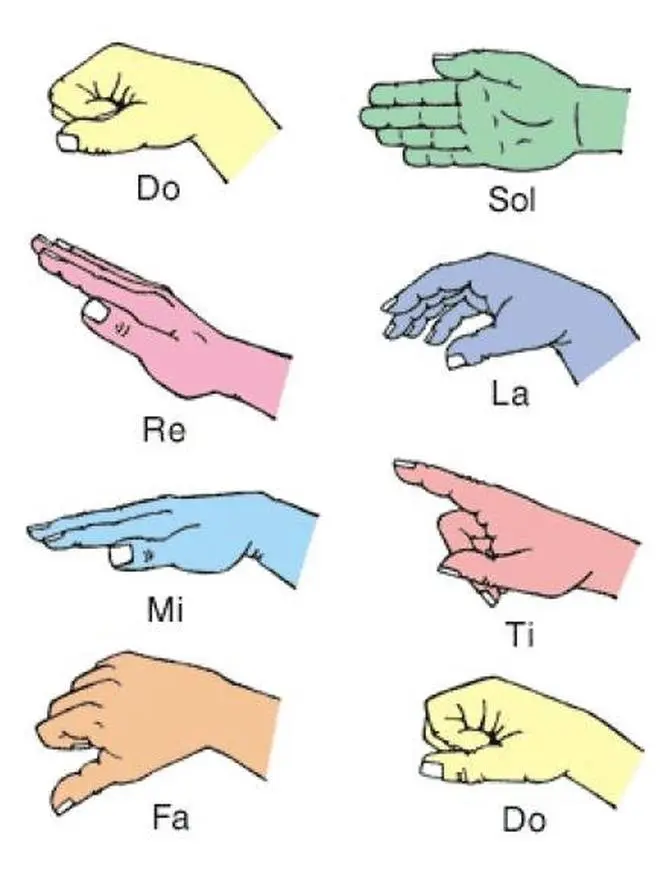
Comments are disabled for this video.
The concept of sequence is very, very important
in the Kodai philosophy.
Splitting out everything that you have to do
into the smallest possible chunks
and putting them in the right order.
Rhythm, pretty straightforward.
Pretty much all sequence naturally,
if we teach rhythm at all.
It's very rare for a teacher to walk into a classroom
and say, here's a whole note, here's a half note,
here's a quarter note, here's an eighth note,
here's 16th notes, let's read them all.
You usually start with one or two
and you branch out over time.
So most of us have that concept there.
You can do the same thing with pitch.
Pitch makes a huge, huge difference.
The traditional Kodai sequence for pitch
is to start with so-mi.
Cross-cultural studies have shown
that pretty much every major culture
that has a Western major-minor diachronic tonality
will gravitate toward that descending minor third
in children's songs.
It's the first interval that can be sung in tune.
So you'll see kids on the playground
and they're, na-na-na-na-boo-boo.
So-mi, so-mi.
Rain, rain, go away.
Hey, Billy, come in for dinner.
So-mi, so-mi.
It's always there, it's always there.
In the calls we do to children
and the games they play with each other,
the next one that naturally blossoms is la.
Rain, rain, go away.
Come again another day.
So-so-mi, la, so-so-mi.
This is based on American folk repertoire.
If most of your students don't have a history
in American folk music at all,
if they're coming from a different culture
or if they're coming with zero background,
you can build up your own repertoire
and decide the sequence that makes the most sense for you.
What songs do you have that have three or four notes in them?
What are those notes?
If it's mostly so-mi and la, start there.
You can also start your sequence with do-re-mi, that's fine.
For older beginners, fifth grade and up,
do-re-mi is often a better sequence
because a lot of the so-mi-la songs are relatively childish.
So if you want to do stuff that doesn't feel in-fifty,
the reason it feels in-fifty
is because those are the songs
that kids naturally make up and sing.
You say, oh, that song sounds like a kid's song.
But yeah, it's because it has the minor thirds in it.
That's where you got to start.
But older kids sometimes need some more advanced stuff,
so give them a little m, a little ja-ka,
although you can start with do-re-mi, that's fine.
Branch up to the pentatonic once you can.
Do-re-mi-so-la-so-mi-re-do.
Add the foundation and stay there as long as you can.
Once you introduce those half steps,
it's a real big jump in the ear training skill required
to sing those in tune.
Pentatonic is a lot easier
but as soon as you add any half steps.
Get to that extended pentatonic once you can.
Do-re-mi-so-la-do-re-mi-re-do-la-so-mi-re-do-la-so.
And you'll never run out of room
once you have extended pentatonic.
You have songs for days,
you need something with a fa or a ti in there,
just don't even bother teaching the solfege.
Teach that song separately,
just kind of bang it on the piano, whatever,
have them sing it,
and then when you're doing your solfege work,
stick to that pentatonic as long as you can.
If you can get them to like middle school
before you really even add in those half steps,
the traditional Kodai sequence
would add it in around four or five minutes.
But like I said,
traditional Kodai sequence was designed
when kids had five years of musical exposure
and singing with their friends
before they got to school.
Don't have that with a building construction.
So a lot of our five, six, seven-year-olds
are essentially different.