
Teaching Children to Sing in Tune! Let’s Play Music! With Topher Keene
Comments are disabled for this video.
Hello, everyone. It's lovely to see you.
So that's a pretty extensive bio there.
Basically, I teach singing, and I teach people who like to teach singing.
And it's a lot of fun. I worked with early childhood at the MIM.
I taught classes all the way down to two-week-olds up to five-year-olds.
That's how I met Shelly.
I heard a podcast interview with one of your wonderful teachers,
and I saw that she happened to live here in Arizona.
Reached out, and she observed one of my classes, I observed one of hers,
and we've been good friends for the last couple of years now.
I love what the organization does. It's beautiful.
I could very much easily see myself becoming a Let's Play teacher myself in my retirement.
My fiancee as well, she teaches elementary.
She teaches kindergarten and does music all day long.
Could have easily been a music teacher, but just fell in love with early childhood and focused in there.
What we're going to do today is focus on some of my techniques
for working with people who can't match pitch well.
Yay! Yes!
Always an in-demand topic.
Music education is in a difficult place right now.
I know many of you came from the public schools and from other teaching situations.
There's value in teaching music theory, music history, analysis, and all of these other things,
but I do find that many of our students are leaving without fundamental musical skills.
I saw many, many students who graduated high school, graduated college,
understanding Tchaikovsky's Birthday and how to analyze a Baroque score,
but not being able to sing beautifully in tune.
And that's tragic to me, because it's music class.
It's not about music class. It's not musicians class. It's music class.
If you can't make music, if you can't engage with music,
then why do you need to be able to analyze it?
It's like taking an English literature course when you can't read.
There's some fundamental skills that matter beneath there,
and I don't want to blame teachers.
We're under a lot of pressure. We have very little time.
There's state curriculum. There's scheduling. There's funding issues.
There's a thousand issues out there.
But if a child graduated high school and couldn't act,
we'd say there's probably a problem with the math curriculum.
And if a child graduated high school and couldn't read,
we'd say there's probably a problem with the English curriculum.
And most of our children, your children especially, have all this early childhood enrichment,
and then they go on to eight years of general music.
And they need not being able to math to get you to keep a steady beat.
And we don't wonder if there's something wrong with the curriculum.
It's a core skill, and I'm not saying Tchaikovsky's Birthday doesn't matter,
and I'm not saying leading with your bass doesn't matter,
and analyzing your key signatures.
I'm saying if you can't sing in tune, those things don't matter.
The fundamental skills are more important.
The quadratic equation matters, but only matters if you can act.
So, today we're going to work on that.
I have worked with several lessons students who I would classify as tone deaf.
We can get to the research, but we're not going to today.
0.0001% of the population, very, very small percentage, functionally tone deaf.
Physical disability, mental disability can certainly have an effect there.
But if you can tell the difference between a statement and a question, you're not tone deaf.
Because you're hearing a pitch difference,
and that's what tells you that you're hearing a statement or a question.
So, we need to work on getting them to finally discriminate between those pitch differences.
But as long as they can hear the fundamental differences,
they definitely can be taught to sing in tune.
Now, they're not going to be taught to be Beyonce.
Let's be honest.
Most of us are not going to be that good either.
I'm certainly not.
But they can get to a level where they can comfortably sing a lullaby with their kids.
And that's really my goal for my students,
is that every student I work with, when they're 80 years old,
can sing a lullaby to their grandkids.
So vocal health is key for me.
Singing beautifully in tune is key for me.
We're going to start with a little bit of a warm-up,
because I've found that many students who struggle to sing in tune,
it's often a technique issue.
So I'm just going to give you a quick master class in technique.
We're going to talk a little bit about how to structure our role training.
And then I'm going to take you through a sequence of what I would do with a student from beginning to end
if they had no pitch-matching skills whatsoever,
so that you leave comfortable with all of that.
It's all there in your handout, but you don't need to follow along.
You can set that on your chair, set it underneath.
You've got it with you to keep with you for the rest of your life.
Also, lots of material and recordings of these topics on my website and on my YouTube channel.
So you can always go back and find more of this if you need it.
But set that on your chair, set it underneath on the floor, and stand up.
It's early in the morning. We're going to get our bodies moving.
You guys are going to be using your voices all day long,
so let's make sure they're nice and warmed up.
Stretch up tall.
And let those arms come back.
Make sure all the shoulders are nice and high.
If you can, if you've got no space, reach down and touch the toes.
My pastor used to tell me,
if God wanted us to touch our toes, we ought to put them on our knees.
Get that stretch, shake out the shoulders,
and come up nice and slow.
Roll those shoulders up nice and hard.
Take your hand and put it on your neck, gently.
Swallow.
It's your Adam's apple or your Eve's pomegranate,
for those of you who are guessing.
Or it's an ox, or it's a bear, or it's a wolf.
You can drop your hand now.
But that little bump is where your voice comes from.
If you look at your thumbs,
your voice is about the size of your thumb nails.
Two little clots of muscle that buzz together
to make the sound of your voice.
Pressure in the lungs, the air pressure,
is balanced against muscle pressure in the cords
to produce that pitch.
They vibrate back and forth very, very fast.
Can you all sing for me?
So when you do that, that's A440.
The reason we call it A440
is that your cords are clapping together
440 times per second.
And when you sing clap, it's slightly slower than that.
Maybe 445 times per second.
When you sing sharp, maybe 442 times per second.
So to sing in tune, what your brain needs to do
is I press this.
That speaker vibrates 440 times a second.
Air in the room vibrates 440 times a second.
Your eardrum vibrates 440 times a second.
The liquid in your cochlea vibrates 440 times a second.
Your brain translates that vibration into electricity.
It sends that signal down to vocal cords and lungs
to balance air pressure against core pressure
so that when you push the air through,
those cords will clap exactly 440 times per second.
Exactly.
Not one time per second slower or faster.
And you don't need to know those numbers,
which is pretty neat.
Your brain can do advanced calculus
without you needing to know it
because every note you sing,
every note you sing is a different frequency.
And what most of you did was,
you heard the piano pitch that I played.
I didn't sing 440.
I sang 220.
The octave below is half the frequency.
So your brain, without even knowing the math,
without knowing any of the numbers,
hears 220.
It knows that's too low for me.
I'm going to sing it up here instead.
It doubles the frequency
and then does everything it was talking about.
When you hear the solo pitch,
lo mi so mi do
lo mi so mi
each of those pitches is a different frequency.
Each of those pitches is a different frequency.
Your brain wants the frequencies
that have a nice, pleasing ratio.
So the reason an octave sounds very nice
do do
480 is a pleasing ratio.
Our brain says,
oh, 1 to 2.
I like that. Simple.
I like that. Very nice.
When you hear, you're hearing frequencies that don't match very well together at all.
The ratio is more complicated.
So if you're slightly out of tune, if you're singing a slightly different number,
if you're singing 440 and I'm singing 437, that ratio is so complex that your brain absolutely hates it.
That's why we feel that pain when we hear out of tune singing.
Because we don't like the bad, complicated math.
What we're looking for is that perfect, beautiful, in-tune chord.
The reason that I'm starting with vocal housing technique is because
it's moving so fast and the muscles are so small.
You can imagine, everybody take your hand here.
Move your hand once per second.
Move it twice per second.
One, move it three times.
One, two, three, move it 440 times.
Kind of hard, right?
Kind of hard to keep it consistent and cause some damage.
Those chords are striking right up against each other.
And for those of you who live somewhere up north, you're a little bit bedrock,
living in the desert, it's not exactly designed for keeping those chords well-lubricated and well-moisturized.
So you need to constantly pound down water and you need to be taking good care of this
because any tightness up here on the instrument, any chord technique, makes that job hard.
It's already a really hard job to keep that exact right frequency,
balancing the air pressure against the chord pressure.
Every note that changes, changes that frequency.
Lots of room for error.
If they're slapping together 440 times a second and one out of those 440 hits the wrong way,
now you've got some voice damage.
And then every time it hits, it's re-emphasizing that damage.
When you get notes, when you get some scarring on your vocal chords,
it just keeps getting slapped every time.
I've had students who had to go three months of vocal rest in order to recover,
in order to find their intonation.
So you've got to take good care of this.
And you don't need to go to this level of detail with your parents and your students,
but it's helpful to know that your voice is doing a lot of the work
and you need to take good care of it.
Don't shout. Don't scream. Don't push yourself too much.
Don't whisper. Connect your voice.
Whispering is just as important.
Speak with the same technique you used when you sang.
Project forward, that rhythm in the front of the instrument.
Use that supportive breath down here.
Relax and free up the top of the instrument.
Let's do a little bit of breath work.
Everyone show me your palms.
And put them down here on your abs.
Your thumbs should be touching the bottom rim.
Fingertips should be touching just about your belly button, maybe a little bit above.
When you breathe in, make those fingertips come apart.
And breathe out.
Now, you're not breathing into your belly.
Some of your choir teachers and voice teachers may have said,
take a belly breath, breathe into your belly.
Right? Have you heard that before? Yeah?
You don't want to breathe into your belly.
You know what happens when you breathe into your belly?
You don't want to breathe into your belly.
You want to breathe out.
But your belly has to get out of the way to make room for your lungs.
You've probably heard a word called diaphragm.
Right? Who's heard the word diaphragm?
What diaphragm means to most students is a fancy science-sounding word
that makes my voice teacher stop asking me how I'm breathing.
What a diaphragm actually is is a flat muscle underneath your lungs
that acts as the floor of the chest cavity.
It can drop to give you more space for your lungs for more breath support.
And more breath support means your cords don't have to work as hard
because they have more pressure.
So I would take your hands and push under your lips a little bit,
try to get behind you a little bit, and then cough.
You hear that muscle that coughs now?
That's your diaphragm.
You don't have conscious control over your diaphragm.
Your brain is smart.
Evolution is smart.
God is smart.
Your brain and God and evolution know that you're a dummy
and can't control your diaphragm and screw it up.
There's a lot of things your body doesn't have control over.
You don't know how to walk.
Your body knows how to walk.
Try and explain to someone what muscles you move in order to make yourself walk.
Pretty hard, right?
You don't get to use your spleen.
You don't get to use your kidneys.
Your brain takes care of that.
You are in charge of beating your heart.
And you woke up one morning and said,
beep, beep, beep, beep, beep, beep.
Okay, I'm going to brush my teeth.
Beep, beep, beep, beep, beep, beep.
You're going to the shower.
Oh, yeah, I love the spleen.
Let's say so.
Beep, beep, beep, beep, beep.
You'd be dead by lunch.
Your brain knows that it needs to take care of important things.
So it takes care of the diaphragm.
You can't breathe with your diaphragm.
What you can do is make space and your diaphragm will move on its own.
So that's why we're taking our hands right here.
We're minding on the abs as you breathe in.
Push those guts out of the way so the diaphragm has somewhere to go.
It needs to drop down into your gut space.
Take a big breath.
Good.
And out.
This time we're going to hiss.
And I want you to feel those abs doing the work.
Don't let your throat do the work.
If your throat does the work, you can damage those cords.
Let your core do the work.
Breathe in and hiss.
Check those muscles.
Make sure they're working.
Relax that neck from side to side.
And this time we're going to pulse.
And every time I want you to feel those ab muscles, those core muscles engaging,
to get that sound out.
Keep that neck nice and relaxed and free.
And let it out.
You'll notice very quickly with the head motion,
if there's any tension in your neck,
and it starts to move like a robot or a sprinkler,
or it is yodeling,
then those muscles are free.
You may have noticed at times getting back home at the end of a long day,
and then going,
my shoulders and neck were tightened up hours ago.
I didn't even notice it.
If that happens to your students,
it's easy to get used to that feeling and not notice that we're back.
So you need to have some cues to remind you to get relaxed.
That gentle neck movement as you're warming up,
and as you're going into the laps,
and as you're singing a song,
is a really helpful way.
Because if you allow it,
tighten up your shoulders,
and try to move your neck smoothly side to side.
If it doesn't work,
you can feel it.
And then control your shoulders and relax it.
And with that freedom in the muscles,
the cords can move much more freely.
Sometimes that tension is one of the causes for our students to sing out of tune.
Sometimes lack of breath support is that reason for our students to sing out of tune.
So make sure that they know how to breathe into their bellies.
If you roll their shoulders back,
and you can have a nice competition to see who can do it the longest,
a rough competition, especially those boys.
Let's go ahead and try that.
Everyone take your biggest belly breath,
and we'll see how long we can hold it.
If you can make it to your ear jam, good job, good job.
Everybody give me a nice, light, relaxed sigh.
Great exercise for getting that tension out of the instrument here.
If you tighten up,
if we put a big smile on,
and then try to do a lip bubble,
it doesn't work so well, right?
Relax those cheeks like you just got back from the dentist
and you're,
Much easier.
That tightness again,
pulls up on the larynx,
tightens everything up,
and now you can't sing as well.
We also need to talk a little bit about registration,
your head voice versus your chest voice.
The easiest way for me to show that to kids
is just to give them a physical sensation.
So repeat after me.
This is my speaking voice.
This is my chest voice.
This is my singing voice.
This is my head voice.
So I need a little more head voice,
and when singers are stuck in their chest,
a little less,
when we've done that walk,
when we're releasing a note,
a very easy gesture to just bring them back,
when they're singing,
Mary had a little lamb,
little lamb,
they get to use that chest all day long,
they don't have to sing.
A few generations ago we did,
and everyone learned the same songs,
it was in Hinton Church,
they would sing the same songs in school,
we had the patriotic pride songs,
in school, a lot of these things,
and everybody,
that started to fade from the culture.
We got the top 40 Billboard hits,
and everybody had the Beatles,
everybody had the same pop tune,
but now people have headphones,
and iPods,
but now people sing the same songs,
and then we had Disney.
That was a lovely couple of decades there,
where everyone knew Lion King,
and Little Mermaid,
and I'm not getting kids to know that.
A lot of kids have not heard that.
We had this really sad decade or so gap,
where kids weren't getting any of this music,
and then,
we got Frozen.
I don't love Idina as a model for children,
but there's a song all the kids know about,
which is good,
because we have a foundation we can work with,
but we need to deal with them.
One of the great things you do here at Let's Play,
is you have those CDs you can send home,
so they have some beautiful singing to play at home.
Many of your kids come to you,
only ever having heard rap,
hip-hop, rock,
maybe country,
maybe some jazz,
if you're lucky,
maybe some musical theater,
if you're really lucky,
probably will never end in a beautiful and true,
head voice,
classical singing.
Probably almost never.
So they need to get it from you.
They need to hear that in their heads,
before they can reproduce it with their parents.
And it's easy to forget that,
as a teacher,
as an adult,
because we have thousands of hours of that to go.
So we need to get that sound back into their heads.
I can honestly tell you,
that if you assign it to your parents,
play those CDs,
play those children's songs to them,
one, two hours a day,
for two or three weeks,
for two or three months,
you're going to get more out of that,
than a year of private coaching.
They just need that sound in their ear,
and they have so much of that sound.
You may not know this,
babies actually are more battling
every phoneme,
every speech sound,
every syllable,
every possible language.
They lose all of it.
They only keep the ones that they hear,
from the adults in their lives.
So most of us have a lot of sounds,
from German,
French,
from Asian languages,
that we cannot produce,
because we can't hear them as children.
They need that modeling,
in order to lock in their range of production.
They need to be able to do the same,
in order to lock that in.
They need a lot more of that.
And you're making music in your classroom,
but there's not as much time for that.
So you have to find ways to encourage that,
to prepare.
A little bit more quick technique,
and then we're going to move into philosophy.
Can you sing for me?
Take your hands,
fingertips touching.
Press lightly on your cheekbones.
This is called the zygomatic arch.
This is where your ringlet comes from.
Everybody say,
sing-a!
Sing-a!
Take your fingertips,
buzz a little bit on those cheekbones.
Do it again.
Sing-a!
You can turn your hands down.
It seems like I speak loud.
Most people think I have a loud voice.
I don't have a loud voice.
I have a very,
very resonant voice.
I speak this exact same volume.
I turn off my ring.
All of a sudden,
you can't hear me at all.
I'm not speaking any quieter.
I just turned off this.
I can turn that back on,
and now I sound a lot louder.
My voice is bouncing off the back of the wall.
Everybody say,
sing-a!
Sing-a!
Good.
Put your fingers on the cheekbones.
Say, sing-a!
Sing-a!
The problem, obviously, is that affects your tone.
All automatically,
as soon as you bring the sound up here,
you're going to start sounding
a little bit like a kindergartner.
That's okay.
Most of your students are kindergartners.
It's okay to sound like kindergartners.
They need that ring and that power,
and a lot of them are told
to shut up and stay quiet.
A lot of them are told
to stay quiet constantly.
When they come to music class,
they go,
and you go, sing out!
The problem is,
they spent 16 hours that day
being told to shut up and stay quiet.
So we need to encourage them
to use their voices
in the right context.
When they need it,
put those fingers one more time
and say, sing-a!
Sing-a!
Sing-e!
Get that buzz right into your fingertips
and put it into the vowel.
Sing-e!
Sing-a!
If there's hungry stuff back here,
it goes louder,
especially if the breath support isn't there
and then there's some tightness in your throat.
Usually musicians come together.
Amazing grace!
How sweet the sound!
You have to engage that proper technique
before we assume
that it's in your drink.
Pratt, put your hands right here.
Give me that Santa ho-ho-ho!
Ho-ho-ho!
Ha-ha-ha!
Ha-ha-ha-ha-ha!
Very nice.
So the point is,
you need to feel the start and stop of the sound
down here.
You hear the difference?
Ha-ha-ha-ha-ha!
Ho-ho-ho-ho-ho-ho!
Cool.
It powers up the breath,
not from the throat.
Think of our singers as singing from the voice,
singing from the throat,
singing from the mouth.
Not going to get you the sound you want.
Sing from the breath.
And if you think of the breath as being up here,
you're going to read that.
Now the thing is,
your students, they're so young,
they don't need a lot of this explained to them.
What they do need is a model to the breath.
If you say,
breathe down here with a deep belly breath,
and then you go...
They're going to do what you do,
not what they see.
They're going to do what you do,
not what you say.
They're going to model exactly what they see.
They're little monkey-see-monkey kids.
They do not have a good understanding of our language.
Even all the way up to middle school and high school,
they really do not understand how to relate speech that well.
They're mostly just kind of nodding along and saying
what they feel you want them to say.
Right?
You've had that experience.
You ask questions,
and they give you an answer,
and you're like,
I don't think you understood anything I said.
You're just trying to make me happy.
That's so sweet.
That's wonderful.
I'm so glad they want to make us happy.
But the problem is we get caught up as teachers
in thinking we're doing good teaching
when they act like they understand.
Any questions?
You guys get that?
They don't understand.
They go right over their head.
But they know if they raise their hand,
they're going to get pointed out
if the video's annoying.
And they know they've made fun of it.
Often when at home,
they ask questions.
They say,
Why?
And they get told,
stop asking stupid questions.
So they learn that it's not safe
to ask the questions.
So we need to show it to them
in our technique.
We need to model for them
the best possible situation.
Because for most of our students,
you are the best musician
they've ever met in real life.
They've heard better musicians
than these.
They've never met one in real life.
They've never seen one in action.
You are the epitome of beautiful,
amazing musicianship
and quality singing.
They've never heard anyone
as beautiful and as wonderful
and as musical as you are.
So you have a responsibility
to model that for them constantly.
When you sing poorly,
they're going to pick up on it.
Can we do a quick exercise?
I want you to clap.
I'm going to say,
1, 2, 3, go.
And then we're going to clap.
1, 2, 3, go.
And clap.
Ready?
Here we go.
1, 2, 3.
Clap.
Go.
It's not just the kids
who ignore instructions
and pay attention to what they see.
I said very clearly,
twice,
1, 2, 3, go,
then clap.
But I chose to clap after 3.
I didn't say anything about
the octave after 3
or whether I would do it or not.
What I told you is,
listen, you don't have to clap.
You still follow what I did.
Because I'm the person
out of the front of the room.
If your brain tells you
the person in front of the room
does things,
I'm supposed to do them.
I'm supposed to pay attention.
The kids do that too.
So don't just think
because you know
how to sing properly
that you're actually
demonstrating a concept.
I highly encourage you
to reward yourself
the same way I'm
doing this session right now
and go back
and go buy a new coat
and pay careful attention
to how to do anything
that I wouldn't want to see
in my students.
Any of that stuff.
Any tightness up here,
any tension,
any high breath
instead of low breath,
any posture issues,
any modeling a poor tone,
any of that,
any out of tune singing,
we all do it.
We all do it.
You've got to be careful
with that.
Really good job.
Really excellent work
with that warm up
behind that seat.
You guys make a beautiful sound.
I hear lovely, lovely
singing in here.
I'm sure 99%
of what you model
for your students
is vlogs.
Thank you very much.
This is for the one
or two of you
who might have
some doubts
whether or not
it's 100% perfect
all the time.
So good job.
Those little technical things
are mentioned on that
first page of the handout.
I want to tell you
a little bit about
one of the graphics
I have in there.
You don't need
to reference the handout,
but you'll see
a little pyramid
that talks about
sequential learning
of music as a language.
I saw this
from Edward Gordon,
who's one of the
best researchers
in music education,
probably on
any Jewish BMS.
Had to see him
in Boston before
he passed
on a bursary
a few years ago.
But if you look
at Edward Gordon,
his books are fabulous.
He has a process
called music learning
theory,
where I stole
a lot of this from.
It's a very
fast revised
and reduced version
of his work.
It'll take thousands
of hours to do
the actual research,
but I'm going to
give you the basics.
So what he talked
about was that
the same way
we learn language,
we have a sequence
of vocabularies
we build up
in order to
build those skills.
Foundation is listening.
We need to hear
the sounds
and then we can
make the sounds.
The next step
is speaking.
We need to be able
to repeat the sounds
that we've heard
after we've heard them.
The next is thinking.
We need to be able
to play with those sounds
and make new sounds
and improvise
within the music
in order to use
the elements that we
already have obtained
in our listening
and speaking vocabulary.
Then we move on
to reading.
We're able to look
at something visual
and translate it
into a sound.
Then we move to writing.
We're able to take
a sound in our head
and translate it
into something visual.
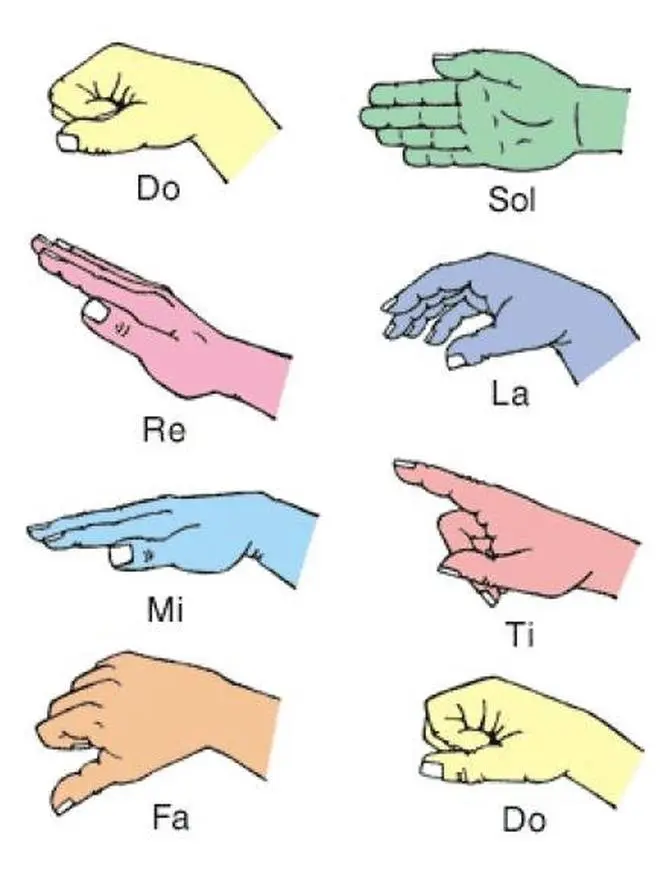
Hand signs are the same
thing as reading
and writing.
We get caught up
in notation very easily.
Notation is not that.
The jump from
Do-Re-Mi
Sing for me
Do-Re-Mi
You
Sing without me singing.
Do-Re-Mi
You
Sing for me.
The jump from this
to this
and running this
with my Do
Do-Re-Mi
Read for me.
Do-Re-Mi
You
Five lines, four spaces.
The jump from that
to the page
is not a very hard jump.
If you can get them
here
and maybe here
that the transition
to page
can come
in elementary school
general music
and they'll come
lost.
You don't need
to get them
to notation early
but once they've
built the ears
and the skills
they'll transition
very quickly.
Our transition
is going from
the eyes
to the ears.
It's very easy
for me to sing
and then you sing.
Do-Re-Mi
Sing for me
Do-Re-Mi
For a child
to see this
hear the pitches
inside their head
and then produce them
without hearing
them first.
That's a big jump
and it takes years
of building that
listening vocabulary
hearing songs
from others
not just while
they're singing
then speaking vocabulary
repeating back
the songs
they've heard
and singing them
in others
then thinking vocabulary
playing around
and improvising
the songs
changing the lyrics
changing the notes
a little bit
playing the music
then to be able
to transition
to reading those visuals
and eventually
the other way around
I sing
do-do-do-do-do
showing with your hands
what I'm singing
do-do-do-do-do-do
beautiful
that's dictation
that's college level
music theory
now that you guys
are doing it
I sing a tune
you're dictating it
because you can go
from this
to the page
very easily
the hard part
is the ear to the hand
once you've gone
from oral to visual
the notation
takes care of itself
now I do want to
point out
that listening vocabulary
is very very very important
it's easy to think
that when we're
singing with our kids
we're also building up
their sound bank
but that is a reflection
of the sound
they've already heard
it's not the same
as listening
our brains
our bodies
have a very specific process
for not allowing us
to hear ourselves
while we're producing
a sound
because my voice
sounds pretty loud
right now
right?
look at how far
away my mouth is
from my ear
it's about this far
now if I was this far
from your ear
you probably wouldn't
want me to talk
as loud as I am right now
right?
it wouldn't be
very comfortable
right?
but my ears don't hurt
when I talk
why is that?
there's a muscle
called the stapedius muscle
it sits under your drum
and it dampens the drum
while your vocal cords
are producing sound
and the reason for that
is if you're a monkey
in a tree
and you're screaming
that a tiger is coming
you don't want to go deaf
while you're running away
from the tiger
on your own screams
that doesn't make sense
so we have all this
little muscle
that lands on the drum
just like if you're
trying to hit a timpani
hit a drum
hit some kind of
percussion instrument
and you let your hand
on top of the drum
it doesn't sound as loud
right?
that's all it does
it dampens the eardrum
but it actually
functions to do that
a microsecond
before you even
produce sound
in your vocal cords
it's really cool
they do brain scans
on that thing
this fires before
this does
so as you're about
to make a sound
your ears turn off
you can still
clean your ears
obviously
when you're singing
together
you can hear yourself
but not as well
it's not the same
so it's not just
about the way
you're singing
it's not just
about the singing
backgrounds
it's also about
acting as a team
closing their eyes
paying attention
to the sounds
getting those sounds
into their brains
without always
forcing them to
reproduce them
that can come
at home
I don't know
how many times
you need to
make music
when you're
with your kids
but they need
to have that
message
and if you
aren't confident
that their parents
are getting it
at home
you need to have
some time
for it in the
classroom
I know
you have to
move up and
move down
so that's the
sequence
to be there
focus on
the hearing
first
then move
up with
the production
then start
braining
with those
sounds
and then
the reading
and the writing
I want to
talk to you
a little bit
about what
I would do
exactly with
a student
who comes in
who has no
functional skill
whatsoever
hold on your
hand for a second
so I can show
you what we're
looking at
and then I'll
talk you through
what we're looking
at
go past the
first couple
pages to page
5
instructional
sequence
for pitch
challenge
singers
so I wrote
this down
number 6
categories
there's a back
to that page
right there as
well
is to work
on their
hearing
they're producing
a pitch
identifying when
pitch matches
and when it
doesn't
you flip the
page
following someone
else's pitch
matching
someone else's
pitch
and reproducing
patterns
once you're
at the point
that you can
reproduce patterns
in tune
you can sing
good job
congratulations
you're done with
needing to learn
how to sing
in tune
so my goal
with this
sequence is
that no matter
what level
your student
is at
you can find
a place
where they
already have
mastery
and build
from there
to the point
where they
can sing
beautifully in
tune
so there are
some who will
come in
halfway through
the sequence
some will come
in almost at
the end
but there are
some who go
all the way
back to the
beginning
I have never
had a student
who failed
all of the
beginning
levels of the
sequence
because the
first level
of the
sequence
is can
the singer
identify
high and
low
including
extremes
so can
you tell me
am I singing
high or
low
put your hands
up if I'm
singing low
put your hands
up if I'm
singing high
ah