
I'm The Smallest Woman In The World | The World's Smallest Woman: Meet Jyoti
2 Video Views·Mar 1, 2025
Jyoti Amge is the the world's smallest woman and weighs only 12-lbs while being 24 inches tall! She goes on a journey to the United States for medical help, but wants to explore her fun side while she's there.
I'm Jyoti Amge. I'm 26 years old. I weigh 12 pounds and I'm 24 inch tall.
World's smallest living woman.
I may be young, but I'm not a kid.
No, baby.
Jyoti, you're still sleeping? It's 11.30 already.
Jyoti is in the U.S. for career opportunities and to have some fun exploring America.
But more importantly, Jyoti is meeting with an American doctor at the end of the week.
She's been living with a debilitating leg issue for years, and she's hoping this new doctor will be able to help her.
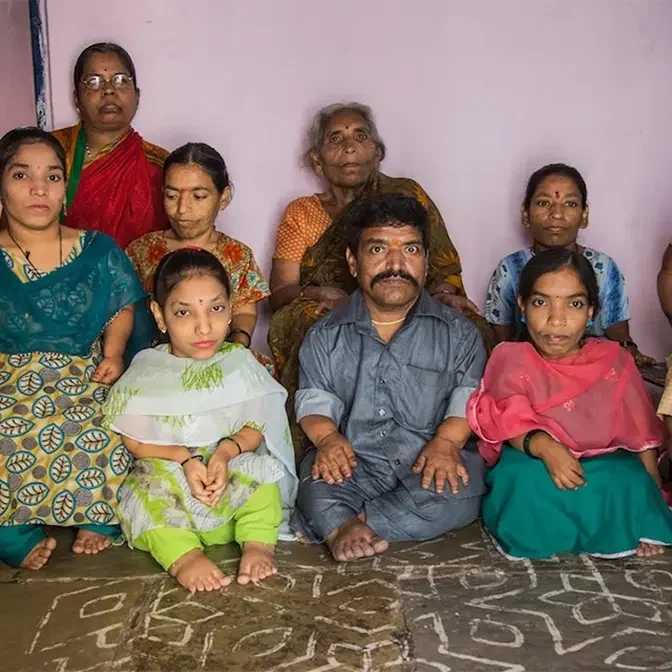
While in America, Jyoti is staying at her manager's house with her parents, Kishan and Manjana, and her older sister, Archana.
The family understands very little English, so they work with a translator while traveling.
The whole world is upside down.
My whole life has been different since I was a kid.
I'm so small that I can't lift heavy things.
I'm from India, Maharashtra, Nagpur.
I have four daughters and one son.
I'm Jyoti. She's the smallest of them all.
When Jyoti was pregnant, it was a little difficult.
She couldn't move around in my womb like any other child.
We went for a check-up, and the doctors told us that she couldn't be seen in sonography.
The doctors told us that she wouldn't survive.
We had to do a caesarean.
She weighed three pounds.
She said, she wouldn't survive.
She said that.
She was 26 years old.
But she survived.
She was like any other child.
She learned to walk on time.
She learned to brush her teeth on time.
She learned to eat on time.
She was fine.
The whole family used to look at me and say,
all the kids are gaining weight, but I'm not.
When I was three years old,
my mom and dad took me to the hospital.
The doctors told me that I had a lack of hormones.
The doctors told me that she wouldn't grow any more.
I'll make it.
Here, I'll make it.
Is it okay?
Wow, it looks good.
She still weighs five and a half kilograms.
We told the doctors to give her hormones,
but they said that she couldn't be normal.
She couldn't be normal.
By giving her hormones,
she could grow a hand or a head.
She wouldn't look normal.
Geeta, she's beautiful.
No one can cure her.
Oh my God, look.
Let's go in and look.
Come on.
Let's go find some clothes for someone tall
and someone really short.
The best way to not look like a kid
is to wear clothes like an adult.
But this is very difficult for me.
I can only shop from the baby section.
What size are you, honey?
Three months.
You must have the hardest time finding anything
that looks adult, like for you and your size.
All these kids are small,
but I'm not a baby.
So I see that you're shopping in the infant section.
How old are you?
26.
This is definitely the first time
anybody has ever asked me for adult-styled clothing
in an infant size range.
Babies' clothes are made differently
to make it easy for the parents to dress them.
So we kind of want to find some stuff
that's, like, cool and age-appropriate.
I don't think that your average person
is looking for trendy or night-out clothing for a baby.
I'll help find something.
Okay.
Oh, I like that one, too.
Turn around.
Wow.
I like that.
Fashion show.
There we go.
Now that rocks.
Yes.
That's adult.
That purse matches perfect.
Do you like it?
It does look awesome.
You can put your phone in your purse.
Perfect.
Yay!
There we go.
The phone's important so she can talk to boys.
Jyoti has had bilateral fractures
on both legs for the past 10 years.
Her family believes that they haven't healed
due to her lack of growth hormones,
but they aren't sure.
So she's visiting an American doctor
at the end of the week for a medical evaluation.
Jyoti and her family have arranged to meet
with a radiologist to x-ray her legs
and hopefully advise them on what they need to do next
to heal them.
Hi, I'm Dr. Chan, Brandon Chan.
Hello.
My name is Tim.
I represent the Yamgate family.
Hi, hello.
I'm Dr. Chan.
This is Jyoti Yamgate.
Oh, hi!
Hi, Jyoti.
Dr. Chan.
I'm Dr. Brandon Chan.
My specialty is radiology.
We look at things such as MRI and CT
to make diagnoses in the patients
as to what's wrong with them.
So what brings you here?
Bilaterally, she had some fractures
about 10 years or so ago.
He's saying that her leg got fractured
and they've come to you to seek your medical advice.
I think the best thing to do is get some x-rays today
and see exactly how they've healed
and how they're lined up.
And then from there, we'll know what the next steps are.
They're really open to suggestions at this point
because they're really concerned.
Sure.
I completely understand that.
So we'll know much more when we get the images.
Okay.
Usually, these things never seem to get better on their own.
They can only get worse.
So you are worried that because the bones have never healed,
she can have very significant damage
that may not be repairable because she's so small.
Come sit down right here.
You too, Mom.
We're going to get you ready for the x-ray, okay?
We're going to have you take off your brace
that you have on your leg
so we can take some pictures, okay?
All right.
Okay, I'll be back in a few minutes.
I looked at your x-rays,
and since the accident,
have you had any surgeries on your legs at all?
No.
Okay.
You have a fracture that's old of your thigh bone,
your femur on the right side,
and you also have old fractures of your tibia and fibula,
this leg down here,
and they're not lined up, so they're malaligned.
They're sort of free-floating.
Because of that, it causes you a lot of weakness
and instability.
Her condition is very rare.
There are probably possibilities of fixing her broken bones,
but I think the most important thing for her
is to see an orthopedic surgeon
that specializes in her type of disease.
It appears to me, based on her bones and her size
and the way she looks,
that she has something called primordial dwarfism,
which is extremely rare,
but you would have to confirm that
looking at what they call a genetic panel.
Yes.
And so we want to make sure that whatever we do,
it improves things so that she can use that leg
for the rest of her life.
So we'll get that ball rolling,
and hopefully we'll have some really good outcome
for her, for us, for life.
Thank you.
Bye. Thank you.