
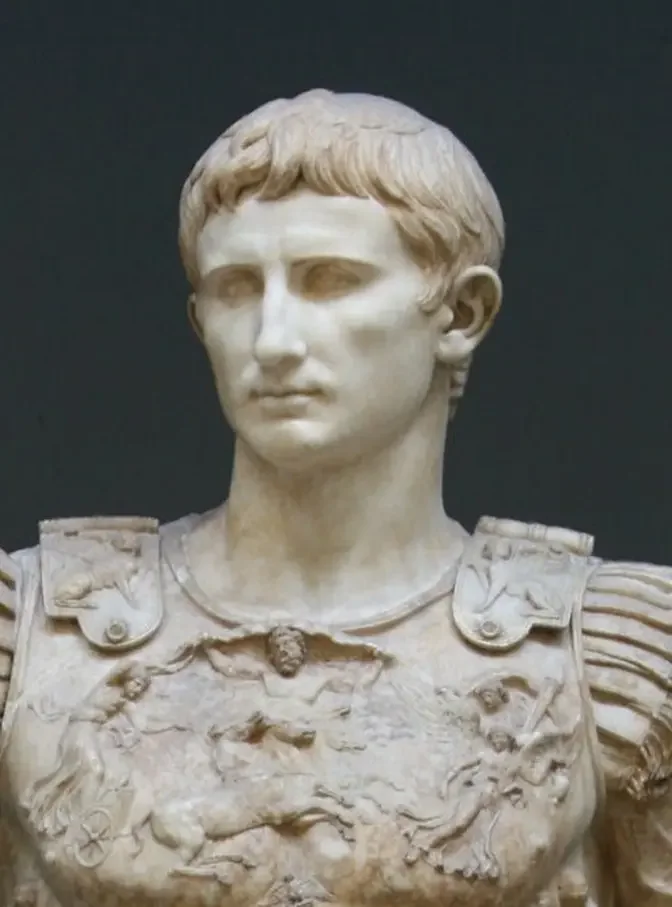
Augustus: Rome’s Greatest Emperor
77 Video Views·Dec 26, 2022
He's likely one of the five most significant human beings to have ever lived.
Gaius Octavius, commonly known as Octavian, spent his entire life at the beating heart
of Roman politics.
The great-nephew of Julius Caesar, he first supported his famous relative in his campaigns
of conquest, before later becoming the avenging angel who murdered Caesar's assassins.
Elevated to leadership position in the Second Triumvirate, he then fought a war with Mark
Antony in Cleopatra, a war that determined the very fate of Rome itself.
Yet while that epic tale alone would be enough to fill any normal-length video, it was only
a preamble to the real action.
Because it wouldn't be as Octavian that the boy's name went down in history.
But as Augustus, the first and greatest Roman Emperor.
Although he never used the term Emperor himself, it was under Augustus' watch that everything
we associate with the Roman Empire came about.
It was he who dismantled the Republic, who transformed a sclerotic bureaucracy into a
long-lived superpower, and who became head of a family that would produce some of the
most infamous rulers in all of history.
In today's very special double-length episode, Biographics is delving deep into the life
of Octavian, the boy who birthed the Roman Empire.
At the moment Gaius Octavius was born on September 23, 63 BC, it was into a world that was already
on the verge of disappearing.
These were the last years that you could convince yourself life was normal in the Roman Republic.
The last years before the First Triumvirate.
Before Caesar's Wars.
Before the bloody transition into the Roman Empire.
Still, no one witnessing the boy's birth could have possibly guessed that he would
That's not to say Octavian came from humble circumstances.
The boy's father, also called Gaius Octavius, was a member of the landed gentry at Velatre
who'd had the fortune to marry Julius Caesar's niece.
Although Julius Caesar wasn't yet the historical Colossus we know today, he was certainly on
his way.
Colossus or not, Octavian never saw much of great-uncle Julius in his childhood.
And just to get this out of the way, yes, it is customary to call him Octavius prior
to 44 BC.
But since we're already doing one name change to Augustus, we're just going to call him
Octavian until then to avoid confusion.
When Octavian was only four, his father died, leaving him to be educated by his grandmother,
Julia Minor.
Julia Minor was Caesar's sister, theoretically bringing Octavia closer to one of Rome's
most powerful men.
But only theoretically.
Even if Caesar had paid much attention to the boy, it's doubtful he'd have liked
what he saw.
Octavian was a weak, sickly child who was overly attached to his mother, all qualities
the macho Roman sneered at.
Yet even as a boy, Octavian showed a knack for making friends with people who had strengths
he was lacking.
People like the athletic, powerful Marcus Agrippa.
But Octavian also had another, secret quality, one which no one ever saw.
The boy harbored an ambition that burned so bright it could outshine the sun.
As Octavian grew up, he slowly began to gain some recognition.
In 51 BC, Julia Minor died and he was chosen to deliver the oration at her funeral.
A few years later, he became a member of the Board of Priests, or pontifices, a hugely
desirable position.
But it would be the action of his great uncle that brought Octavian to the heart of power.
In 50 BC, the struggle for Rome was reaching its epic climax.
On one side, the general Pompey and his supporters were trying to force Julius Caesar to give
up governorship of Gaul.
On the other, Caesar and Mark Antony were trying to force Pompey out of politics.
It was the final act in the collapse of the First Traumvirate.
When it was over, only one of the former comrades would be left standing.
And you already know who that's going to be.
On January 10, 49 BC, Caesar marched his troops across a small stream known as the Rubicon
and into history.
The boundary between Cisalpine Gaul and Italy itself, the Rubicon was a big deal.
Crossing it with an army automatically meant declaring war.
It was this declaration that made Caesar's name.
When Pompey got news of the invasion, he fled Italy, leaving Caesar to go chasing after
him.
In the following years of bloodshed, Octavian begged to be allowed to fight alongside his
great uncle.
But he was too young, too much of a child for military life.
Nonetheless, two events did come out of the civil war that would transform Octavian's
fortunes.
The first was his friend Marcus Agrippa's brother being captured by Caesar in North
Africa fighting for the Pompeians.
When Agrippa got the news, he begged Octavian to save his brother's life.
Octavian duly asked Caesar to forgive the boy and, to everyone's surprise, Caesar
agreed.
From that point on, Agrippa would be a die-hard Octavian loyalist.
The second was more indirect.
While off fighting, Caesar left his number two, Mark Antony, in charge of Rome itself.
Unfortunately, Antony was such a lazy frat boy that he almost caused a revolution.
When Caesar returned in 46 BC, he was so pissed that he sent Antony into exile.
And just like that, Julius Caesar was suddenly in need of a potential successor.
It was this need more than anything that would set Octavian on the road to infamy.
With Antony off sulking in Gaul, Octavian got to join Caesar on the triumphal procession
for his African victory.
But this was just a quick breather because in 45 BC, old Julius galloped off again, this
time to Hispania to fight the sons of Pompey, Gnaeus, and Sextus.
The plan was that young Octavian would go off with his great uncle.
Instead, the boy was forced to watch in horror as his body betrayed him.
We mentioned earlier that Octavian was sickly.
But maybe we need to take a moment here to emphasize just how sickly he was.
All his life, he would be wracked by illnesses that would put him out of action for months
or even years and left him stranded at death's door, just shy of crossing the threshold.
It was one of these crippling illnesses that stopped him going with Caesar.
But of course, nobody in Rome knew this.
They all thought he was a coward.
This was a serious charge in ancient Rome, more damaging than it would be today.
It left Octavian with no choice.
Mustering the sort of willpower usually reserved for ultramarathons, Octavian forced his hurting
body to leave his bed, to leave Rome, to ride out to Hispania to meet his great uncle.
By the time he got there, the war was already won.
But it still turned out to be a wise move.
As Caesar noted, Octavian couldn't possibly have known the outcome when he set off, meaning
there was every chance he'd ride into Hispania and be massacred by Pompey's sons.
In other words, Caesar was saying, guys, it turns out my great-nephew is not a sniveling
coward after all.
How about that?
The journey home was a mixed blessing for Octavian, though.
At first, the boy, still only 18, got to ride in Caesar's carriage, which was a huge honor.
But then Caesar decided to take a detour and patch things up with Mark Antony, and it was
Antony who rode with Caesar the rest of the way home.
Still, it seems Octavian had made a good impression.
It would be during this journey that Caesar made the history-changing decision to alter
his will.
2,000-year-old spoiler alert!
It's not going to end well for Mark Antony.
Back in Rome, Caesar handed Octavian a plum role as a powerful administrator to help him
learn the ropes of politics.
At the same time, Julius started acting more and more like an ancient king, a fact that
was lost on absolutely nobody.
Across 45 BC, he pushed the Senate into extending his term as dictator, and pulled PR stunts
like having laurel crowns secretly placed atop statues of him in the city.
Come February, 44 BC, the Senate had decided the only way to stop Caesar from literally
becoming king was to assassinate him.
Yet when the Ides of March finally came, Octavian wouldn't be around to witness it.
That spring, he and Agrippa traveled to Apollina, in what's now Albania, to complete their
military studies.
And there they were, on March 15, when Caesar's senators stabbed the dictator to death.
Mark Antony, on the other hand, was in Rome.
When the news broke, he fled the city, convinced that he would be next.
Cicero uttered a famous phrase, the Ides of March was a fine deed, but half done.
He meant that no one had killed Antony.
No one had traveled to Apollina to murder Octavian.
Instead, a confused Antony slunk back in late March and resumed his consulship.
One of his first acts was to open Caesar's will.
Reading the contents must've been like being dropkicked in the nuts by Caesar's ghost.
The will stipulated that Octavian would be posthumously adopted by Caesar.
Not only that, the boy would receive nearly all of his fortune.
The moment Antony read these words marked the beginning of a rivalry between the old
soldier and Octavian.
A bitter, nasty rivalry that would shape Rome's future for generations.
And it would only be over when one or both of the men was finally dead.
News of the Ides of March forced Octavian to make a life-changing decision.
Should he return to Rome, or simply flee into the night?
At the impromptu council the boy held, almost everyone was like, dude, you should definitely
run.
These guys just killed your great uncle, you're probably gonna be next, dude.
But there was one exception.
Marcus Agrippa, by now a powerful soldier, declared this was ancient bull poop of the
highest order.
He urged Octavian to return to Rome to be a man.
To claim his inheritance.
It would be far from the only time Agrippa's advice saved Octavian's butt.
That spring, the boy returned to the Eternal City to find events moving rapidly.
Mark Antony had successfully whipped up the mob against the conspirators, forcing assassins
like Cassius and Brutus to flee Rome.
Less successfully, he also tried to make out like Caesar had actually left his fortune
to the Roman people, and definitely not posthumously adopted any heirs.
So when Octavian realized the truth, he also realized Antony was gunning for him.
And this was bad news for Antony.
Because one of the cardinal rules of ancient Rome is don't **** with Octavian.
Especially not when you're already a walking PR disaster zone.
Antony's first major mistake was to try and make peace with the Senate, having riled
up the mob.
This allowed Octavian to tell the mob, look guys, he's betraying you, and force Antony
into a corner.
The second was to act so unstable that guys like Cicero became convinced Antony was a
danger to the Republic and began promoting Octavian as an alternative.
The third, and probably biggest, mistake Antony made was to go and invade the Sarpian Gaul.
The reasons why are slightly complex, involving Antony's consulship ending and the Senate
wanting to pack him back off to Macedonia.
But, basically, it was designed to be a show of force.
For the Senate, this was too much.
Antony was declared an enemy of the state.
In early 43 BC, the Senate authorized Octavian to take two legions into the Sarpian Gaul
and defeat the renegade general.
But since Octavian was still young and untested, they didn't put him in charge of the campaign.
Instead, the boy would have to serve under two consuls who would help keep him in line.
There's good reason we're not mentioning either of their names.
No sooner had Octavian got to Sarpian Gaul than he killed them both and seized control
of the anti-Antony forces.
So this must be it, right?
The final showdown between the two massed armies of Antony and Octavian?
The epic battle for Rome's future?
Well, not quite.
As the two men faced off across the jagged, mountainous terrain, they both seemed to have
realized something important.
They could fight now, wipe one another out, and leave the victor to limp home to a smug
and treacherous Senate, or they could join forces and become unstoppable.
In October of 43 BC, after a whole lot of negotiating, Octavian, Antony, and another
Caesar loyalist named Marcus Aemilius Lepidus met on a small island in a river.
There, they spent two days hammering out a framework for their three-way alliance, an
alliance that would dominate Rome for the next 13 years.
Its name?
The Second Triumvirate.
Amid the chaos of the Octavian-Antony showdown, the flight of Cassius and Brutus to the East
had kind of been, well, maybe not forgotten, but certainly put to one side.
But now the championship fight had been postponed, all eyes were back on the traitors.
From its inception, the Second Triumvirate made tracking down the assassins its top priority.
For that, they were going to need some money.
The proscriptions of late 43 BC funded the coming war by randomly choosing 2,000 Roman
citizens to forfeit their property and lives.
But really, there was nothing random about it.
Every single one of those 2,000 had pissed off either Octavian, Antony, or Lepidus.
Lists of names were posted, and anyone on those lists could be murdered without consequence.
In all, 300 senators bit the dust, alongside nearly 2,000 from the equites class, middle-class
Romans who owned land and had enough wealth to own their own armor and horses.
Among the dead was Antony's old enemy and Octavian's friend, Cicero, whose badass
death involved showing his assassins his neck and declaring, get it right the first time.
With the slaughter over, Octavian and Antony headed East to kill the traitors, leaving
Lepidus in charge of Rome.
The Republic that Octavian and Antony temporarily left in 42 BC was one as fractured as it had
ever been.
Brutus and Cassius hadn't just fled East, they now basically were the East, controlling
huge swaths of territory.
At the same time, a much smaller force of Republicans commanded the seas.
Among them was Pompey's son, Sextus, who'd miraculously escaped the war in Hispania.
Yet despite the circling sharks, the Second Triumvirate was still strong.
Strong enough that, in September 42 BC, they tracked down Cassius and Brutus and forced
a battle.
Sadly for Octavian, it was yet another moment when his body gave out, leaving Antony the
one to go marching out into battle and glory.
Well, almost.
Just like when he'd dragged himself to Hispania to be with Caesar, Octavian managed to pull
his broken frame onto the battlefield to witness their triumph.
Amusingly, the battle was actually a draw, but Cassius, watching from a hillside, could
only see his own camp being captured and, assuming he'd lost, committed suicide.
The following month, Octavian and Antony likewise blew through Brutus' forces like some sort
of divine wind.
When Brutus ended his own life, Octavian removed his head and sent it back to Rome to be displayed
before a statue of Caesar.
In the wake of their victory, the Triumvirs parted ways, with Octavian heading back to
Rome while Antony stayed in the East.
Before they parted, though, Octavian signed an agreement with his rival.
One which effectively split the Republic in three.
Most of the West, except Antony's base of Gaul, went to Octavian.
Most of the East went to Antony, and whatever crappy bits no one wanted were sort of chucked
to Lepidus.
Well, that's in theory, at least.
In reality, the Republic was actually divided between four.
Over in Sicily, Sextus Pompey was having the time of his life, establishing his own kingdom
and blockading Rome's ports.
When Octavian made it back to Rome, it wasn't to parade around in triumph, but to deal with
the massive headache caused by food shortages and riots.
He also had to deal with demobilizing his own troops, which involved confiscating land
for them to live on, which triggered yet more riots.
And all the while, Antony was off swanning around the East, looking like the great hero
he'd always fancied himself as.
At this stage, if you're an outside observer, you'd probably have assumed Octavian was
the weak link here.
In a modern world context, his polls would be slumping, SNL would have hired a Baldwin
brother to impersonate him, and he'd be repeatedly committing PR blunders, like that
time he held a banquet during a famine.
But, as our era has repeatedly shown, polls can be wrong.
In 41 BC, Octavian might have looked like he was on the ropes, but in reality, he was
now only a decade away from becoming the most powerful man on Earth.
Unfortunately for you, it doesn't take ten years if you want to make a great website.
With today's sponsor, Squarespace, it'll feel more like ten seconds.
Look, it's the New Year, so whatever that thing you're thinking about doing is, it's
time to do it with Squarespace.
Squarespace is the platform to use if you want to get started on that web project you're
thinking about.
Are you looking to get in and out quick without thinking too much about what your website
should look like?
Bam!
Use one of their quick, beautiful templates to make a website that is fresh and for you.
It's like it's right out of the box, it's easy, or maybe you're a person who's a bit
more hands-on.
You've got opinions about how you want things to look?
Well, customize that template however you want, or start from scratch.
Also, when you've made your websites, there's no updates, there's no patches, there's no
technical BS to worry about.
Once you're done setting up your website, tinkering with the design if you're so inclined,
there are also a whole load of other features that Squarespace provides so that your website
can thrive.
Email campaigns, patronage portals, social integrations, member-only areas, analytics,
commercial options.
Do I need to go on?
Well, I will.
24-7 support.
Look, I've been partners with Squarespace for a long time, even longer than the length
of this video.
And I will say that I made a website for one of my other channels, Megaprojects, using
Squarespace.
You can find it at Megaprojects.net.
I have no design skills, no web skills whatsoever, and it was so easy, and I just made this.
I think it's simple, but it's a great-looking website using Squarespace.
Megaprojects.net if you want to check it out.
So when you're ready to get started on that next project of yours, big or small, do it
with Squarespace.
Go to squarespace.com for a free trial, and when you're ready to launch, go to squarespace.com
Although the Second Triumvirate would officially
last until 33 BC, it spent nearly its entire life on the edge of violent collapse.
It nearly fell apart in 41 BC.
As Octavian was reeling from the blockade and riots, some of Antony's relatives tried
to overthrow the young triumvirate.
But, as we've already noted, the cardinal rule of surviving Rome is do not **** with
Octavian.
The boy and Agrippa crushed the rebels.
Afterward, Octavian marched north and swiped Antony's province of Gaul.
For Antony, this was like Octavian had just kicked his way into his house, pissed on his
PlayStation 5, and molested his mother.
The general was livid.
So livid, he tried to ally with Sextus Pompey to finish the boy off.
So, Octavian got the drop on him, actually marrying Sextus' aunt, Scribonia, to win
him over.
And while we're probably not going to mention Scribonia again in this video, just know that
she was far from a historical nobody.
One of her great-grandsons would become Emperor Caligula, while her great-great-grandson would
be Emperor Nero.
Not bad for a two-line side character.
Anyway, the upshot of all of this was that Antony flew off the handle and laid siege
to Rome, and Octavian came out to fight him.
But by now, everyone was so fed up with all of this civil warring that both of their legions
refused to do battle.
They basically just said, nah, we're pretty tired, guys, just figure it out yourselves.
So once again, a final battle between the two great rivals was averted.
Instead, Antony let Octavian take back Gaul, while Antony married the boy's sister, Octavia.
That done, the Trumbret negotiated peace with Sextus, and the moment it was agreed, Octavian
birth to his daughter, Julia, and shacked up, instead, with Livia Drusilla.
Since Livia already had a child at this stage, and that child was the future Emperor Tiberius,
this would turn out to be a fateful marriage.
After that, it was right back to scheming and warring.
As Antony headed back east, Octavian tried his best to finally defeat Sextus.
But while he might've been cunning, he simply didn't have the tactical skills.
Sextus ran, or should we say, sailed rings around him, culminating in a 38 BC naval battle
that nearly killed the boy.
In the midst of war, the Trumbret's first term expired, and Antony demanded they trade
120 of his ships for four of Octavian's legions to keep the deal alive.
Octavian being Octavian was all like, yeah, sure thing, dude, and took Antony's ships
and then refused to send him any legions, presumably all while laughing his ass off.
But what could Antony do?
By 36 BC, Octavian's fortunes were already turning.
His forces under Marcus Agrippa defeated Sextus that year, ending Octavian's last challenge
to power.
When fellow Trumvir Lepidus tried to claim Sextus' old territory, Octavian removed
him from his post and shunted him off to the important, but powerless, role of Pontifex
Maximus.
Lepidus wisely took the job without complaint.
That left only Mark Antony standing between Octavian and his ambitions.
Luckily, it was around this exact same time the wheels started to fall off the Antony
train.
While Octavian was finding his feet in Rome, Antony had been busy getting his butt kicked
invading Parthia and then parading around Alexandria like a new pharaoh-in-waiting.
At this point, Ptolemaic Egypt was still independent, even if Cleopatra relied on the graces of
the Romans to survive.
But once Antony shacked up with the Queen, he started doing stuff like declaring her
Julius Caesar, King of Kings.
From a Roman perspective, this was the screw-up to end all screw-ups.
Antony was trying to kneecap Octavian's claim to being Caesar's only heir, but the
impression he gave off was of someone about to hand half of Rome to a bunch of Egyptian
hicks.
It was beyond stupid.
Now all Octavian had to do was not make any mistakes of his own, and the people would,
by default, rally behind him.
Over the next few years, Octavian concentrated on shoring up support, throwing public games
while simultaneously spreading propaganda about Antony going native.
While Antony tried to fire back, claiming Octavian only became Caesar's heir after
seducing the old man, he simply wasn't very good at this game.
When the triumvirate's second term expired at the end of 33 BC, it was Octavian who made
a big song and dance about voluntarily giving up power, leaving Antony looking like the
evil tyrant unwilling to relinquish control.
Of course, Octavian didn't actually give up anything more than a title.
He still wielded power like a dictator, causing a third of the Senate to leave Rome and join
Antony in Alexandria.
But it was the public perception that really mattered.
And Octavian was a master of the dark arts of ancient PR.
The climax to the now ex-triumvir's war of words came in 32 BC.
That year, Antony divorced Octavian's sister, an outrageous act of disrespect.
In response, Octavian stormed into the Sacred Temple, where Antony's will was held, and
removed it.
It was a crazy move.
To disrespect a temple could have sent Octavian's stock plummeting.
But then Octavian read the will and realized his gamble had paid off.
Antony had bequeathed the entire East of the Republic to the non-Roman Queen Cleopatra,
an act of treason.
It was the death knell for Antony's support in Rome.
Soon after, the Senate authorized Octavian to go to war.
But in the end, it wouldn't be Octavian who destroyed Antony.
It would be Antony's own boneheaded stupidity.
Although Antony set off to fight at the head of a vast fleet, he was too scared to just
go charging in and invade Italy.
So he hunkered his ships down in a bay on the Ionian Sea.
A bay which Marcus Agrippa then blockaded on behalf of Octavian, trapping Antony in
a miserable siege.
Over the next few months, Agrippa's blockade starved Antony.
As in, they literally starved him.
Many of his men died of malnutrition.
At the same time, Octavian funneled troops overland to cut off Antony's escape.
Finally, on September 2, 31 BC, a weak and desperate Antony tried to smash the blockade
with his remaining ships.
It would be a career-ending disaster.
The Battle of Actium was such a one-sided affair that it became synonymous with miserable
defeat.
Sort of like Waterloo, if Napoleon had just been really, really bad at war.
Antony's navy was annihilated.
Although he and Cleopatra managed to escape, they lost everything.
To rub salt in the wound, Octavian then offered clemency to the survivors, allowing Antony's
men to demobilize with honor.
The message was clear.
This is about Antony.
Desert him now, and you will be spared.
It was a message that would quickly find its audience.
All throughout the winter of 31-30 BC, Octavian and Agrippa prepared for an invasion of Egypt.
Although the winds were in their sails, they knew this could be a tough fight.
Egypt was home turf, Antony.
What would it take to break his rule?
In the end, the answer was … not much.
That spring, Octavian's forces advanced on Egypt for the final assault.
As Octavian himself pushed down overland through Syria, his vast navy descended on Alexandria.
Yet there would be little fighting.
At the sight of Octavian and Agrippa bearing down on them, teeth bared and eyes blazing,
Antony's men muttered the Latin equivalent of,
…
He was Majid's applique.
Antony's men's mass deserted.
By the time Octavian reached the city, his old rival had already committed suicide.
Still, Octavian had his fun.
He had Cleopatra brought before him, made her beg for her life, and then agreed to spare
her, but only after stripping her of everything and parading her in humiliation through the
streets of Rome.
Rather than face this fate, though, Cleopatra committed suicide.
After all that was left for Octavian was to have the teenage Caesarian executed, eliminating
his last possible rival.
At last, he was Rome's unchallenged master.
So, here we are then, way over 20 minutes in.
About the time in any normal video where we'd thank you for watching, thank the sponsor
Squarespace, tell you to smash that like button, and roll the credits.
But this isn't a normal video.
This is a video about Octavian, probably the most important figure in the whole history
of Rome.
A guy who did so much vital stuff that telling his story within a normal time frame would
just be impossible.
We have already watched him change the course of history, fighting through multiple civil
conflicts.
We saw him avenge his uncle, destroy Mark Antony, and take over the entire Republic.
But as we warned you in the introduction, this is only the beginning.
For the victorious Octavian, lording over a defeated Egypt, aged only 33, the real work
was yet to come.
In the wake of Octavian's victory, the political map of the Mediterranean was radically redrawn.
No longer were the western and eastern parts of the Roman Republic split into two zones
of influence.
No longer was Egypt independent, although it hadn't exactly been absorbed into Rome
either.
Instead, Egypt, yep, the whole of Egypt, became Octavian's personal possession, instantly
making him one of the wealthiest men in history.
Or was it just Egypt?
Less than 30 months after Antony's bitter end, the boy strong-armed the Senate into
granting him dominion over Gaul, Hispania, and Syria.
In other words, Octavian now had his own private empire within the wider Republic.
But it wasn't just on the maps that the state of play changed.
There were transformations behind the scenes as well.
Most obviously, this came in the slate of executions Octavian ordered against Antony
loyalists.
If you were the governor of some region that had sided with the dead general, well, sorry,
but now Octavian was going to calmly add your body to his confirmed kill count.
No hard feelings.
That being said, while Octavian was ruthless as hell, he was also capable of flashes of
magnanimity.
A surprising number of Antony's old friends survived the purge.
Which is surprising in the sense that the number wasn't zero, including, random historical
crossover alert, King Herod the Great.
But Octavian's maneuverings went beyond just slaughter.
The entire political class was shaken up, leaving only those loyal to, or scared of,
Octavian.
Still, the boy was always careful not to repeat Julius Caesar's mistake of actually making
himself look like a tyrant.
In January 27 BC, he even made a big deal of announcing his retirement from public life.
Of course, it was all a ruse.
The Senate begged him to stay until Octavian was all like, no, alright then.
In a spasm of pathetic joy, the Senate responded by endowing him with the title of Revered
One.
Or, as we better know it, Augustus.
From this point on, Octavian the ruthless, ambitious boy would vanish, replaced by Augustus,
the ruthless, ambitious man.
And unlike with Octavius earlier, this time will likewise be changing the way we refer
to him.
Following his latest honor, first citizen Augustus left Rome to tour his new possessions,
heading off to Gaul and Hispania to fight some wars.
Unfortunately, his sickly body gave out once again, and Augustus spent more than a year
laid up in Hispania, almost at death's door.
Yet his recovery and return to Rome in 24 BC would only be a respite.
In 23 BC, Augustus fell deathly ill.
Even for a man who'd spent his entire life in a kind of protracted dance with the Grim
Reaper, this was next-level stuff.
Everyone assumed it was the end, which was a serious problem.
Unlike Julius Caesar before him, Augustus did not have an heir.
Sure, he'd spent the last few years grooming both Livy's son Tiberius and his own nephew
Marcus Claudius Marcellus for the role, but they were both still too young.
Certain he was dying, desperate to place the Empire in the hands of someone he could trust,
Augustus did the only logical thing.
He made Marcus Agrippa his heir.
This was an excellent choice.
Agrippa was popular, respected, and on good terms with the Senate.
Possibly a little too good.
When the Senate heard, they were all like, great, don't let the door hit you on your
way out, Augustus.
And this isn't a joke.
Most of them would have been happy if the first citizen had died then and there.
Sadly for them, Augustus clung on to life by a miracle.
And when he recovered, he made sure to demonstrate, once again, that cardinal rule of Rome.
On July 1, 23 BC, Augustus effectively made the Senate hand over its remaining power.
The moment they acquiesced is notable for being the last possible moment you can date
the death of the Roman Republic to.
Since it's not an exact science, the end date of the Republic is traditionally placed
at either Cicero's murder in 43 BC or Octavian's transformation into Augustus 16 years later.
Although some people think that's jumping the gun, no one has any doubt about where
things lay by July of 23 BC.
However you cut it, the Roman Republic was 100% dead and buried after Augustus' latest
power grab.
From now on, our story is taking place within the Roman Empire.
The new empire got off to a rocky start, at least on a personal level.
At the end of 23 BC, Augustus' nephew Marcellus died, leaving him suddenly short of heirs.
With the docile Senate clearly pining for Agrippa, the first citizen began to get paranoid.
By making his old friend his heir, had he actually just created a dangerous new rival
for himself?
But if you were expecting to now hear that Augustus did a bit of classic Roman emperoring
and had Agrippa fed to the lions, just know that that's not how this particular story
shakes out.
Agrippa had been his best friend since childhood.
Murder and open conflict were off the table.
If Augustus was going to both neutralize the Agrippa threat and keep his friend alive,
there was only one possible option.
The wedding of Marcus Agrippa took place in 21 BC.
His bride was Augustus' 18-year-old daughter, Julia.
Remember her?
The baby was born literally the same day Octavian divorced her mother to play hide-the-salami
with Livia?
With Agrippa now his son-in-law, Augustus no longer had to worry about him getting any
ideas.
Not that Agrippa ever would have.
He was steadfastly loyal to Augustus, as he always had been.
Far from scheming his way to the top, he was happy to settle down with Julia and sire
a bunch of kids.
One of these kids would become known to history as Agrippina the Elder.
When she grew up, she'd marry a dude called Germanicus and have her own boy named Little
Boot.
Why are we telling you this?
That's because the Latin for Little Boot is Caligula, as in the utterly bananas future
emperor.
Honestly, all these family tree digressions are one of the most fascinating aspects of
Augustus' later life.
At the same time he was laying the foundations for the empire, he was also laying the foundations
for the family that would shape its early fortunes.
Tiberius, Caligula, Claudius, Nero… these are names etched into history, recognizable
even 2,000 years later.
And it's all thanks to Augustus' dynastic games that most of them never existed.
Speaking of laying the empire's foundations, we should probably talk about Augustus'
reforms.
When the first citizen came to power, Roman bureaucracy was like a creaking, old, decaying
ship, just one more hole away from completely capsizing.
Bribery was rampant.
The private tax collection system was so open to abuse that it encouraged extortion.
Vital official positions changed hands yearly and were frequently political appointments,
meaning everyone running the show was mostly looking out for number one.
Augustus threw the whole rotten system out.
It was Augustus who brought in Rome's first professional class of civil servants, chosen
on merit.
It was Augustus who took not only tax collection into state ownership, but also the city of
Rome's fire and police departments.
Suddenly, your house bursting into flames was no longer just your problem, just as bad
roads blighting the provinces were no longer just something for the hicks to whine about.
Augustus upgraded the empire's infrastructure, repairing old roads, building new ones, and
instituting a standing navy to patrol the Mediterranean and protect ships.
Granted, this was all way less exciting than Octavian and Antony chasing each other around
the world and doing battle, but you know what?
In the long run, it was probably more important.
The Rome that Augustus took over was old and dysfunctional.
It might not have quite been on the verge of collapse, but it also wasn't going to
survive clear to 476 AD without a serious overhaul.
Well, Augustus was the guy who slapped it into shape.
And he did such a damn good job that even the appearance of multiple crappy emperors
who followed him could not break it apart.
He turned the army into a professional fighting force, paid for from the state treasury.
Up to this point, Rome's armies had traditionally relied on their generals for money, meaning
guys like Caesar or, you know, Octavian effectively controlled legions free from oversight.
Under Augustus, all of that changed.
Incentives were removed for soldiers to place their loyalty in their leaders, and replaced
with incentives, like pensions for veterans and care for the wounded, to place their loyalty
in the empire.
Taken together, these reforms transformed the empire, all but guaranteeing it a long
and healthy life.
Sadly, the major lesson here, that statecraft relies as much on the boring stuff as the
conquering and drama, would be a lesson most of Augustus' heirs forgot to learn.
The trouble with doing long videos like these, even when they're twice the normal length,
is that it's all too easy to fall into portraying our subjects as either wholly good or wholly
bad.
It saves time, streamlines the narrative, and stops things from getting overly complex.
However, that's not what history is actually like.
Rarely are people just straight up awesome, or totally incompetent sociopaths.
So having just talked up the first citizen, let's tear him down a little, by examining
his darker side.
One of the least popular aspects of Augustus' entire reign were his morality laws.
Today, we have an image of Rome as a pretty hedonistic place.
But that wasn't always the case, especially not under a prude like Augustus.
Beginning in 18 BC, the first citizen set off on a crusade against immorality, including
a controversial law that made adultery a crime against the state.
That meant adulterers could be punished in court, and if they were female, they could
even be killed.
At the same time, Augustus tried to promote marriage, bringing in additional laws designed
to make unmarried life expensive, miserable, and not worth the effort.
The twist?
Augustus himself was a serial adulterer, screwing around Rome like some sort of rich, hypocritical
rabbit.
Another strike against the first citizen had to be the war in Germania.
Determined to expand the empire's borders all the way to Elba, Augustus declared war
against all the tribes to the north in 17 BC.
It would be a long, bloody, pointless affair, eventually culminating in the Battle of the
Teutoburg Forest in 9 AD.
It's one of the only times the Roman army was thoroughly stomped by an outside force.
That stomping was so complete that it essentially ended Roman expansionism right up until Claudius
invaded Britain some 40 years later.
So yeah, don't go thinking Augustus' only deal was enlightened despotism and making
the empire a better place.
But while all this important stuff was going on, Augustus' mind was laser-focused elsewhere
on the question that would preoccupy the rest of his reign.
Ensuring he had an heir.
With Marcellus dead, the first citizen still had Tiberius to fall back on, along with his
stepson, Drusus.
But while they were fine lads, they weren't blood.
So Augustus got right back to his old dynastic games.
First, he forced both Tiberius and Drusus to marry into his wider family, ensuring he'd
have some link to their children.
And again, we get to see the future unfold a bit here, because Drusus would father both
Germanicus, aka Caligula's dad, and the future Emperor Claudius.
Yeah, we know this family tree is insane, but still, it's very cool to see how much
the empire's first century is owed to Augustus, forcing everyone to marry each other.
The second thing Augustus did was to adopt the two sons Marcus and Crippa had fathered
with Julia.
From a young age, Gaius and Lucius were raised by Augustus.
For the first citizen, they must've been the perfect combination.
His blood, by his daughter Julia, mixed with that of his eldest and most loyal friend.
How could things possibly go wrong?
Sadly for the future of Rome, going very wrong was what things were about to be all about.
The first blow came in 12 BC.
That year, Marcus and Crippa travelled to the Balkans, aged 51, to prepare for an upcoming
military campaign.
While there, he contracted a nasty disease and, although his people tried to return him
to Rome, he died en route.
When Augustus got the news, he was devastated.
Riding out, he accompanied the body on its journey back to Rome, where he ordered a Crippa
to be interred in his own mausoleum.
It's curious to imagine what must've been going through Augustus' mind on that journey.
There, right there, was the body of the man who'd been with him since the beginning.
The guy who'd talked him into returning to Rome following the Ides of March, who'd
been the key to his triumph over Antony.
It's possible Augustus was aware that his life had just crossed its own Rubicon, a point
from which there was no going back.
With Agrippa dead, the First Citizen was now on his own.
And while it wouldn't be all downhill from here, it was certainly going to be difficult.
The death of Marcus Agrippa was followed with yet more bad news.
In 9 BC, Drusus fell from his horse and died, leaving Augustus again short on heirs.
Although he was still raising Agrippa's sons, Gaius and Lucius, they were both way
too young to take over if another illness carried the First Citizen away.
So Augustus turned his attention fully onto Tiberius, promoting him and even making him
marry Agrippa's widow, Julia.
But Augustus had forgotten, or perhaps never learned, a simple fact of human psychology.
People don't like being told what to do.
They don't like being forced to divorce their wives and marry older women they have
nothing in common with for dumb, abstract ideas.
All of which may be why, in 6 BC, Tiberius abruptly upped and left.
He just went off to Rhodes and refused to come back, refused to have anything more to
do with his stepdad.
Augustus raged and exerted all the pressure he could, but the always-moody Tiberius had
simply had enough.
He was gone.
And that was that.
The wrench this threw into the works was big enough to destabilize everything.
Although Augustus began investing heavily in Gaius and Lucius, it seemed fate was determined
to laugh at him.
In the year 280, Lucius died of an illness en route to Gaul, aged only 19.
Two years later, 24-year-old Gaius went and got himself wounded during the siege of a
town.
The wound got infected and, well, that was it for Gaius.
Now Agrippa and Julia had another son, one born just after Agrippa died.
But he grew up to be such a nasty, violent bastard that Augustus refused to even let
him live in Rome, banishing him to a remote island.
And so it was that, in 6 AD, the first citizen came to a miserable realization.
If he wanted an heir, he was going to have to beg Tiberius to return.
For a guy who never had to beg for anything, it must have been the most humiliating dish
he'd ever had to swallow.
For Tiberius, though, it was party time.
Within a couple of years of flouncing off, Tiberius had realized he'd made a mistake.
But a combination of his own pride and Augustus' epic grudge-holding had kept him from coming
back.
Now, though, the moment of his triumphal return had at last arrived.
And this was something of a problem for everyone in Rome, because Tiberius already had a bit
of a reputation for being a massive dickhead.
He might not have been a monster, but Tiberius was surly, uncooperative, and egotistical.
So few people wanted Tiberius on the imperial throne that Augustus had to force him to adopt
his dashing 20-year-old nephew, Germanicus, meaning that, no matter how crappy Tiberius'
reign was, the next emperor after him would be a popular hero.
And you'll have to jump ahead and watch our Tiberius and Caligula videos to see just
how badly fate screwed up that particular plan.
The return of Tiberius to Rome marked the effective end of Augustus' time as a significant
ruler.
Sure, he remained emperor for several more years, and even found time to make an impact
on the literary world, both by writing Deeds of the Divine Augustus and for exiling poet
Ovid for reasons that still remain tantalizingly mysterious.
But the main act of his life was over.
And by now, the old man knew it.
In 9AD, Augustus withdrew from public life, handing most of the day-to-day running of
No sooner was he in charge than Tiberius began a slow crackdown on people's rights that
would foreshadow his own authoritarian regime.
But of course, Augustus wouldn't be around to see this.
In early 14AD, Augustus retired to a villa below Mount Vesuvius, laying low again thanks
to another recurrent bout with illness.
This time, however, there would be no miraculous recovery, no return from the brink.
Finally, after a lifetime spent on the threshold of death, Augustus at last stepped through
the door.
We can only hope that, as he did so, he saw his old friend Marcus Agrippa there on the
other side, waiting for him.
Augustus died on August 19, 14AD, at the age of 76.
At this point, he had ruled Rome for over four decades, the longest reign of any emperor,
shaping the fortunes of the empire in ways that no one would ever replicate.
Accordingly, his funeral procession was enormous.
After his cremation, the first citizen was deified as a god.
Yet even then, dead and buried, Augustus still had an impact on official policy.
Augustus' will exhorted those who followed him to not expand the empire any further,
and with the exception of Claudius conquering Britain, no other emperor would go against
this until Trajan arrived nearly a century later.
At the end of that epic life, then, what is left to say about the man once known as Octavian?
Without a doubt, he remains one of the most important people to have ever lived.
Excluding founders of religions, he is very possibly the most important.
Pick any other so-called great man of history, whether they're Napoleon Bonheur, Abraham
Lincoln, Simon Bolivar, or Genghis Khan, their brilliance is a mere pinprick of light next
to that of Augustus, a firefly beside a supernova.
This is the guy who created the Roman Empire, who laid the foundations for a superpower
that would last another 450 years.
Without Augustus, the whole of Western history looks completely different.
Household names like Claudius and Nero never even existed.
But even taking away the butterfly effect stuff, Augustus was a man who demands to be
remembered.
As the first citizen himself once truthfully said,
I found Rome a city of bricks, and I left it a city of marble.
What better epitaph could there be for the sickly young boy who grew up to be Rome's
first and greatest emperor?