
Ancient Egyptian Hieroglyphs Have Just Been Deciphered And It's Shocking
Jun 7, 2025
# Culture#Ancient Egyptian
The entire history of ancient Egypt, in like around 20 minutes, let's go. Meet the early homo sapiens of northern Africa.
These folks lived about 8,000 years ago and were hunter-gatherers. These particular hunter-gatherers, or
HGs to their friends, are hunting and or gathering in the Sahara.
Wait a minute, you say, isn't the Sahara a desert? Or a big hotel in Las Vegas?
The answers to those questions are yes and yes,
although the second one seems a little weird given the context clues, and they're doing their thing in a period known as the Green
Sahara. This fine greenery was also known as the African Humid Period, and it saw an increase in rainfall,
which transformed the Sahara into a much more savanna-like environment. Hot,
humid, with frequent rains? Put in a Disney theme park and a topless donut shop and it sounds a lot like Florida.
Ha ha ha. This led to the formation of multiple lakes and rivers,
which gave the hunters and gatherers something else to hunt and or gather. Fish.
Yep, the dudes got to hunt and fish all day while the women worked in the garden.
Love what you do when you'll never work a day in your life, am I right?
No 45-minute commute to work or forced overtime. Sounds like a pretty sweet gig.
It also saw the development of agriculture, including growing wheat and barley.
Yep, they grew wheat and barley for a thousand years before someone thought of beer.
They also domesticated animals for food and labor, meaning more time for fishing.
Although if you're fishing without beer, you're really even fishing. As farming became more widespread,
the people began building more permanent housing, mainly using mud bricks.
They also began to make pottery, which they then used for cooking, food storage, and throwing at their husband when they spent all day fishing
Just when it seemed like the party would never end, climate change reared its ugly head,
and the lush green Sahara began to turn into the desert it is now.
The people who lived there packed up their cows, clay pots, and bass boats,
and migrated away from the encroaching desertification.
Eventually, pretty much the only greenery left was in the Nile Valley.
By 6000 BCE, the people figured that since they'd reached the Nile, they weren't migrating any further,
so they might as well start building some cities.
As a bonus, the Nile provided natural protection from invading hordes.
As people began to live closer together, communities began to form.
And more permanent structures were built, including public spaces that served as markets and places for communal gatherings like HOA meetings.
One of the earliest examples of true urbanization in Egypt was the Merimdi culture, which existed from roughly 4800 to 4300 BCE.
Gradually, two distinct autonomous kingdoms began to emerge,
one in the Upper Nile, which was the South, and the Lower Kingdom, which was the North.
And why is the Lower Nile in the North and the Upper in the South?
Because the Nile flows from South to North.
This bougie river couldn't be all basic like the Amazon, Mississippi, Yangtze, or Congo,
all of whom flow North to South.
Look at me, I'm flowing backwards.
By the way, we don't know exactly when they officially became two kingdoms.
Not only had the laptop not been invented yet, but neither had writing.
That explains why the guy who started the pencil shop went out of business in like six months.
I should've stayed on the farm.
These two areas were very different.
Upper Egypt consisted of a long, narrow strip of fertile land along the river, bordered by harsh deserts.
By the way, do we really need to describe the desert as harsh?
Have we ever heard of a desert that's described as pretty chill or user-friendly?
It's a desert. Harsh is kind of its thing.
Upper Egypt developed into a warrior culture and was always looking to expand,
which makes sense since they were pretty much locked into the narrow area of fertile ground on both sides of the Nile.
The rulers of Upper Egypt adopted the white crown, or hedja, as a symbol of their authority,
while Lower Egypt was a lot more laid-back and much less warrior-y.
Their capital, which was probably located in Budo, became an important hub for trade and commerce
and had extensive contact with other cultures, including Mesopotamia and the Levant.
Of course, they also had a special crown, the Deshret.
And while the Upper and Lower Kingdoms traded with each other on occasion, they also had beef.
The Upper Kingdom kept eyeing the North and kept saying things like,
Pretty nice kingdom you got there. It would be a shame if something happened to it.
And of course, eventually, something did happen to it.
That something came in the form of King Narmer, or Menes to his friends.
He was the son of a powerful ruler in the Upper Kingdom, most likely King Scorpion.
Again, we don't know for sure because of their terrible habit of not inventing writing yet,
but I did see the Scorpion King starring The Rock.
Since, above all else, Hollywood is known for their historical accuracy, it's gotta be true.
And can we just pour one out for the crappy name Narmer got from dear old Scorpion Dad?
Pop got the coolest nickname in the world, and poor Junior got stuck with Menes.
I'm sure grade school was a non-stop delight for little Menes.
Of course, once he ratted them out to the Scorpion King and his classmates were dumped in the Nile,
the jokes probably slowed down a little bit.
Finally, around 3100 BCE, our buddy Menes made his big move
and drove his army north into the Lower Kingdom.
And because most of the Northerners were just hanging around playing hacky sack and listening to jazz,
it wasn't much of a fight.
At this point, you might be wondering,
how do we know all about this semi-hostile takeover that happened over 5000 years ago?
After all, how many movies can The Rock make?
Say hello to the Narmer Palette.
This stone slab was discovered in 1898 and is 64 cm long and 42 cm wide,
and it contains some of the earliest hieroglyphic inscriptions ever found
and provides one of the earliest known depictions of an Egyptian king.
On one side is Narmer, wearing the white crown of Upper Egypt, fighting his enemies.
And on the other side, he is also wearing the red crown of Lower Egypt.
That's how we know that he came to Lower Egypt to kick ass and chew papyrus.
And at some point, ran out of papyrus.
He also became the first pharaoh,
meaning he was not only the political leader, but the religious leader as well.
He convinced everyone that he was the earthly embodiment of Horus, the divine protector of Egypt.
And since it was hard to argue with a descendant of a god,
the idea of divine kingship really caught on and would pretty much be a thing from then on in Egypt.
Narmer's reign kicked off in the First Dynasty and began the First Dynastic Period.
He built his capital Memphis at the mouth of the Nile Delta,
a strategic spot on the river that was close to the old border between the Upper and Lower Kingdoms.
Memphis' population would eventually swell to 100,000 residents,
and it was renowned for its magnificent temples, palaces, and ports,
as well as its vibrant blue scene and amazing barbecue ribs.
In the centuries that followed, the unified Egypt would see the establishment of a centralized
government and the development of key aspects of Egyptian culture, including writing and art.
Because as soon as someone slaps a picture on the wall,
there has to be a smartass scribe to tell everyone how bad it is.
The next 500 years were known as the Old Kingdom.
I mean, it wasn't known then as the Old Kingdom, if anything they probably just called it the Kingdom.
It ran from the Third Dynasty to the Sixth Dynasty.
And these dudes were some serious overachievers.
They didn't nickname it the Age of Pyramids because everyone was into some kind of policy scheme.
Nah, they got stuff done.
Some of that stuff being building pyramids.
The Third Dynasty kicked off with King Djoser.
Immediately, we see the resourcefulness of the Egyptians,
because not only did they invent paper and build the pyramids,
but they also introduced the Silent Letter, and where would society be without it?
King Djoser leaned into the whole God-King situation and built the Step Pyramid of Saqqara.
It was designed by the famous architect Imhotep.
By the way, if you ever want to find your tribe of fellow history nerds,
just get the license plate Imhotep.
Sure, you'll get a lot of questions and blank stares from the rabble,
but anytime someone honks or waves, you'll know that's a solid human being right there.
Djoser also expanded Egypt's up-and-coming empire by conquering the Sinai.
This gave them access to vast amounts of valuable resources like turquoise and copper.
This means the Egyptian merchants now had the ability to make ugly jewelry
and sell the overpriced trinkets to gullible tourists in the roadside stands.
Yippee!
The Fourth Dynasty was when the real estate prices around Giza skyrocketed
with the building of several pyramids,
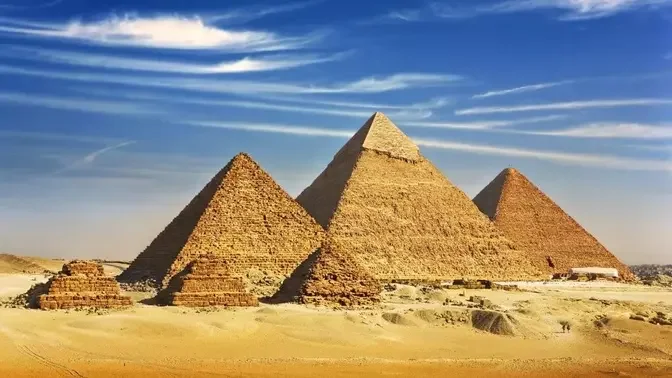
including the Great Pyramid, the Pyramid of Khafre, and the Pyramid of Menkaure,
along with their associated pyramid complexes and the Great Sphinx.
These structures were designed to demonstrate the power of the pharaoh
and the efficiency of the Egyptian administration.
It also showed the advantages of an enslaved workforce of thousands
to do the actual building over a grueling 20-year period.
Or it might have also demonstrated his close friendship
with an alien race who knocked it out in an afternoon.
I like that theory.
The Fifth and Sixth Dynasties would see a lot of construction of solar temples
dedicated to the new cool god Ra, who was all the rage with the hipsters and influencers.
The pharaohs began to portray themselves as the sons of Ra.
Say what you want, the whole god-king thing is a killer griff.
This was also about the time the pharaohs started getting tired of all the mundane tasks,
like ruling on zoning disputes,
running the sanitation department, and actually talking to common citizens.
So they gave a little bit more power to the regional governors to handle the boring stuff.
No way that would ever come back to bite them.
The last ruler of the Old Kingdom was Pepi II, who took the throne when he was six.
He made Queen Elizabeth look like a rookie,
because he would go on to rule for another 90 years.
Even more impressive, because this was a time when any guy over 40
was known around the office as Old Man.
But during Pepi's time on the throne,
or more accurately, his time in the high chair, throne, and then wheelchair,
he would see the governors gain more power,
and droughts and famines caused widespread food shortages.
Eventually, this fragmentation and the fact that everyone around the Old King
kept telling him what a great job he was doing,
would lead to the first big collapse of the Old Kingdom,
and usher in the first intermediate period.
It doesn't say exactly how Pepi died,
but I think we can make a pretty good guess that it may have been age-related.
I'm pretty sure if he'd been hit by a tourist bus,
or struck down by an assassin, they would have mentioned it.
This is the first time we see the start of a pattern.
Everything goes well, the king loses much, if not all of his power,
and the country goes to hell in a handbasket.
Then a new king finally reunites the country, and we rinse, lather, and repeat.
The dynasties continued in the north with the Heracliopolitan kings.
But nobody really cared, especially those hale-a-billy Thebians in the south.
But per usual, those folks in the south were not happy.
Since it had been a minute since they'd conquered their neighbors,
in 2055 BCE, Mentuhotep II cruised into the north
and declared himself the sole ruler of Egypt.
His reign would mark the beginning of the 11th dynasty,
as well as the beginning of the Middle Kingdom.
Seems like we've seen this movie before.
Because Mentuhotep II had just bought a new house in Thebes,
and was still way upside down in his mortgage,
the capital of the new and improved Egypt was moved there.
And naturally, everything was going great for a while.
Agriculture was killing it, there was trade with their neighbors,
and there was even a cool new god to worship.
The appeal of Osiris, god of the underworld, was that, for the first time,
average Egyptians, and not just the pharaoh, had a chance at a glorious afterlife.
With the correct combination of living a moral life, and the right rituals after they died,
even the stable boy or the golf pro at the country club had a shot at eternal glory.
The 12th dynasty was pretty much the peak of the Middle Kingdom.
It was ushered in by Anenmet I, who didn't want any part of the brutal commute to Thebes,
and promptly moved the capital again to the brand new city of, ahem, Ichtoi.
It was located near the modern city of Lisht, close to Cairo.
Not only was it an easier drive,
but it also gave the pharaohs a lot more ability to keep an eye on both Upper and Lower Egypt.
Egyptian literature reached new heights during the Middle Kingdom,
with popular texts focusing on wisdom, morality,
and the responsibilities of the king and his officials.
Also popular were Zen and the Art of Chariot Maintenance,
Tequila and Ibis, and Barley and Me.
Any guesses what happened next?
The 13th dynasty.
Egyptians saw a bunch of pharaohs whose time at the top didn't last long.
From 1759 BCE to 1695, only Neferetap I had a reign that lasted longer than 5 years,
and now the Middle Kingdom grew weak and was ill-prepared.
So what happened when they didn't rule long enough?
Wanna take a guess?
If you guessed everything was just fine and life was totally cool,
you clearly haven't been paying attention.
Without consistent leaders, local rulers, especially in the delta region,
started claiming more autonomy.
And just like that, here come the Hyksos.
The Hyksos were a Semitic people whose name literally meant rulers of foreign lands.
Good lord, you don't have to be Sherlock Holmes to know that's a pretty good clue right there.
They likely came from Canaan, which was a part of the Levant,
in what's now present-day Syria, Jordan, and Israel.
They were definitely playing the long game, arriving in Egypt as traders,
immigrants, and mercenaries, and gradually assimilating into Egyptian society.
The Eastern Nile Delta was where most of them lived, and as their population grew,
they were gradually able to establish political and military dominance,
and eventually took control of Lower Egypt in 1650 BCE.
The more things change, the more they say the same,
because here comes the Second Intermediary Period.
If Ancient Egypt were a hockey game,
think of this as the break between the Second and Third Periods.
They established the 15th Dynasty, and even though they adopted many aspects of Egyptian culture,
they were still seen as foreign rulers.
That did not go over well with the native Egyptians,
and their dominance was deeply resented by them.
But in Upper Egypt, they did a lot more than bitch and moan about the Hyksos.
The government in Thebes went on ahead and established the 16th and 17th Dynasties.
They still had to pay tribute to the North,
but they managed to hold onto a great deal of autonomy.
It all came to a head the way so many global conflicts do, with a brain teaser.
The Hyksos king, Apepi I, challenged Second Nenri Tau, the local ruler of Thebes,
with an adinitin.
That's a fancy way of saying it was a puzzle or an impossible task.
What was it?
He complained that the noise of hippopotamus in the Theban pool
disturbs his sleep in Avaris, his capital in the Nile Delta.
Why is this such a puzzler?
Because Apepi I was in Avaris, his capital in the Nile Delta, which is hundreds of miles away.
So either he's a light sleeper, or he's messing with Second Nenri.
And that was the last straw for our pal Second Nenri Tau.
He took up arms and led his army against the Hyksos,
and as so often happens when someone goes off half-cocked and looking for a fight,
it did not go well.
When his mummy was discovered in the 19th century,
it had massive head wounds, indicating he was either killed in battle or was smashed in the head.
Although they couldn't hold their kingdom, the old Sekhi Tau's family could hold a grudge.
His son, Ahmots I, was able to drive out the Hyksos,
and finally get revenge for treating his pop's head as a whack-a-mole.
In an ironic twist, his army was able to defeat the Hyksos,
using some of the same technology they brought with them when they invaded.
Things like horse-drawn chariots, composite bows, and bronze weapons proved invaluable.
Oopsie.
Ahmots the Great, as he was soon called, was the first ruler of the New Kingdom.
And he discovered that nothing united the country like a shared hatred of foreigners.
So for the third and last time,
a unified Egypt was again set to dominate the region at the beginning of the 18th dynasty.
The 18th dynasty would see something truly unique.
For the first time in Egyptian history,
a woman was able to break through the papyrus ceiling and become king of Egypt.
You heard that right.
She wasn't a queen.
She was a king.
Talk about progress.
And it only took 4,500 years.
She was technically a regent.
A regent was a mother or stepmother who handled the day-to-day affairs for kings
who were still too young to wipe their own butts.
Traditionally, the young king would take over somewhere between the ages of 14 to 16.
Technically, her stepson Thutmose III was the rightful heir.
But once she had a taste of life at the top,
when it was time for him to take over,
She ruled for over 20 years and did a pretty fine job.
She concentrated her energies on trade and architecture rather than military conquests,
and the people found out you can do some pretty amazing stuff
when you're not out there invading Nubia every five years.
She also confused most of the male population
by maintaining diplomatic relations with Egypt's neighbors
instead of constantly invading them.
But just because she was a woman didn't mean she didn't have a pharaoh-sized ego.
Her mortuary temple at Deir el-Bahari is widely regarded to be
And after her death, Thutmose III finally got his chance.
Seriously, that dude had to be feeling like Prince Charles,
wondering if his mom was ever gonna die.
There's also a chance he held a teeny tiny grudge against his stepmom.
Why?
Because the first thing he did was erase most of her images and inscriptions from around the country.
Really, dude? That is some serious little de-energy.
Everything was going swell until Akhenaten decided to start his own cult.
Polytheism was out, and the worship of the sun disc Aten was in.
Yep, a disc.
Imagine going to Italy and saying,
I know you're all Catholic, but starting tomorrow, we're all gonna worship a frisbee.
Luckily, the next pharaoh would pull the plug on that nonsense
and restore the old religious ways.
Enter the boy king Tutankhamen.
Assuming the throne at nine or ten,
even the youngster knew that Amenhotep III was awkward as rocker
and people shouldn't be worshipping a frisbee.
The rest of his nine-year reign was pretty unremarkable,
mainly because he died before his 20th birthday.
No one knows for sure, but the most likely cause was probably an ATV accident.
So why is King Tut the most famous pharaoh and the only one who's a Batman villain?
Is it his strong social media following or guerrilla marketing campaign?
It's just because his tomb's entrance sits low in the Valley of Kings,
so thieves weren't able to get in because the entrance was blocked
by leftover building material and debris.
That's it.
So then when Howard Carter discovered it in 1922,
it had most of the goodies still intact, including his golden death mask,
which is probably the most famous ancient Egyptian artifact of all time.
After King Tut came the last pharaoh to rule over a united Egyptian empire,
Rameses II, also known by the humble moniker of Rameses the Great.
He ruled for 66 years, from 1279 to 1213 BCE.
You might know him today from movies like The Ten Commandments and books like The Holy Bible,
but he was a lot more than the villain of Exodus.
He was also a serious warrior who often led his troops into battle,
including the Battle of Kadesh, fought against the Hittite Empire in 1274 BCE.
It featured the largest chariot battle in history
and featured thousands of soldiers.
Although the battle ended in a stalemate,
Rameses the Great presented it as a huge victory,
and the Egyptian people totally bought it.
Later pharaohs of the 20th dynasty struggled to maintain power,
and by the end of Rameses XI's reign in 1070 BCE,
the centralized state had collapsed, and it was time for the Third Intermediate Period.
Once again, we see a split between the North and the South,
with sketchy pharaohs in the Lower Kingdom and sketchy priests down South.
That made them ripe for invasion, and that's exactly what happened.
Libyan warlords, Nubians,
who were pretty darn tired of getting invaded by Egypt for the last 4,000 years,
shot their shot, and so did the Assyrians.
Fun fact, during the hundred years they ruled,
the Nubians had the first black pharaoh, King Pai.
I don't know how to say it, but here's how you spell it.
With a name like Pai, of course he ruled for 31.4 years.
That's right, we got history and math jokes.
Think of this channel like homeschooling for cool people.
After the Assyrians bounced, the country united again under King Samdik,
who founded the 26th, or Saite, dynasty.
The Saites viewed themselves as the restorers of Egyptian greatness,
and the people ate it up.
Shop owners would see the mega hats and hoodies fly off the shelves
as soon as they received a shipment.
But all good things must end, and in 525 BCE,
the Persian king Cambyses II told his generals not to come back
until they'd conquered Egypt.
So, they defeated the troops of Samdik III,
and soon turned Egypt into a satrapy, or province,
of the vast Achaemenid Persian Empire.
And eventually, the Egyptian people got tired of the Persians
trying to put their rugs everywhere, and in 404 BCE,
Amyrtaeus sent the Persians and their ugly rugs packing.
Eventually, the Egyptians would kick out the Persians,
but the Persians were nothing if not persistent.
They soon re-conquered Egypt,
and because they didn't want another uprising on their hands,
they cracked down pretty hard on the population,
killing and imprisoning tons of people
just for congregating with too many people,
or having their neighbor rat on them for making fun of the king's rug.
In 332 BCE, Alexander the Great,
along with his younger brother Steve, the slightly above average,
rolled into Egypt and were greeted as conquering heroes.
He was crowned as pharaoh, and since nobody was currently using it,
set up shop in Memphis, just down the street from Graceland.
Although Alex would stick around for less than two years, he got stuff done.
His most notable accomplishment was the founding of the city of Alexandria.
The bustling city was a serious melting pot,
and was home to Greeks, Egyptians, Jews,
and people from all over the Mediterranean.
It featured an extensive library, and its lighthouse,
the Pharaohs of Alexandria,
would become one of the seven wonders of the ancient world.
Alex would eventually meet the only opponent he couldn't defeat, typhoid fever.
His kingdom was divided up between his generals,
with Ptolemy I establishing the Ptolemaic dynasty and ruling Egypt as its new king.
The Ptolemies were Greek, but they adopted many aspects
of traditional Egyptian rulership to legitimize the rule.
But they still kept Greek as the official language,
leaving native Egyptian people to coin the phrase,
it's all Greek to me, whenever Ptolemy I would post a sign or give a speech.
The last pharaoh of the Ptolemaic dynasty was maybe the most famous pharaoh of them all,
Cleopatra VII.
She was intelligent, multilingual,
and she sought to restore Egypt's strength and independence
through diplomacy and strategic alliances.
Unlike some of her predecessors,
she fully embraced Egyptian culture and styled herself as the reincarnation of the goddess Isis.
But Cleopatra had one weakness.
Roman dudes.
First, it was Julius Caesar, to whom she bore a son, Caesarian.
Anyone wanna guess how that birth went?
Then, after Caesar was brutally assassinated,
she turned her attention to the Roman general, Marc Antony.
As J. Lo would discover nearly 2,000 years later,
relationships with Marc Antony's never end well, and this one was no different.
They made a plan to run off together and take the Roman Empire with them.
The Emperor Octavian was a hard no on their plans,
and dealt the lovebirds a crushing defeat in the Battle of Actium in 31 BCE.
The defeated lovers managed to escape and decided to take the Romeo and Juliet exit.
He ended himself with a sword, and she poisoned herself.
Apparently, she didn't have a sword.
Either way, she was dead, and her rule, as well as 3,000 years of pharaonic rule, was over,
and Egypt officially became a Roman province.
Good game, Egypt.
The Romans would manage to hang onto it for a few centuries,
but in 641 AD, they would be conquered by the Rashidun Caliphate,
essentially completing the fall of the Roman Empire.
Alright, that's everything.
If you liked the video, subscribe, and if you didn't, subscribe.
And watch this video over here next.
See ya.