
A Golden Age: Furniture and Decorative Arts from the 19th Century #frenantique; #antique
Jan 24, 2026
pecialists Casey Rogers and Giles Forster present highlights from A Golden Age, a sale of fine furniture and works of art from the top Parisian ateliers of the 19th century.
‘What connects the pieces in this exceptional group is the absolute exquisite craftsmanship of these top makers,’ explains Casey Rogers, Christie’s specialist.
The sale presents furniture by the top Parisian cabinet makers of the 19th century, including works by the Beurdeley dynasty, Paul Sormani, Henry Dasson, Lexcellent, and Françios Linke.
‘The best Paris-made furniture is so exquisitely crafted,’ notes Giles Forster, Decorative Arts specialist at Christie’s. ‘It combines rare materials and precious materials to create perfectly beautiful objects.’
The sale presents furniture by the top Parisian cabinetmakers of the 19th century, including
works by the Baudelaire dynasty, Paul Solmani, Henri Dasson, L'Exelon, and François Linck.
What connects the pieces in this exceptional group is the absolute exquisite craftsmanship
of these top makers.
The best Paris-made furniture is so exquisitely made. It combines rare materials and precious
materials to create perfectly beautiful objects. What I really love about this piece is just how
deluxe it is in the use of exotic materials, be it in the timbers or the hard stones with the
mahogany drawers, so representative of Dasson's work, as this is by Henri Dasson.
It was really at the end of the Belle Époque, which ended with the great tragedy of the First
World War, that was the last time when works of this quality could be made.
The Belle Époque, the beautiful period, it was a time of prosperity, it was a time of success,
affluence. This is indicative of that time and just its stunning use of materials.
These marble groups of drunken putti children reference classical antiquity,
the stories of Bacchus.
The references are there, that's for sure, but it's done in a very
late 19th century treatment of the marble itself.
This is Italian Carrera marble that would have been imported, the most precious medium for
sculpture.
The skill that was involved to create them with a lot of movement, they're extremely playful,
by the artist Benoit Rougelet.
The debauchery of the evening, which has sort of progressed to the drunken Solanus.
The clock set with the central clock and pendant candelabra is by Henri Dasson.
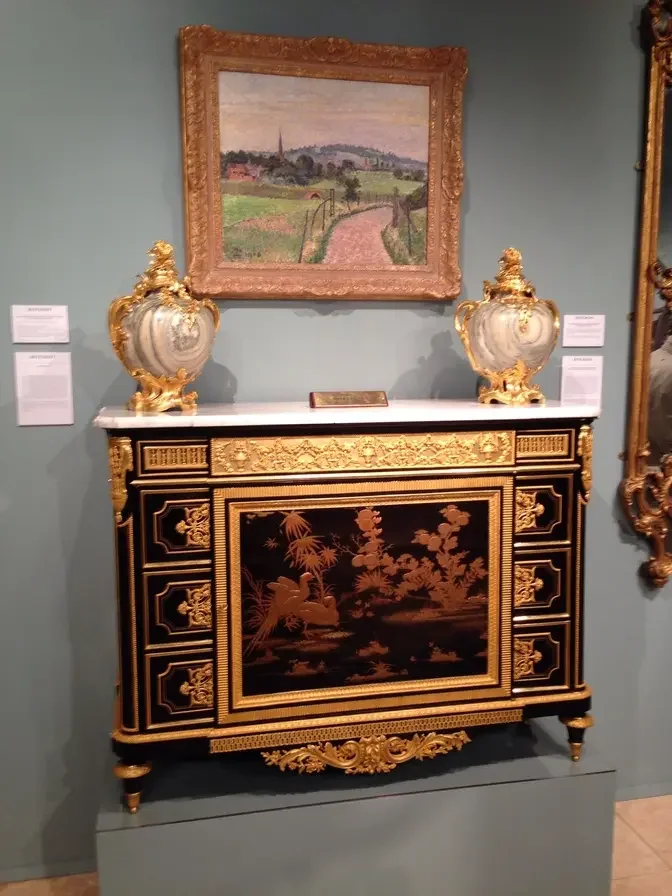
The cabinet is by a contemporary of Dasson's, Lexolon.
And these lacquer panels with crazing and craquelure to look as they've been aged and
made bowed to fit this cabinet like a glove.
Here, if you can believe that after 150 years, this drawer still closes with a swoosh of
air, it's so wonderfully made.
These two here, though wildly different in design, are actually by the same maker and
foremost retailer, Escalier de Cristal.
Their variety was unmatched in the Paris market.
So this magnificent mantle clock is by one of the greatest makers of the period, the
Baudelaire dynasty.
Steeped in mythology with this goddess and diaphanous drapery, the cupid, topper, and
of course we have a signed work again.
Here it's very easy, of course, to identify the maker.
It's proudly displayed in the title beneath the dial, A. Baudelaire for Alfred Baudelaire.
These maker's marks is all part of the process and it makes it extremely rewarding for us
as specialists when we are able to discover just who has made these pieces.
What makes each individual piece special and different from the rest are those small hallmarks
for each specific maker.
And what I find so wonderful about this category is that there's still objects that transcend
time and space and could be seen in any contemporary interior today.