
Tour of One of the Most Iconic French Chateaux: Vaux-le-Vicomte - with its Co-Owner.
1K Video Views·Aug 2, 2023
Exclusive Tour of one of the most beautiful French Chateaux, guided by Alexandre de Vogüé, co-owner of Château de Vaux-le-Vicomte.
You will discover the story of Nicolas Fouquet - Superintendent of Finances of the king Louis XIV - who built this castle with 3 artists: Louis Le Vau (architect), Charles Le Brun (painter and interior designer) and André Le Nôtre (for the garden).
Welcome to Volvicomte.
Imagine we are here in 1639
and a young guy is standing here in the middle of the nature.
Forest, hills, rivers.
There's absolutely nothing but pure, rough nature.
And this young man has a dream.
A dream to have one day the most beautiful house ever.
He's standing here next to one of his friends called André Le Nôtre,
the famous landscape designer.
And he wants Le Nôtre's advice for the future property.
So he's got a dream.
He's barely 25 years old.
His name is Nicolas Fouquet.
And I'm going to tell you a little bit about his story.
So Nicolas Fouquet is an ambitious man.
He wants to be as close as possible to the world power.
And he's also, and above all, a lover of arts.
He's an amateur.
He's a collector.
And he wants to have a house where he will show,
for himself, but also for his friends,
his taste, his wealth and his influence.
But something will happen that will stop his project.
A war, a civil war called the Fronde,
where the powerful people in France are fed up with the tax pressure
and want to overthrow the king.
The king at this time is Louis XIV,
but he's very young and he's a young child.
And 10 years will pass before he will have the opportunity
to gather around him the best artists of his time.
So I'm going to jump a few years after the civil war.
We are in 1652 and finally he can work with these artists
and he will give them what any artist would dream of.
A blank canvas of 1200 acres,
lots of money and freedom.
Freedom to do whatever they want,
but with two conditions that have to be fulfilled.
First, they have to work hands in hands.
And second, they have to be as innovative and bold as possible.
Nicolas Fouquet wants to break with the canons and habits of the ancient time.
Louis XIII's taste is already old-fashioned for him
and he wants something new,
something that would blow the mind of everyone.
Ten years later, in 1661,
Volvicont appeared and everyone is going to be blown away
by the beauty, the harmony of this place that is unique in France.
So I told you about this young man, Nicolas Fouquet.
Ambition.
And yes, he is a very ambitious man.
He wanted to be a good friend of the king.
He is actually a good friend of the king
because of one main reason.
He remained very faithful to the prime minister at the time,
who was Mazarin,
and to the mother of the king, Anne of Austria.
And he was very faithful during this civil war
and he defended them against the powerful people of France.
And that really touched Anne of Austria and the king.
And Mazarin, the prime minister, appointed him as minister of finance
to gratify his loyalty to the king.
So the first objective of Nicolas Fouquet was fulfilled.
He was a very good friend of the king.
He was the most powerful person after the prime minister Mazarin in France
as minister of finance.
And he was building, creating,
what is going to become the masterpiece of the 17th century.
A masterpiece that will soon become the model to get inspired from.
So here is a portrait of our host, Nicolas Fouquet.
And as I was telling you,
he was this ambitious man that wanted to become the next prime minister.
But next to him, there is another man called Jean-Baptiste Colbert.
He is the personal assistant of Mazarin, the prime minister.
And he also wanted to become the prime minister.
Except that he's got Fouquet in his way.
And Fouquet is this flamboyant, intelligent, charming person
that is way more successful than him regarding the opinion of Louis XIV.
So Colbert, in order to get rid of his rival,
is going to convince the king that Fouquet is the bad man.
That Fouquet is stealing money.
That Fouquet is raising an army to overthrow the king.
And he will be quite successful.
Those three artists were the best artists of their time.
Le Nôtre, the landscape designer.
Le Vaux, Louis Le Vaux, the architect.
And Le Brun, the painter, decorator.
They were all with Fouquet in the mid-40s when they were working at Vaux-Vicomte.
So there was really a bonding of friendship between those four men.
And Fouquet was this extraordinary master of organizing,
to organize in the best way and most efficient way possible
the work that had to be done in a very reduced time.
Fouquet was in a hurry to show to the king Vaux-Vicomte at his best image.
So we are on the 17th of August 1661.
The party is going to be the most beautiful party of the century.
And Fouquet invited the king, his mother, and the whole court is there.
And finally his dream is achieved and he can show the beauty of Vaux-Vicomte.
He is in an ecstatic state.
But all of his friends, his best friends,
Molière, La Fontaine, Madame de Sévigné,
are telling him, be careful Fouquet.
There is a man that wants you dead.
And this man is Jean-Baptiste Colbert.
Jean-Baptiste Colbert convinced the king three months before this party in May 1661.
And they both decided to put a plot and to get rid of Nicolas Fouquet.
Nicolas Fouquet will be arrested right after the party in September 1661.
There is going to be a trial that will last three years and not three weeks
as Colbert and the king thought it was going to last.
And he is going to be sent to prison for the rest of his life.
What Fouquet left us is Vaux-Vicomte,
this home that was going to become his main house.
And this home has been inhabited for the last three centuries and a half by a family,
always, non-stop.
And that is what we want to show today.
It is the home of Nicolas Fouquet.
And look at this beautiful room.
This is an angle room, a cabinet, le cabinet des jeux,
where Lebrun, the painter decorator,
designed this absolutely ecstatic piece of decorations with flowers, with gold,
and with this fresco.
And I really want to show you this fresco where an historian told me about his theory.
And if you look close, there is the squirrel, the coat of arms of Nicolas Fouquet.
There is right of the squirrel a snake, which is the coat of arms of the Colbert family.
And just below the snake, there is a lion, which symbolizes the king.
And we have here the three main characters of our story.
And this historian was telling me that it might be a subliminal message
that Lebrun, the painter, would have painted on this ceiling
to tell Fouquet about the danger of Colbert chasing him
with the king controlling the situation.
I like the story, definitely. I'm not sure that it is accurate.
For the little anecdote, you know that my family,
we had the immense privilege to live in this chateau.
I was a small kid at the time, and I have to say I don't have much recollection about it.
But this room was used as our dining room.
So we were living on the first floor, but we were using some of the rooms,
some of the stately rooms of the ground floor for our own use.
Imagine, it was just magical.
So our objective is definitely to preserve this house,
to maintain this huge property, which is the largest property in France,
classified as a historical monument, so private property,
which makes it the most costly to maintain.
And to help to fulfill this mission, we have, and my parents had created
and funded the Association of the Friends of Vaux-Vicomte.
And one of the last furniture that we bought, again to show the decor
and the furniture and the ambiance of this house of the 17th century
as nothing had been left because the king, after the arrest of Nicolas Fouquet,
took absolutely everything, 150 statues, 200 tapestries, and all the furniture.
So each family had to refurnish the house.
We continued this, and one of the last pieces of furniture
that the Association of Friends of Vaux-Vicomte bought
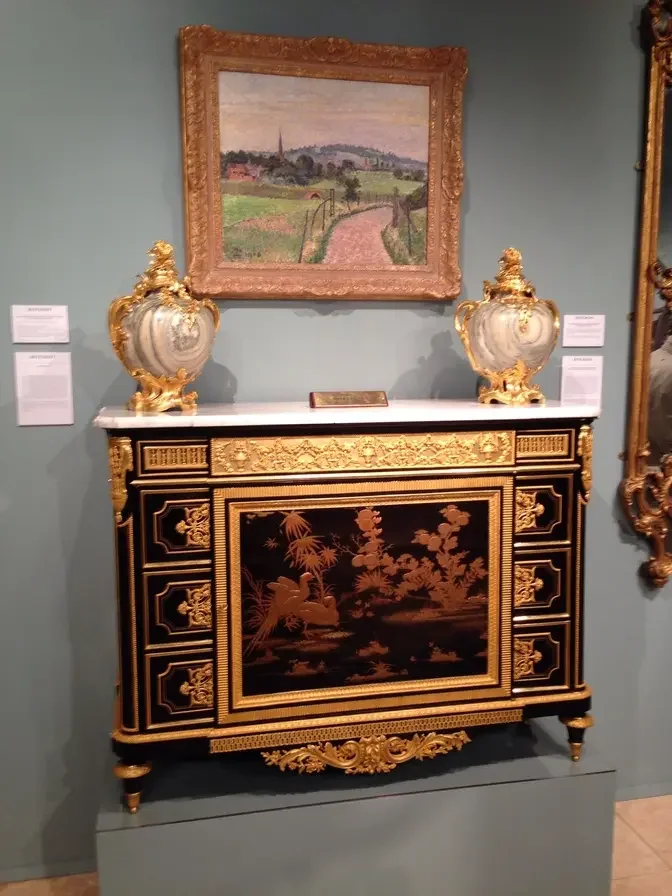
is this beautiful cabinet that I wanted to open for you,
just for you to have a look inside.
So I would like to open this cabinet to show you the exquisite work of art
that has been done at the time.
So inside, you've got those two doors with some image of a garden.
Someone told me, well, this is kind of a bit of a squirrel.
I don't think that's a squirrel. It's more of a rooster or something like that.
But anyway, and then a theater in three dimensions with the perspective
and the trompe-l'oeil and with some mirrors on both sides to make it wider
and some lots of different, let me see.
Oh yeah, I think it opens like this.
So a lot of hidden, you know, drawers here that you would have no idea
that they're there if you don't know the trick.
And then I think there's something here, another drawer,
this beautiful balustrade made of bone, you know.
And then if we open this simple drawer, but here we have a chest.
So this is the kind of thing that artisans were spending hours, days, months
to create those masterpieces.
And for the owner to show his taste, his wealth, he was installing this.
It was not very useful.
Perhaps they would hide some mails, some letters or some jewels,
but it was above all to show to the guest, you know,
the wealth and taste of the owner.
So the idea here at Vaux-le-Vicomte is to create the atmosphere
of the home of Nicolas Fouquet.
And as everything, all of his collection got scattered around the world
after his arrest, after being in the Louvre and Versailles,
the idea is to find the maximum objects, items of his collection
around the world and to have one day an exhibition here at Vaux-le-Vicomte
of the part of his collection.
That would be absolutely extraordinary.
It will require a lot of work.
A friend of my father called me and told me about this tapestry
that he had seen in Atlanta, USA, in a lobby of a big company.
And he sent me the picture of this tapestry thinking that perhaps
it was part of this series of tapestries that we have here at Vaux-le-Vicomte.
And we made some studies and it was part of this series.
So we made an offer to the company and we bought the tapestry,
we made it restored and here it is.
So I'm standing here in the middle of the Grand Salon
and on my right there is the arrival of the guests that we can imagine
on the night of the 17th of August 1661.
They are arriving by the courtyard, the Honor Courtyard.
And then they are walking up the stairs and Nicolas Fouquet
and his wife Marie-Madeleine de Castille are standing at the top of the stairs
waiting for the king.
This is not something one should do.
You don't wait for your king at the top of the stairs.
You go down the stairs to meet your king and to greet him.
Well, Nicolas Fouquet was kind of drowned on his own ambition
and thought that he was so powerful that he could do that.
But the king didn't like that, I have to say.
Then they crossed the vestibule, crossed the Grand Salon
and looked at the absolutely fantastic observatory point
where we are here towards the garden.
So there is this transparency of the doors that allowed us
from one point in the Grand Salon to have an amazing image,
look towards the whole perspective of the garden.
This year we are going to restore this room.
This room is the Nevragic centre of the château.
It has an amazing 400 square metre cupola, so that's almost 1500 square feet.
There is this not very interesting painting from the 19th century
because it has been restored in the 19th century.
But there is a fresco that Charles Le Brun had to paint.
Unfortunately, because Nicolas Fouquet got arrested,
he didn't have time to do so.
But the Louvre still has the preparatory drawings of Charles Le Brun.
So we are going to use those drawings and to create a mapping video,
so a projection of those drawings onto the cupola
to show to the visitors what this fresco was about.
So it's a giant fresco.
It is going to be surrounded by those terms, those fantastic sculptures.
There are 16 of them all around the Grand Salon
representing the four seasons on the south and north
and then the 12 months with the zodiac sign on each of these sculptures.
Those sculptures are going to be restored as well at the very beginning of 2021.
And hopefully at the end of 2021, beginning of 2022,
we will have the extraordinary surprise to have above us
the fresco of Le Brun that was supposed to be painted in the 17th century.
I would like to show you a small detail, but I love this detail,
it's the shutters.
The shutters are painted on the inside of the room,
but not just on the inside, but also on the outside.
How elegant is that?
You are standing outside the house and you can see the decoration of those shutters
with the double F of Fouquet with the cross of love
indicating both of the letters.
So this is, I think, the elegance that people had at the time.
You just paint your shutters not on one side, but on both sides.
We are now standing in the king's bedroom.
You know that at that time the king was travelling a lot towards his provinces
and if you had a nice house, you had to have a room dedicated to the king
if he wanted to spend the night there.
And Fouquet, being a good friend of the king,
he not only dedicated one bedroom, but the whole apartment.
Antichambre, chambre, cabinet.
So the whole east part of the ground floor of the château is dedicated to the king.
I want to show you, not that the visitors can do that,
but I will give you this privilege to have a closer look at the bed of the king.
To tell you the truth, the bed and the whole alcove
had been restored by my father in the year 2000.
And we asked some companies and artisans to do and to recreate
the embroidery that exists on this bed.
And you just have a look at the exquisite, again, work that had been done
by this French company that works with Indians in India
because they are the best artisans to do this kind of work.
And the passementerie here, along the wall,
which are maybe half a centimetre thick of gold and silver strings.
This was, again, the kind of detail that one loved to have on his bedroom.
One of the most exceptional pieces of the furniture that we have at Vaux-le-Vicomte
is this commode mazarine.
We have a pair, and it is my great-great-grandfather who bought them.
They are unique in the world, and they are by Charles-André Boulle,
the famous cabinetmaker.
And Charles-André Boulle made those two chessboards
at the very early stage of his work, at the very end of the 17th century.
And it has been used as a model for the one that exists today at Versailles
that had been done for the Queen, and that is in the Grand Trianon.
So this is the kind of level that Fouquet would have,
the kind of perfection of artisan, of craftsmanship,
that Fouquet would have in his home.
So we're very proud and very honoured and privileged
to have that kind of furniture at Vaux-le-Vicomte.
So we are now on the second floor of the château,
and I want to show you the top of the château, the highest elevation.
So there's a few stairs, small and narrow, to climb.
And before going to the top of the roof,
I would like to show you something that I don't show to anyone.
So I just have to climb here a little bit, open this door,
and please follow me.
Don't you love those sounds of an old house?
And there's this wooden box that is sheltering something
that is quite unique here.
Let me just find the light.
Here we are.
Unfortunately, it's not working today
because we have our craftsman, restorer, François-Simon Fustier,
who is someone that is following us and taking care of this clock
for the last 20 years.
He has to pass soon to relaunch it.
But this is the little shelter that I guess my great-grandfather created
to protect the system.
And look at the beauty of this paper,
you know, very old-fashioned paper
that has absolutely nothing to do with the rest of the château.
But I love this little room.
I love this little room.
Before the last door, going again some stairs,
but to have this view on the structure,
the beam structure of the dome of the château.
So we are right below the dome,
and we are right above the cupola,
the cupola that I was telling you about
and the fresco of Charles Le Brun,
where the cupola is right beneath our feet.
And we are surrounded here by our forest.
You remember the forest of the poor Notre-Dame de Paris that had burned.
Here we have our little forest made of beams from the 17th century.
So we are very proud of having this, again,
another masterpiece of Louis Laveau, the architect that designed this structure.
Last steps of this escalier en collimaçon,
don't tell me how you translate this,
that will give access to the top of Vaux-le-Vicomte.
So we are here at 70 feet of altitude,
above the garden,
and we have here the very obvious design that Le Notre and Le Vaux,
so the landscape designer and the architect,
designed together the house and the garden.
So the house is built on the axis that is running south to north,
and the house is at the top of the mise-en-scène, of the setting.
Wherever you are standing in the garden,
you will always have a view of the château that is dominating the scene.
And the visitors, without knowledge of landscape designing or architecture,
they love Vaux-le-Vicomte because the setting is extremely simple,
because beauty comes from simplicity,
and they can understand very soon where they are standing in the estate,
and where everything is organized along the central axis.
What we can see as well is the ephemeral ribbons,
those aluminum planks that had been designed by a French artist,
Patrick Hourcade, last year.
Why? Well, it began with another drama,
the one where we lost all our boxwood.
That was two huge parterres of embroidery boxwood from the early 20th century,
and because of the disease, because of the box blight,
we lost all of our boxwood.
We had to remove them,
and we put up this call for proposals towards artists, designers and landscape designers
in order to create something new,
but to create something that would integrate perfectly into the rest of the estate.
And unanimously, the jury chose those ephemeral ribbons,
and there is this wonderful compliment that we've been receiving quite regularly since,
telling us it looks like they've been there forever,
and that is exactly what we want.
I think Patrick, the artist, had the intelligency and the humility
to step back from the masterpiece that is Vol Vicomte,
and to create something simple
that is actually the main line of the embroidery boxwood that exists just before.
So he took the main central line of it and made it in aluminum,
where the sky is getting reflected on those plates,
as well as the pools where the sky is reflected by the water.
So we really have the same optical illusions that Le Notre created 350 years ago.
Le Notre