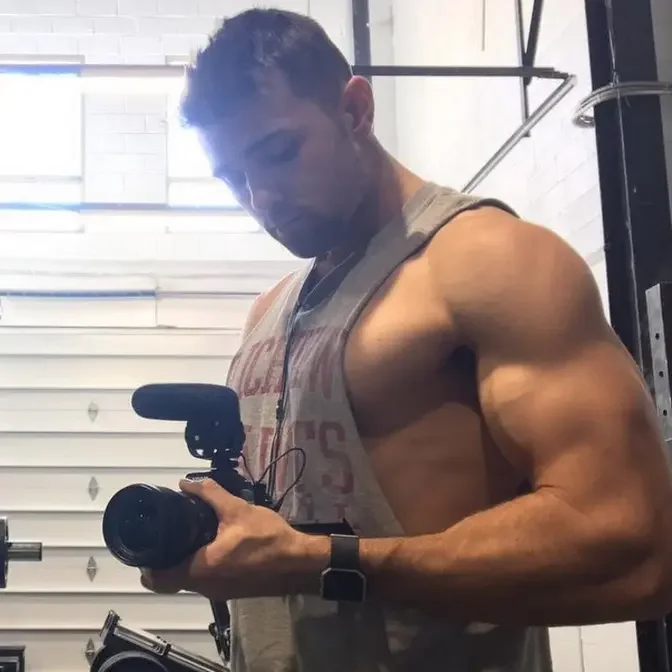
Want to lose body fat, get lean, and build muscle without constantly eating less food?
In this video, I'm breaking down how I use nutrition with my online fitness coaching clients to help them lose fat, maintain muscle, and achieve sustainable weight loss results.
Getting lean isn't just about cutting calories, eating smaller portions, or doing more cardio. It's about understanding how to structure your diet, prioritize protein, manage hunger, and make smarter food choices that support your fitness goals.
We'll cover fat loss nutrition, calorie deficits, high-protein foods, meal planning, flexible dieting, and how to eat for fat loss without feeling hungry all day.
Whether you're trying to lose stubborn belly fat, improve body composition, build lean muscle, or finally stop yo-yo dieting, these nutrition strategies can help you make long-term progress.
After helping over 5,500 people transform their bodies, we've learned that the best fat loss diet is one you can actually stick to.
Coach Josh explains how to use food as a tool to build muscle and lose fat without starving. He emphasizes a balanced, data-driven approach over restrictive dieting or \"cheat meals,\" focusing on protein targets, calorie ranges, consistent movement, and simple meal planning to ensure long-term sustainability and avoid the \"skinny fat\" look.
What up? Coach Josh here, your online fitness coach
who's worked with thousands of people,
created amazing transformations.
And today I want to show you how I use food to get my clients to
lean, to put on more muscle, and to actually look good.
If you're just starving yourself,
you're going to end up looking horrible.
You're just going to end up looking like a skinny fat
version of yourself. And today I just want
to lay out how to avoid that, cut out all the nonsense,
and give you like a full presentation on how I do this for my clients.
Totally free. I'm letting you behind the curtain,
showing you exactly what to do.
So show up for yourself, pay attention to this,
and let's transfer over to my computer.
So let's jump right into it.
Honestly, as a coach, like I said, with over thousands of
personal transformations,
there's just so much bad information out there. And I just want to
give you the actual formula you're going to need to succeed
and how I get amazing transformations
just like this. And then most importantly, how I use food as a tool.
Too many people look at food
is a problem. Food is a good thing.
It's just restructuring your relationship with it. I'm
going to show you exactly what you need to focus on.
None of the nonsense and four simple steps.
So first things first, getting lean just means eating less.
This is the myth. This is what you've been told to believe.
It's to starve yourself out, to be good
to stop eating good food.
It's not going to actually change anything for you. If anything,
it's just going to end up making you look worse.
Immediately, we need to change this mindset.
And on the flip side of that, you'll get a lot
of people saying food is fuel. You should eat as
much of it as possible. You can make
your physique look pretty trash by eating whatever you want.
So let's dive into it a little bit more.
So food, as I mentioned, is a tool and you want to use it
Use it intelligently.
And the best way to start is with your protein intake.
Ideally, the easiest rule of thumb
is you wanna build your protein intake up to one gram.
per lean body weight of your goal.
So if I'm 220 pounds, I want to cut to 210. And I feel that
is my lean physique, I should be eating about 210 grams of protein.
So naturally, you're going to
want to work your way up to that goal amount of protein,
because protein is going to actually
help you be more full with your food.
It's going to help you put on more muscle during this process.
And it's most importantly,
can allow you to keep more muscle as you begin to lose weight.
Next thing is calories as a range.
So I think where a lot of people go wrong is they'll say,
I'm dieting. I'm going to starve myself.
And they'll just slash the calories. And all my
calculators have their place.
And people like to assume, OK, if I use this, it's accurate.
But it's going to be so different for someone
who has a lot of non-exercise activity thermogenesis.
And what that is, the fancy way of, as you can see,
I talk with my hands. Some people are always
bobbing their head. They just can't stop moving.
Those people are inadvertently going to burn more
calories. If you're a commuter and you drive an hour to work,
that's a lot less movement.
Then me, perhaps, who will walk 20 minutes to my workplace.
So all of these things come into consideration.
That's where calculators aren't the most ideal.
Instead, when you start, start with the range,
like kind of just start tracking to where
you feel satisfied.
If you think of a scale of hungry, satisfied, full.
Find that point of satiety
and then from there our goal is going to be to about decrease calories
by about 20 to 30 percent from that marker.
So if I'm eating 3,000 calories at a point of
satisfaction my weight is level at that amount.
Quite simply if we're doing 20 percent we would
drop it 600 calories so it would be at a 2,400 calorie daily intake.
When you give yourself a
little bit of flex like this and you stay rigid at least in that range
but you do have some freedom
On those days you're starving and it's just a tough day,
you have an ability to eat a little
bit more. On the days where things are easy,
things like just a busy day, a typical day,
it's meal prep, you can eat to that lower end of that range.
So now that we've kind of got an idea
of how we're eating to support this goal, we want to look at our steps.
So steps is a really easy
way to regulate out your movement.
If we can establish a solid baseline each day, for most
Most of my clients I recommend 8,000 steps.
And 10,000, if they're able to do that quite regularly,
it's just a really good baseline
to ensure we're getting an adequate amount of movement in.
And we can kind of baseline out
our activity to support our other goals.
Now, the biggest one is just making it simple and making it easy.
Where people go wrong is they get way too exotic.
They do all these funky things.
They're eating like pickles with mustard wrapped
in like a piece of ham or something like just
ridiculous stuff.
And like those hacks have their play.
But like for me,
Typical days, I'll have Greek yogurt with some berries, some oatmeal.
For me, there's no thought behind it.
I know exactly what it is.
I can track that in daily.
There's just no confusion around it.
So the more you can have these static meals...
The better of a position you're going to be in.
You're removing friction, you're removing
guesswork, and it's going to allow you to
stick to these four categories to actually use food as a tool.
So once again, like slash and suffer, and I'm going to go over this.
If you're just slashing your calories
and just minimizing everything, suffering, starving
yourself, the natural opposite end of that,
the binary of that is you just going off the
deep end, letting loose and having a break.
And that's where I'm not a fan of that at all.
You'll notice how I didn't talk about cheat meals
because even with that.
If you're starving yourself, you're nuking your hormones,
and then you're having a ton of food
one day, you're spiking your insulin,
it's going to be so hard for you to regulate and actually be
consistent. And if you're one of these people
who wins Monday to Thursday, and then the weekend
comes and you blow it all out,
you're suffering four days to loosely celebrate three, not even a
healthy way to live in remorse on Monday.
And this is the worst way to live. And I've been there,
it sucks. I hate when my clients come to me
in this because I'm like, why do you need to do this?
If you use those four tenets and you have a range
and you go out to an event that you think's cool,
you can go to that event, you can enjoy it,
you can celebrate it, you can have something fun,
but you can have it within balance and you can stay on track.
There's no remorse, there's no
friction. Then you forge this identity of like,
oh, this is something I can do long-term.
So what I like to do in terms of how I track
this is I track this on my tracking spreadsheet.
I do this every single day for myself and then my clients.
And week to week, I'll adjust their calories
as necessary. And I'm going to look at the week as a whole.
One-off days are not a good picture.
If you have one good day of eating and six trash days,
your week was trash. It's the sum,
right? The sum matters more than the part.
So that's where it's really important. You're
zooming out with this data
and you're making changes week to week. This also prevents you
from doing things drastically where one day you feel skinny.
So you start eating more calories.
And then the next day you feel fat.
So you cut more calories from there.
It's just such a messy cycle.
So the more we can track this,
be aware of our adherence, be aware of if we're actually
progressing to our goals.
And if we're not, have that ability to readjust.
This changes everything.
And being accountable to those numbers is most important.
For my clients, like I said, I check in there all the time.
I'm actually going to put it on the screen.
I messaged one of my clients.
I said, hey, I noticed we had a really big day eating.
What happened there?
And she's like, hey, I just had one day after dieting
for three months and crushing it.
I wanted to go a little bit on the higher end.
I thought, why not?
Screw it.
She did it, immediately felt bad about it.
And she's like, I'm so happy you caught me on this
because it wasn't worth it.
And I actually feel way better in my other form of eating
and really this identity that she's taken so long to forge.
So this is something I'm so passionate on here.
And being able to do this
and being able to do it consistently, it's not hard.
All my clients are like, wow,
I didn't realize this was so easy.
I've seen so much success.
Why was I struggling before when I can approach it?
from this bigger position of balance
and really setting out that goal. This is how you can use
food intelligently and not suffer to it.
So I just want to show some examples as well
of how you can also reintroduce calories after this.
So once you put in that work and you lose
that weight, you have that opportunity
to actually reintroduce food by way of a reverse diet.
There's a high level technique I use
for my clients where effectively when you're dieting,
your body thinks it's starving, it's suppressing hormones,
it's trying to fight that effect of it.
But when you reintroduce that, the furnace starts,
ghrelin and leptin start to kick in.
So how satisfied you are with food when you diet actually goes down.
So once that starts to improve, you become more satisfied
and you feel less of a desire to eat tons of food.
And just the next side of that, how hungry you are during the day
becomes a little bit easier as well.
You'll notice that will suppress, become better,
and you'll reintroduce more calories at a lower weight.
And from here, this gives us a really
great opportunity to put on more muscle.
So this is one of my client examples, and you can see from week one.
Calories to week 16,
we got eight pounds lost during this time while adding 550 calories
and relatively keeping protein the same.
But obviously, as our goal of our lean muscle went up,
we naturally bumped up our protein
goal to adjust.
So now that we're in the long game.
You can see too, when you have a big journey like this,
if you have a lot to lose,
stop trying to rush it. When you rush it, you're going to fail.
There's a reason we have a weight
regain problem, not a weight loss problem.
If you're watching this, you've lost weight before,
it's putting it back on that's messing you up.
So zoom out, be accountable to it. This is how
I get my clients to lose weight and keep it off.
So what I want you to do for your next 14 days,
set that protein target, hit it every day, non-negotiable.
There's no reason you can't do this.
Get in front of it.
One thing I say as well to all my clients
is no one's putting food in your mouth.
If you track it before you eat it,
you can actively see, am I on track for my goal or
am I behind?
And you can make adjustments on the fly to actually see success.
The next, find those static meals
that are going to be successful for you.
Play around with it.
See what's going to be your token meal that's high protein,
consistent, easy, low friction.
I like smoothies.
I like Greek yogurt.
I love Pro Oats.
Chicken and rice is always an amazing one.
Beef and potatoes is another favorite of mine.
Whatever's going to work for you.
Don't crash your calories.
Go back to what I said earlier
and actually just start at that point of satiety.
Drop it from there and begin to see change.
Then naturally create a system to actually hold you accountable
to the data that's in front of you.
And once again, if you want help with this,
this is something I do for all my clients and I take
all the hard guesswork out.
So if you want to work with me, you can DM me ready to my Instagram
at ColossusFit. Say you came from this video,
I'll give you a special deal to make that happen. But
like I said, I'm just tired of the bad information.
So I really wanted to get some good information
out between eating and food and just give you guys some value.
So thanks for tuning in. If
this helped you smash like
Peace out, let's get some results.