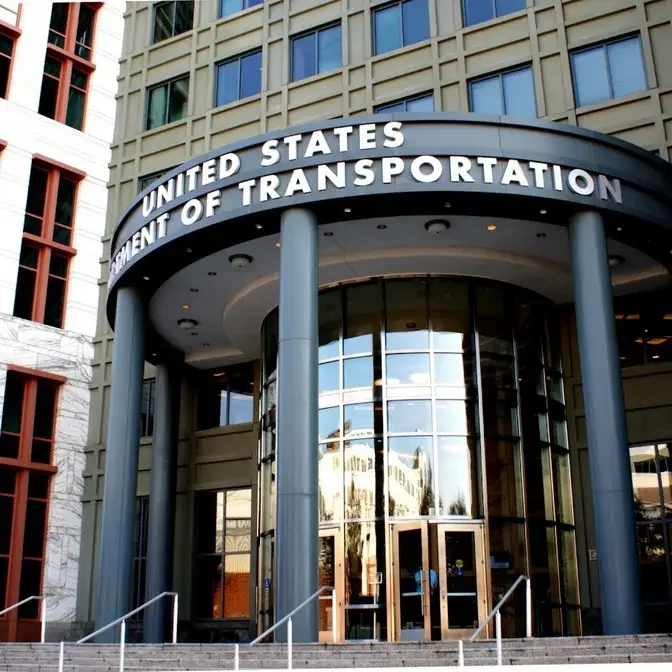
U.S. Transportation Secretary Sean P. Duffy, Federal Aviation Administrator Bryan Bedford, and White House OMB Director Russ Vought are calling on Congress to put American travelers first and fully fund a Brand New Air Traffic Control System (BNATCS). Building on the Trump Administration’s historic $12.5 billion down payment from the Working Families Tax Cut, Secretary Duffy is leading the charge to replace legacy equipment neglected for decades—a critical mission underscored by last Friday’s nationwide ground stop.
To deliver the world-class, resilient aviation network the American people deserve, the Trump Administration is requesting $50.1 billion to transform our skies from the ground up: $10.1 billion for next-generation digital architecture, resilient telecommunications, and controller safety tools; $10 billion to overhaul outdated airport infrastructure; $10 billion to modernize aging airport terminals; $10 billion to build five new consolidated Air Route Traffic Control Centers to replace 22 deteriorating facilities dating back to 1969; and $10 billion to construct and upgrade up to 140 air traffic control towers across the nation.
AI Generated·May contain errors
Video Summary
AI Generated
Sean Duffy discusses a recent airspace shutdown caused by a technical router failure during a network upgrade. He outlines a comprehensive plan to modernize America's aging aviation infrastructure, emphasizing that safety outweighs travel inconvenience. The strategy involves replacing obsolete analog systems with a resilient digital mesh network through bipartisan funding and strategic domestic manufacturing.
Hey everybody, Sean Duffy here. Administrator Brian Bedford is with me.
I just want to cover a couple topics
and I'm happy to take your questions.
First off, I had a great conversation with the senators today.
They had a lot of questions,
a lot of interest in our proposal to modernize the airspace.
Probably a little longer than I anticipated,
my first Senate lunch, but the engagement is fantastic
and I know over the next couple days they are going to work through
What they think is the right approach,
the right funding levels to make sure we have the resources
to address the needs in the American airspace.
I want to do three things.
I want to talk about what we know about what happened on Friday.
I want to talk about what's happened
with the $12.5 billion in modernization.
And then talk about the ask that we're making right now
to this Congress before the end of the year.
And so some of you have reported on this, but just want to reiterate.
We had...
A routine switchover from an analog copper wire,
switching it over to digital fiber.
Now, this was a line that was going to be decommissioned.
These lines are so old, they were going to put it out of service,
so this work had to be done.
When we did the switchover,
what we now know is that it started to create issues in our network,
and it created instability.
And we saw that we were having issues
with communication between air traffic and our pilots,
and then we saw issues in our radar feeds.
And it's because of that that we made
the extraordinary step to shut down the airspace.
And I just, on a side note,
I was just out with the families of Flight 5342.
And I think it's important
to understand how serious we take aviation safety.
My first full day on the job was with those families.
Thank
We want to make sure that we do everything we can,
that the story is people were inconvenienced
versus families are having
a different conversation about the loss of a loved one.
That's why we don't take any risks.
So in regard to what we did after the airspace was reopened,
you.
we were able to take control
of the router that was our issue.
By the way, this was the 69th.
The installation of that router, 68 times it worked well.
This one, the router started to broadcast into our network
and it started to overload the network.
So we have it, or L3Harris, who is the owner of our network
and they monitor our network, run our network, they have it.
We went to their facility with the router in Florida.
So at that facility is L3Harris.
HP is there, Cisco is there, the FAA is there,
and I called Kash Patel and I said, you know,
there's a lot of things happening right now
that all of us don't know where it's coming
from.
And I've been told by our national security three-letter agencies
that we weren't hacked.
But I think it's important that we have all precautions,
so I asked Kash to send me part
of his FBI team to be part of the analyzing of this router.
We've been able to recreate what happened in El Dorado.
But the root cause of what happened, we don't have clarity yet.
And I promise all of you that when I
know what happened with that router,
injecting that overload into our system,
I will most definitely share that with you.
If we were subject to a hack, we will share that with you as well.
But all of my intelligence partners
are telling me that wasn't the case.
But again, we have the FBI there partnering
with us as we work through this analysis.
Let me tell you a little bit about the process.
And I'll take your questions, I'm sure, on that, that you have later.
I want to talk about this $12.5 billion.
Billion.
Since I had this job, I've been pounding
the drum about the need for investment in aviation.
That we, we've.
We've neglected it.
Our system is old.
It's showing its age.
We have to make the investments.
And Congress gave me a historic down payment of $12.5 billion.
I've heard some people say, well, you haven't spent the money, right?
Where's all the money?
So let me just explain that to you all, what's happening here.
Thank you.
The Congress gave us very specific categories
in which we had to spend the money.
And so because our airspace is so big,
we have so much equipment in the airspace,
and I can't go to, say, a Best Buy and just take it off the shelf.
We actually have to order the equipment,
and then the companies that get the contracts,
they actually have to build the equipment
for us to then take possession.
The senators in here would have
been very annoyed had I prepaid for the equipment.
So I only pay when they deliver.
So we've had a lot of radios and voice switches
and surface awareness systems that have been delivered,
but not all of them.
So I still hold some of that money.
Good example is we haven't we haven't built radar
in America for 30 years and I thought that if
we're going to have a historic buy for radar we should build
those radar in America with American
workers and so the companies that got
the contract they set up facilities in America one in Florida
one in Kansas and they're building those radar they have
a contract for us with us to purchase
the radar well I haven't taken the delivery of those radar yet.
In a few months, I'm going to, and when I do,
when I receive them, I'll pay for them.
So all of the money hasn't left our account
and gone to those who won in the contract.
I only am going to pay when they deliver.
And I think the point here is all the money has
been set aside for this mission of modernizing the airspace.
Thank
It's all going to be done in two and a half, two years from now.
This has this has never been done.
To be clear, we are keeping planes safe in the sky
you
and we are switching out equipment. It's been a problem for decades.
very
I and the president have decided we are going to lean in and fix it.
It's a little complicated,
but we are doing great work and making great progress.
much.
So as part of this new ask to Congress,
I want to talk about that, then I'll take your questions.
Part of it is, I talked, we're switching this old network,
this new, this old architecture
from copper to fiber, right, from analog to digital.
But it's an old architecture. We need
a new mesh network that is, that is state of the art, that's resilient.
I've asked for money to
build that new network. And the Congress is very interested in that.
The software that we use to manage the airspace
was developed in the mid-90s. It works, it's
functional, but the advancements in software,
if we are able to go out develop and buy it,
it's going to give us far greater safety
and far more efficiency in the airspace.
And it's time, it's been 30 years,
it's time that we make this investment. On top of that,
The newest, so we have towers, TRACONs, and centers.
The centers, which controls
the upper altitude airplanes, we have 22 of them.
Do you guys know the newest one was built when?
The newest one that we have was built in 1969.
That's how old this stuff is.
We have old towers from the 60s, old TRACONs from the 60s.
I'm asking the Congress to, as part of this historic investment,
invest in that infrastructure.
We have a country that's grown and expanded.
Our people go to different places.
We've seen growth in a lot of our cities.
I want to invest in their infrastructure.
Some of them need new runways.
We need money for some of our airports.
So this is what I wanted to do is I wanted
to put everything on the table.
I wanted to show it all to them.
I know that Congress will work its will.
They'll pressure test it.
They'll look at it.
And they'll make a determination
and a decision on what they see as their priorities.
But the current trajectory that we're on right now,
if I stay on this course,
I will replace every single tower in America in 300 years.
In 300 years.
So we have to do something different.
I'm willing to take the heat, the pressure, to dive in.
Administrator Bedford, he's right here,
has done a fantastic job on modernization.
He's got a great team.
We're all working together to make sure people stay safe.
And we have the right equipment and technology in our airspace.
We're not going to let up.
We're going to continue on that mission.
And I hope that the Congress joins us at this really important time.
One last point, then I'll take your questions.
I don't want to start this work in six months, eight months, a year.
The time is right now,
and what I love about what's happening is I'm talking to Democrats
and Republicans in both chambers, and this is about America.
This is about American airspace, and they're all pretty engaged.
What they're going to do, I can't tell you.
I don't think anyone can tell you what the Congress will do,
but they're all very interested
in making sure we get the right investments here,
and that's a great sign for all of us,
everyone who flies, everyone who's leading the project at DOT.
And with that, Brian and I are willing
to take your questions that you may have.
30 seconds, 30 seconds.
I know you don't want to do this in a piecemeal fashion.
I don't.
No, we don't.
However, if that's the only way Congress will get this through for you,
are you willing to separate the most safety-critical components
of the system to get the funding to be?
I'm already in a piecemeal approach.
The $12.5 billion was piecemeal, right?
And so, yeah, I'll take what I can get.
And I will work with the Congress to make sure that we do.
The highest priority is first,
and I would hope that they don't do that to me,
but I'll take what I can get, and I'm going
to build with whatever they give me.
Yeah.
Just kidding, just kidding, just kidding.
Yeah.
There's millions of people who are playing.
I don't know.
I've just been watching your show.
I don't know.
What guarantees can you make that they won't face the same destruction?
I haven't seen it.
No one has seen it.
Okay.
Thank you.
So when we pulled this router out that was broadcasting
You're welcome.
I'm going to have to go now.
Alright.
I'll see you later.
into the network, it took longer than I would have liked
Take care.
Yeah.
Bye bye.
Okay.
to identify that router with L3 Harris who monitors our network.
Bye.
Thank you.
Bye.
Bye.
Brian and I are working through other procedures
Thanks.
Bye.
Bye.
Thanks.
that we can have a belt and suspenders approach.
Bye.
Bye.
Bye.
Bye.
But now we've isolated the problem.
I think the airspace is going to operate like it has over
the course of the last years and decades.
But I will tell you that I'm not going
to take a risk with anyone's life.
I will not do that.
And so if we see an issue,
I want people to get safely to their destination.
I don't want to see disruptions.
We're working on delays and cancellations.
But when the rubber meets the road.
Safety will always come first for the administrator and me.
There are even some Republicans who say that someone in the
administration should be held accountable for what happened on Friday.
Will anybody be held accountable
in the administration for the groundwork?
Well, to be held accountable, you have to look at,
I mean, listen, this network dates back decades.
It's decades old, right?
It's what I inherited and Brian inherited.
And this is the first time that you've had, and many
of you will cover this, I've been talking about it for two years.
And so we are well on our way in transforming what we were given.
If I could just give you...
If someone did something wrong, they should be held accountable.
Um, but
But Brian and I do not apologize for shutting down the airspace.
I'd rather have the disruption story versus the story
and conversation I have with 5342.
But I want to tell you how quickly we're moving,
and I don't want to throw darts at anybody,
but the last administration was able to transition 19%
of this old network from copper to fiber
or analog to digital, 19% of it in four years was transitioned.
In one year, we've done over 50 percent.
So we're moving at a different speed
because we think the moment is now to actually fix
the system.
And we put a lot of effort
and energy into making sure people are safe and our networks
actually work.
So you've done more than the first organization?
Sorry.
We're still talking a lot about the urgency and the speed.
But there have been many, including the government agency,
that are saying we're moving too fast
and too little coordination to avoid any difference.
I appreciate that.
I've listened to all of you.
I've listened
to all of you.
And some of you will say I'm moving too fast.
Some of you say I'm moving too slow.
Maybe I'm Goldilocks and I'm going just right here.
We will not go faster than what the safety mission would allow.
We are moving at the right pace.
But I'll just tell you, the longer we stay on an old,
rickety network, the less safe it becomes.
So we do have to charge forward.
We do have to get this work done.
Otherwise, staying on the old system for longer is going to mean more
risk as opposed to fix the system and you're going to reduce the risk.
And by the way, build a new network, even less risk.
But that new network I mentioned,
the new architecture, I've talked to AT&T.
Lumen and Verizon, they have committed to make
this a national priority, which is great on their part.
We believe that with their counsel, we can do that in two years, which
is, for the FAA and the partnerships that we get, is remarkable speed.
That American telecom is going to offer us
to deliver on behalf of the American people.
Secretary, just to be clear,
are you asking Republicans to pass this funding request on party lines?
Why not also meet with Democrats when you're going to need their votes?
That's a great question.
So I have met with Democrats.
I've spent hours on the phone with Democrats.
Get along with them well.
They understand this issue.
By the way, I'm not talking about this just because of Friday.
I've been talking about this every month.
I bring it up to the Democrats and Republicans.
How the Congress is going to do it,
I had the privilege of serving in the House for nine years.
I'm not going to tell them how to do their work.
But I'm telling everybody what we need.
I'm making a nice ask, and I'm going to let them work their process.
And whether it's on a party-line vote or if it's a bipartisan vote,
I do think this is one moment in a very charged political environment,
one moment where almost all Americans
and bipartisan members of both bodies
are kind of in agreement that we should lean in and do it.
So how they do their work, we'll watch that together.
Mr. Secretary.
Thank you.
So I'll let Brian speak in a second on that.
So L3, so my L3 Harris contract that I inherited was given in 2002.
It was given, not 2022, it was given in 2002.
So they've had it for 24 years. They, in essence, own the network.
They contract out all the work in the network,
and then they also monitor the network.
And so one of the problems I have when they have that kind
of that kind of vendor lock with us, I'm going to have to work with them.
And I'll tell you, they do a lot of work in the
government, a lot of work in the government.
We'll
We need to make sure that they're going to be good partners.
They put the best minds or they hire better minds
to make sure we get better performance from them.
be
And we are going to mandate that.
right
And as I mentioned, it's not just what they're going
to do in the service to the FAA and the American people.
We are going to look for, and we're talking the last couple of days,
who else could we bring in to monitor this network?
back.
Because when you do some of these switches,
everyone who has done a network switch, small things can happen.
But you need to monitor your network
to be able to quickly identify and isolate.
That they didn't identify and isolate, that concerns me.
So we have to have them perform better,
and then we're going to look at bringing some outside help in
to make sure we have belts and suspenders.
Mr. Secretary, can you talk about
a little bit about what you told us about the FAA?
Let's go.
Yeah, your first question was on the router.
So we had installed, again, this was the 69th.
And 68 had gone really well.
This is the one that started to behave this way.
So we thought it's only prudent to pause the use of these routers,
which, by the way, the
administrator would tell you that we spent
a year in our tech center in New Jersey testing
these routers.
And so there is a lack of clarity of why
the router was able to have this impact on the
network, and we are working on that the last several days.
And I can't wait to get the answers, and I'll share that with you.
With regard to Starlink,
I've worked well with Elon,
and Starlink was a great solution for some of our assets in Alaska,
but we sent Starlink in one of its prior iterations to our tech lab,
and there was some issues that we had to navigate,
and we thought that the best method is to have
a network that's based in the ground.
Now, I think what he's doing with Starlink and the speed is...
Mr. Secretary, can you talk
a little bit more about what's going on in the United States?
Mr. Secretary, can you talk
a little bit more about what's going on in the United States?
Mr. Secretary, can you talk
a little bit more about what's going on in the United States?
Mr. Secretary, can you talk
a little bit more about what's going on in the United States?
Mr. Secretary, can you talk
a little bit more about what's going on in the United States?
Mr. Secretary, can you talk
a little bit more about what's going on in the United States?
Mr. Secretary, can you talk
a little bit more about what's going on in the United States?
Mr. Secretary,
can you talk a little bit
more about what's going
on in the United States?
Mr. Secretary, can you talk
a little bit more about what's going on in the United States?
When I got here with the plane crash on my first day,
I asked the question, we have to talk about aviation, and I wanted
to know what are the problems that we have in the assets that we run.
And what I was told was everything is a problem
because it's all really old because there hasn't been investments.
So what I'm saying is this system actually works,
right, but it's old and it's shown its age.
And we're seeing that in a number of different places.
But does our telecom network still work?
It does.
But how long does it work?
I can't guarantee you that, but it works now.
And just a side note, we spend, the Congress spends,
gives us $800 million a year just for obsolescence.
So it's actually safer and more cost effective to do this build.
But, yes, if I have taken my eye off the ball,
I've never taken my eye off this.
I have been focused on this for two years.
Like, no other secretary has ever been focused.
And I think every interview that I've had with anyone's network,
I'll talk about this very issue.
And even when I got the 12 and a half billion,
I was talking about how much more we need to finish the job.
So, to take accountability, when I have issues in the network,
right, it's a network issue,
I inherited an old network,
I don't want to blame anybody for that, but that's what I
was passed off, I didn't create that network,
I didn't develop that network, I did not invest
in that network, but that's what I got,
and I did the job of telling all of you that,
and telling you how I was going to invest and fix it.
In regard to shutting down the airspace, Brian did a great job.
His team did a great job.
Thank you, Bob.
Again, there was a lot of disruption.
And for the American people that were stranded in airports,
especially the families with children,
I've been in that situation.
And my daughter was stranded all night with her new baby in California.
She slept all night with her baby.
I heard about that as well.
It was hard for people.
But I would rather have that story than the other story that we didn't
do our job and we let risk into the system, but we kept flying
because then all of you would say, why didn't you shut it down?
Why didn't you make that decision? And if that was what I had done
and something bad had happened, that would be my fault.
That would be my fault. That would be Brian's fault.
And this is an important point to the American people.
We
We take their safety so seriously that we'll take extraordinary
precautions, like we did on Friday, to make sure they're safe.
I'll take one more question.
Talk a little bit about it.
Thank
Are you looking at...
you
very
Uh, come on in.
How the FAA tested the routers before installing them.
much.
We're going to go about focusing.
Insulation process.
That's a lot of Brian's. I'll let Brian go first, and I'll come second.
Thank you. Andrew, there is a comprehensive risk management process
with every installation,
and that installation happens whether it's
with a contractor or with an FAA employee.
There's always some oversight in each facility.
So in this case, we had an L3 Harris, highly trained,
certified engineer, former Air Force veteran.
I'm told a generally competent guy doing the work that he's done dozens
and dozens of times before.
He was monitored by an FAA technician, a member of our past union,
and the deployment went
the way it's gone thousands of other times before.
It is unique that this Juniper router was being used.
It was the 69th installation.
Historically, we've been a Cisco to Cisco business,
And I think where we're at today, we don't know the fault trigger.
We do know that this router could be enabled to do what it did.
We thought we had that technology turned off.
We thought we had it disabled in the configuration.
We've seen nothing in how the configuration
on that device was changed by the installation.
So there is some uncertainty that we have today
as to how the configuration changed in a way
that allowed this multicasting to become effective.
No, no, I'm not saying that. I don't know. What I'm saying is we have
been able to duplicate the situation that triggered this. We've
been able to duplicate the fact that it could be reanimated in a way.
The configuration could change. We just don't know how it did it.
Again, every element of this is going
to be analyzed to see what we learn here and make
sure that it doesn't get repeated.
And meanwhile, we have suspended the use
of this particular router and we've disabled
the ones that are out there.
So yes, I feel highly confident that we won't repeat
this level of disruption, but I'll
also repeat what the Secretary said.
We had a series of the best FAA career executives walking through
this system in real time.
As we saw instability in the enroute environment,
we had not lost anything.
We were on our backups, then the primaries would come back,
then the backups would spring in.
So we were seeing this.
Unexplained activity, about an hour into this diagnosis,
it started to trickle into the terminal environment,
which is a completely different system, and at that point,
I asked the carriers, are you 100% certain that we
are safe now as we were two hours ago, and I didn't get a yes,
and we made the decision to suspend putting more airplanes in the air.
We had not lost any service,
we still had contact with all the aircraft, but I was
un-
I was not comfortable continuing to launch aircraft
into that environment where we had
uncertainty.
And so we made the difficult decision to draw
an inconvenience to the traveling public in
order to absolutely ensure their safety.
I think that's the missing headline here.
We will ensure that the system is safe
and people can fly with confidence.
And I'll fly and my family will fly with confidence.
Brian, is there any indication this could be in other routers or beyond
the 69 that this problem could be hidden somewhere else in the FAA network?
So, as the Secretary said, in the five years preceding,
you know, us coming into the market,
the FAA has been changing out these lines habitually,
and they were up to 18, 19 percent
of those lines had been switched before we got here.
It's true, we've moved at a much
faster pace. Well, why is that? One, we got funding.
You know, the FAA in the past was
trying to fund this, you know, with, you know,
change that it was finding in the couch cushions.
So it was doing what it could with the limited funding that it had.
A significant amount of funding, and we were told to go get this done.
And we have gotten it done,
and we will be off the TDMI system by the end of September of 2027.
Do you believe that the $12.5 billion
was enough to change all of those systems over,
or do you need more money beyond
the $9.5 billion that has not been spent?
Well, the original ask in May of 2025
that Secretary Duffy asked Congress was for $31 billion.
There's been a lot of speculation that AI might be...
Yes there has. It's completely unfounded.
Can you talk to people who are worried that AI implementation might
be the reason why the plan is grounded?
I absolutely can. First of all,
I invite all of you to come over to our Smart Center at the DOT.
So if you haven't been there,
and I know many of you have, please come over and see it.
But what you'll see is a fantastic use
of AI taking in over 200 different data streams,
providing predictive analytics around weather,
And it's making suggestions,
and then you're going to see every one of the data analysts
that are using the system pick up a phone
and call our command center and ask if they
would in fact put this flight plan into the system.
It's done manually.
It shouldn't be, but that's the way we are today.
So the two systems are not connected.
Anytime we move a trajectory recommendation
from the smart system into the NAS,
it goes manually, gets data entered into the ERAM system.
This is, this is, this is, this is.
We've seen a lot of conversations about AI and how it's gotten out
and affected different parts of other companies.
This is predictive analytics.
We have a tool that will give us predictive analytics
on trajectories and on weather.
We take a feed in, but we don't feed anything
from this system back in to our network.
If there is any communication from the intelligence
that we get from this predictive analytic tool,
actually our people in the smart lab will call.
Our command center.
So they're not even connected.
The phone call is made to go,
do you think you can speed this plane up
or slow that one down?
That's our suggestion.
And they'll decide whether to accept it or deny it.
So I've heard all of the speculation,
but that is not true.
I want to thank you all for coming
and let you know that we, at this moment,
with this FAA, we are building...
With the money that was given,
we've got great contractors that are giving us equipment.
We are working to keep every single American safe,
not just today, but for the next generation,
because this is a historic generational investment.
I'm going to continue to work with the Congress,
bipartisan, both sides, working on this.
The president, even though he's overseas
and you guys have followed him, he's been engaged.
He called me from the plane on the way over talking about this.
phone calls as well while he's on this trip.
This is very important for him too. And we're
going to continue as we get new information off
of what happened on Friday. We commit to sharing
that with you. I think transparency is key.
This is the very last thing I'll say. The three-letter
agency said this was not a hack.
I think every single American is looking around at all the
All the different things are happening.
To different companies and then would say, well,
it doesn't make sense to me how this you guys couldn't be part
of what was happening since since Thursday and happening even today.
And all I can tell you is the our intelligence
community community has said that is not your problem.
That's not your situation.
But also, I'm I'm concerned about what what does what
do the American people think?
Which is why Kash Patel has sent his team to us from the FBI.
And we do have that team looking
at this because if there is a possibility,
we want to make sure we have the right people, the right intelligence
from the FBI assisting us to see it
because they have the expertise to do that.
So even though I said they told me it wasn't
a problem, I still asked Kash.
Kash came in and they're providing us the assistance.
And so we are going to have answers for you.
When I have those answers, we'll share them.
And just as I close, I want to thank Brian for his work.
I want to thank the Senate today.
They were very engaged.
Thank
They can be fiery, too, sometimes, pointed questions,
but it was a wonderful conversation with them about where we're at,
what we want to do,
and I hope they take under serious consideration our proposal.
you
God bless you.
very
much.