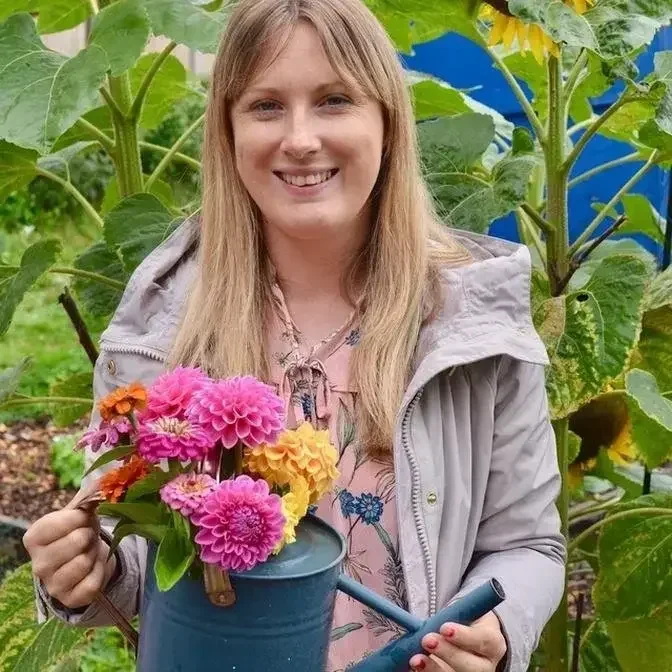
Emma shares her experience and practical tips for creating a wildlife-friendly allotment in South London. She emphasizes that inviting diverse nature balances the ecosystem, reducing the need for pesticides by allowing natural predators to manage pests. She encourages gardeners to be patient and accept that nature and food production can coexist harmoniously.
Hey everyone, welcome back to my allotment channel.
My name is Emma.
This is my allotment plot in South London.
And in today's video,
I'm going to be talking all about
how you can create a wildlife-friendly allotment plot.
If you enjoy this video, don't forget to subscribe,
give me a like, and leave me a comment below,
letting me know what you do on your allotment plot
to make it wildlife-friendly.
I've always enjoyed the wildlife here on my allotment plot.
It's one of the big reasons
why I've stuck with it for so long.
As much as I love growing my own vegetables and flowers
and seeing all the plants grow,
I also really enjoy being submerged in wildlife and nature.
I've learnt so much about the wildlife
just by being around it and observing it.
And I have to say,
it's just one of my favourite things about the plot.
I think it's quite easy to be afraid
of inviting more wildlife onto your allotment
and trying to grow your own food.
It doesn't always feel like they kind of go together.
Sometimes when we think of more wildlife,
we think of our crops being destroyed and eaten.
And it's something that we've got to protect against.
I actually think the opposite is true.
The more diverse the wildlife is
that you invite onto your allotment plot,
the more you balance out the ecosystem
and they kind of take care of each other.
Aphids can be eaten by ladybirds.
Birds come down and eat the slugs and snails.
Foxes will come and eat the slugs as well.
So the more you kind of invite onto your plot,
the more they kind of balance each other out.
It definitely doesn't happen overnight though.
So if you are hoping to invite more wildlife on
to kind of balance out your ecosystem
and to have all the pests kind of eat each other,
give it time, be patient.
It can take a few years and it's not always foolproof.
You will always have one pest one year
that takes over something
and that you just cannot get on top of.
Before you go reaching for all those pesticides
and trying to protect everything with wire and mesh
and all sorts of things,
see if there is a more wildlife-friendly way
of taking care of your crops
while also allowing wildlife to kind of bloom on your plot.
Wildlife can be so wonderful and so magical to watch.
And after all,
these spaces don't really completely belong to us.
It belongs to nature as well.
So the more we can encourage nature and wildlife
onto our plots in a way that works for all of us,
the better.
Here are some of the ways that I encourage wildlife
onto my allotment plot here in South London.
Firstly, I have a wildlife pond,
which I have rebuilt twice
to try to make it as wildlife-friendly as I can.
This was the first year where I actually had tadpoles
in my pond and frogs, which is incredible
and means that it's all working.
Right, so one of the crucial mistakes that I made
when I first made this pond
was that I created a shallow end and a deep end,
like a swimming pool.
Apparently wildlife don't really like that.
They don't want a deep end where it's just deep.
They want the shallow end around the whole pond
and it to get deeper towards the middle.
That's what they want.
So I built it like for a human,
for a very, very small, for a borrower.
And what I should have done
was build a wildlife pond for wildlife.
And that's what I'm gonna try and rectify.
So before, this end here was sort of shallow
and it got deeper towards this end.
But now what I'm gonna try and do
is make the shallow end around the perimeter of the pool
and it to get deeper in the middle.
I'm keeping kind of the general sort of shape of the pond
because I quite liked it,
but I am gonna make it a little bit bigger.
So I redid my pond over the autumn time last year.
So this new pond has been going on my allotment plot now
for one year.
I have lots of plants planted around it, mainly bulbs.
So this plot is really thriving in the springtime.
I get lots of tulips and irises come up
and it's a really, really beautiful space.
Not just for wildlife, but also for me as well,
just to observe and to look at.
One of the things I would change
if I was gonna dig this wildlife pond again,
which I'm definitely not, twice is enough,
is I would double up the pond liner.
Because even though it is specific pond liner
for a wildlife pond, you do still get holes in it.
So I would definitely double this up.
You know what, this is the only time
I'll ever be able to tend to take a bath in my own pond.
So we might as well take full advantage.
Here we are, taking a bath in my own pond.
Wow, it's lovely.
Right, so this is where we are so far.
So the idea is that the whole,
all the liner will be covered with rocks and growth.
And I'm not really worried about it growing
because it always grows up really well
and becomes an overgrown, weedy mess.
So this will be covered in overgrowth in no time.
I also do need to put some rocks inside the pond.
What they need is a little beach around the outside.
So the best water to use to top up your pond is rainwater.
It's a little bit green because it's been sitting
in a bucket for a very long time,
which does mean it has algae in it and probably pond weed.
But this is what I'm working with.
Right, I'm sure that you can see
that although the pond is very similar,
it's a lot bigger and it's a lot deeper.
And you can just see, you can just tell
this is a much better wildlife pond.
All right, so we'll just pop them in.
Same way you plant anything, really.
In they go.
This one's cool, isn't it?
I like that one.
Is that a root or a plant?
I can't decide.
And then what we need to do is put some rocks around it
so the soil doesn't just fly out the pot.
Small rocks would obviously be better,
but I don't have any, so I'll just put in what we've got.
Yeah, that's better.
That's better, I think.
Any creatures that sort of end up in here
can kind of get back out.
That's a really good start.
I'm really happy with that.
Oh God, oh God, I found it.
There's more.
Oh, there's more.
I don't think I should touch the pond.
I don't think I can be trusted.
Oh my gosh.
All right, I've got my hand over the reflection.
That is a tadpole.
That's not the one I saw yesterday.
This is much smaller.
It's a much smaller tadpole.
Don't you eat them.
Don't you dare.
Oh my God.
Oh my God, is that a frog?
Oh my God.
Oh my God, oh my God, oh my God, oh my God, oh my God.
It's a frog, it's a frog, it's a frog.
Oh my goodness.
Oh my goodness, they've turned into frogs.
They're teeny tiny little baby frogs.
Oh my God, there's a frog.
Guys, I can't tell you.
It's not even gonna focus for too long.
Oh my goodness, because it's so hot.
There's a frog, there's a frog.
There's a baby frog.
Oh my gosh, and I just, I saw like two more,
but they've literally gone back under the water.
Oh my goodness me.
Baby frog.
Oh, you're so beautiful.
You're so perfect and beautiful in every way.
See that?
So, so, so, there it goes.
Did you see that?
I very much hope I have convinced you
to dig yourself a little wildlife pond,
whether that be on your allotment plot
or just in your back garden.
It's so worth it.
Another thing that I do for wildlife
is I don't tidy up as much as I used to in the garden,
especially over the autumn time.
I tend to leave areas to get a little bit overgrown.
If I'm collecting leaves,
then I will leave some to pile up.
And I do leave things like old pallets about
just so everything's got a place to hide.
And I even allow the fox to have a little den
in the corner of my allotment.
Not the most common thing to see on an allotment plot,
anybody kind of encouraging foxes,
but they've got to go somewhere, haven't they?
In this kind of bramble jungle here,
this is where the fox comes
and he has his little nest in there
and he did have some cubs in there at one point as well.
And yes, foxes can be quite destructive here
and they do dig in my beds.
But like I said,
if you're going to start encouraging more wildlife,
then you have to be open to all the wildlife.
You can't just shut out one entire species
because you think it might be damaging.
I sometimes have to put mesh over some of my beds
if I've got new crops in them
because the fox and the cats love to dig in them.
That's something that I do just to protect new beds.
But I definitely do encourage all wildlife.
And I just think,
if you're going to encourage wildlife in general,
then you have to kind of encourage all of it.
You can't pick and choose which wildlife you encourage
and which you try to get rid of.
You might not be able to see this
because it is covered in weeds, unfortunately.
The bindweed just took it over this year.
But under here is a wildlife-friendly fence.
It's a dead hedge and it's just a fence
which is made up of loads and loads of sticks
and branches and logs.
It's great for birds who are nesting.
It's great for insects to hide in.
It's just a really easy way,
if you've got loads of branches or sticks on your plot,
of using it up in a way which is really wildlife-friendly.
I love flowers.
Flowers are so important on an allotment plot
if you're growing food
because you need to encourage all the pollinators.
So I'll grow things like spring bulbs and cosmos and dahlias,
but I will also allow more wild kind of flowers to come up
like Californian poppies and borage.
Sometimes it's those wild flowers that pop up in a pathway
or on the edge of a bed
that actually the pollinators seem to prefer.
I always think just leave them and allow them to flower
so the pollinators can enjoy them.
And of course, there are those dreaded slugs and snails.
Now, if you really want your plot to be wildlife-friendly,
there's no point putting down all those nasty pellets
that are not only gonna kill the slugs,
but they're gonna kill anything that comes along
like a hedgehog or a fox
and eats the slugs that have been poisoned.
So those nasty pellets are a real no-no.
So what can you do instead?
Because I know firsthand how frustrating it can be
when all of your crops are eaten by slugs.
I have tried many, many natural slug and snail defences.
In fact, I've probably tried all of them,
and I have to say the best defence
is to use lots of those defences in one go.
Don't just put down eggshells.
Put down eggshells, straw, porridge.
Try to use as many different methods as you can.
That is the best way to deter them.
If they are a real problem,
then it's always a good idea to allow your crops
to grow as big as they can in a safe place
like the greenhouse in a pot before planting them outside.
Plants do know they're gonna be eaten by something,
but the bigger your plant is before you put it out,
the more chance they've got of being able to survive
a little bit of a nibble.
So grow them as big as you can before you plant them out.
That's the bird again.
That's Einstein again.
Einstein is my little Robin.
If you are new to this channel
and you're wondering why I'm shouting Einstein out,
he's a little Robin that comes to visit me,
and I just love him.
I hope this has given you some inspiration
as to how to encourage more wildlife
onto your allotment plot.
Thanks for watching.
Don't forget to give me a like,
and I will see you in my next video.
Thanks for watching.
Bye.