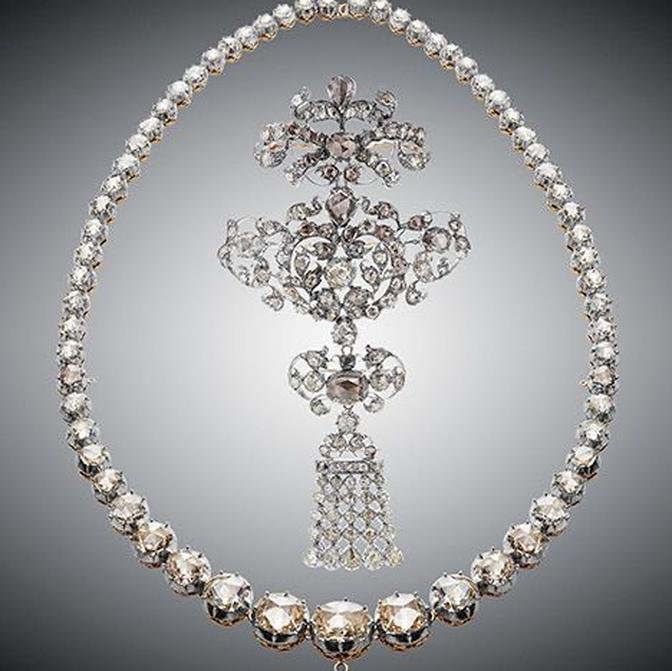
MOST EXPENSIVE ROYAL JEWELS | The Record-Breaking Crown Jewels Ever Sold at Auction What makes a royal jewel worth $36 million? Why did a single pearl worn by Marie Antoinette become the most expensive pearl ever sold? And how can a simple ring containing a lock of the queen's hair sell for 50 times its estimate? In this video, we explore the most expensive royal jewels ever sold at auction—treasures that belonged to queens, emperors, princesses, and royal dynasties. These are not just extraordinary gemstones—they are priceless pieces of history whose stories transformed them into record-breaking masterpieces. From Marie Antoinette's legendary pearl pendant to the Wittelsbach-Graff Diamond, the Henckel von Donnersmarck Emerald Tiara, and the famous Poltimore Tiara of Princess Margaret, every jewel has a remarkable journey. Featured Royal Jewels & Record Prices: Marie Antoinette's Pearl & Diamond Pendant — $36.2 million (Sotheby's, 2018) Marie Antoinette Hair Ring — $444,000 (around 50× estimate) Marie Antoinette Diamond Bracelets — $8.2 million (Christie's, 2021) Wittelsbach-Graff Blue Diamond — $24.3 million Henckel von Donnersmarck Emerald Tiara — $12.7 million (most expensive tiara ever sold) Beau Sancy Diamond — $9.7 million Princess Margaret's Poltimore Tiara — £926,400 Baroda Pearl Necklace — $7.1 million Empress Eugénie's Diamond Bow Brooch — $10.5 million (private sale to the Louvre) Anglesey Diamond Necklace — $4.8 million The Duchess of Windsor Jewellery Collection — over $50 million These extraordinary jewels survived revolutions, wars, royal scandals, and the collapse of empires—before astonishing collectors with record-breaking auction prices. Which royal jewel would you bid on?
AI Generated·May contain errors
Picture a small box, packed in a hurry in the summer of 1791,
while a mob pressed against the gates of a Paris palace.
Inside it, a single pearl, a great grey drop the size of a thumb,
hangs beneath a bow of diamonds. The woman who owned it would be dead within two years.
The pearl would vanish for two hundred. And when it finally surfaced again,
in a Geneva sale room in 2018, the auctioneer expected it to sell for one, maybe two million.
It sold for more than thirty-six. No pearl had ever fetched so much.
No jeweller queen had worn ever would again.
Welcome back to Jewelry Pleasure. Thank you for every like and every comment you leave,
they genuinely keep this channel going. Today we're chasing the royal jewels that
walked into the world's great auction rooms and walked out having broken records.
The pearls, the blue diamonds, the emerald tiaras and the little rings that sold for 50 times what
anyone guessed. If you love this kind of story, subscribe and tap the bell so the next one finds
you. First, one thing worth getting straight, because it changes how you read every number
that follows. The most expensive jewels ever sold at auction are not royal at all.
The CTF Pink Star went for over 71 million in Hong Kong in 2017. The Oppenheimer Blue took
57 and a half million the year before. And the Blue Moon of Josephine, despite the imperial
sounding name, has no crown behind it whatsoever. A Hong Kong tycoon bought it and named it after
his young daughter. Those are spectacular stones. And that's all they are. What you're
about to see is different. These jewels rarely have the biggest gems. What they have instead
is a name attached. And as you'll see, a name can multiply a price in ways a flawless diamond
never can. Marie Antoinette's Pearl and Diamond Pendant. The record. So let's start with the
pearl from the box. It's an 18th century pendant. A large natural drop pearl, slightly irregular,
hanging below a diamond bow set with a single oval diamond added later.
Nothing about its size alone explains the price. The story does. When Louis XVI and Marie Antoinette
prepared to flee the besieged Tuileries in 1791, her jewels were packed up and smuggled out of
France, carried to Brussels by Count Mercy Argento, then on to Vienna and into the safe
keeping of the Austrian Emperor, her own family. Marie Antoinette never escaped. Her daughter,
Marie-Therese, the only one of her children to survive the revolution, eventually received the
jewels and passed them down a single private line, the Bourbon-Palmer family, where they sat unseen
for roughly 200 years. Then, in November 2018, Sotheby's put the pendant up in Geneva with an
estimate of around 1 to 2 million francs. The bidding stopped at over 36 million, about 18
times the high estimate, and more than three times the previous record for any pearl, Elizabeth
Taylor's La Peregrina. A Sotheby's specialist called it the Marie Antoinette factor at work.
The buyer stayed anonymous. The pearl had outlived the queen, the revolution,
and the dynasty that hid it, and nobody outside that family had laid eyes on it in two centuries.
The rest of her jewels, the Bourbon-Palmer sale and the ring with a lock of hair.
The pendant didn't come up alone. It was the centrepiece of a single sale, royal jewels from
the Bourbon-Palmer family, and the rest of that evening tells you just as much about what a name
is worth. Every one of the hundred lots sold. The total reached around 53 million dollars,
more than seven times the high estimate, with bidders calling in from 43 countries.
It became the highest-grossing royal jewel auction in history, and the smallest pieces
produced the wildest results. A modest diamond ring, monogrammed with the letters M.A. in rose
cut stones and holding a lock of Marie Antoinette's hair, had been estimated at 8 to 10 thousand
dollars. It sold for nearly 444 thousand, about 50 times its estimate. A three-strand
necklace of her natural pearls took roughly two and a half million. Three years later,
a separate piece came up at Christie's, a pair of diamond bracelets, three strands, 112 stones,
kept in a faded blue velvet box marked, in old script, Bracelets of Queen Marie Antoinette.
She'd bought them herself in 1776. They sold for over eight million, the highest price ever paid
for a diamond jewel with her name on it. The diamonds were lovely. They were never the point.
The Wittelsbachgraf diamond, a crown jewel, and a re-cut that outraged the experts.
Now to a stone that broke a record and then started a fight. The Wittelsbachgraf is a deep
greyish-blue diamond of just under 36 carats, dug from the collar mine in India centuries ago.
It belonged to two sets of crown jewels, Austrian and Bavarian, and sat at the centre of the
Bavarian royal crown from 1806. The last time the public saw it, it was glinting at the funeral
of King Ludwig III in 1921. Then it disappeared into private hands. In December 2008, Christie
sold it in London for more than $24 million, a world record for any diamond at the time.
The buyer was the jeweller Lawrence Graf, and then he did something that horrified the historians.
He had the stone re-cut, shaving it down by several carats to sharpen its colour and clarity.
One celebrated diamond cutter called the decision the end of culture.
A German museum director compared it to painting over a Rembrandt. Graf was unmoved. He said he'd
simply removed the blemishes and revealed the stone's true perfection. A few years later he's
reported to have sold it to the Emir of Qatar for something like $80 million. The crown it once
anchored no longer exists in the form Ludwig III knew. The diamond, slightly smaller now, does.
The Beaux-Saintes, 400 years, four crowns. Some stones pass through one royal house.
The Beaux-Saintes passed through several, and it's a pear-shaped, double rose-cut Golconda
diamond of just under 35 carats with a resume that reads like a tour of European power.
It sat in the coronation crown of Marie de' Medici in 1610. It moved to the House of Orange.
It glittered in the English crown jewels under William and Mary. It ended up in the
Royal Crown of Prussia. By 2012 it belonged to George Friedrich, Prince of Prussia,
head of the House of Hohenzollern, who decided to let it go. Five bidders fought over it at
Sotheby's in Geneva for about eight minutes. It sold for around $9.5 million, more than double
the estimate, to a buyer who stayed in the shadows. 400 years, four crowns, and at the
end of it a stone small enough to close your hand around. The Henkel von Donnersmark Emerald Tiara,
the most expensive tiara ever. If the title of this video promised you crowns,
here's the one that holds the record. Eleven pear-shaped Colombian emeralds,
over 500 carats of green between them, drop from a frame of diamonds. It was made around 1900,
commissioned by Prince Guido Henkel von Donnersmark, one of the richest men in Europe,
for his second wife, Princess Katerina. The emeralds carry their own whispered history.
They're rumored to have come from a Maharaja's treasury, and possibly before that from Empress
Eugenie of France, though no one has ever proven it, so treat that as legend rather than fact.
What isn't legend is the price. In May 2011, Sotheby's sold the tiara in Geneva for over
$12.5 million. No tiara has sold for more, before or since. When you next hear someone
call a tiara priceless, remember there's a number, and that's it. Princess Margaret's
Baltimore Tiara, the tiara a princess bought herself. There's a photograph almost everyone
has seen, even without knowing the name behind it, a young woman lying back in a bath,
wearing nothing but a tiara. The woman is Princess Margaret, the Queen's younger sister.
The tiara is the Baltimore, and unlike almost every other jewel in this video, she bought it
herself. In 1959, breaking the royal habit of borrowing from the family vaults, Margaret went
to a Sotheby's sale and bought the diamond cluster and scroll tiara, made by Gerard around 1870 for
Florence, Lady Baltimore, for £5,500. It was hers, not the crown's. She wore it at her 1960
wedding to the photographer Antony Armstrong-Jones, and then in that famous bath.
When Margaret died in 2002, her children, David, Viscount Linley, and Lady Sarah Chateau,
were left with a tax bill, and the tiara went to Christie's in 2006. It was a clever thing,
this piece. It came apart into a necklace and 11 separate brooches, with its own little
screwdriver to do the work. It sold for over £900,000, around five times the estimate.
The sale is said to have broken Lord Snowden's heart. He reportedly wrote to his children,
begging them to stop it. Their answer was the plain one families give, when someone dies,
the taxes come due. A private buyer carried it abroad, and it hasn't been seen in public since.
The Baroda pearls, two strands where there were once seven. Here's something worth knowing about
natural pearls before the number lands. You can't manufacture a matched strand of them.
Each one forms by chance inside an oyster, and to gather dozens of the same size,
colour, and luster, a buyer once had to sift through tens of thousands. That rarity is why
a great pearl necklace was, for centuries, a measure of a dynasty's reach. The Maharajahs
of Baroda, the Gheequad rulers of Western India, among the richest princes on earth,
owned one of the greatest ever strung, seven rows of perfectly graduated natural pearls.
Over the generations it was taken apart and remade, and by the time it reached Christie's
New York in April 2007, it had been reduced to two strands, 68 pearls, the largest close to 16
millimetres across. Two strands where there had once been seven. And it still sold for just over
seven million dollars, at the time, a world record for a natural pearl necklace. The buyer bid
quietly by telephone and left no name, carrying off what remained of a treasure the Gheequads
had spent generations building. Empress Eugenie's diamond bow brooch, the auction that never
happened. This next one nearly didn't sell at all. Empress Eugenie, wife of Napoleon III,
owned a great diamond bow brooch made by the French jeweller François Kramer in 1855,
a cascade of stones designed to be pinned across a bodice. It was set to cross the block at Christie's
in New York in April 2008. Hours before the sale, a court order stopped it cold.
The auction was cancelled, and rather than let the brooch slip back into obscurity,
Christie's negotiated a private deal instead, selling it to the Louvre in Paris for ten and a
half million dollars, well above the estimate. For a few hours that April it looked gone for good.
Instead it went on display in the Louvre's Gallery d'Apollon, where anyone with a ticket could stand
in front of it. Until one morning in October 2025, when thieves broke into that gallery in broad
daylight and were gone in minutes, the brooch among their haul. It hasn't been recovered.
The Anglesey necklace, two coronations, 300 carats, and a rumour. Picture the same necklace
in Westminster Abbey at two coronations, 16 years apart, worn by two different women who held the
same title. Marjorie, Martianess of Anglesey, wore it to Crown George VI in 1937. She died in 1946.
The necklace stayed in the family, and at Elizabeth II coronation in 1953 her daughter-in-law Shirley,
the next Martianess of Anglesey, wore the very same diamonds.
The necklace itself is a Georgian piece from around the turn of the 19th century.
Roughly 300 carats spread across some 500 old cushion-cut diamonds, very likely from the
Golconda mines, built as a pair of diamond tassels that could be worn knotted, draped,
or wrapped as a belt. It stayed with the Paget family until the 1960s, then disappeared into
a private collection for about 50 years. When Sotheby's brought it back to Geneva in November
2024, they raised a tantalising possibility, that some of its diamonds might trace back to
the infamous Collier de la Reina, the necklace at the heart of the scandal that helped bring down
Marie Antoinette. There's no proof, but the rumour was enough to set seven bidders fighting for seven
minutes. It sold for nearly five million dollars. The Duchess of Windsor collection,
the jewels a king abdicated to give. And we end with a love story that cost a throne.
In 1936, King Edward VIII gave up the British crown to marry Wallis Simpson,
a twice-divorced American. He couldn't give her a country, so he gave her jewels,
drawer after drawer of them, much of it from Cartier, and they became the most talked-about
private collection of the 20th century. After Wallis died, those jewels came to Sotheby's
in Geneva in April 1987. Sotheby's had quietly estimated the collection at about seven and a
half million dollars. It made over 50 million, close to seven times that. And for two decades
it stood as the benchmark for a single-owner royal sale. One onyx and diamond Cartier Panther
bracelet that fetched just over a million in 1987 came back to auction in 2010 and sold for more
than seven, a record for the house. Elizabeth Taylor bought one of the brooches that night
and wore it for the rest of her life. There's a story that Edward, possessive even from beyond
the grave, wanted the jewels broken up after Wallis died so no other woman could ever wear them.
If he did wish it, the wish was ignored. The jewels were sold whole, scattered across the world,
and women have been wearing them ever since. So what actually shatters these records?
Look back across all of it and the gemstones almost never explain the prices. The pink star,
with no history behind it, sells for more than any of them and is forgotten the next season.
But a pearl a doomed queen packed in a hurry, a diamond cut from a crown that no longer exists,
a ring holding a lock of hair, a necklace that stood through two coronations, those sell for 10,
20, 50 times what anyone dares to estimate. You're not bidding on the stone. You're bidding
on everyone who touched it before you. And the history doesn't stop the day the hammer falls.
Ask the Louvre, which paid millions for Eugenie's brooch only to watch it carried out the door in
2025. These jewels never really come to rest. Which of these would you have raised your hand for?
Tell me in the comments. And if you want the next chapter of stories like these,
you know what to do. Until then. Thank you for watching Jewelry Pleasure.