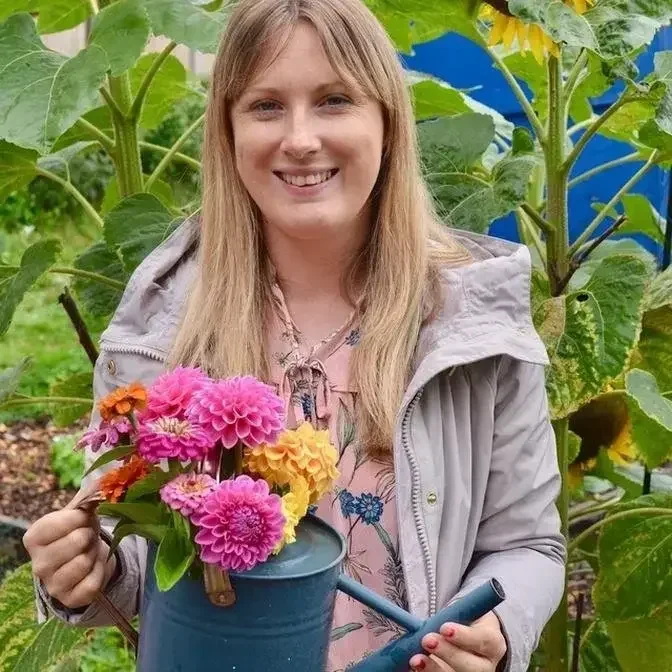
Emma provides an update on her allotment, covering the recovery of dried-out seedlings and the benefits of increased sunlight following the removal of nearby trees. The video focuses on the technical process of planting main crop potatoes using the trench method, maintaining a healthy pond ecosystem, and the importance of resilience when facing crop loss and unpredictable weather.
Look at those!
Oh no, don't do this to me. No, not today.
Come back to life, please.
Come back to life, come back to life.
Please, please, please come back to life.
Oh no, all my poor seedlings.
I've only been away from here for two days and I tell you what, I didn't think they would dry out
because the weather's not been that hot.
We've had a little bit of sun but it's actually been quite cool
and we've had quite a lot of rain.
Like, it's very wet out there at the moment so I just assumed they'd all be fine
but they're all really suffering from my lack of watering.
So, I have had a few tips from you guys,
mainly putting water into a tray and then putting my seedlings into the tray of water
and I think I might do that.
I won't do it today because I'm going to be here for the next few days in a row
but I think maybe over the weekend, if I'm not going to be here, I will start doing that
because they're just drying out like crazy.
Luckily, none of my squash plants or pumpkins, whatever they are,
none of them dried out so they all seem to be doing quite well
and we do have a bit of sweetcorn germination on my new sweetcorns
which is quite exciting.
Anyway, good morning everyone. Welcome back to my Lotman Diaries.
My name's Emma. These are my chaotic, crazy Lotman Diaries
where I just desperately try to keep everything alive.
So far, it's doing okay. We're doing okay.
We had a close call but it's all good.
We've actually planted quite a lot out and it all seems to be doing okay
and today is an exciting day because we're going to plant out our main crop potatoes.
So, we need to clear a bed and get those in the ground.
I have an update for you.
I'm pretty sure in my last couple of vlogs you've probably noticed this.
I'm going to show you super quickly but across that fence there
which backs on to my allotment plot, all the trees are now gone.
So, there were loads and loads of trees across that fence in a neighbouring garden
and it used to give really good coverage against that house
but it also did cause quite a lot of shade on my allotment plot.
They've now cut all of their trees down so they're all gone
which opens up all the building and stuff which I don't love
because it looks quite plain there and quite sad.
Also, the birds used to sit in there and I used to quite like watching all the crows sit up there and watching me.
So, it's quite sad in that sense and I do miss the view.
I'm going to have to start turning the camera around more
because it does look very bare and plain if I film from that way
which is such a minor detail like not really a problem at all.
But what it has done in a positive sense is it's opened up the sky.
It's opened up the sky and it means that we're going to get a lot more sun onto the plot
especially at the front which was notoriously known as being super shady
and before I took on this allotment plot it had about four different owners
and they only lasted about a year and they would always say to me
oh it's just too shady, it's just like covered in trees
like the trees just sort of envelope the whole plot and they couldn't grow anything
and it just caused this weird climate where the weeds would just come up like no tomorrow
and they all struggled and now that I've taken it on, this is my second year of it
it's opened up for the first time and I've actually got sun at the front of the plot
so I can actually use it which is just brilliant and that's exactly what I'm going to do.
So, we've got the sweetcorn out over there.
We're going to clear away the beetroot which has sort of flowered and become nothingness
and we're going to whack in main crop potatoes.
So, I think we should start with feeding the bird because I can hear him singing away
and then we'll get started on the jobs.
The pond is looking a bit dark and ominous over there isn't it?
The water looks really dark, really weird looking.
I haven't seen the tadpoles for a while, I haven't looked for them for a while.
Let's go and see if we can find them.
I think it's safe to say that the barley straw has definitely cleared up all of that pond weed
because it really is minimal.
Now, I think it's mainly just around this log but other than that it's sort of gone which is fantastic.
You know what, it's really dark in there and I can't actually see anything at all.
There are still a lot of living things in here guys.
I know a lot of you had a lot to say about me putting in those mosquito bite things
but there are still a lot of creatures for tadpoles to eat in here.
It's not like I completely destroyed the ecosystem.
Okay, I did just see one but I just kind of got it on camera because the reflection,
the reflection of the sun is just not good or the sky, whatever that reflection is, I think it's the sky.
You can sort of see a few bubbles coming up and that's them sort of fluttering around,
swimming around I should say.
Yeah, they are still in there guys.
So, I think the only thing that I killed in there was those mosquito baby things.
They're not in there anymore so they must have been that
because those things that I put in the pond only affect those.
Like little mosquito creatures, gnat things and they just turn into biting flies
and I just didn't want it around my pond.
So, but that's the only thing that I've taken out of the pond.
Everything else is thriving, there's loads of life in there and the tadpoles are still swimming away.
So, I think they're doing okay.
Right, the sun has come out, hurrah, hurrah and we've got blue skies and sunshine.
So, let's get that bed cleared and then let's whack in our main crop potatoes
and I'll tell you more about it as we whack them in.
Let's go.
It does appear this bed already has potatoes in it because any bed on my allotment plot
or in my home garden actually that has had potatoes in
will continue to have potatoes in for the rest of its life.
These I think are early varieties and I don't really want them in here to be honest.
So, putting our main crop, yeah look.
Oh my gosh, it's half a potato.
Look at that, that's the original one, the seed potato.
It's just half a potato, it's been sliced.
I must have gone through it with my shovel when I was digging them up and I just left it in.
Look at those teeny tiny little potatoes.
Honestly, you're probably wondering why I'm pulling these up.
It's because I'm about to dig the whole bed over to put the main crop in.
So, oh my goodness, look at these.
Look at these.
That's so funny.
They seem to have done okay in here though to be fair.
So, I think that's a good sign that my main crop will do okay in this bed.
Potatoes seem to do well anywhere even when they've been sliced in half.
So, right.
The bed is almost cleared.
I think I might give it a hoe.
Right, I'm just making some trenches and this is the trench method of growing potatoes.
Every time I show this method, somebody always says you don't have to use this method.
Or they say, oh I grow it in pots and you don't have to earth them up.
If you grow them in pots, you won't have to earth them up.
You can if you want to.
And if you put them in the ground, you don't actually have to earth them up.
It's not like a life or death situation here.
You will still get potatoes.
It's the method that I use and I enjoy using.
And it works every time for me.
Particularly with main crop potatoes that take longer to grow.
So, the difference between early, second early and main crop is the length of time it takes for the potatoes to be planted to harvest.
And main crop is the longest.
It takes about four and a half months.
So, that's a long time for your potatoes to be in the ground.
And they will grow really big and bushy.
So, when we earth them up, it's just a way of making sure all the potatoes stay under the ground.
Don't hit the sunlight.
And it gives them more time to develop and get bigger.
It's the method that I like to use.
And it's very simple.
You just dig some trenches and you pile up the earth on one side of the trench.
If you've just got an allotment plot, you might see quite a few allotments with this sort of weird looking bed with trenches.
So, you're just digging a trench and you're piling up as much earth as you can on one side of it.
Then we'll plant our potatoes and we're going to use half the amount of earth to cover them over.
And then when they start to grow, we'll use the rest of the earth to cover them over again and earth them up.
The sun keeps going in and out.
Honestly, it can't make its mind up today.
So, the variety of main crop I'm growing are Maris Piper.
A great Christmas potato.
A great roasting potato.
The thing that I like the most about growing main crop potatoes is that they store really well.
So, you can kind of go a bit mad with them when you plant them.
Which is why I'm planting up such a huge bed.
Because when I pull them up, I'll be able to store them for a long time.
Early and second early varieties do not store that well.
And they're smaller.
They're kind of more like a salad potato.
So, when you harvest them, it's best to harvest them as and when you need to use them.
Take them home and use them pretty much straight away.
They will not last very long.
With the main crop, they last a long time.
So, if you haven't planted in any potatoes so far this year, go and whack in your main crop.
That is the one to put in now.
And you won't regret it.
I'm going to space them out about 30cm apart.
And that's because they've got such a long time to grow.
I want to get them as big as possible.
So, I want to give them as much space as possible.
So, we're going to put them 6 inches deep, about 30cm apart.
That's new information from me.
I don't think I've ever told you that before.
I've just read the packet, basically.
Alright, Einstein. Einstein's going to love this bed, by the way.
Because there's so many worms coming up.
Alright, so here's our trench.
Here are our potato seeds.
You do have to buy specific potato seeds, guys.
You can't just plant normal potatoes, I don't think.
Because it will spread diseases and all sorts of things.
It's best just to get the seeds.
It's so much easier.
We plant them chits up.
So, this bit here, that's the greenery.
So, they go chits up.
We just put them down.
You couldn't see that at all.
Hang on a second, I'll do another one.
Alright, there's our chits.
Chits up.
So, just stand them up like that.
But, as always, guys, if they fall over,
when you cover them over or something,
they'll know which way to grow.
Oh, God, I can't get that one out.
They'll just turn themselves around under the ground.
Just like tulips bulbs do.
Hang on, I'm not doing them far enough apart.
That's a bit better.
They know what they're doing more than we know.
That looks about right to me.
There we go.
We've got one, two, three, four, five.
About 30 centimetres apart.
So, we'll just whack them all in like that.
And then we're going to cover them over halfway.
I guess I can't reach the middle of the thing.
So, then we're just using this
pile of earth
just to cover them over.
Just so that they're covered.
I'll leave that for Einstein.
He's like, where's my tree gone?
Right, there we go.
So, we have covered them over halfway,
leaving some of the trench there
so when they start to grow we've got something
to earth them up with.
You can use straw, you can use shredded paper.
There's a lot of other things you can use
to earth up your potatoes.
It's quite, it's just a bit easier.
It's just a bit easier to leave the earth
piled up like this so you can just pull it back over
when you need to.
Right, let's give them a water.
Right, I think we shall build
Oh my god, I can't talk.
I think we will build the pea structure.
It's going to go here.
So, I've put in a couple of rows of
oh my goodness, what on earth did I put in?
Spring onion.
A couple of rows of spring onion.
So, the peas are going to go just in front of it.
So, it needs to be quite a narrow
but secure structure.
So, we'll give it a go.
Even if we don't know what we're doing,
we'll always give it a go.
Might need a longer stick for the middle.
My stick collection
is looking a little bit bare at the moment.
I've been using so many bleeding sticks
for things.
There must be one in here
which is just long enough.
Oh, that is.
I think that's a sunflower stem.
That's not going to be strong enough.
That one looks too thick.
No, they're too short.
OK, we might need to look at actual
rule sticks.
I've got my little fence here at the back
made of sticks.
If you didn't see me make this,
go back and look at my videos
from I think January, February time
when I was making this fence.
It's so much fun and so many people
on the site have done it now
and I'm not in any way implying
that they have watched me or seen this
and copied it.
I think it's just quite a typical thing to do.
A lot of the parks around me now
are making these wildlife-friendly fences.
It must be a bit of a scheme or something
from the council, I don't know.
But they are fantastic.
I've got a lot of sticks in here.
Sticks are invaluable
on an allotment plot.
You need sticks.
Never underestimate how many sticks you will use
when you grow stuff.
Everything needs support
and if you buy those bamboo canes
they're quite pricey
and they don't last forever.
They do snap and wear and tear
and you do have to buy more.
The more sticks you can find and collect,
the better.
That one's too small.
I will have one in here.
This is a good stick.
Right, I sort of wanted to get this up
so I could see what it would look like there
and I actually quite like it.
I think it's quite good.
I do think I'm being over-ambitious
with the size of it.
I don't think my peas will grow that tall
because I think they're snap peas
that I'm growing, aren't they?
So I'll probably grow about half of that.
But I think it looks good
and I think Einstein will like it.
He'll be able to sit up there and use it as a toilet.
So all good.
Right, I feel like we've got quite a lot done today.
We've done quite a good job
and the rain clouds are coming
and apparently it's going to rain in about 20 minutes' time.
Believe it or not.
I actually do believe it this time.
The weather's just been so up and down
I actually genuinely believe it's going to pour in 20 minutes
even though it's bright, bright blue skies and sunshine.
We've definitely had a few casualties
on the plot.
I just had a little look around
and some of the crops have completely been eaten.
Some of them are just not growing very well.
So we will have to buy some plants and replace those
because some of them it's too late to sow more.
I have to buy it from a plant.
And I know that a lot of you have lost plants too
and a lot of people on the plot
lost a lot of crops in that freak kind of frost
that we had the other week.
And that's just part of allotment life.
That is just life, guys.
So please don't be disheartened.
Garden centres do sell
vegetable crops as plug plants
and I know they're a little bit expensive
and everyone wants to sow from a seed
but if worse comes to worse
just go and grab yourself some plug plants
stick them in, they'll do great
and you can just save yourself the heartache.
There's no point crying over it
even though I've cried many, many times
over crops that have not made it or been eaten.
I am learning
over time, it's not the end of the world
and you can try again.
You can buy a plug plant, you can try again from a seed
and it's just allotment life.
But I hope your plots are doing well
I hope you are coping
with all the slug and snails
and the different weathers and all the rest of it.
I'll be back again in my next vlog
whenever that will be
so I will see you when I see you.
Thank you for tuning in today.
See you next time. Bye.